How Voice AI Connects Calls With Sales Operations
The Sales Data Problem Nobody Talks About
A steel buyer from Pune calls, wishing this ‘quickly’. He wants a hot rolled coil, grade IS 2062 E250, a monthly order of 500 MT, and arriving in 15 days. He’s fed-up with his current supplier and wants to move on. Why not? 20 minutes later, the CRM blares: ‘Connected with buyer. Dispatch the quote.’
Ever felt like your calls are just a little rushed, a little loud, or a little competitive? Well, here’s what: A Voice AI Agent is built to pick up all of that. It’ll listen, pull out the important pieces, and sync it straight to your CRM, ready to pass to the next buyer.
Curious how this tech works? It transcribes calls, integrates with your CRM, qualifies leads, and even follows-up. But what do you need to be aware of prior to pulling the purchase activate?
What Is a Voice AI Agent in Sales?
Put simply, a Voice AI Agent is a program that can handle a call or listen in to a call with a complete comprehension of what the buyer is saying.
Once it does, it acts on it. A lead fills in a form and gets a call five minutes later. A rep finishes a discovery call and finds the deal already updated.
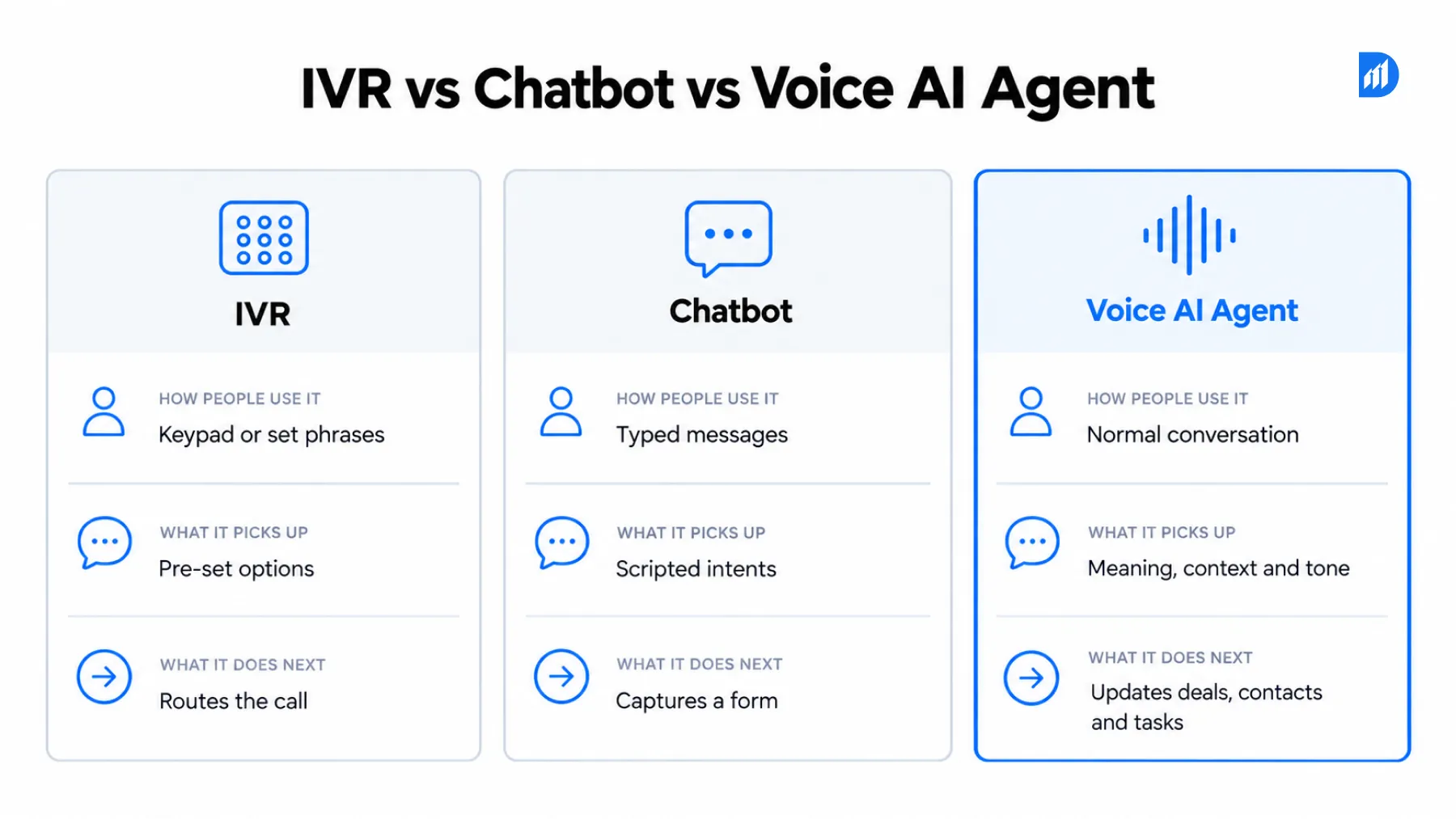
How it differs from a regular chatbot or IVR
An IVR is a phone menu with a recorded voice. A chatbot is friendlier, but it’s scripted, and customers soon learn which phrasing it accepts. A Voice AI Agent follows real speech: the interruptions, the half sentences, the buyer who says “yeah, no” and means no. We go deeper on this gap in Voice AI vs chatbots, using recruitment as the example.
Where it sits in the sales tech stack
Dialers and meeting tools carry the call. The CRM stores the record. In between sits a person typing from memory, and that’s the seat a Voice AI Agent takes. It runs on five layers, from the live call to the audit log.
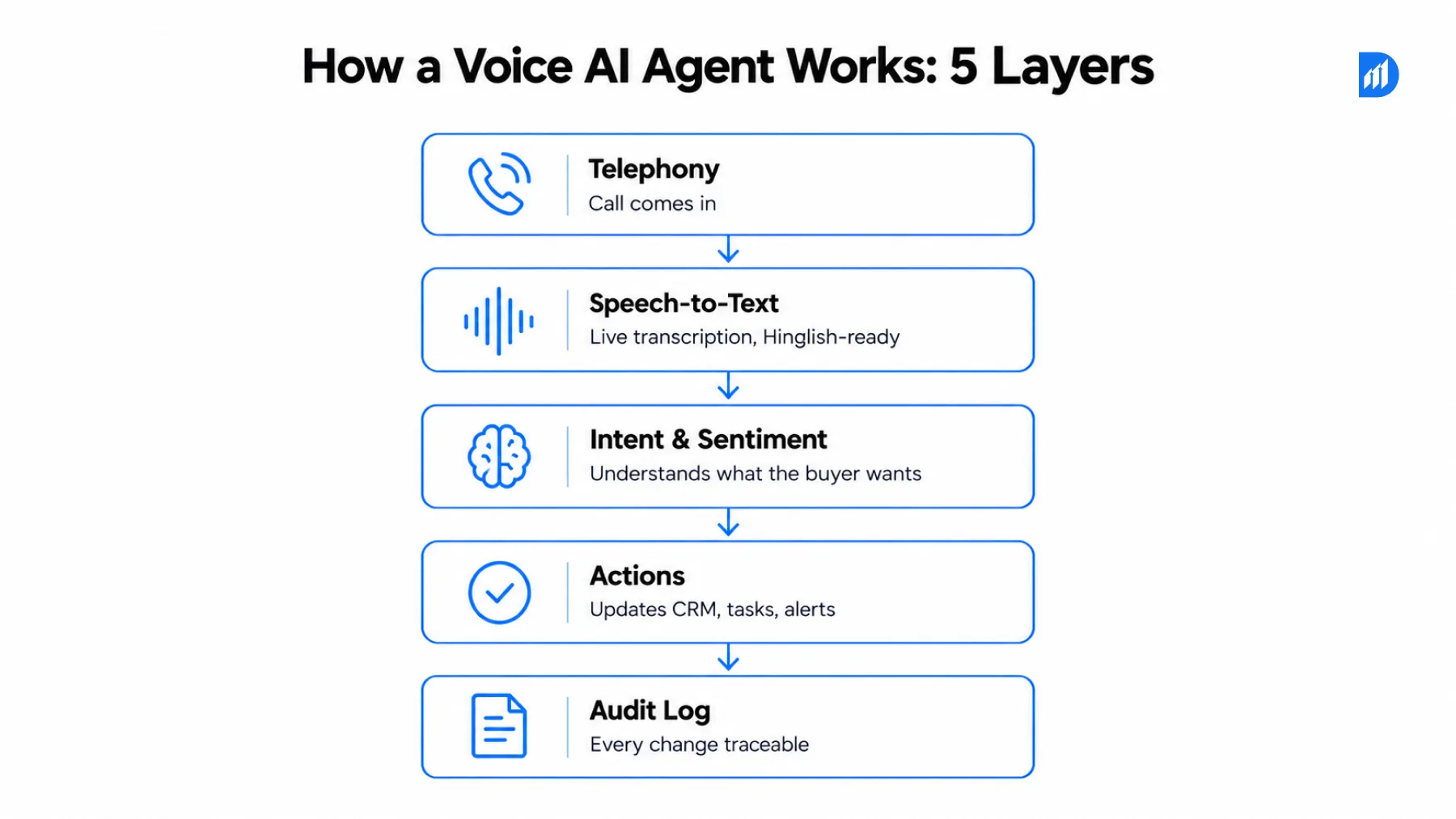
The call enters at the telephony layer, and the Actions layer is where the CRM gets updated.
How Voice AI Listens and Acts in Real Time
Suppose that a buyer is just getting to the middle of the process of giving a delivery date. By now, the agent has already picked up the words and determined what it is for and checked it against your rules. Each one leads on to the next, and therefore the accuracy at the beginning is the most important. The engineering behind it is in how voice AI agents are built.
Speech recognition and live transcription
Have you ever wondered how your phone calls turn into text while you’re still on the line?
When a call is received via Plivo/Twilio, the speech-to-text engine kicks off at Sarvam and transcribes it on the fly! The crux of an Indian sales call isn’t the noise, it’s the language. You probably know what I mean: someone even asks a question in Hindi/English (“Hinglish”) and the buyer responds in the same way. That’s exactly why we chose Plivo/Twilio’s models. We also adapted our agent to your product, for instance “IS 2062 E250” was transcribed correctly too.
Intent detection and sentiment analysis
The transcript goes to a large language model (we run Llama 3.3 70B on Groq) that works out what the buyer is after: price, delivery, a comparison with a rival, a deadline. Sentiment alone tells you little. A buyer annoyed at a competitor’s late deliveries is good news for you; a buyer annoyed at your price is not. The agent separates the two by tying tone to topic.
Trigger-based actions during and after a call
Rules decide what happens next. Name a competitor and the rep sees a battlecard. Let a large deal start sounding shaky and a manager gets pinged. End the call and the summary, tasks and follow-ups start moving.
Two details come as standard:
- Built-in guardrails for compliance and call quality: the agent warns callers who go off-topic or abusive and ends the call after a limit you set.
- Rules that reload from the database: policy changes go live without a redeploy.
We also built a voice agent for industrial inspection requests. A plant shutdown on Thursday and a required completion date of Friday? It flags the request as priority on its own. Sales works the same way: a delivery deadline that clashes with the buyer’s own schedule pushes that lead up the list.
From Sales Call to CRM: Zero Manual Entry
Filling in the CRM is the least exciting thing a Voice AI Agent does, and possibly the most valuable.
Auto-logging call summaries and outcomes
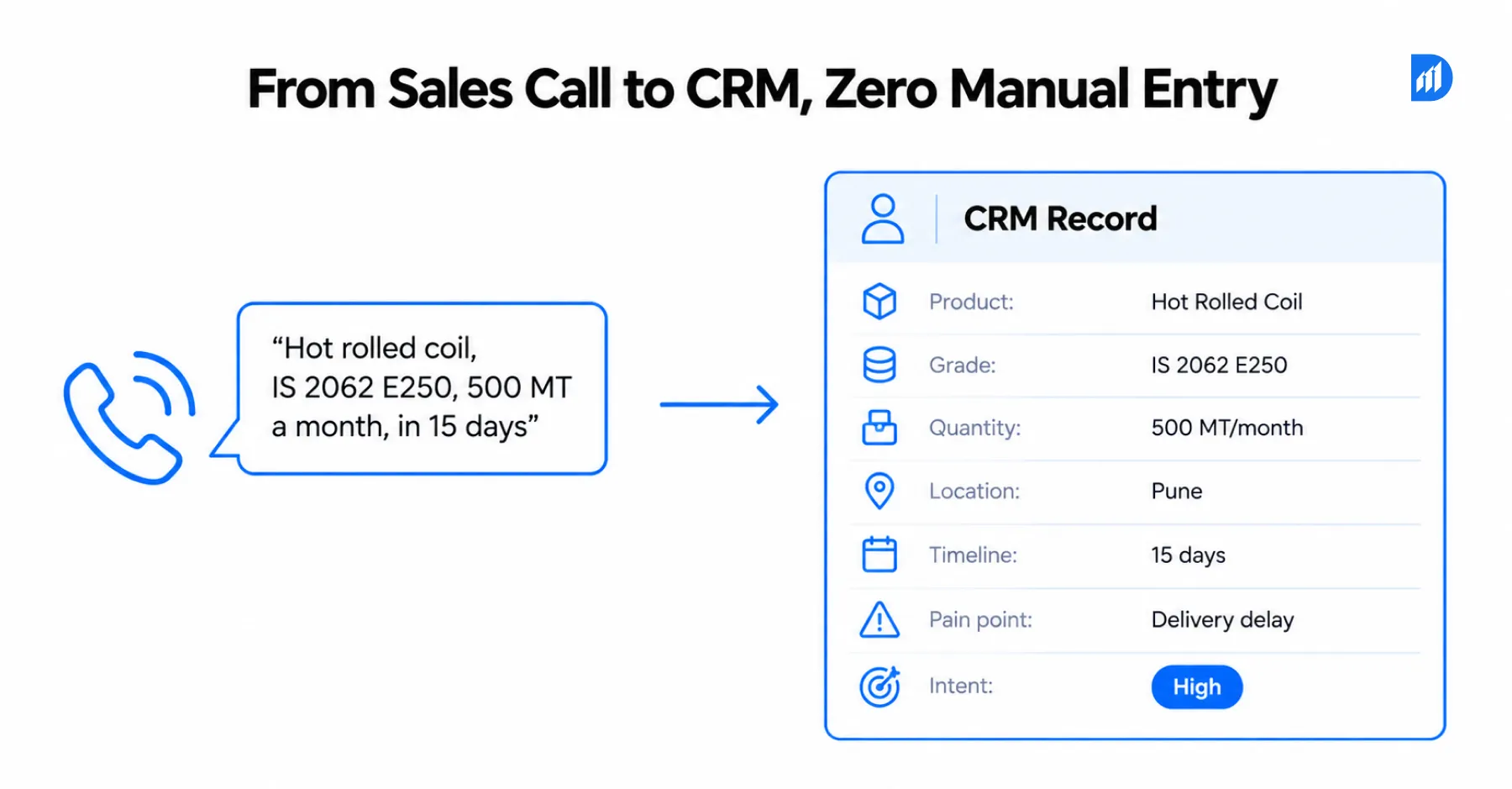
A paragraph of notes is readable, but you can’t filter a pipeline by a paragraph. So after every call the agent writes two things: a short summary for whoever opens the account next, and structured fields for your reports. For the Pune call:
Updating deal stages and contact records
Deals change most of the time, buyer says his purchase head needs to approve. That is a contact related to the opportunity. The buyer says they will move when price is confirmed: that’s a movement change. An agent recommends both and a rep approves with one click. All transcripts, statuses and ratings are logged too. If a stage looks odd, anyone can open the log and see what changed three weeks later.
Why reps stop updating CRMs (and how AI fixes it)
Managers say it’s laziness. No it isn’t. The CRM is primarily for the forecast call, not the rep. The CRM is filled out at the end of a long day when the details of the morning have faded. These fields were often built for the tidy reporting of someone who had never been on a procurement call. No amount of extra training will fix that, nor will asking reps to type faster. It will remove the typing. If the CRM itself is part of the problem, our enterprise CRM guide covers how to pick a platform and where rollouts usually go wrong.
Lead Qualification at Scale
Senior reps lose hours on calls that were never going to close, while good leads wait days for a callback. A Voice AI Agent fixes both.
How AI scores leads during a live call
Ever get excited for scoring rules to kick butt in recruiting and sales? You build them once, and your agent just uses them every time. As a recruiter, you define the skills per role through a short file (no modding code every time a new role appears). And salespeople it’s just the same. One criteria set per product line-volume, delivery window, decision-maker.
While on a call today in Pune, the agent was on it. We heard the details: 500 MT a month, 15 days, and a complaint about the delivery of the current supplier. Labeled as “Intent:High” this lead shows they are serious. And here’s the kicker: each signal is directly associated with the transcript line, so reps can verify any score within seconds. Are you set for a walk-through?
Outbound voice AI flows that qualify before a human joins
A prospect downloads your price list at 9:40 pm. Five minutes later the Voice AI Agent calls, says up front that it’s an AI assistant and asks what your best SDR would ask. Then it books time with an account executive, puts a hot lead through to a live rep, or moves a cooler one into nurture. Every call follows consent rules.
Routing logic based on call intent
Routing follows intent, not rotation. Specification questions go to a technical specialist, extra volume from an existing customer goes to their account manager, and a Hindi-speaking caller gets a Hindi-speaking rep. If a prospect’s contract ends next month, that date travels with the lead.
Want to see this on your own leads? Join a demo session and see Durapid Salesvoice AI qualify a live call, score the lead and update your CRM as it happens. Book your demo session →
Automated Follow-Ups Triggered by Call Outcomes
Most deals aren’t lost on the call but in the quiet days after it.
AI-generated follow-up emails post-call
Buyers spot a template instantly. What gets a reply is an email that sounds like it came from someone on the call: talk about E250 coil and a 15-day window, and the email says so. The agent heard all of it, so a draft is waiting before the rep’s next meeting starts. It checks that the contact has opted in to follow-ups before anything goes out. The rep reads it, tweaks a line, sends.
Task creation, reminders, and calendar scheduling
Listen back to any sales call and count the promises. “I’ll send the quote by Thursday.” “Let me bring in our technical lead.” Each becomes a CRM task with an owner, a due date and a reminder. With calendars connected, the agent proposes times or books the meeting itself.
Personalised sequences based on what was said
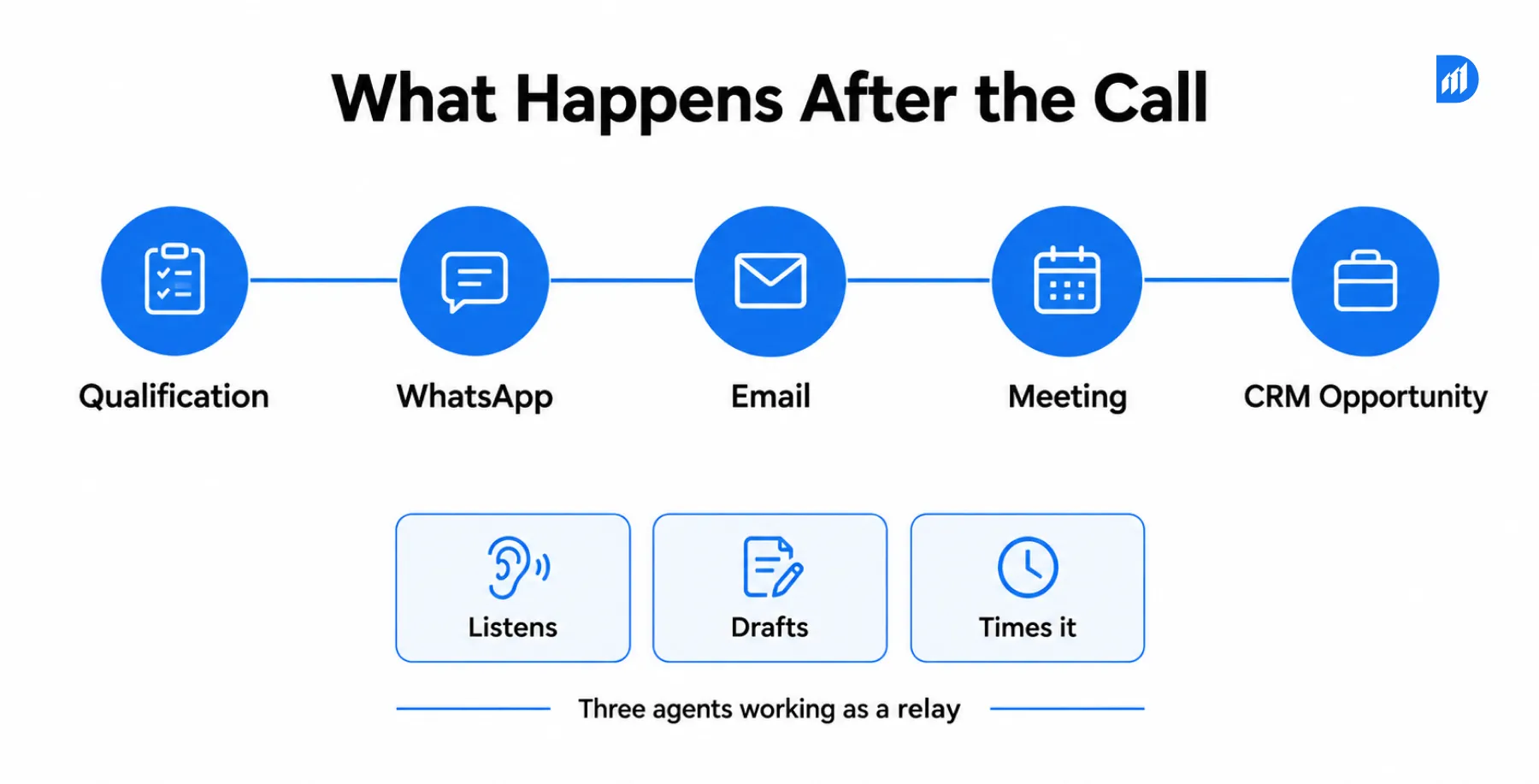
The sequence follows the conversation: qualification, then WhatsApp, then email, then a meeting, then an opportunity in the CRM. A buyer who is worried about delivery gets proof of delivery. One who asked about grades gets specifications. Behind it, three agents work as a relay: one listens, one drafts, one handles timing. Why that beats one giant workflow is in agent chaining.
Voice AI and CRM Integration in Practice
Understanding the call is half the job. The other half is getting the right detail into the right field on the right record, which is why Durapid maps the agent to your CRM setup. Reps see accurate data, so they keep trusting it.
How it connects with Salesforce, HubSpot and Zoho
Now, you can add voice AI to your CRM in just seconds – this is the magic of Durapid Sales.
Salesforce? Hubspot? Zoho CRM? You’re in luck!
In these CRM systems and others like Microsoft Dynamics 365, we are able to work with you to add voice AI.
With Salesforce, we customize the integration to your setup, honoring all required fields.
Because additional custom objects and validation rules tend to accumulate over the years, don’t they?
The problem is: not with Hub Spot – everything in your entire call logs into the contact and deal. Therefore, the deal owner always knows what is happening.
Both work in the same way: Call recordings are uploaded to a record in the CRM, which can just as quickly run your workflows with modules and custom functions.
Want to inform everyone? All in one the Microsoft Dynamics 365 entity models and security roles ease it.
Across all of these platforms, you can see where the agent is writing, which records are getting written to, and what call caused each change. And adding a field is one configuration change, not a complete development sprint.
Real-time sync vs. post-call sync: which to use when
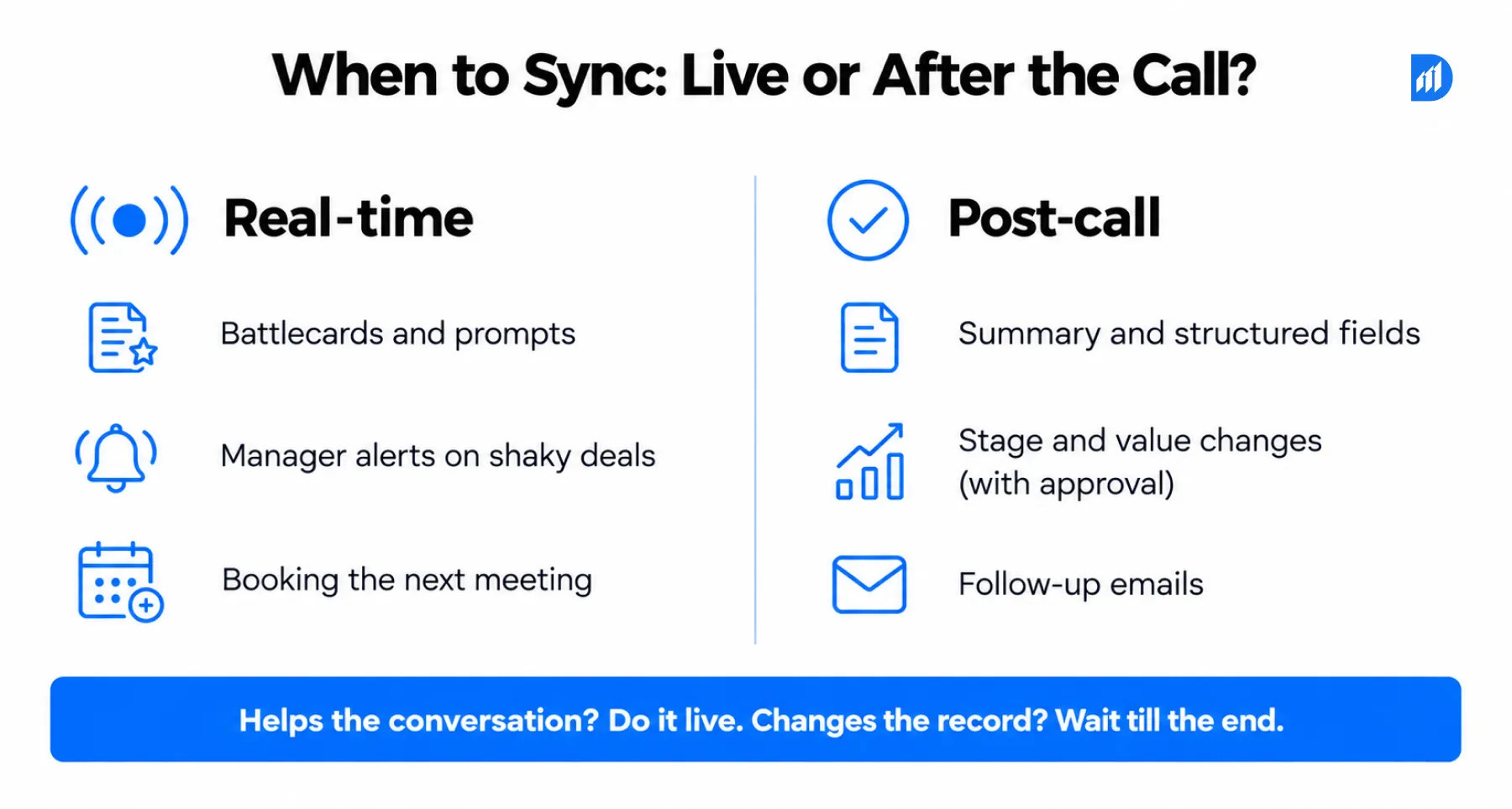
Rule of thumb: So if this benefits the chat, do it live. But if it changes the record, wait until the end.
What Sales Teams and RevOps Actually Gain
Faster onboarding for new reps
Interested in quickly getting your new reps to perform? This is a call every rep can listen to, and search to play, when I have their lunch, about a week after they record their first call with a delivered customer objection. Our CRM does the filling in, so month one is for learning our product and buyer.
Cleaner pipeline data and better forecast accuracy
Well guess what: you have more time to sell, less admin to do. How’s that for efficiency?
More selling hours for the buyer: more calls, more accurate quotes, less lag in follow-up.
How to Pick the Right Voice AI Platform
Judge a platform on your calls, in your CRM, under your compliance rules.
Must-have features for sales operations
Look for:
- Real write-back to CRM fields, stages and contacts, not a transcript pasted into notes
- Human approval on sensitive changes
- Language support that matches your buyers, including Hinglish
- Built-in guardrails for compliance and call quality
- A full audit trail of every transcript and rating
- Rules your team can update without engineering
- Written confirmation that call data stays yours
Durapid Salesvoice AI covers all seven.
Red flags to watch for in vendors
Challenge any vendor with these key questions; Durapid Answer to each:
- Have they live demos with rehearsed, scripted audio? Ours is based on your real recorded calls.
- Is “CRM integration” just a generic set of notes thrown in? We synchronize your fields, stages and contacts exactly with your configurations.
- Are they vague in storing data? Our use of storage recording and holding ownership of data is included clearly in writing.
- Are scores unable to be explained? Transcripts support each score; each score directly corresponds to a transcript sentence.
- Is it only through a pilot that pricing is possible? Our pricing is based on your real production call volume.
- Are pilots just not full deployments? We integrate flawlessly with live sales calls and custom CRMs.
See It Work on Your Own Calls
Every Voice AI Agent we build at Durapid starts from how your team already sells: your CRM setup, your qualification rules, your product vocabulary.
The quickest way to judge a Voice AI Agent is to hear it on your own calls. Book a demo session, bring a recording, and we’ll show you the summary, lead score and CRM update it produces. Book your demo session →
Website: durapid.com | Email: business@durapid.com | Phone: +91 99835 75860
Recent Blog

How Voice AI Connects Calls With Sales Operations
October 15, 2026-
How GCCs Can Scale Engineering Teams with Staff Augmentation?
October 10, 2026 -
Asset Management Software for CFOs: From Depreciation to Capital Planning
September 29, 2026 -
Why Voice AI Is Different From Chatbots in Recruitment?
September 17, 2026