Why Voice AI Is Different From Chatbots in Recruitment?
Recruiters don’t always lose candidates at the interview stage. A lot of them are lost earlier.
An application for a job in a warehouse, customer service, healthcare, deliveries, or retail comes through at 9:40 p.m. The individual is expressing interest and is available. They could even be a great fit. But nobody reaches out to them. The recruiter looks at their application in the morning, sends a message, waits for a reply, and tries again. Meanwhile, the candidate may be talking to another company.
This is where recruitment starts to differ vastly from a chatbot with regards to Voice AI. The former will be able to answer a question posed by a candidate who starts a conversation, whereas the latter will be capable of conducting it. That may seem like a small difference on the surface. In bulk hiring, it is anything but. This technology changes the way a recruiter can initiate a conversation, gather information in one interaction, and react to something unexpected from a candidate.
What Is the Actual Difference — Not the Marketing Version
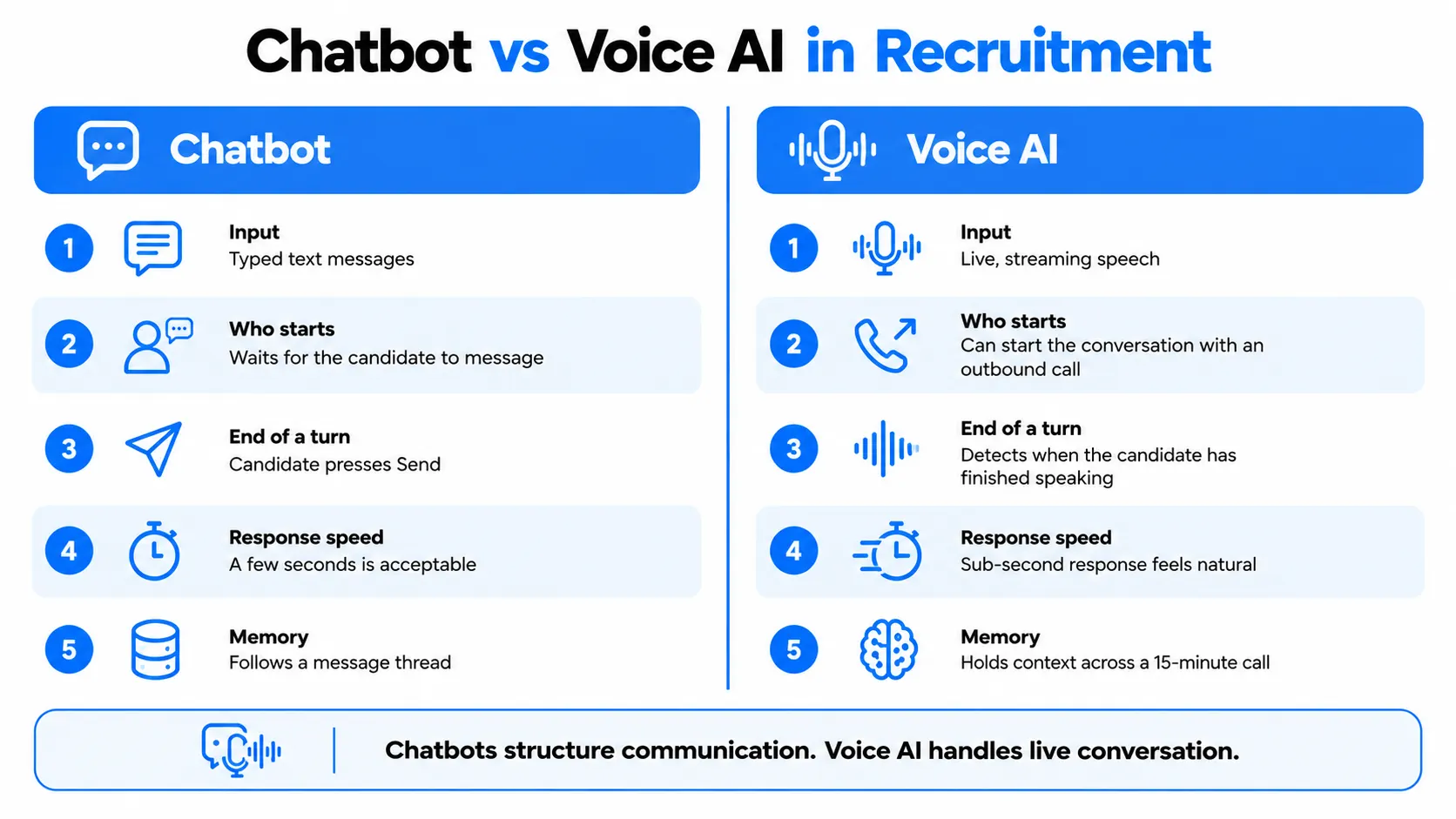
A chatbot and a voice AI can both run a recruitment conversation, but they work through different modes of interaction. A chatbot works through written text and waits for the candidate to reply. Voice AI works through real-time speech — listening, understanding context, and responding as the conversation happens, without waiting for a message to be typed and sent.
What a Chatbot Actually Does in a Recruitment Workflow — and Where It Stops
Chatbots in Recruitment are useful because of one simple reason only: a large share of communication during recruitment is repetitive in nature. Recruits ask similar questions like – Is this job position a remote one? What shift does it include? What are the requirements? What is the location? How much time is the notice period? What is the application procedure? All these can be answered using a chatbot and even the preliminary data can be collected by the chatbot before involving any recruiters. It’s obvious; there is no point in turning everything into a telephone conversation. The problem starts when the conversation becomes unstructured.
1. It Waits for a Message. It Does Not Start a Conversation.
In most cases, the chatbot does not do anything until it receives an input. It is up to the candidate to access the system, look at the question, respond to it, and press send. To a candidate using a laptop, this does not pose any problem. However, to a candidate using a smartphone between shifts, during commute, or after an exhausting day at work, filling out multiple text fields could be quite challenging.
Voice introduction changes this very first step. Instead of waiting for the candidate to come back to the system, the voice agent can start the interaction by introducing himself, telling the candidate the purpose of the call, and asking if the candidate has some minutes to talk. This is especially important in cases where the candidate’s interest is at its peak right after application.
2. It Cannot Hear Hesitation, Confidence, or a Candidate Thinking Out Loud
This has to be handled with some care. The use of Voice AI should not involve selling it as something that will help you listen to someone’s voice and make a decision on their honesty, competence, or trustworthiness. Such a usage of the technology would be highly inadequate.
The value provided by the voice channel here is more data on the process itself. A candidate may hesitate as he tries to recall one of his projects. He may interrupt himself mid-sentence and correct his statement. Or he may ask the question: “Sorry, are you talking about my current notice period or notice period in the previous position?”
Text-based chatbots receive a text message. A voice-based system receives all these elements in the flow of the conversation. The hesitation is an element of the conversation. Self-correction is an element of the conversation. And the clarification is an element of the conversation.
3. Candidates Stop Responding Mid-Screening — and the Chatbot Has No Way to Notice
In text, silence is just silence. A candidate can read a question and disappear for ten minutes. The system knows there has been no reply, but it does not know why. Maybe the candidate got a phone call. Maybe their manager walked into the room. Maybe they are checking an old payslip for a salary number. Maybe they simply changed their mind.
A live voice interaction has another problem to solve: is the candidate still thinking, have they finished speaking, or has the call itself broken? That is harder engineering. It is also one of the reasons simply connecting a speech AI voice generator to an existing chatbot does not automatically create a good recruitment voice experience.
4. Every Answer Gets the Same Next Question Regardless of What Was Just Said
Not all Chatbots in Recruitment are like that. Quality conversational tools rely on branch logic. An applicant who has been working for five years could be asked a different question from a graduate. An applicant who does not want to work on the weekend could be directed differently from an applicant who wants to work on weekends.
However, there are limitations. Recruiters never get candidates’ answers in categories. Candidates suddenly change their minds. Candidates add some crucial information at the end. Candidates ask a question back. Candidates reply to two questions at once. All of these have to be considered during a live conversation. This is where voice AI gets the upper hand.
What Voice AI Actually Does Differently
Voice AI is not interesting because it makes computers talk. Voice AI is interesting because of everything which has to happen in-between one utterance and another.
1. It Processes Speech as It Happens — Not After the Candidate Finishes
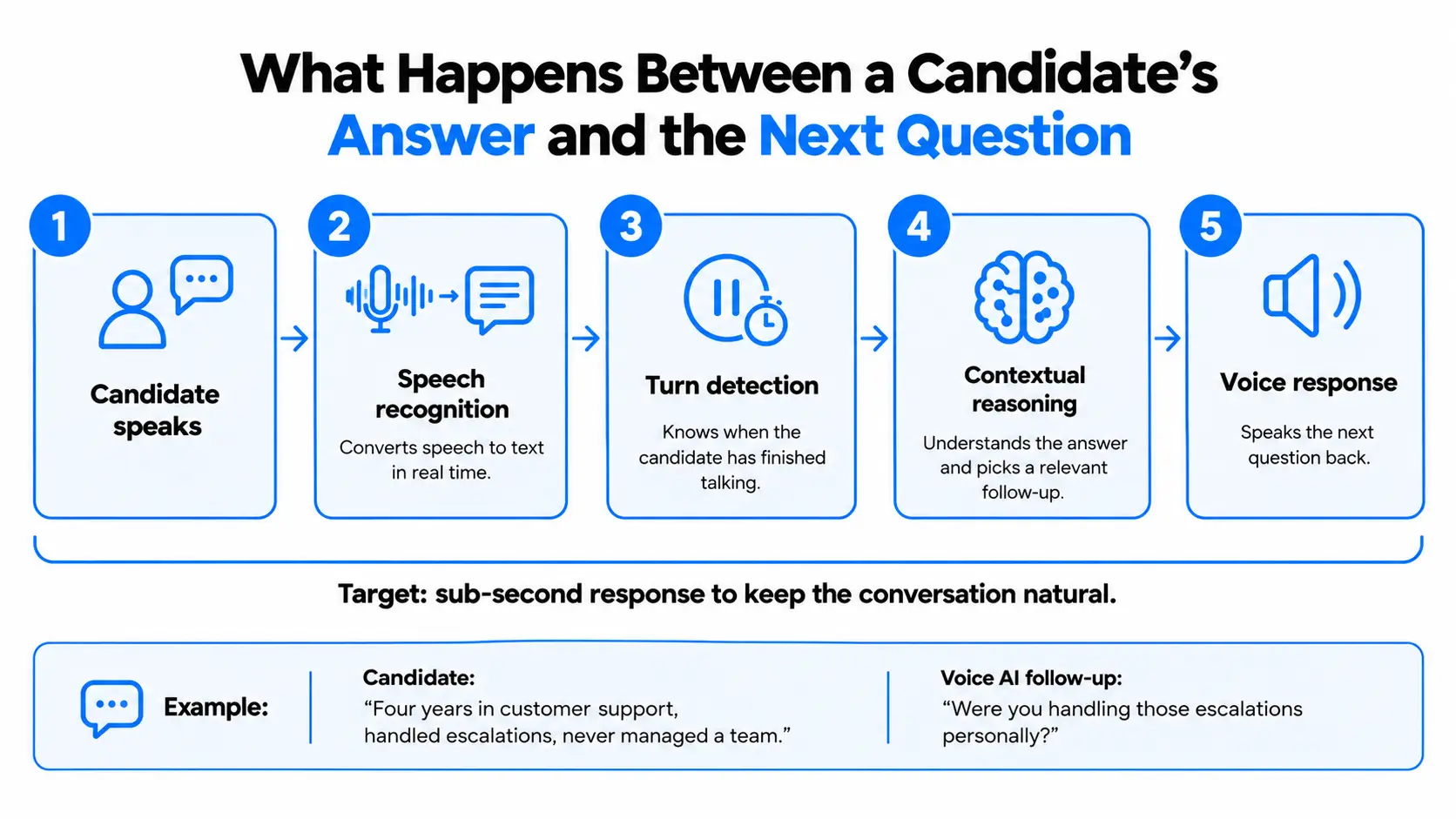
When we talk to a recruitment voice agent, a few systems work together. One transcribes the candidate’s speech to some useful input. The second tries to make sense out of it by using contextual reasoning. And the final step is sending this response to the voice synthesis module for the candidate’s hearing.
And these steps cannot take too long. While a text user can be patient and wait while the bot thinks of the answer, a phone caller will notice any delays very quickly. That’s why real-time voice AI is not a matter of a pleasant voice but a matter of a whole interaction done right: recognition, reasoning, speed, turn-taking, and error recovery.
The real talking AI voice is not supposed to sound like an announcement and a question after it. It should sound like the system has actually understood what was said.
2. It Knows When a Candidate Has Finished Talking Without a Submit Button
There is no Send button during phone conversations, and this leads to a peculiar challenge: it is necessary for the system to know when the person has stopped talking. Too much delay makes the conversation uncomfortable, while interrupting too early leads to the system interrupting the speaker. And when the system fails to recognize an interruption, the candidate has to repeat the message.
Voice-based AI technology needs to use certain mechanisms, such as voice activity detection, timing, and turn taking, in order to identify when the speaker finishes. And all of these settings have importance because a fast-speaking person in a quiet environment is not the same as a slow-talking person in a noisy office. All these elements affect the experience, and this very difference is one of the greatest distinctions between creating a chatbot and creating a voice agent.
3. It Asks the Next Question Based on What Was Just Heard
Suppose a candidate is interviewed like this: “I have four years’ experience in customer support, mainly for customers from the United States. I have also taken care of escalations, although I never had a team to manage.”
An inflexible screening process could simply move on to question six at this point. However, a talented voice agent would probe further into the matter, asking:
- How many people did you work with?
- Were you taking care of escalations personally?
- What ticketing system did you use?
Such an approach turns screening from reciting pre-written questions from a spreadsheet into a real conversation. Voice agents for hiring interviews today are built precisely like this: not merely robotic dialers, but intelligent systems able to ask specific role-related questions, listen to the candidates’ answers, and deliver structured output back into the hiring pipeline.
4. It Can Score a Competency Mid-Call Without Waiting for a Transcript
Yet, there is another difference in practice. The system does not need to wait until the entire conversation finishes before making its decision. In case of structured screening, the agent can document answers throughout the conversation, following a predefined rubric. Such a rubric could include, among other things, years of experience in the field, availability of shifts, location, language requirements, certifications, notice period, role-related questions, and knockout factors. The word that really matters here is structured. Voice AI does not need to make some magic and automatically produce a perfect hiring decision out of the conversation. Instead, it should take a conversation and make hiring information out of it.
5. It Routes to a Human When the Conversation Goes Somewhere It Shouldn’t
It is possibly the most important decision to be made in designing an enterprise voice AI system: when should the agent get out of the way? The candidate may bring up the issue of pay negotiations, accommodation requests, a rejection appeal, or an inquiry about their immigration status or any other delicate aspect of employment. It is not about making the AI sound more intelligent at this point but rather transferring control of the call to a human. What works in the best enterprise voice AI projects is that they are designed not with the idea of leaving everything to AI but understanding what is to be left to AI and where human input is required.
The Technical Gap Between the Two — Why You Cannot Just Add Voice to a Chatbot
This is where many AI projects underestimate the engineering work. It is easy to think of Chatbots in Recruitment as the brain and voice as simply the microphone and speaker. It isn’t that simple.
1. Text Input vs Streaming Audio — Two Completely Different Engineering Problems
A chatbot receives text. Voice AI receives an ongoing audio stream. The system has to deal with speech recognition, partial speech, interruptions, silence, background noise, turn detection, response generation and audio playback while the conversation is still happening. The architecture therefore has to be designed around continuous interaction. Adding voice on top of an existing chatbot can work in some cases, but a production-quality agent usually needs much more than a speech layer.
2. Latency: Chatbots Have Seconds, Voice AI Has 500 Milliseconds
Nobody panics when a chatbot takes two seconds to answer. On a phone call, two seconds can feel like the other person has disappeared. There is no universal “500 milliseconds” rule that magically makes every conversation good, but sub-second responsiveness is an important engineering target for natural voice interaction.
That means the pipeline has to be designed carefully. Speech recognition cannot be unnecessarily slow. The reasoning layer cannot introduce avoidable delays. The response cannot spend too long generating before speech begins. And the audio has to start quickly enough to maintain the rhythm of the conversation. That is one reason voice projects often require different engineering decisions from ordinary chatbot projects.
3. Turn-Taking: Chatbots Wait for Submit, Voice AI Has to Detect It
A chatbot gets an explicit signal: message sent. A voice agent gets something much less certain: maybe the person has finished speaking.
That difference becomes especially obvious when candidates pause. “Yes, I worked there for…” pause “…about three years.”
An overly aggressive agent may interrupt after the first pause. A slow one may wait so long that the candidate wonders whether the call has frozen. Turn-taking is therefore not a cosmetic feature. It is part of the core interaction design.
4. Holding 15 Minutes of Conversation State vs a 15-Message Thread
A recruiter can refer back to something a candidate said several minutes ago. A voice agent needs to do the same. If a candidate said early in the call that they are only available for night shifts, the system should not ask twenty minutes later whether they can work mornings. That requires conversation state, memory, context management and reliable extraction of important facts. It is also why enterprise voice AI becomes an architecture problem rather than just a voice-generation problem.
Where Chatbots Still Make Sense in Recruitment
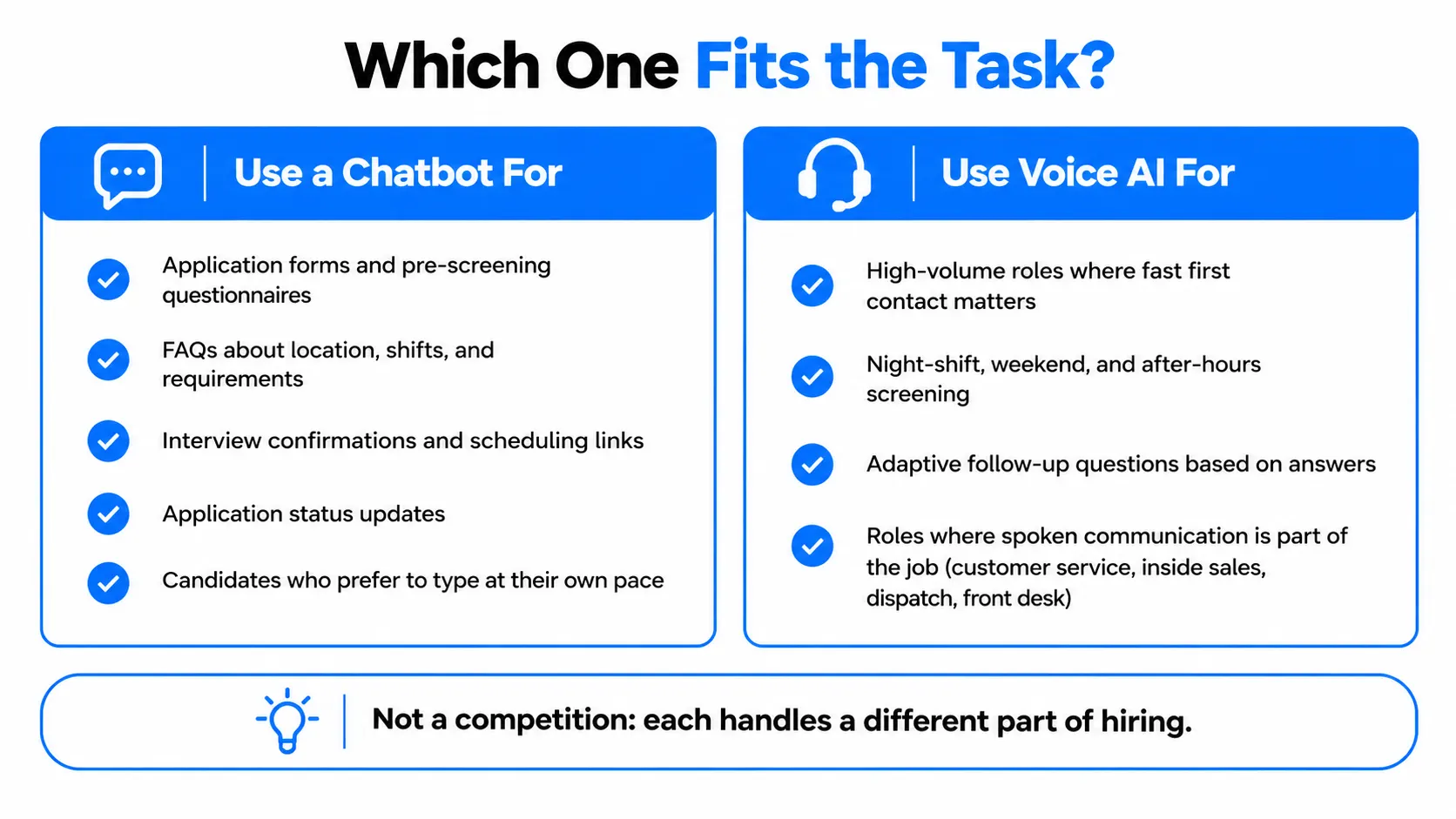
None of this makes chatbots outdated. Quite the opposite. There are plenty of recruitment tasks where typing is simply the better experience.
1. Application Forms, Pre-Screening Questionnaires, and FAQs
A candidate does not need a phone call to confirm a location or read a job requirement. For structured information, chat is faster and easier to review. This is still an important area for GenAI Chatbot Development Services, particularly when the bot needs to answer questions from company or job data rather than relying on a fixed FAQ list.
2. Follow-Up Confirmations, Scheduling Links, and Status Updates
Some messages should stay messages. “Your interview is confirmed for Thursday at 2 PM.” “Please upload your certification.” “Your application is under review.” There is value in having a written record. A phone call would add unnecessary friction.
3. Any Workflow Where the Candidate Controls the Pace
Not everybody wants to talk to an AI agent. Some candidates would rather type. Technical candidates may prefer writing a detailed answer. Others may be in a place where making a phone call is inconvenient. Good hiring technology should give candidates an appropriate interaction for the situation rather than forcing voice into every step.
Where Voice AI Is the Only Option That Actually Works
“Only option” needs a little nuance. Voice AI is not literally the only technology that can support these workflows. It is the option that can solve some of them more naturally than a text-only interaction.
1. High-Volume Roles Where Speed of First Contact Determines Conversion
This is the clearest use case. When hundreds or thousands of applications arrive for the same type of role, recruiter capacity quickly becomes the bottleneck.
A recent Phenom case study reported that a large organization achieved 80% candidate response within 1.5 hours using conversational voice-agent screening, while another 2026 case described 1,800 screenings completed in two weeks with an 85% completion rate. These are vendor-reported results, not universal industry benchmarks, but they show why enterprises are testing voice for high-volume hiring.
The practical benefit is straightforward. Instead of choosing which 50 candidates a recruiter has time to call, the system can create a conversation opportunity for a much larger part of the applicant pool. That can change the economics of screening.
2. Night Shift, Weekend, and After-Hours Screening
Consider a nurse finishing a shift at 11 PM. Or a delivery driver getting home after midnight. Or a retail worker applying for jobs after their store closes. The recruiter may not be available. The candidate is. Voice AI can close that timing gap. Current recruitment voice-agent deployments are specifically targeting candidates who are difficult to reach through traditional recruiter calls and helping teams extend screening beyond standard working hours.
3. Roles Where Tone, Pace, and Confidence Are Part of the Evaluation
For certain jobs, communication is not just another qualification. It is part of the job. Customer service. Inside sales. Front desk. Dispatch. Call center operations. Support.
For these roles, a live conversation can give the hiring team information that a written form simply cannot capture as naturally. That does not mean judging someone’s personality from their accent or pretending an AI can measure confidence perfectly. It means using a format that resembles the work itself.
What the Right Combination Looks Like in a Real Hiring Workflow
The future of recruitment will not be about pitting chatbot against voice AI. Rather, the process is likely to evolve into a well-coordinated workflow, where both systems work on their strengths.
1. Chatbot Handles the Before — Voice AI Handles the Conversation
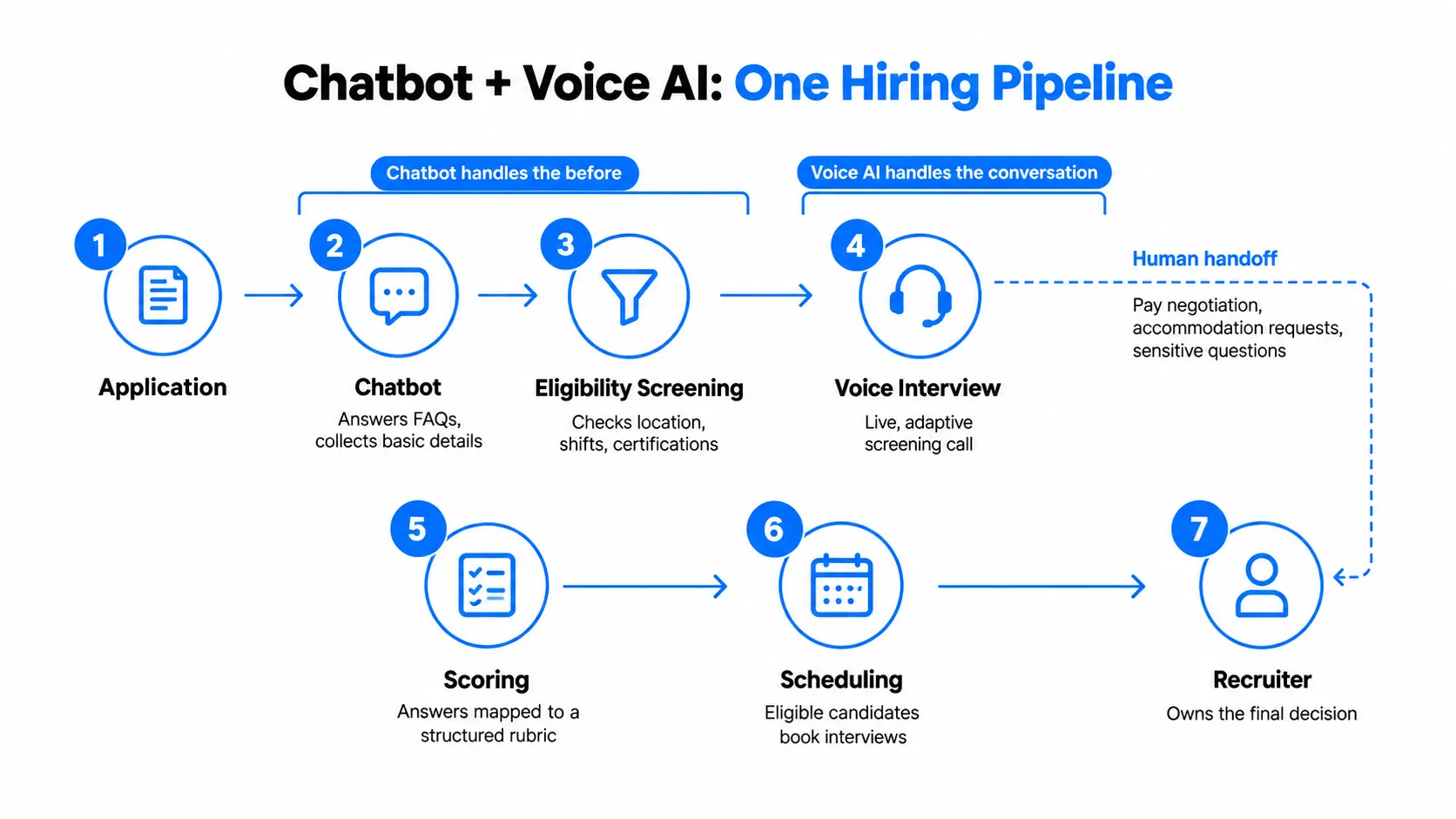
Think of something like that: Application → Chatbot → Eligibility Screening → Voice Interview → Scoring → Scheduling → Recruiter
Chatbot does the initial groundwork. Voice agent conducts an actual interview. Workflow does the scoring according to predefined criteria. Eligible candidates are ready to schedule interviews. Recruiter steps in only where required.
2. What an Enterprise Recruitment Stack Actually Looks Like in 2026
In enterprises, the voice agent is merely one piece of a larger puzzle. There is an applicant tracking system, candidate management system, scheduling system, messaging system, identity and access control systems, analytics, compliance issues, and multiple AI components all collaborating together. At this stage, orchestration plays a critical role. This pattern is increasingly becoming clear in enterprise AI; specific agents take care of specific jobs, and orchestration takes care of providing context, coordinating actions, integrating systems, and ensuring human intervention when needed.
The same orchestration logic is already playing out in AI in Procurement, where sourcing, approvals, and vendor communication run through specialised agents under one coordination layer — recruitment is simply catching up to a pattern procurement teams are already living with.
One system starts the conversation. Another provides context. Another schedules. Another records the outcome. A human owns the decision. That is a much more realistic view of enterprise AI than expecting one “smart bot” to run an entire hiring department.
For a broader look at how orchestration can connect specialised AI capabilities across business workflows, see our work on Generative AI in Procurement and AI in Procurement Automation.
One Final Thing: Voice AI Should Not Be Confused With AI Voice Imitation
It seems that there is a lot of talk about voice-generating AI, AI voice tools, AI voice assistants, realistic voice AI, AI voice impressions, and AI voice imitators. However, these are not one and the same thing.
AI voice imitation is an AI whose purpose is to recreate the voice of a particular person. The speech AI voice generator, on the other hand, turns generated text into actual spoken language. Talking AI voice may be used as an assistant, content generator, or entertainment provider. Recruitment Voice AI performs another function. It is responsible for managing the conversation, processing candidate answers, maintaining context, adhering to screening structure, triggering action, and recognizing the moments when recruiter intervention is necessary.
In essence, the voice is not the core of the technology — conversations are. This is important in assessing vendors, as no matter how human or how realistic voice AI sounds, the process behind it will remain flawed if the conversation logic isn’t built right.
FAQs
What is voice AI in recruitment?
Voice AI in recruitment is an AI application that allows the computer to engage in live dialogue with potential employees. It can ask screening questions, understand the answers, collect structured data, provide relevant answers, make plans for future interviews, and forward conversations to recruiters when required.
What is the difference between a voice AI agent and a chatbot in recruitment?
A chatbot relies on text messages and waits for the candidate to type the next message. On the other hand, a voice AI agent uses a verbal conversation in real-time, which includes speech recognition, turn-taking, interruption handling, contextually relevant follow-up, and responses.
Can a chatbot replace a voice AI agent for candidate screening?
Yes, sometimes. When it comes to structured applications, commonly asked questions, and simple screening questions, then a chatbot is certainly the best choice. Voice AI comes out as a winner when there is a need for faster communication or even after-hour communication.
Is voice AI better than a chatbot for high-volume hiring?
Possibly. There is one great advantage of using voice AI other than speed, which is scalability of screening candidates without the need to manually call each one of them. It largely depends on the position and workflow among other things.
What does a voice AI agent need that a chatbot does not?
The voice agent needs to support streaming speech, speech recognition, voice synthesis, turn management, interruptions, quick response times, state tracking, and telephony. In addition to this, there need to be some rules in place defining when it is time to close the conversation and pass the baton to a human agent.
Can voice AI and chatbots work together in the same hiring pipeline?
Yes. It is even recommended. While the chatbot handles applications, FAQs, and structured information gathering, the voice AI conducts live screening and contextual conversation. Finally, all of the information is passed through the ATS, scheduler, and other enterprise systems which move the applicant on to the next phase.
In Summary
The comparison between the chatbot and Voice AI doesn’t constitute direct competition. While they can’t replace each other entirely, they play different roles. The chatbot is suited to structure communication. Meanwhile, Voice AI is better suited for live communication. It can be seen how the difference comes to life whenever a job seeker starts to show traits unlike the form: pausing, interrupting, posing a surprising question, explaining the answer rather than selecting it, and appearing at 11 p.m. rather than 11 a.m. Voice AI can prove its usefulness in such situations.
The optimal recruiting workflow may use both approaches. Chatbots can be responsible for structuring those things that need to stay structured, whereas Voice AI will handle the communication part of the hiring. It will enable recruiters to concentrate on making decisions that require their competence. This goal — to make it useful — matters much more than attempting to make every part of the hiring process “AI-powered.”

Recent Blog

Why Voice AI Is Different From Chatbots in Recruitment?
September 17, 2026-
LlamaIndex vs LangChain: Which One to Choose in 2026?
July 29, 2026