How GCCs Can Scale Engineering Teams with Staff Augmentation?

Picture a Monday morning at a Global Capability Center in Bengaluru, where the head of engineering has just learned that headquarters wants the new platform live a quarter earlier than planned, while the five senior roles she opened three months ago still have candidates stuck somewhere between the second round and a counteroffer.
Nobody is short of budget here and nobody lacks ambition, but the team simply can’t grow fast enough to match the roadmap, and that gap is exactly where staff augmentation comes in.
In this guide we’ll walk through why GCCs hit this wall, what staff augmentation really looks like inside a GCC, and how to use it to scale without losing control of your people, your code or your culture.
Why GCCs Hit a Scaling Wall (And It’s Not About Budget)?
Most GCC leaders think of growth as a money problem, despite the fact that the most challenged centers are often well funded and unable to move quickly enough on headcount, since the limiting factor is how the talent is found, hired and absorbed into the team. It’s like an IPL auction, where a franchise may show up with the biggest purse in the room and lose the player they wanted, since three other franchises had their paddles up at the same time and the player had already made up his mind. The same thing happens to engineering teams inside a GCC, where a GCC model built around steady, predictable hiring starts to strain the moment the roadmap speeds up.
The Talent Acquisition Bottleneck That Slows Every GCC
Every GCC in Bengaluru, Hyderabad and Pune is fishing in the same pond, trying to hire senior cloud, data and AI engineers, and whoever has run a hiring campaign in any of these cities knows the drill.
Say you found Priya, a senior data engineer with seven years of Azure and Databricks experience, she accepted your offer on Monday and a rival GCC two buildings away matched it on Wednesday, her current employer came back on Friday with a counteroffer, and even if she eventually chooses you, there is still this three-month notice period keeping her away from your sprint board.
Meanwhile your existing engineers are covering her work on top of their own, the pipeline she was supposed to build keeps slipping, and by the time she arrives, the project has often been reshaped to such an extent that the role itself has changed, meaning that the hiring process has become the slowest part of your delivery.
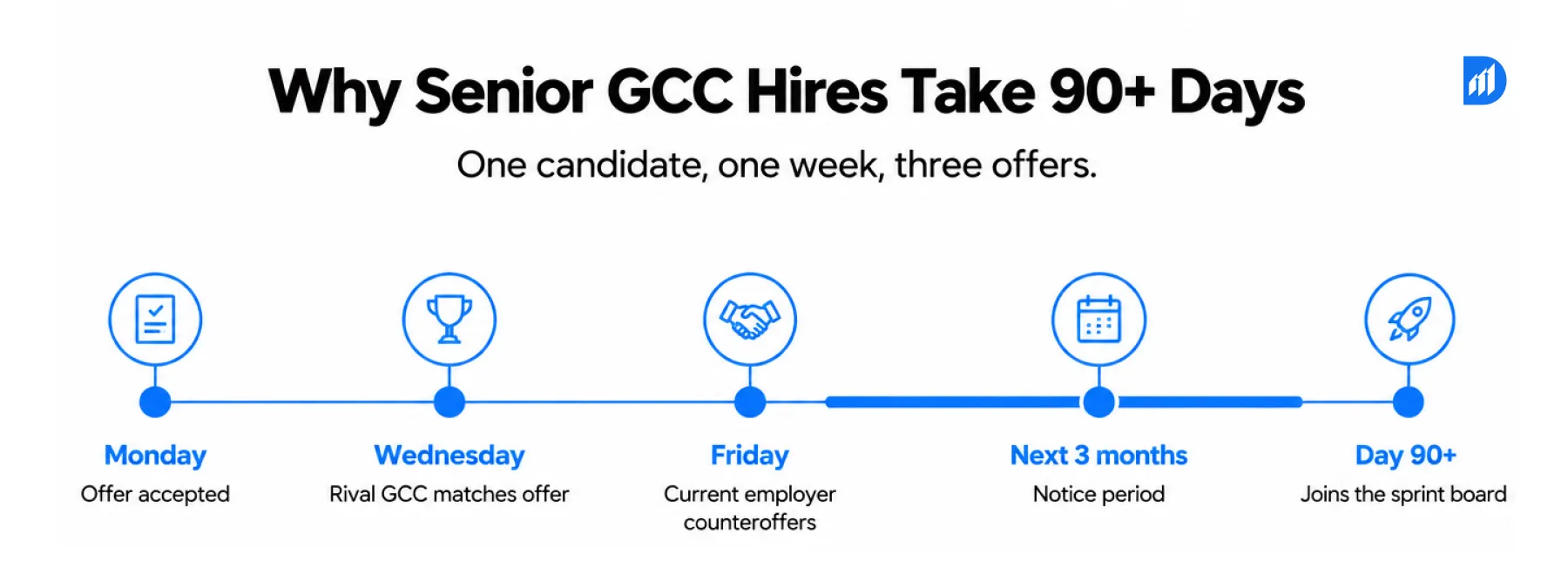
This is the talent acquisition bottleneck, where time-to-fill for senior roles regularly stretches beyond 90 days and niche skills in AI/ML and data engineering take even longer, as the same small pool of proven engineers is being chased by every GCC in the city.
What “Long-Term Scaling” Actually Requires vs. What Most GCCs Plan For
No family keeps fifty cooks on its payroll all year just because there’s a big wedding in December, they run the house with the people they have and bring in caterers when the guest list grows, and yet that is exactly how many GCCs plan their headcount, as one fixed annual number that assumes demand stays flat all year.
Real scaling looks very different, because the GCC of a US retailer might need double the frontend and QA capacity in the weeks before Black Friday and then far less in January, or a banking GCC might need a burst of cloud engineers for a six-month migration that has a clear end date. A plan built only on permanent hiring can’t flex like that, which leaves teams either overstretched during the peaks or overstaffed once they pass, and this is precisely the gap that staff augmentation is designed to fill, which is why it’s worth looking closely at what the model actually means for a GCC.
What Staff Augmentation Actually Means for a GCC (Not the Agency Version)
If you’ve ever searched “what is a staff augmentation” on Google, you’ve likely seen an entry suggesting it’s a matter of renting developers by the hour, which is how many IT staff augmentation agencies like to present it. The staff augmentation definition that works best for a GCC, however, is a scenario where the external engineers join your team, work in your sprints, use your tools and report to your leads while the partner focuses on sourcing, vetting, payroll, compliance and replacements. Done well, it is enterprise IT staff augmentation, with engineers who meet your security standards and follow your SDLC from the first week rather than sitting on the sidelines as outsiders.
Staff Augmentation vs. Managed Teams for GCC Delivery: Which Model Fits
The easiest way to differentiate between the two models is to see who is holding the steering wheel, because when it’s a managed team you hand over an outcome and the vendor takes charge of the people, the process and the delivery, whereas, when it’s staff augmentation the extra engineers are inside your squads and take direction from your own leads. Durapid draws that same distinction on its service page, where staff augmentation is described as bringing skilled people into your team while you stay in control of how the project is managed, whereas outsourcing hands a whole project to an outside company that takes it from end to end, leaving your internal team with less control.
To demonstrate the difference let’s imagine a situation which might happen to any GCC. Suppose there is a banking GCC in Pune, which has two items in its short-term roadmap. First, they need to migrate a certain number of reports from legacy SSRS to Power BI, following certain acceptance criteria and having a limited impact on the whole platform. Second, they need to design and implement a credit decisioning microservice which will consume Kafka events from the loan origination system; the API contracts are currently under design reviews and the GCC is supposed to maintain and develop this service for several years.
The reporting tool migration seems to be a good candidate for a managed delivery model because it has a clear scope and limited impact. The decisioning service is a more complex scenario. Since the GCC will own this service for a long time to come and its requirements continue to evolve, it makes sense to keep developers engaged in the maintenance and enhancement of this product. This way they continue to build the domain knowledge and technical expertise of engineers, which is the main reason for embedding GCCs in the first place.
This difference is critical to understand because the two options, staff augmentation and managed delivery, have a different impact on the long-term technical development of the GCC. Both are aimed at reducing the burden on the core engineering organization by bringing in outside help. Staff augmentation does this by adding external engineers to the GCC’s own teams, so the work, the decisions and the knowledge stay inside the GCC. Managed delivery, by contrast, is better suited for scenarios where a clearly defined body of work can be handed to a provider that takes responsibility for the outcome.
The key to choosing between them lies in the analysis of the delivery constraints and the desired balance of control and responsibility. In most cases, the two approaches are complementary and should be used in combination with each other.
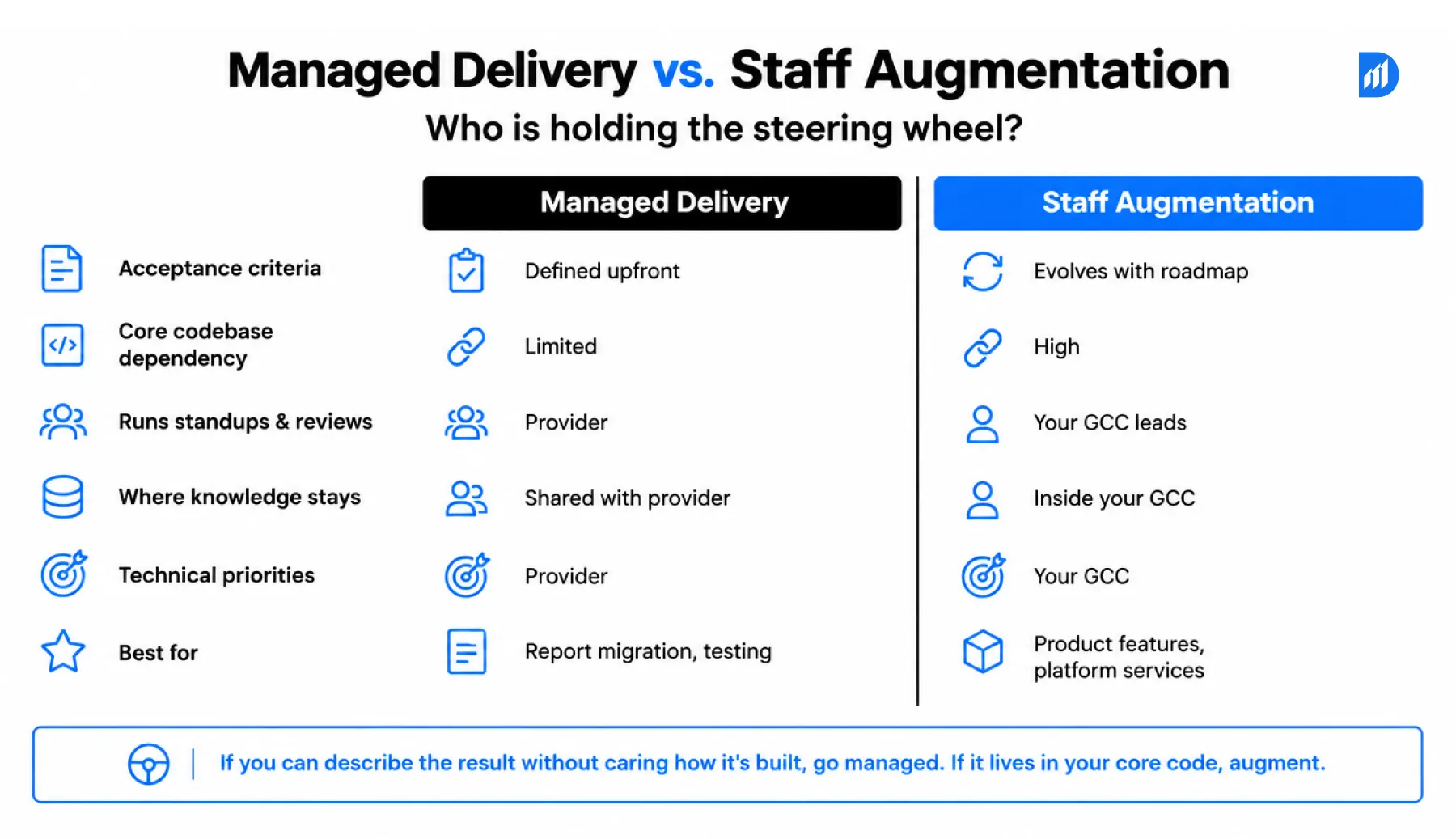
A useful rule of thumb is that if you can describe the finished result without caring how it’s built, a managed team works fine, but if the work lives in your core code, changes every sprint and needs to be understood by your team long after the contract ends, staff augmentation is the better fit.
The GCC + Staff Augmentation Hybrid Model in Practice
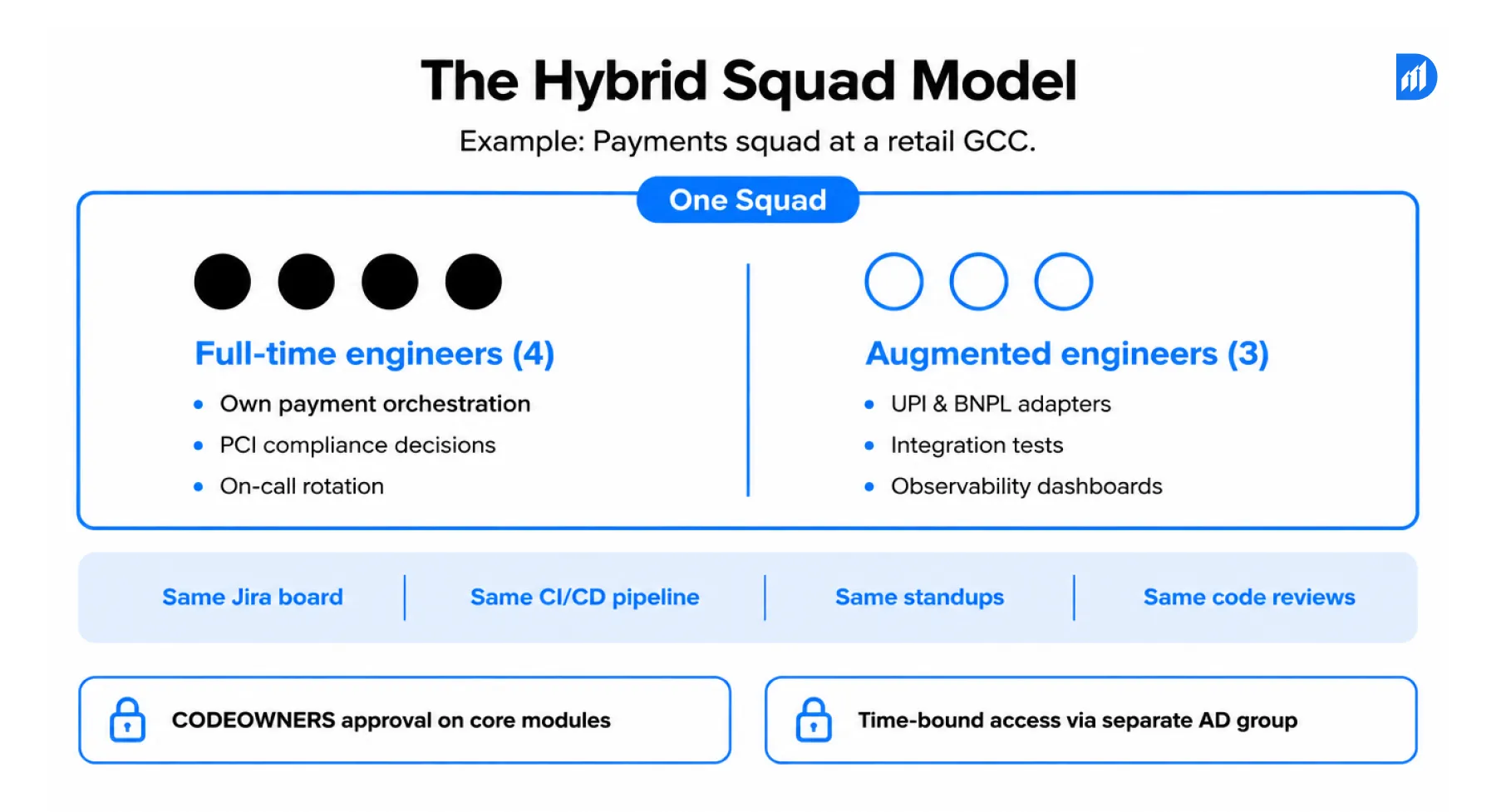
In real life, very few GCCs pick only one model, and the strongest ones run a hybrid where full-time engineers own the architecture, the critical systems and the product context, while augmented engineers add capacity inside the same squads and follow the same rules. Durapid’s own engagement options reflect this, with time and material for projects where requirements keep changing, fixed price for work with clear and set requirements, dedicated teams for long-term projects, and a hybrid model that mixes them to keep flexibility while holding costs under control.
Here’s how that looks on the ground for the payments squad of a global retail GCC in Hyderabad, where four full-time engineers own the payment orchestration service, the PCI compliance decisions and the on-call rotation, and three augmented engineers join to build adapters for new payment methods like UPI and BNPL, write integration tests and set up observability dashboards. Everyone works from the same Jira board, ships through the same Azure DevOps pipeline and joins the same standups, but a CODEOWNERS file in the repository makes sure any change to the core orchestration module needs approval from a full-time owner, and the augmented engineers get time-bound access through a separate Azure AD group, so the GCC adds speed without loosening its grip on the systems that matter most.
The partner’s role in this setup is to remove the friction around the people rather than manage the work itself, and on its Durapid Staff Augmentation, says it handles the administrative, HR and logistical side of augmented staff so that clients can stay focused on core project work, which leaves your leads free to do what they do best, guiding the engineering.
When this hybrid runs smoothly, the customer at checkout never knows who sits on whose payroll, and the GCC can grow or shrink the squad around a launch without rewriting its org chart, which brings us to the question every engineering head eventually asks, how to scale this kind of capacity without waiting six months for each hire.
Scaling Your Software Development Capacity Without a 6-Month Hiring Cycle
Once the model is clear, speed becomes the real advantage, because a good partner can put vetted engineers in front of you within days instead of the months a full hiring cycle takes, although that speed only pays off if onboarding is just as quick. For most GCCs, this is where software development capacity is won or lost, because every week a software developer role stays open is a week of roadmap that quietly moves to the next quarter.
How to Onboard Augmented Software Developers Into an Existing GCC Team
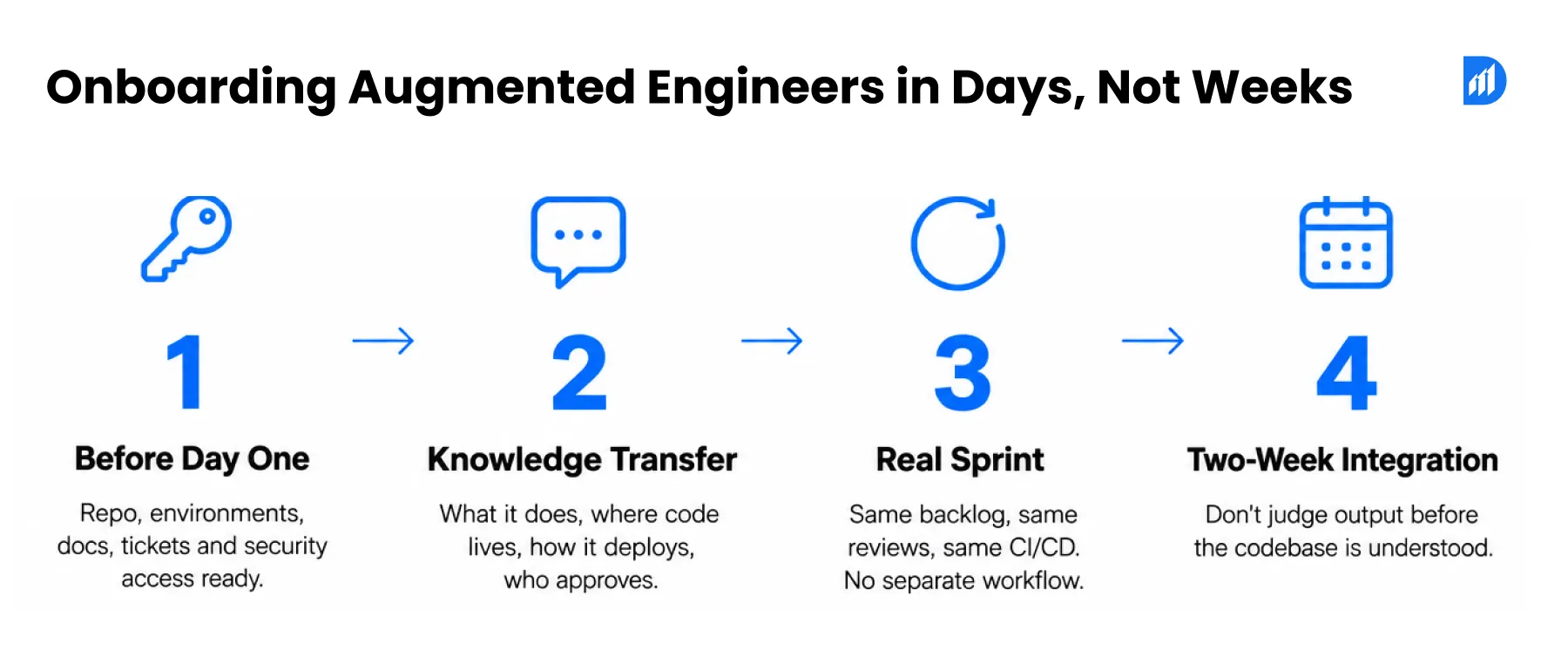
The fastest onboarding for engineers is where the process helps the engineer to become productive. This does not require much of the in-house people. The ideal process should start before the actual start date by having access to the repository, architecture documents, development environments, coding conventions, ticketing system permissions and security requirements. It is a huge waste of time for a contractor to wait for days for access to be granted. The process should then involve the first knowledge-transfer meetings about the concrete questions:
- What does this service do?
- Where is the code stored?
- How is the code deployed?
- What are the available environments?
- Who approves for production?
- What are the technical constraints?
The process should then involve getting the engineer into a real sprint. Do not create some ‘external developer’ workflow that makes them work in a different way than the main team. If the main team is writing React and Node.js code, the new engineer should have the same backlog, code reviews and CI/CD setup as everyone else. When a GCC has a temporary need for frontend engineers to help with a product release, React.js Development Services can fill this need without having to set up an entirely new frontend team.
One last thing to consider is that the first two weeks are an integration period. If the in-house team judges the engineer on his productivity during the first weeks, there is a high chance that they will make wrong judgements due to a lack of understanding of the code base.
Full-Time Hire vs. Augmented Developer: When Each Makes Sense at Scale
A simple framework helps here.
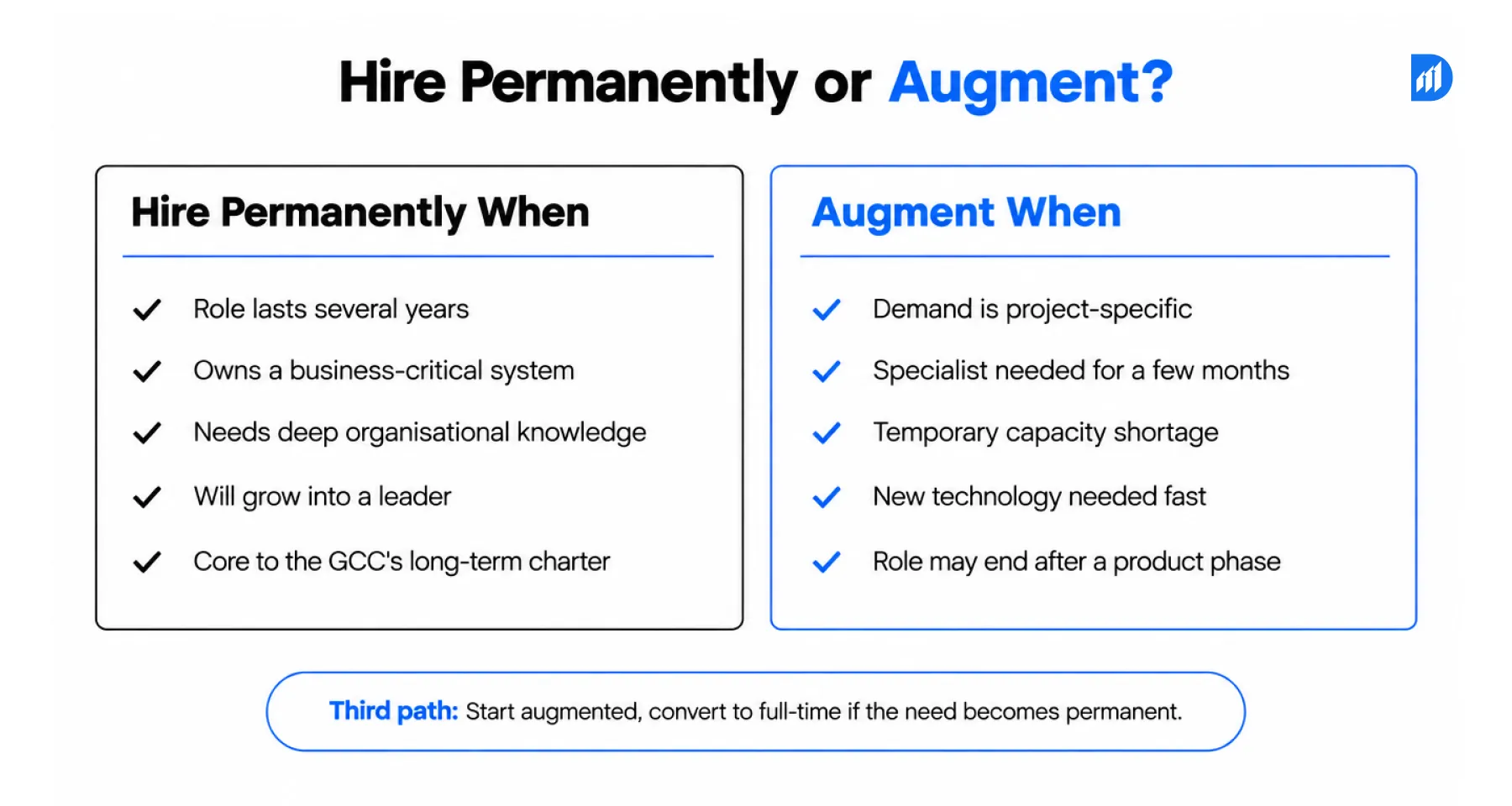
Hire permanently when:
- The role will exist for several years.
- The engineer will own a business-critical system.
- Deep organizational knowledge is required.
- The person is expected to become a technical or people leader.
- The capability sits at the center of the GCC’s long-term charter.
Augment when:
- Demand is tied to a specific project.
- You need a specialist for a few months.
- The internal team has a temporary capacity shortage.
- A new technology has to be introduced quickly.
- The role may disappear after a product phase.
There’s a third way, which is to begin with augmentation and change course if the business need becomes permanent. It gives you the opportunity to understand the technical fit, working style and long-term requirement before making a permanent addition to your org chart.
One caveat: don’t compare augmentation against full-time staff as a cheaper alternative. It’s a fundamentally different product, designed and priced with a different purpose in mind and evaluating it purely on cost per head will lead you to the wrong conclusion.
Building Data Engineering and Analytics Capability Through Augmentation
If software roles are hard to fill, data roles are harder still, and this is where a lot of GCC roadmaps get stuck even when every product squad is fully staffed. Think of a GCC whose team has finished the screens for a new personalized offers feature and has a recommendation model that works well on a sample file, yet the launch keeps slipping because customer data still sits across a CRM, an old order database and a loyalty app, and nobody has had time to build the pipelines that join it all together reliably. It’s a bit like finishing a beautiful new kitchen and then discovering the water connection was never laid, because the dashboards, analytics and AI features your leadership is excited about all depend on data arriving clean and on time, and when the data team is short of people, all of that waits. In most GCCs, data analytics and data engineering are now the two areas where demand grows fastest and the talent pool grows slowest. Filling that gap sounds simple until you open a data engineering role and see what actually comes through the door, which says a lot about why this hire is so difficult right now.
Why Data Engineering Is the Hardest Role to Hire for in GCCs Right Now
“Data engineer” may sound like one position, but everyone who has hired for such a role in a GCC knows that it actually covers a range of fairly distinct roles, since some engineers work exclusively on batch ETL and SQL, some are stream processing experts who work with Spark, Databricks, Kafka or Azure Event Hubs, while others specialise in data architecture, governance and cloud security rather than hands-on pipeline code. A candidate may list “Azure Data Engineer” among their skills, but they may not have the particular expertise that you need, and finding somebody who is truly strong across the board is an exception, not the norm.
Imagine hiring for a retail GCC that requires building a real-time inventory feed on Kafka and Databricks, only to find that the “perfect” candidate has such a title because they have worked extensively on SQL Server ETL jobs that run once every 24 hours over the last four years, while their knowledge of stream processing is fresh from the book. The cost of such a hiring decision will not appear on the offer letter, but it will manifest itself in senior engineers fixing and re-writing the pipelines and stream jobs, or in a junior engineer taking weeks to understand what the previous person was doing, not to mention the cost if an external agency made the recommendation and you then have to pay them again for the new hire. This is why screening should be technical rather than a generic competency-based interview covering a list of technologies.
Ask people to describe how they would design a pipeline (what they do when a job fails in the middle of a load, how they ensure data quality, how they partition big tables), how they deal with dependencies and how they monitor everything once it is in production, and you will see who has spent the last several years learning the hard lessons and who is good at ticking all the boxes in interviews. People who have dealt with production issues will rarely give the same answers as somebody who has been reading up on the theory and best practices.
For GCCs building a modern data platform, data engineering augmentation can fill those specialist gaps straight away, while the permanent data team grows at a pace that doesn’t force anyone into a rushed hire.
Using Staff Augmentation to Staff a Data Analytics Team During Product Development
Consider a GCC that wants to build a new analytics platform. During product development, the data team often needs to be at its largest, because the platform is being built, tested and connected to every source system at the same time. There will likely be a need for engineers to design and implement the ingestion, transformation, orchestration, and overall system. But, when the system is up and running, the staffing mix will change.
Here’s one possible division:
- Build: data architect, data engineers, analytics engineer, DevOps support
- Production: core data engineers, platform owner, analytics specialists
- Expansion: more engineers may be added depending on the domain or workloads
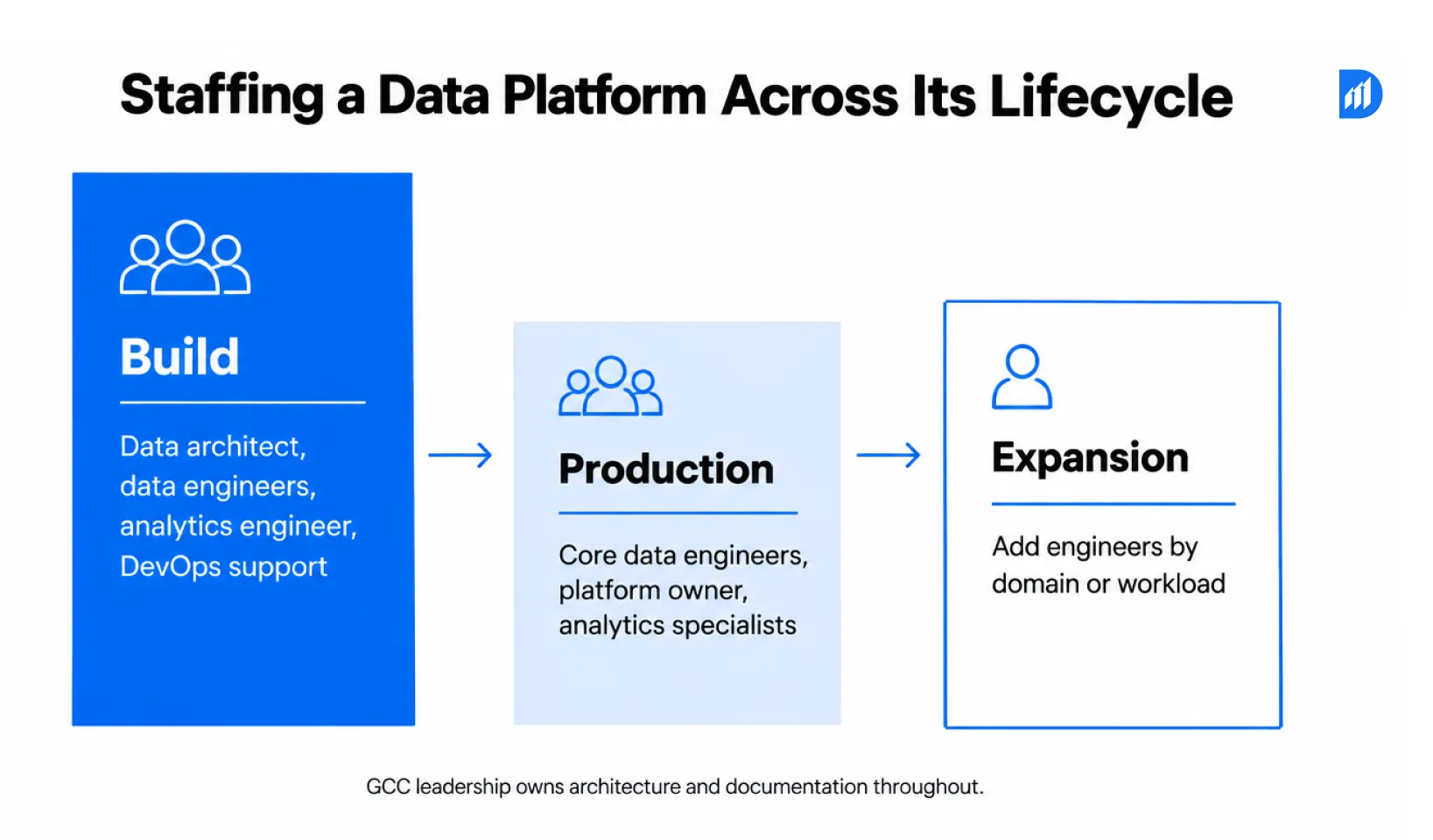
External engineers can be hired to create ingestion pipelines, build transformations, migrate workloads or participate in supporting a Databricks implementation. At the same time, the GCC leadership retains responsibility for the architecture and the product.
The internal team should be responsible for the final documentation. External engineers can contribute to it, but the documentation has to be in the GCC’s systems to ensure that the knowledge is captured for the long term. That discipline prevents a temporary augmentation from becoming a permanent dependency.
Performance Management When Half Your Team Is Augmented
Bringing in more people raises a natural question for every engineering manager, which is how you measure people who don’t sit on your payroll, and the answer is to measure them exactly the way you measure everyone else. Good performance management in a mixed team starts with one rule, which is that nobody should be able to tell from the dashboard who is permanent and who is augmented.
Setting KPIs for Augmented Engineers That Your Core Team Can Measure
Use the same metrics for everyone, like cycle time, review turnaround, defect rates and sprint commitments, and then add documentation contributions as a shared expectation. Avoid billing-based metrics like hours logged, because it rewards time spent not value created and it implicitly creates a two-tier team.
Retaining Institutional Knowledge When Augmented Contracts End
The bigger risk isn’t performance. It’s what walks out the door when the contract ends.
An augmented developer walking away isn’t dramatic, but if they were the only one who knew about a particular service, you find out at 2 a.m. while triaging an incident. The solution to this problem is to bake knowledge capture into delivery from the beginning, not an after-thought cleanup.
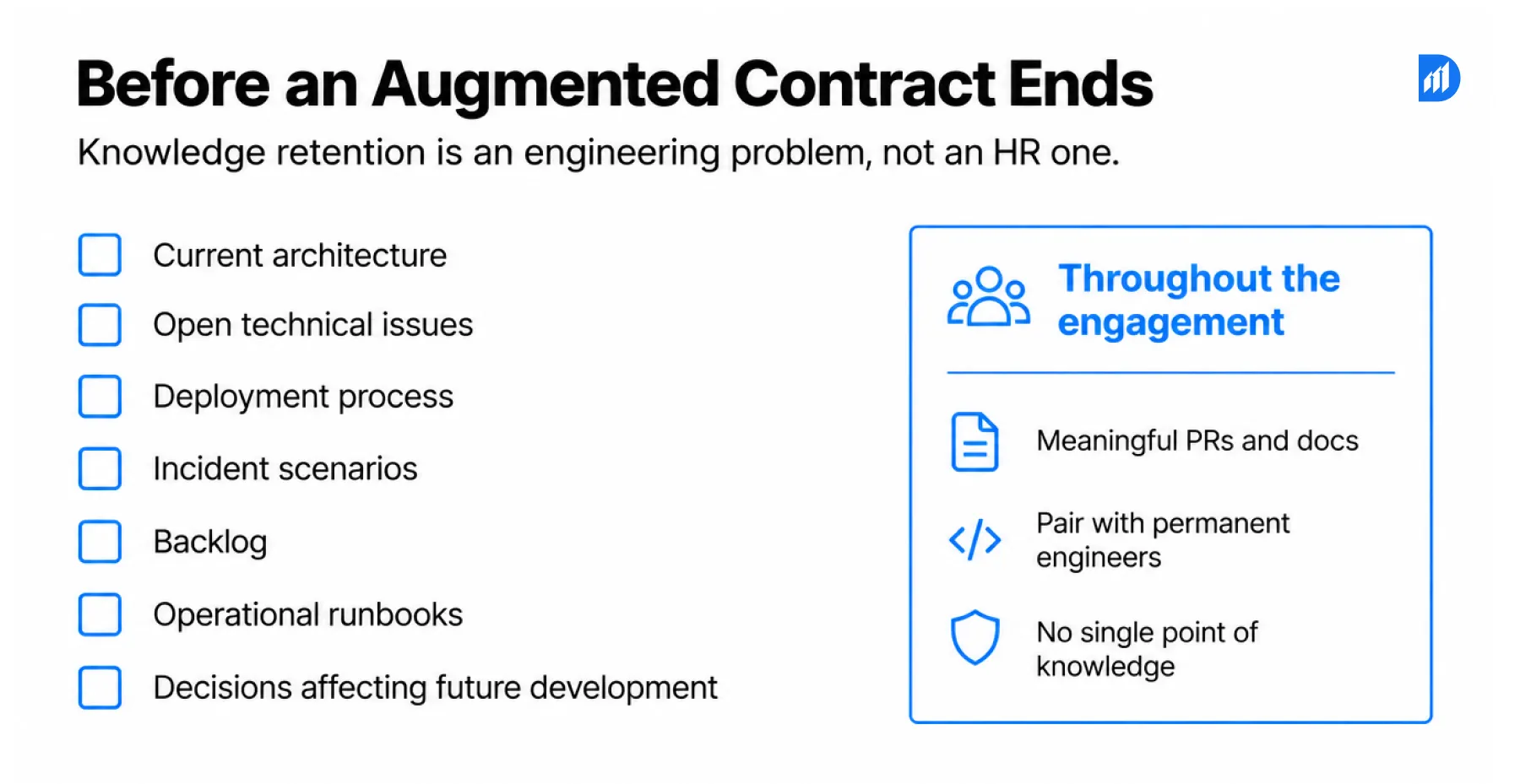
Demand meaningful pull requests, architecture notes, runbooks and documentation throughout the engagement. Have permanent engineers always pairing with augmented developers on complex work within critical systems. And don’t ever have an outside specialist as the sole person who understands a critical pipeline or service.
Before the contract ends, run a formal handover where the departing engineer walks the team through:
- Current architecture
- Open technical issues
- The deployment process
- Incident scenarios
- The backlog
- Operational runbooks
- Decisions that will affect future development
This is especially important for data platforms. A pipeline may appear to be functioning correctly on its own, but it fails in six months when the only person who understands the peculiarities of the source system leaves the company.
Knowledge retention is not an HR issue. It’s an engineering problem.
AI-Driven Staff Augmentation: How GCCs Are Using It in 2026
All of this works better when finding the right engineer takes days instead of weeks, and in 2026 AI is changing how that search happens.
How AI Matching Platforms Cut Talent Acquisition Time
Modern matching platforms tap skills from actual work in project histories and code rather than keyword-laden resumes, which results in better shortlisted candidates from the start. Some partners have begun using voice AI agents to conduct first-round screening calls at any hour and in any time zone, and Durapid has revealed its techniques for developing AI-powered recruiting agents that can listen, reason, and decide at the speed of thought, but always with a human in the loop.
Combined with pre-vetted talent pools and voice AI screening that checks communication and technical basics before a hiring manager ever gets involved, this is how the search for niche engineers shrinks from weeks to days.
For GCCs, the primary value proposition will be speed: When an engineering team needs three Azure Data Engineers, React developers, or AI specialists for a specific project, faster screening and more relevant shortlists will reduce the time between identifying the requirement and assembling a team of qualified engineers.
AI does not eliminate the need for technical evaluation and human judgment. It only transfers more of the drudgery to the earlier stages, giving engineering and recruitment teams more time and capacity to invest in evaluating candidates’ ability to meaningfully contribute to the work at hand.
GenAI Tools That Augmented Engineers Bring Into Your GCC Stack
Augmented engineers often already work with AI coding assistants, automated test generation, documentation systems and other AI tools. The key to success is that their usage is allowed within the GCC’s tools, security controls and data policies. In particular, the code, customer data, and other sensitive information must not be entered into an unapproved AI system, while using the tools provided by the GCC can be safe.
In practice, this means engineers who are already comfortable with GitHub Copilot, who know how to write effective prompts, and who use AI-assisted code review to catch issues before a human reviewer even opens the pull request.
For GCCs, the adoption of AI tools is not a matter of providing more options for engineers to choose from. Rather, it is a question of how they can make the development process more productive without sacrificing code quality, security, and intellectual property.
Workforce Strategy for GCCs Scaling Past 100 Engineers
As soon as a GCC passes 100 engineers, staff augmentation stops being a tactical recruitment tool and becomes a strategic workforce planning function. That is, it moves from a reactive practice driven by imminent hiring needs to a proactive practice that forecasts the company’s requirements in advance. A clear workforce strategy is what turns staff augmentation from a quick fix into a planned part of how the GCC grows.
Building a Global Talent Strategy Around a Core + Augmented Model
A GCC’s healthy workforce can be grouped into three capacity pools:
- Core: permanent engineers who develop platforms, products, architecture and hold organizational knowledge.
- Specialist: permanent or long-term external experts whose skills are hard to acquire or develop in house.
- Flex: augmented engineers who provide extra delivery capacity in known demand peaks.
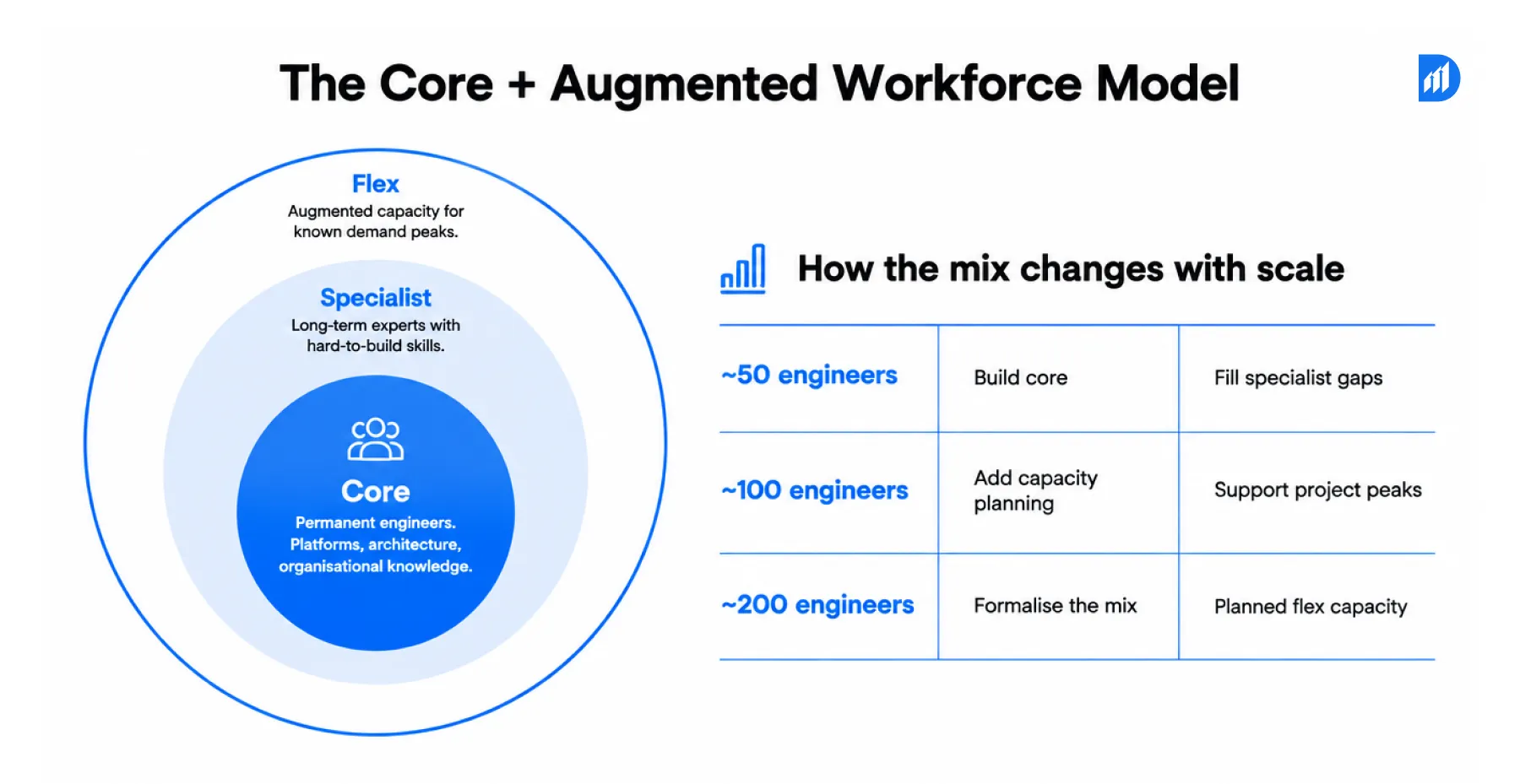
This is what a global talent strategy looks like in practice, where the GCC knows ahead of time which roles stay permanent and which ones flex with demand.
The optimal mix of these pools will depend on the business: a payments engineering center would lean more into the permanent due to the domain knowledge and regulatory know-how required, whereas a product engineering center launching several applications at once would have more flex capacity. Crucially, the strategy has to be planned: if the GCC finds itself always in a position of hiring emergency contractors, it has failed to architect its workforce in a way that accounts for speed. Capacity planning will typically involve the product roadmap, the hiring plan and the external talent plan, and should take place in the same conversation, ideally on the same sheet of paper.
The GCC Model That Works at 50 Engineers vs. 200 Engineers
At 50 engineers a GCC can typically rely on its engineering leads and TA partners to make day-to-day workforce decisions, usually over a friendly call. At 200, this stops being scalable: the demand for augmentation now comes in from multiple products at once and has to be prioritized accordingly.
| GCC size | Workforce priority | The role of augmentation |
| Around 50 | Build core capabilities | Fill specialist gaps |
| Around 100 | Introduce capacity planning | Support growth and project peaks |
| Around 200 | Formalize workforce mix | Maintain planned flex capacity |
This should not be seen as a progression, but rather as a set of planning milestones that a GCC has to reach as it grows. Losing a specialist at 50 is a much bigger problem than losing one at 200: the latter has more internal specialization and shared knowledge to rely on. Symmetrically, the 200-head GCC has more complex requirements in terms of external expertise, and has to plan its workforce management around those needs. In particular, there must be guidelines in place for when to bring in external help, how long such resources should stay, and what expertise is best kept in-house. This way, the workforce strategy parallels the company’s maturity.
How to Choose the Right Staff Augmentation Partner for Your GCC?
All this strategy rests on one choice that looks obvious but is easy to get wrong: selecting the right staff augmentation partner, one that works as an extension of your team rather than a resume vendor. For enterprise IT staff augmentation, the partner’s process matters as much as its talent pool, because your security, compliance and delivery standards have to hold from the first week.
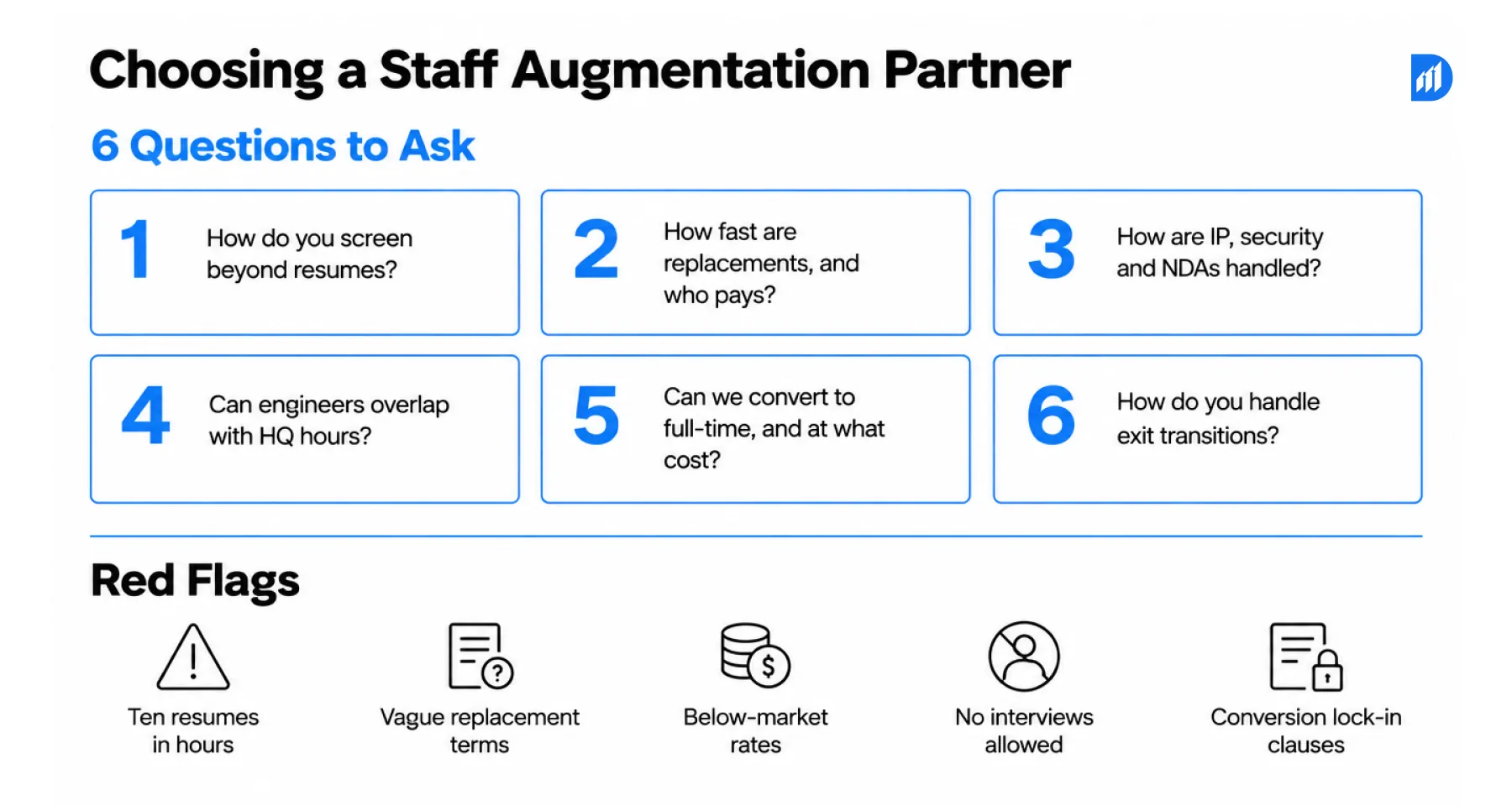
6 Questions to Ask Before Signing Any Staff Augmentation Contract
- How do you screen engineers beyond resumes and keyword matching?
- How fast can you provide a replacement if someone is not working out, and who bears the cost of such a failure?
- Who owns what, and how do you secure IP, deal with security checks, and sign NDAs?
- Can your engineers work in hours overlapping with our headquarters?
- Can we convert augmented heads into full-time, and what does it cost?
- How do you facilitate transitions in case of a contract termination?
Alongside these, check the notice period clauses on both sides and whether you’re getting a dedicated engineer or someone shared across several clients, because both quietly affect delivery once the engagement starts.
Red Flags in Staff Augmentation Proposals GCC Leaders Miss
Many IT staff augmentation agencies look identical on paper, so the real differences only show up in the details of the proposal. Be wary when a partner sends you ten resumes within hours for a niche role because their true intent is a bench of bodies willing to be placed at any position and any time. Vague replacement terms, rates below the market, unwillingness to allow you to interview and lock-in clauses to prevent conversion are some of the red flags that the partner is looking to optimize their margins at the expense of your delivery. Another warning sign is a partner that can’t name a single GCC client reference or show domain specialisation in your industry, because a GCC carries security, compliance and delivery expectations that a general staffing vendor rarely understands.
GCC Staff Augmentation in Action: Real Deployment Scenarios
To see how this comes together, here are three scenarios based on situations GCCs commonly face.
Scenario 1: Scaling a Data Engineering Pipeline Team in 8 Weeks
A GCC for a European retailer needed to migrate its reporting from on-premise servers to a cloud lakehouse before the holiday season, but its two data engineers were already maxed out. Three augmented data engineers and an analytics engineer joined the team during the first week: they shadowed the existing pipelines during the second, and during the third week, they migrated the most critical sales and inventory pipelines first, thus by week eight the core team had their documented, running platform and the augmented engineers departed.
Scenario 2: Augmenting a React + Node.js Squad During a Product Launch Sprint
A US insurance company’s GCC had one quarter to launch a new customer portal, and its squad of four couldn’t cover both the frontend and the APIs in time. Two augmented React developers and two Node.js developers, backed by React.js Development Services, joined the existing sprints, the portal launched on schedule, two engineers rolled off afterwards, and the GCC converted one to a full-time role because he now knew the codebase better than almost anyone.
Scenario 3: Building an AI/ML Capability Layer Without Full-Time Hires
A logistics firm’s GCC wanted to test whether AI could read shipping documents automatically, but leadership wasn’t ready to hire a full ML team for an idea that might not work. An augmented ML engineer, an MLOps engineer and a data scientist built and tested a pilot over a few months, documented everything as they went, and once the results proved the value, the GCC used that groundwork to justify and hire its first permanent AI roles.
FAQs
Q1: What is staff augmentation in the context of a Global Capability Center?
It means supplementing existing GCC teams with external engineers who can be managed inside the client’s GCC under the direction of their own leadership, tools and processes, while a partner manages hiring, payroll, compliance and replacements, so that they can gain capacity without long hiring cycles. In short, the staff augmentation meaning for a GCC is added capacity without giving up control of the work.
Q2: How quickly can augmented engineers be onboarded into a GCC team?
With access and equipment in place prior to day one, most augmented engineers can contribute within their first week or two, which is much faster than a typical full-time hiring and notice period cycle.
Q3: Is staff augmentation better than hiring for long-term GCC scaling?
Neither option works best on its own for long-term needs. Headcount should be used for the system’s owners and leaders, and augmentation should be applied for sporadic, specialized, and uncertain requirements, so the best option for GCCs is to combine both approaches in a single core-augmented strategy.
Q4: How do GCCs manage performance for augmented talent?
By using the same indicators as the core team, including cycle time, code quality and sprint delivery, and by involving augmented developers in reviews and retros, instead of measuring their performance based on hours logged.
Q5: What roles are most commonly filled through staff augmentation in GCCs?
Data engineers, cloud and DevOps engineers, frontend and backend developers, QA automation engineers and AI/ML specialists are the most common, especially for launches, migrations and new capability builds.
Q6: How does AI-driven staff augmentation work for engineering teams?
AI platforms match engineers to roles using real project and skill data, and voice AI agents can run first-round screenings, which shortens the search while hiring managers still make the final decisions.
Q7: What is the cost difference between a full-time GCC hire and an augmented engineer?
Augmented engineers often carry a higher monthly rate, but you avoid recruitment fees, long vacancies, benefits overhead and bench costs, so for short or uncertain needs the total cost is frequently lower than a full-time hire.

Recent Blog

How GCCs Can Scale Engineering Teams with Staff Augmentation?
October 10, 2026-
Asset Management Software for CFOs: From Depreciation to Capital Planning
September 29, 2026 -
Why Voice AI Is Different From Chatbots in Recruitment?
September 17, 2026