Asset Management Software for CFOs: From Depreciation to Capital Planning
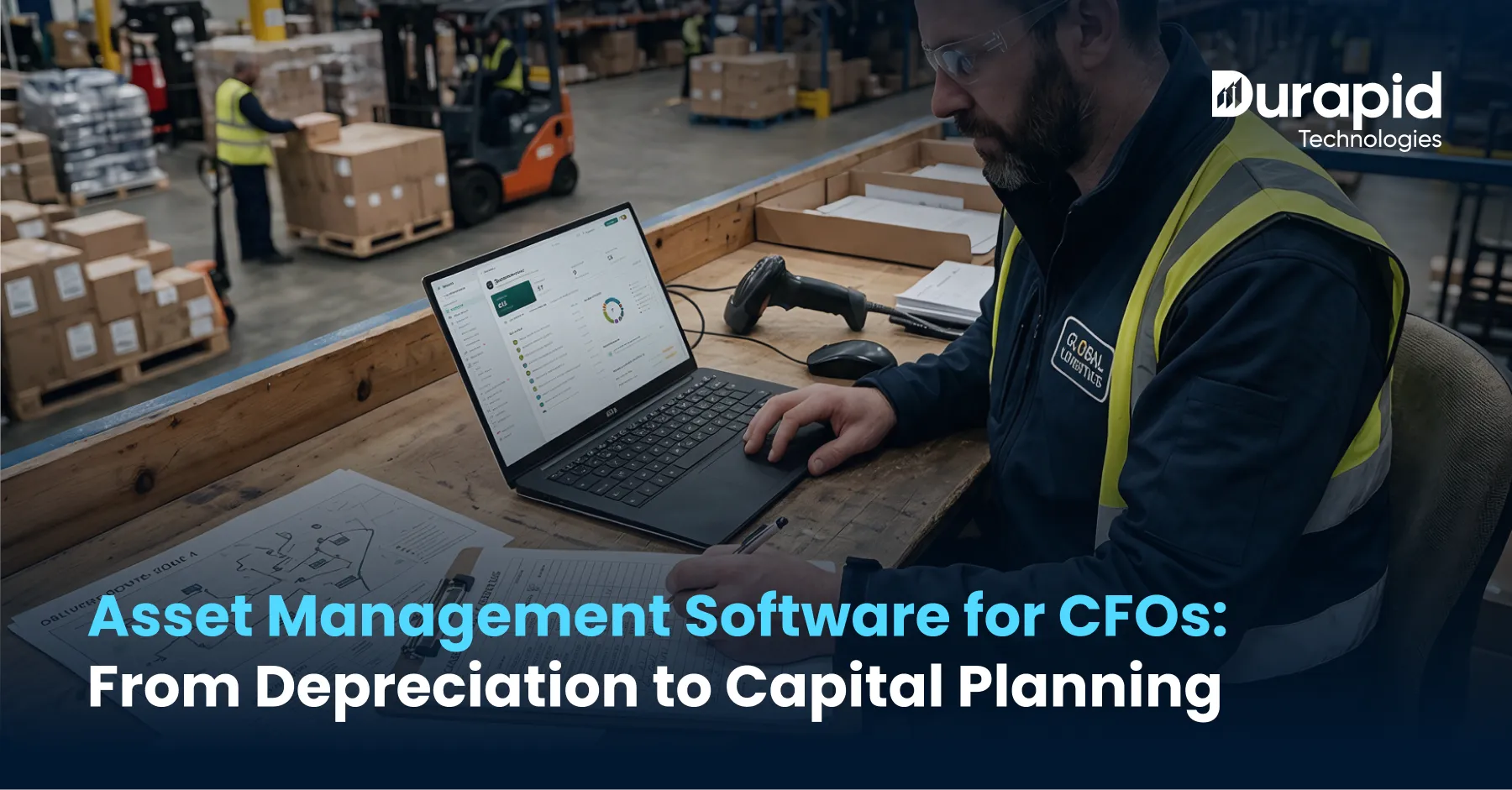
Your asset portfolio can tell Finance much more than what the business spent to acquire it.
With the right visibility, the same asset data can help a CFO understand what the organisation owns, what those assets are worth, how much they cost to operate, how effectively they are being used, and where future capital may be required. That makes asset management relevant far beyond the asset register. It connects accounting information with what’s happening across operations, maintenance, procurement and physical locations.
Consider a straightforward example. A business may have ₹18 crore of assets spread across different locations and business units. Some are heavily utilised, some are approaching replacement, and some simply need better verification or updated ownership information. When Finance can see that information together, decisions around depreciation, CapEx, maintenance and asset lifecycle planning become far easier to evaluate.
The opportunity isn’t just to maintain a more accurate register. It’s to make asset information genuinely useful for financial decision-making.
This is where asset management software becomes a valuable decision-support layer for the CFO.
What CFOs Actually Need From Asset Management Software?
The CFO who owns asset intelligence owns capital strategy.
Today, most organisations still treat asset management as an operational checkbox. Track what we buy. Depreciate it. Verify it once a year. Dispose of it. Move on.
But assets represent committed capital. They generate cash flow. They carry real risk. They drive CapEx decisions worth billions. Yet most CFOs don’t have complete visibility into what their asset portfolio actually means—financially or operationally.
That gap is what needs to close. 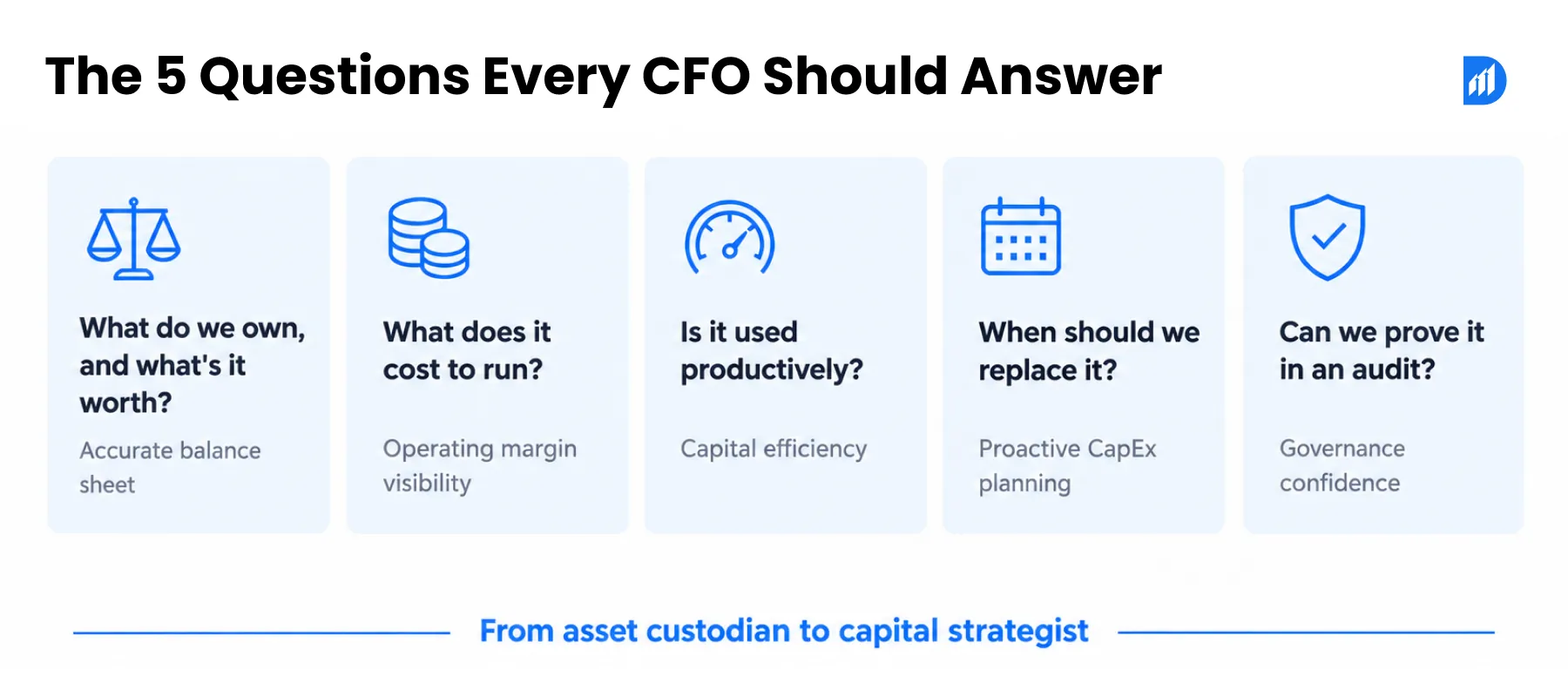
The CFO who can answer all five questions in real-time, with documentation linked to every claim moves from asset custodian to capital strategist. That’s where modern asset management software creates competitive advantage.
The Financial Visibility Gap: Where Asset Data and Finance Data Break Down?
Before discussing features, it’s worth talking about what actually becomes possible when asset data is properly connected.
Depreciation Schedules Running on Accounting Assumptions Not Actual Asset Condition
Most organisations spend 3–5 days every month on manual depreciation processing. Export the register. Update it with new purchases and disposals. Apply depreciation formulas across thousands of assets. Reconcile. Post to the GL. Verify the numbers. It’s repetitive, error-prone, and pulls Finance away from strategic work.
But there’s a better way. Imagine depreciation that calculates automatically. New assets capitalise and begin depreciating on schedule. Book and tax treatments run in parallel without manual adjustment. Impairment signals surface automatically when condition, utilisation, or repair costs indicate risk. Journals post directly to your ERP. Month-end close happens in a day, with Finance focused on review and exception management instead of data entry.
That’s not just an efficiency gain. That’s moving Finance from transaction processing to actual financial strategy.
The payoff looks like this:
- Month-end closes 60% faster
- Fewer manual entry errors
- Better visibility into impairment risks
- Audit-ready documentation built in automatically
- Finance team doing work that actually matters
CapEx Decisions Made Without Visibility Into What the Business Already Owns
CapEx requests arrive on the CFO’s desk without context. Operations requests 50 new laptops. Procurement asks for ₹5 crore in manufacturing equipment. IT wants a server refresh. You review each request in isolation, based on business need and available budget.
Now imagine this: Before approving any capital spend, Finance has real visibility into what you already own. What assets exist. Where they sit. How they’re actually being used. What the maintenance cost trend looks like. How much useful life remains. What the replacement risk forecast shows.
A laptop request arrives. Finance checks the system: 80 compatible laptops are sitting unused in another division from a previous restructuring. Redeploy them instead. Save ₹1.2 crore.
A machine replacement request comes in. Finance sees: Rising maintenance costs over the past 18 months, utilisation is declining, the asset is approaching end-of-life. Yes, replace it—and it’s already in the 3-year CapEx plan anyway.
Equipment procurement shows up. Finance checks inventory: Similar equipment in the warehouse is underutilised. Consolidate and free up ₹8 crore for other priorities.
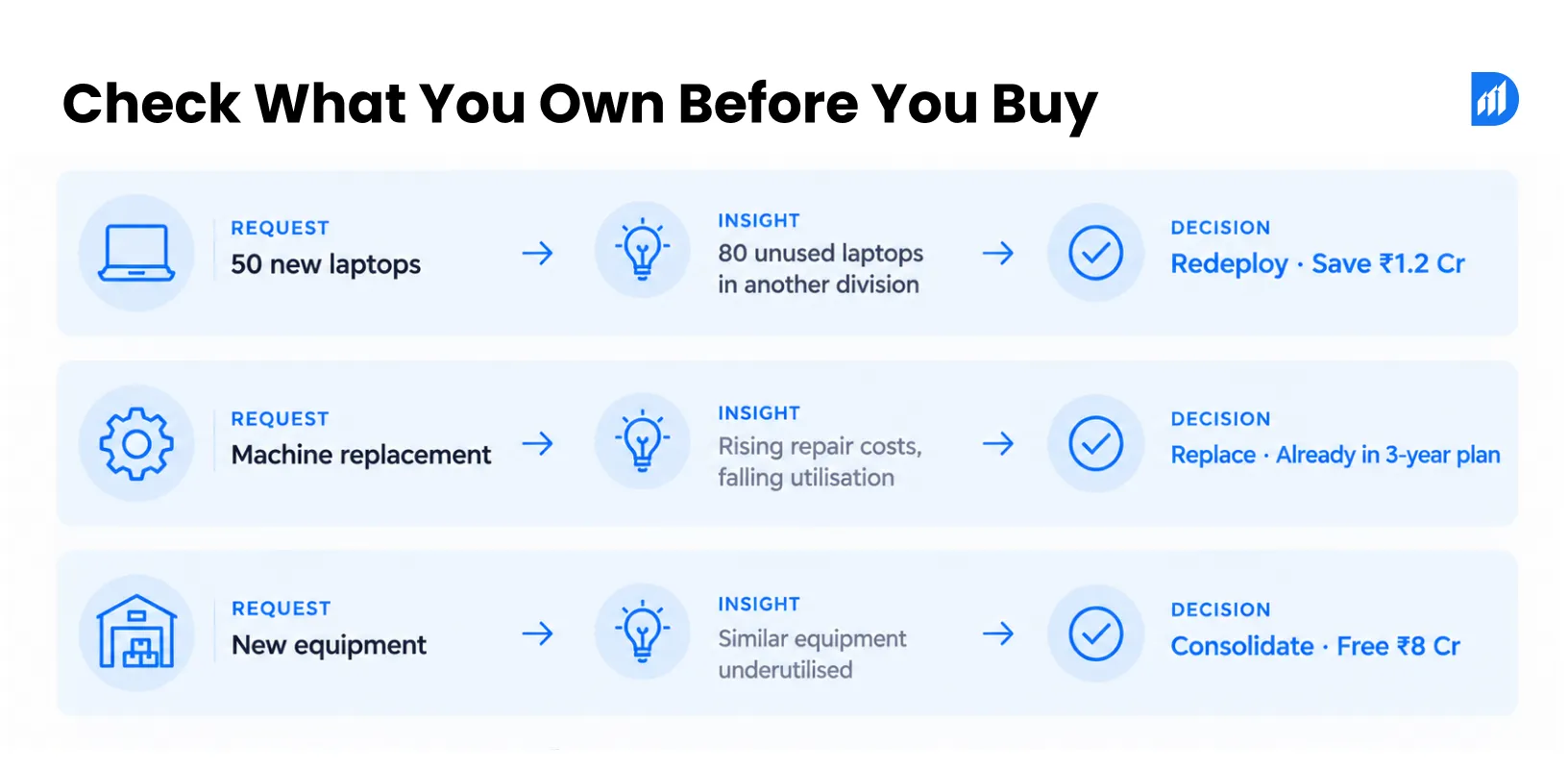
That’s not saying no to CapEx. That’s making CapEx decisions that actually make sense.
The business benefits are real:
- CapEx decisions backed by real asset data
- Redeployment opportunities identified before fresh spending
- Replacement cycles forecast 18+ months in advance
- Board sees actual capital strategy, not just spending plans
- Capital efficiency improves by 15–20%
Ghost Assets Inflating the Balance Sheet and Distorting Net Worth
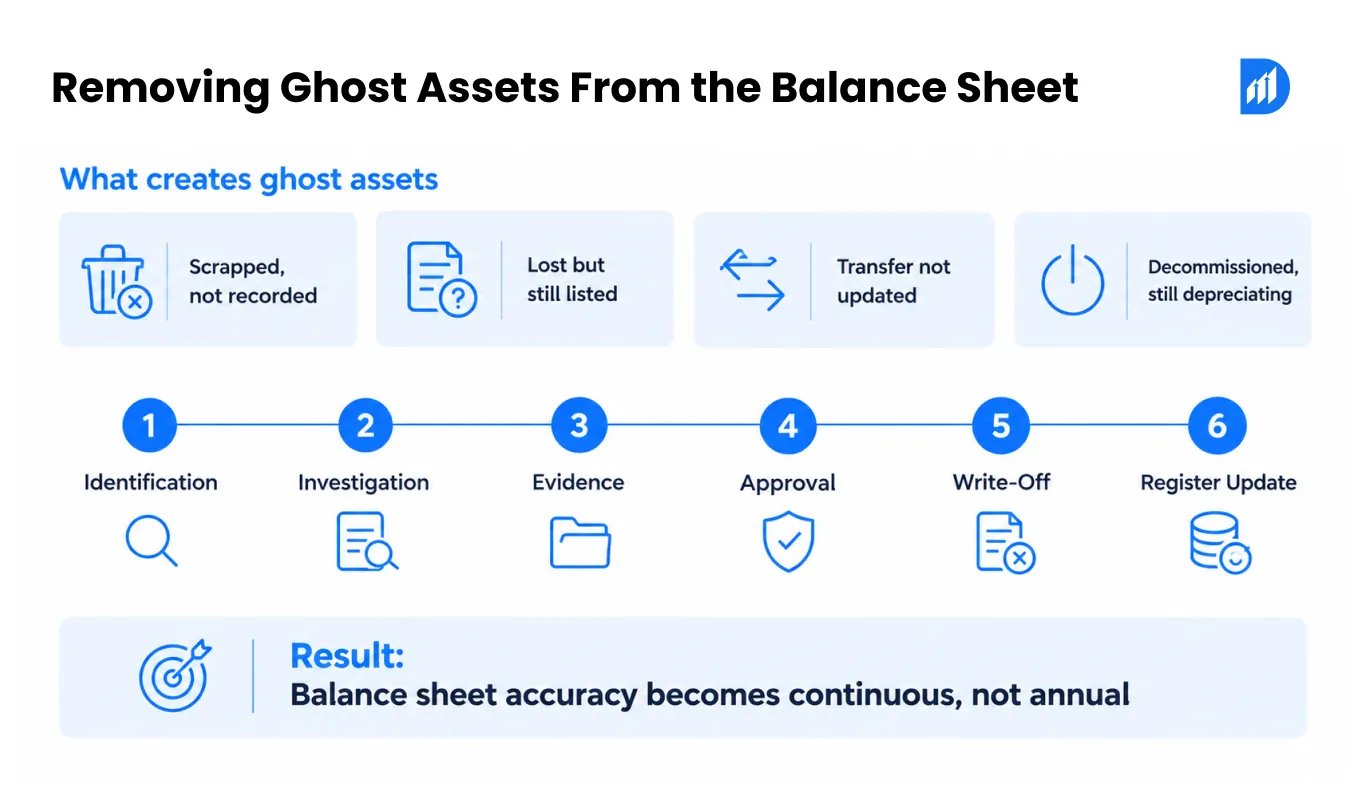
Ghost assets are the financial skeleton in most organisations’ closets. Equipment on the books that doesn’t exist physically. A machine was scrapped, but the disposal was never recorded. A laptop lost but still on the register. A device transferred between departments but the record never updated. An asset decommissioned but continuing to depreciate.
The balance sheet consequence is immediate. Net worth is overstated. Asset turnover ratios are misleading. Carrying values reflect equipment that isn’t really there.
The fix is continuous physical verification using QR and barcode scanning. Real-time location updates as custody changes. Automated alerts when an asset can’t be located during routine verification. Systematic write-off workflows that route missing assets through proper investigation and approval before removing them from the register. The result: balance sheet accuracy becomes continuous instead of discovered once a year.
Audit Findings That Start in the Asset Register Not the Finance System
Auditors don’t always start in the general ledger. They often start in the asset register, asking the question: “Show me that asset.”
It’s a simple question. And for most organisations, the answer involves chasing paperwork across multiple systems. Finance has the GL entry. Procurement has the purchase order. Operations has a location note somewhere. Maintenance has repair tickets. Administration has insurance documents scattered in a file. Physical verification exists in a spreadsheet that hasn’t been updated since last year’s count.
The audit becomes an extended investigation, and findings accumulate.
When asset data is properly connected—GL entry, purchase documentation, location, condition, maintenance history, insurance status, verification timestamp audits become faster and findings shrink. An auditor asks to see an asset. Finance answers with complete confidence: Here’s the proof. It’s all linked. It’s all auditable. Audit closes faster. Governance is solid.
Depreciation Management: What the Software Must Handle Without Manual Intervention?
Depreciation is the most predictable financial process most CFOs manage. Transactions are known. Useful lives are estimated. Methods are configured. Yet most organisations still spend days manually processing depreciation each month.
The solution is software that automates the calculation while keeping Finance in control of the policy.
Straight-Line Method (SLM) – Uniform Charges and Where It Breaks Down
SLM distributes the depreciable amount systematically over the asset’s useful life. For one asset, that’s straightforward. For 20,000 assets acquired on different dates, across different locations, in different categories, with different useful lives, in different business units—the control requirement becomes significantly more complex.
Modern automation handles this by calculating SLM across thousands of assets simultaneously. New assets auto-capitalise and begin depreciation on schedule. Book and tax treatments run in parallel without manual intervention. Journals generate automatically. Finance reviews exceptions instead of reviewing transactions.
The outcome: Depreciation accuracy improves. Month-end effort drops by 60%. Finance moves from data entry to actual strategic review.
Written-Down Value (WDV) – Accelerated Depreciation and Tax Optimisation
WDV adds another layer of complexity because book depreciation and tax depreciation can follow completely different frameworks. In India, Section 32 of the Income-tax Act provides depreciation treatment for specified assets, including WDV-based treatment for relevant blocks of assets.
For Finance, this means the asset data should remain consistent even when the accounting treatment differs between book and tax purposes.
Modern platforms maintain both SLM (book) and WDV (tax) calculations simultaneously on a single asset record. Useful-life assumptions, residual values, and component treatment remain consistent across both schedules. Reconciliation between book and tax treatment becomes automatic and auditable instead of a manual monthly burden.
The result: Tax and book depreciation are no longer separate reconciliation exercises. Both flow from the same asset record. Compliance is embedded in the system.
Component Depreciation – Treating Sub-Assets as Independent Financial Units
Some assets aren’t economically uniform. A large manufacturing system contains components with different useful lives and different replacement patterns. Under Ind AS 16, significant components must be depreciated separately where appropriate.
Component-level depreciation tracking preserves the asset’s financial history while allowing different depreciation rates for different components. A manufacturing system with a motor, control system, and specialised component can depreciate each at its own rate. Replacement costs are tracked separately. The parent asset record remains intact.
The payoff: Compliance with Ind AS 16 componentisation requirements. More accurate depreciation treatment. Better visibility into when individual components need replacement.
Book Depreciation vs Tax Depreciation – Managing Two Ledgers Simultaneously
Book depreciation supports financial reporting. Tax depreciation supports tax computation. They can produce different values even when they originate from the same physical asset.
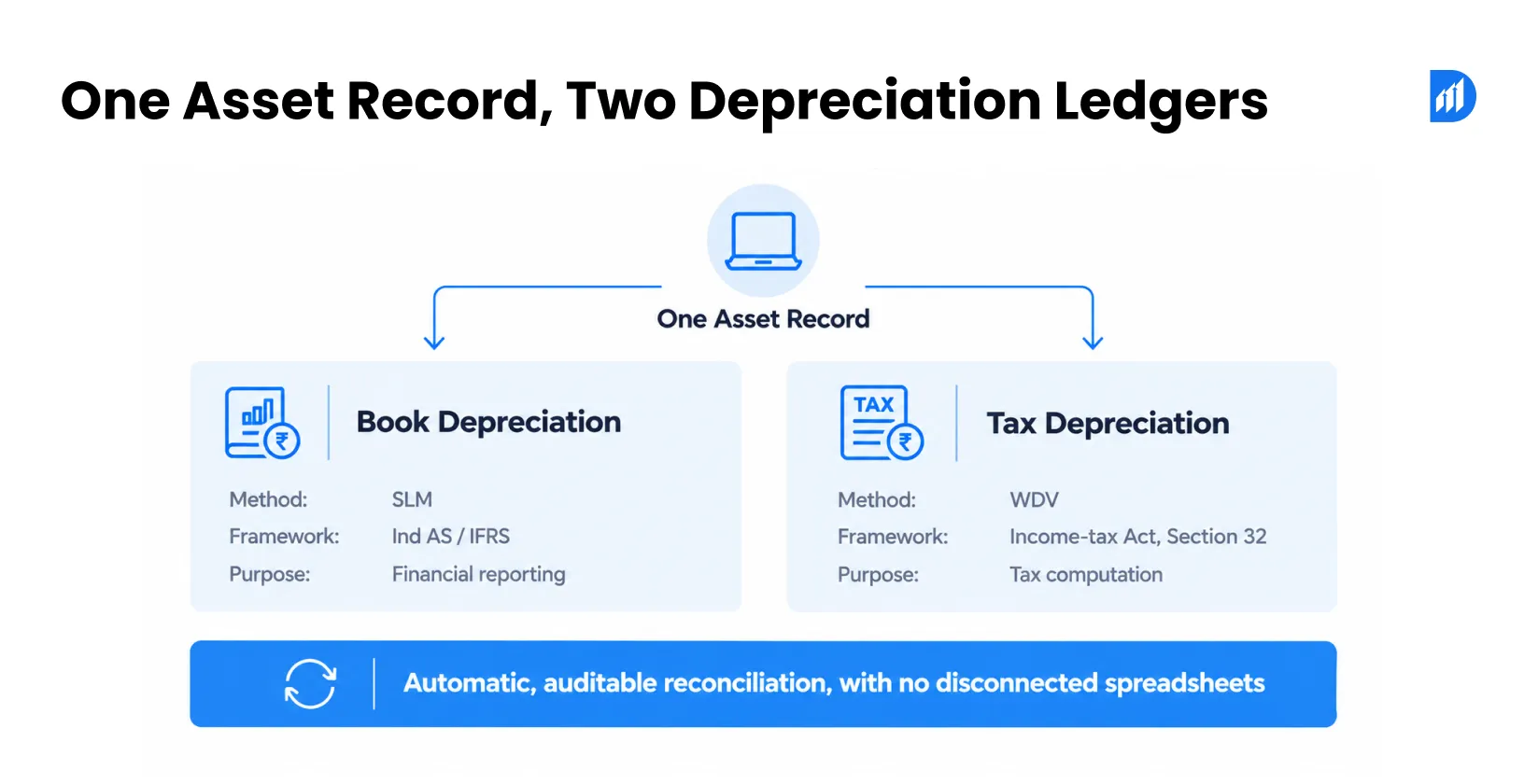
The challenge is maintaining one controlled asset identity while allowing separate financial treatments. Book depreciation follows your financial reporting framework. Tax depreciation follows the Income-tax Act. Both run from the same asset record. Reconciliation is clean and auditable. No more managing multiple disconnected spreadsheets trying to reconcile.
Automated Depreciation Engine – What Should Run Without Human Input at Month-End
A month-end process shouldn’t require Finance to repeatedly export reports, update spreadsheets, manually apply formulas, and upload results elsewhere. That’s wasting your Finance team’s time on work that a system should handle.
The workflow is straightforward: New asset → Capitalisation → Depreciation calculation → Validation → Journal preparation → ERP posting → Reconciliation.
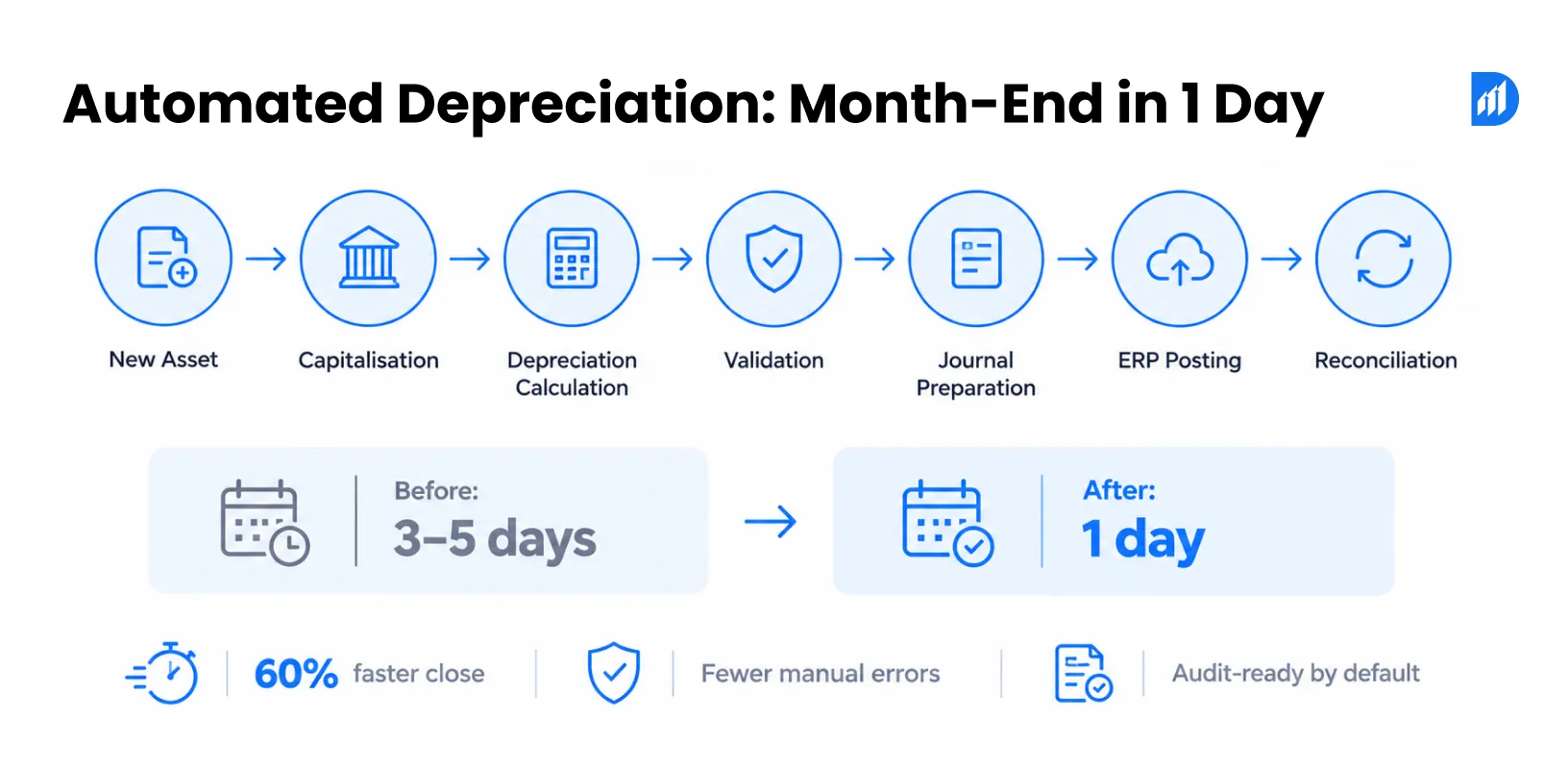
The key principle here: Automation should reduce manual effort without reducing financial control. Finance should never lose oversight; they should just stop doing data entry.
What this actually means in practice:
- New assets auto-capitalise and begin depreciating on schedule
- Depreciation calculates across all assets at once
- Validation flags exceptions automatically (missing data, policy conflicts)
- Approved journals post directly to your ERP
- Reconciliation runs automatically
- Month-end close goes from 3–5 days down to 1 day
- Finance focuses on review and exceptions instead of data entry
The outcome: Faster closes. Fewer errors. Better documentation. Finance becomes strategic.
Capital Expenditure Planning – From CapEx Approval to Asset Activation
CapEx planning is only as good as the asset visibility behind it. Modern asset management transforms CapEx from reactive spending into proactive strategy.
Construction-in-Progress (CIP) Tracking – Capitalising Project Costs Before Activation
Major capital projects often accumulate costs before the resulting asset becomes operational. That creates a window where Finance needs to understand what’s been spent, what’s still under construction, which costs belong to the project, and when the asset is ready for capitalisation.
Think about building a new plant. Equipment arrives. Installation takes months. Testing is completed. Commercial production begins. The financial lifecycle shifts at every stage.
With proper CIP tracking, Finance can:
- Track all project costs in one place
- Distinguish between capitalised and expensed items
- Know exactly when an asset is ready for capitalisation
- Identify when depreciation should begin
- Maintain a clear audit trail from project spend to asset record
The result: CIP tracking becomes systematic, auditable, and accurate. Finance knows exactly when and why costs capitalise. Audit documentation is built in as part of the process.
CapEx vs OpEx Decision Framework – When Asset Data Changes the Call
Consider a maintenance request for ₹12 lakh on an industrial machine. On its own, that looks like a straightforward repair.
Add asset history to that decision, though, and everything changes. Repair costs in the last 24 months: ₹18 lakh. Downtime: Increasing. Utilisation: Down 30%. Replacement cost: ₹22 lakh. Expected useful life: Approaching the end.
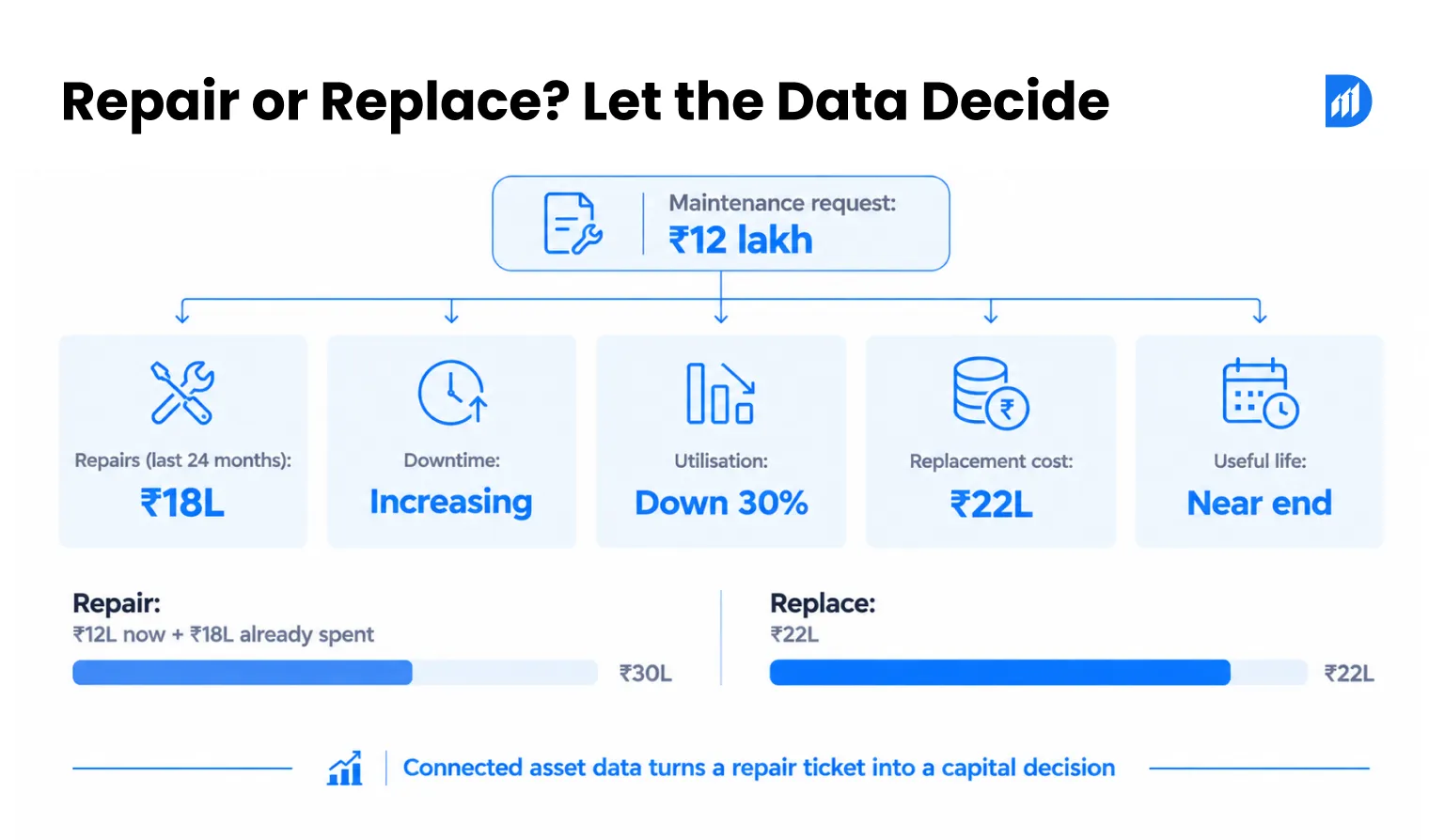
Now the conversation shifts. The real question becomes: “What’s the economically sensible path for this business?”
With connected asset data, Finance can see:
- Asset repair history with actual cost trends
- Utilisation metrics
- Age and expected remaining life
- Replacement cost compared to repair cost
- Board-level repair vs. replace analysis
This means CapEx vs. OpEx decisions are informed by complete asset data, not guesswork. Finance makes smarter choices. Capital gets allocated more efficiently.
Multi-Year CapEx Budgeting – Projecting Asset Renewal Cycles
Most organisations build CapEx budgets by looking backward. “Last year we spent ₹50 crore. So this year we’ll budget for ₹48 crore.” Historical spending becomes the planning anchor.
A better approach: Use the asset portfolio lifecycle as a forward-looking signal.
Suppose detailed asset analysis reveals that ₹8 crore of critical manufacturing equipment reaches the end of its useful life over the next three years. That’s not an automatic capital mandate. But it’s critical information that Finance should factor into medium-term capital planning.
With asset data, Finance gets:
- Asset lifecycle visibility 3–5 years forward
- Replacement risk forecast by asset
- Aggregated CapEx demand by year
- Budget planning backed by actual asset data
- A forward-looking capital strategy for the Board
The result: CapEx budgets become proactive instead of reactive. The Board has confidence in capital plans. Emergency CapEx drops.
Scenario Modelling – Balance Sheet Impact of Asset Investment Decisions
Capital allocation is often a scenario exercise. Take an ageing piece of equipment. Finance could model multiple paths:
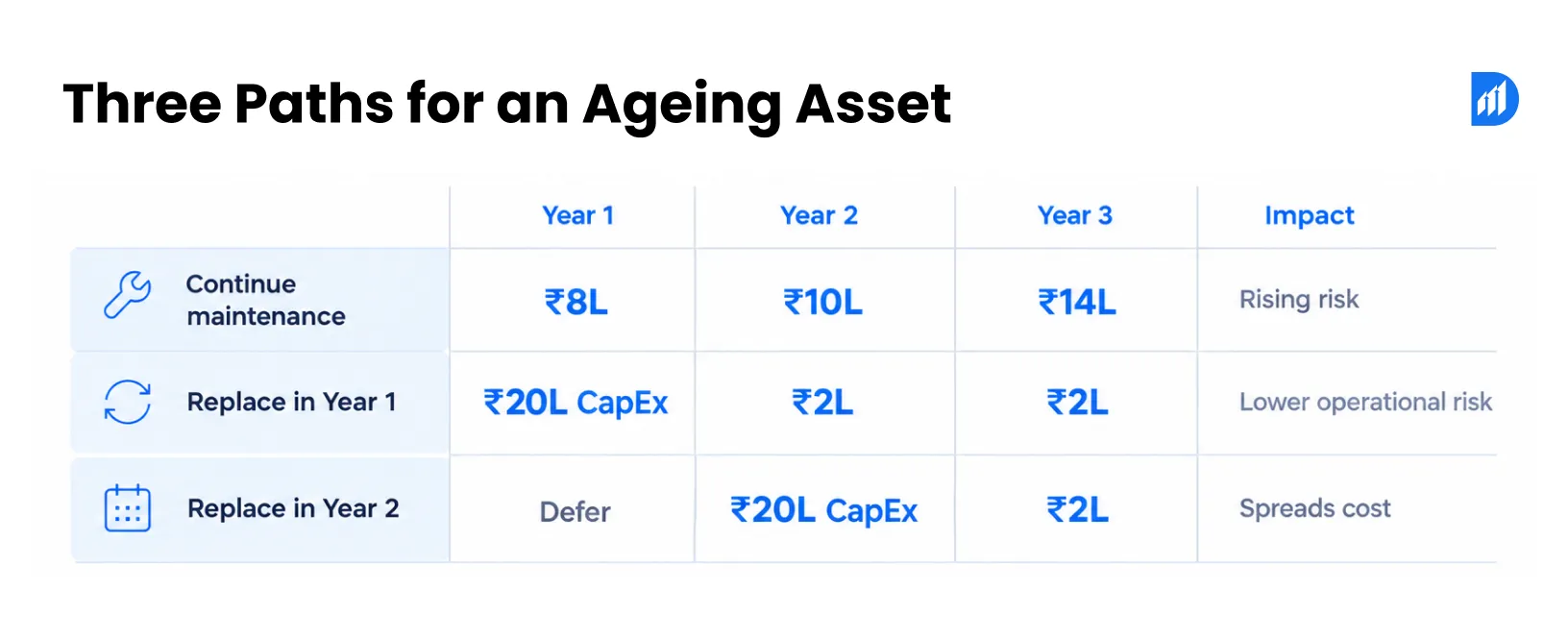 With proper asset data, Finance can:
- Build scenarios using real numbers
- Model cash flow impact of each option
- Project balance sheet under different paths
- Show maintenance cost trajectories
- Model depreciation impact of replacement timing
The Board sees consequences of each decision. Management chooses the optimal path. Capital strategy becomes data-backed.
ERP Integration — Keeping Asset Records and Financial Systems in Sync
An enterprise asset strategy usually works best when it complements the systems Finance already relies on.
ERP platforms are central to accounting and financial transactions. A dedicated asset management layer can add operational context, physical verification, lifecycle tracking and asset-specific intelligence around that financial core. The goal isn’t to replace what you have. It’s to connect it more intelligently.
SAP Asset Module vs Dedicated Asset Management Software
SAP provides Asset Accounting capabilities across asset master data, valuation, acquisition, retirement, depreciation and reporting. The documentation describes support for assets under construction, depreciation forecasting and parallel valuations.
So why would an organisation consider a dedicated asset management layer?
Because the CFO’s questions often go beyond what accounting software handles well.
An ERP might tell Finance: Acquisition value → Depreciation → Carrying value.
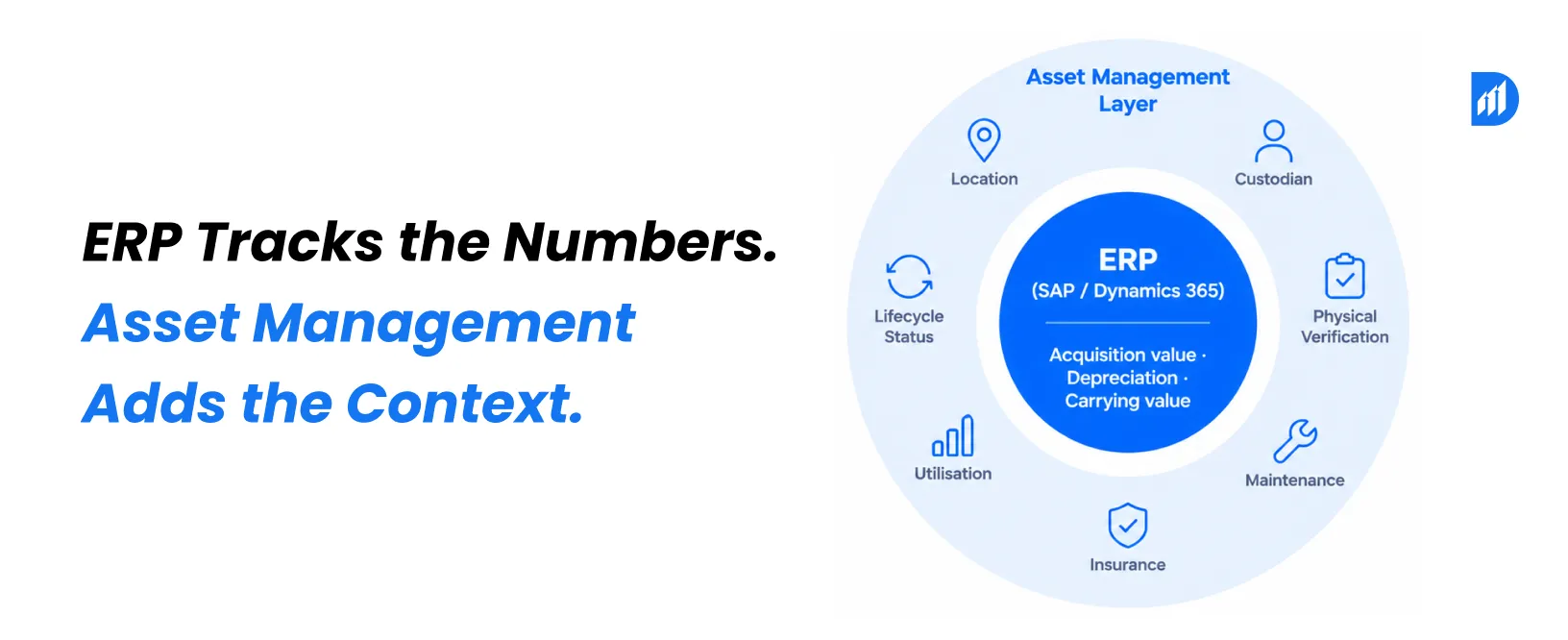
A broader asset management platform adds: Location → Custodian → Physical verification → Maintenance → Insurance → Utilisation → Lifecycle status.
The objective isn’t to replace SAP. It’s to connect operational asset information with the financial record. That’s especially valuable in large organisations where asset activity spans multiple departments, branches or systems.
Durapid positions its Fixed Asset Management Software as ERP integration-ready—designed to work alongside existing enterprise infrastructure rather than requiring a complete rip-and-replace.
Microsoft Dynamics 365 Integration — Native Azure Connector Patterns
Microsoft Dynamics 365 Finance already provides a Fixed Assets capability with depreciation profiles, books, journals, posting profiles and integration with the General Ledger and other modules.
For organisations using Dynamics 365, integration can focus on the information that needs to flow between the operational asset layer and the finance environment.
Depending on the architecture, organisations might use APIs, integration services, data pipelines or other Azure-based integration patterns. The important point: “native connector” shouldn’t be treated as a universal implementation claim.
The right integration design depends on the version of Dynamics 365, available interfaces, security requirements, data ownership and business processes. For Durapid, the positioning is ERP integration-ready—including the ability to fit into an organisation’s existing technology architecture.
The result is a connected flow between operational asset activity and financial records without unnecessarily replacing systems already in use.
Automated Depreciation Journal Posting – Eliminating Month-End Manual Entry
Depreciation becomes most useful when the calculation and accounting workflow stay connected.
The process flows like this: Asset transaction → Depreciation calculation → Validation → Journal preparation → ERP posting → Reconciliation.
Both Microsoft Dynamics 365 and SAP provide depreciation proposal and fixed asset journal posting capabilities. A connected asset management environment complements those by maintaining richer operational context around each asset.
The CFO benefit is straightforward. Instead of Finance spending time moving numbers manually between systems, the process can focus on exceptions, approvals and reconciliation. That improves process consistency while keeping Finance in control.
IFRS 16 and Ind AS 116 – Right-of-Use Asset Tracking and Lease Liability Amortisation
Lease accounting creates another important connection between physical assets and financial reporting. Under IFRS 16, lessees generally recognise a right-of-use asset and a lease liability for leases within the standard’s scope, subject to the requirements and exemptions.
Ind AS 116 follows a similar right-of-use model for lessee accounting.
For an organisation with a large property, vehicle, equipment or branch footprint, lease information becomes part of the broader asset and financial picture.
A software environment helps Finance maintain relevant information: the leased asset, lease term, commencement date, right-of-use asset, lease liability, depreciation information, and related changes and events.
The objective isn’t to turn an asset management system into a substitute for lease-accounting judgement. Instead, it creates better visibility around the asset-related data Finance needs. For CFOs managing a large portfolio, bringing those records into a connected environment makes lease-related planning and review more structured.
Physical Asset Verification – Reconciling Finance Records With What the Business Actually Owns
The credibility of an asset register ultimately depends on the relationship between digital records and physical reality.
Physical Audit Workflow – Barcode and QR Code Scanning Against the Asset Register
Physical verification doesn’t need to mean printing a 300-page spreadsheet and walking through a warehouse. A digital workflow allows authorised users to scan an asset QR code or barcode, verify the location and custodian, and record exceptions immediately.
What this makes possible:
- Scan asset QR/barcode
- System displays expected location, custodian, condition
- Verify or flag exceptions
- Real-time alerts for missing assets
- Continuous verification instead of annual counts
The outcome: Ghost assets are identified immediately, not discovered during annual audit. The balance sheet stays accurate. Verification is efficient and auditable.
Ghost Asset Write-Off Process — From Identification to Balance Sheet Removal
Finding a missing asset isn’t the end of the process. Finance needs a structured path: Identification → Investigation → Evidence → Approval → Write-Off → Register Update.
What this enables:
- Missing asset alerts trigger immediately
- Investigation workflow is documented
- Approval is recorded and auditable
- Write-off is justified and traceable
- Balance sheet is updated promptly
The outcome: Ghost assets are removed systematically. Audit findings decrease. Balance sheet accuracy improves.
Asset Impairment Testing — When to Trigger a Write-Down Mid-Cycle
Impairment is different from normal depreciation. Under IAS 36, impairment occurs where an asset’s carrying amount exceeds its recoverable amount.
An asset management system can surface situations worth investigating:
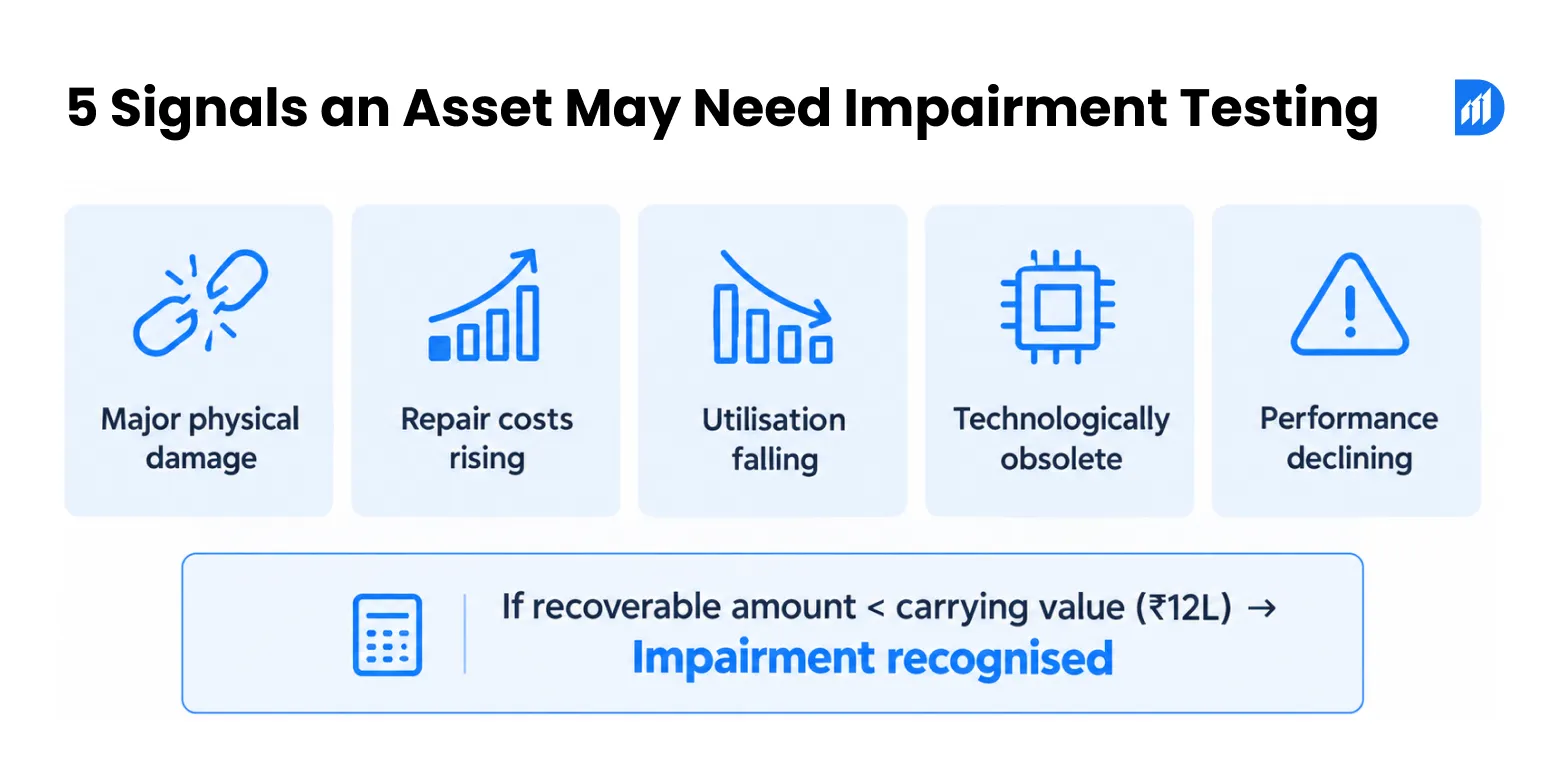
These aren’t automatic accounting conclusions. They’re signals for Finance to investigate. Impairment testing becomes data-driven instead of manual.
For example: Machine damaged mid-cycle. Repair cost ₹8L versus replacement ₹15L versus carrying value ₹12L. Finance analyses recovery value. If recovery is below carrying value, impairment is recognised.
The outcome: Impairment is detected early. The balance sheet reflects economic reality. Audit risk decreases.
AI-Powered Financial Intelligence for the CFO’s Asset Portfolio
This is where asset management becomes truly strategic. Earlier systems focused on recording. Modern systems help Finance interpret patterns and make better decisions.
Predictive Asset Replacement Forecasting – Building CapEx Budgets From Asset Health Data
Modern platforms can combine multiple signals simultaneously: Asset age, utilisation patterns, repair history, downtime frequency, maintenance cost trends, asset condition, and business criticality.
The outcome is an asset replacement risk forecast that actually helps.
Finance can forecast replacement risk 18–24 months ahead. Build CapEx budgets from asset data rather than guesswork. Identify replacement priorities. Model cash flow implications. Budget capital before crisis strikes.
For example: “Based on current condition data, this asset has 18–24 months of productive life remaining. Budget ₹4.2 crore for replacement in Q2 2025.”
The result: CapEx planning becomes proactive. Board visibility improves. Cash flow management tightens. Operational disruption risk drops.
[Related reading: AI in Financial Decision Making explores how AI transforms capital planning across the finance function.]
Utilisation Analytics – Identifying Underperforming Assets Before the Next Procurement Cycle
An asset can be available without being productive. That’s a critical question: How much capital is tied up in assets not generating expected returns?
Modern analytics surface:
- Underused assets
- Idle equipment
- Redundant capacity
- Capital trapped in non-productive assets
- Recommendations for redeployment or divestment
For example: “Asset ABC operates at 30% utilisation for two years. Redeploy to Division B, consolidate with similar equipment, or divest.”
The outcome: Capital efficiency improves. Procurement becomes smarter. Redeployment opportunities are identified before fresh spending.
Conversational AI Querying – Finance Questions Answered Without Running Reports
This is one of the most practical executive applications. A CFO should be able to ask a question in plain language rather than navigating multiple reports.
Sample questions that get instant answers:
- “Which assets have the highest repair cost this year?”
- “What’s my depreciation by business unit?”
- “Which high-value assets are due for insurance renewal?”
- “Which assets have not been physically verified?”
- “Which machines have recurring maintenance issues?”
The outcome: Finance moves from report-running to exception-driven decision-making. Answers arrive in seconds, not hours. Executive queries are answered instantly. Finance becomes more responsive. Decision-making speeds up.
Compliance and Governance – What the CFO Is Accountable For
Good governance gives Finance confidence in both the number and the evidence behind it. For asset management, that means bringing together accounting treatment, approvals, physical verification, access control and lifecycle documentation.
IFRS, Ind AS, and Companies Act Depreciation Schedule II Compliance
The applicable accounting framework determines how assets should be recognised, measured, depreciated, impaired, and disclosed.
Ind AS 16 addresses property, plant and equipment and depreciation requirements, including componentisation. Schedule II of the Companies Act, 2013 provides prescribed useful-life and depreciation-related requirements for applicable classes of assets. Tax depreciation follows the Income-tax Act and related rules—and may differ significantly from book depreciation.
What asset management enables:
- Configuration of applicable useful lives per Schedule II
- Component-level depreciation tracking (Ind AS 16)
- Separate book and tax calculations
- Audit trail documenting policy application
- Compliance reporting built into the system
The result: Compliance is embedded. Policy application is documented. Audits confirm adherence.
Audit Trail Depth – Every Asset Action Logged With Timestamp, User, and Reason
A proper asset audit trail shows the complete lifecycle of the record.
What gets logged:
- Who created the asset record, and when?
- Who changed it, and when, and why?
- Who transferred it, and was it authorised?
- Who approved the disposal?
- When was the asset physically verified?
- Which supporting documents were attached?
- Who approved the impairment, and on what basis?
- What was the approval decision?
What this enables: Auditors have complete visibility into every asset action. Evidence is linked to decision. Traceability is automatic. Investigations are structured and efficient.
The outcome: Audits close faster. Findings decrease. Governance is demonstrable and defensible.
Role-Based Access Control – Who Can Authorise Write-Offs, Disposals, and Revaluations
Visibility should never equal authority. The person who can view an asset shouldn’t automatically be able to change its financial status.
Role-based access separates responsibilities:
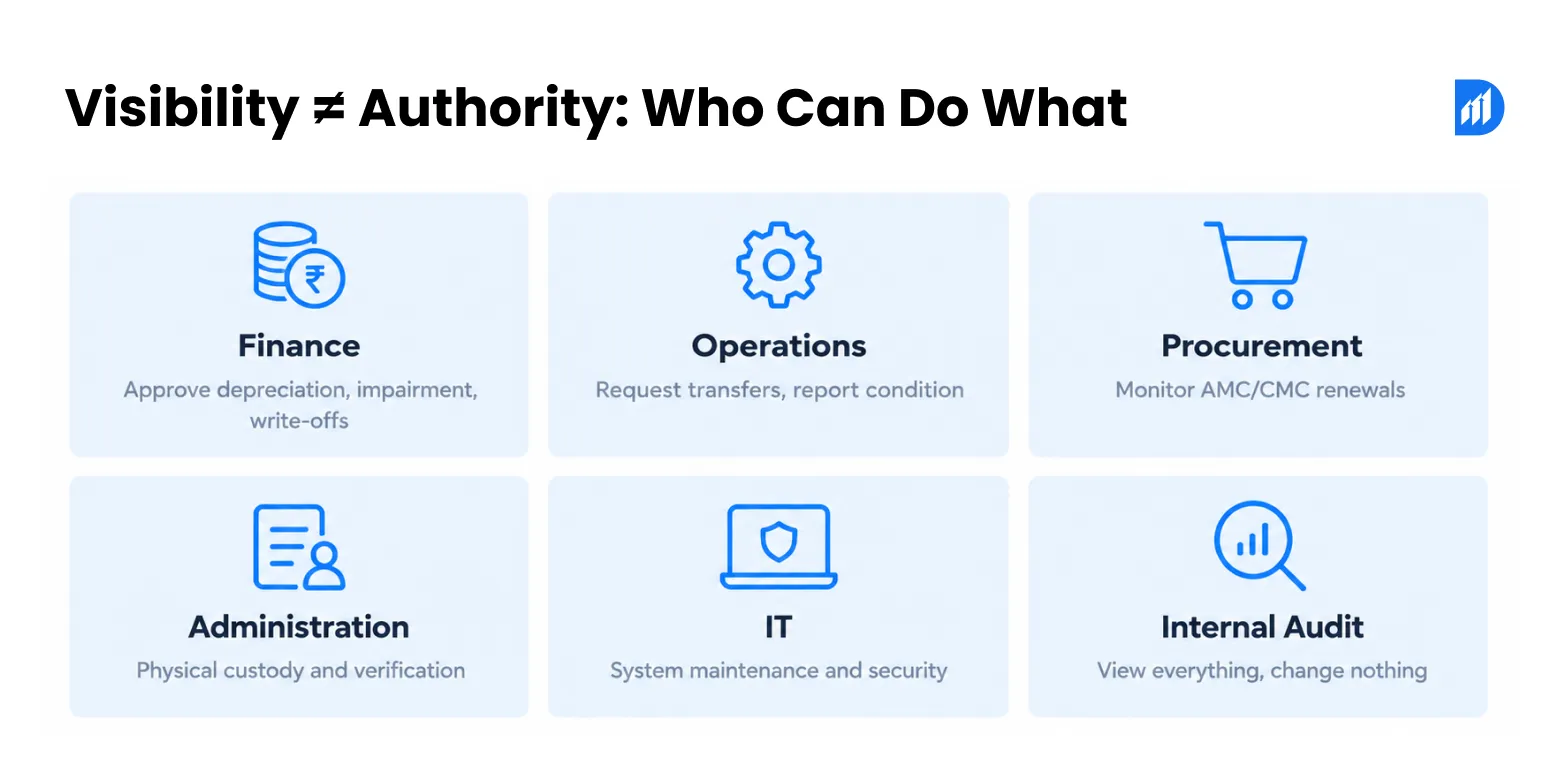
What this enables: Financial transactions require proper authorisation. No unauthorised changes. Governance is embedded in system design.
The outcome: Financial authority is matched to role. Changes are tracked and approved. Risk is controlled and demonstrable.
How Durapid’s Asset Management Software Addresses the CFO’s Requirements?
Durapid’s Enterprise Fixed Asset Management application is built on a straightforward reality: Enterprise assets don’t live inside a single department.
They move. They depreciate. They require servicing. They need insurance. They get transferred. They become idle. They are physically verified. And eventually, they are replaced or disposed of.
The platform brings all these lifecycle stages into a connected environment, from procurement through disposal.
| CFO Strategic Goal | Durapid Solution |
| Faster, more informed CapEx decisions | Real-time asset portfolio visibility + condition + utilization + replacement forecasting |
| Accurate financial reporting | Automated depreciation (SLM/WDV), component-level treatment, impairment detection |
| Audit confidence | Single asset record with complete audit trail + verification proof + approval documentation |
| Proactive capital planning | Asset lifecycle forecasting + replacement risk signals + multi-year CapEx visibility |
| Operational efficiency | Month-end close reduced by 60% + AI-powered querying + continuous verification |
| Board-level governance | Capital strategy reporting + asset efficiency metrics + compliance documentation |
Explore Fixed Asset Management Software to see how these capabilities come together in practice.
Durapid’s core capabilities include:
- Asset registration, tagging, and QR/barcode scanning
- Automated depreciation (SLM/WDV) with real-time journal posting
- AMC/CMC and insurance tracking with renewal alerts
- Repair and maintenance cost tracking with trend analysis
- Continuous physical verification with missing-asset alerts
- Lifecycle reporting and disposal workflows
- Executive analytics and KPI dashboards
- AI-powered conversational queries on asset data
- ERP integration-ready (SAP, Dynamics 365, NetSuite)
- Role-based access control and Microsoft Entra ID
- Audit trail logging and compliance documentation
The outcome: Finance goes from managing assets to strategising with assets. The CFO becomes the capital strategist, not the asset custodian.
Frequently Asked Questions
What depreciation methods does asset management software support?
Modern platforms support SLM (Straight-Line Method), WDV (Written-Down Value), and component-level treatment per Ind AS 16. Durapid’s platform auto-calculates both book and tax depreciation in parallel, giving Finance the flexibility to comply with financial reporting standards and tax requirements simultaneously. For an enterprise implementation, Finance should define applicable accounting policies, useful lives, residual values, component treatment, and tax requirements before configuration.
How does asset management software integrate with SAP or Dynamics 365 for depreciation posting?
Asset management software can connect asset events and depreciation workflows with ERP systems for journal preparation, posting and reconciliation. Durapid positions its platform as ERP integration-ready, while the exact SAP or Dynamics 365 integration architecture depends on the organisation’s existing systems and implementation requirements.
What is the difference between book depreciation and tax depreciation?
Book depreciation follows your financial reporting framework (Ind AS/IFRS). Tax depreciation follows the Income-tax Act (Section 32, WDV-based for specified assets). The same asset produces different depreciation values under each framework. Modern asset management platforms maintain one asset record while running both calculations in parallel, eliminating reconciliation headaches and ensuring compliance.
How does asset management software support CapEx planning and CIP tracking?
Asset management platforms provide broader visibility into existing assets—including age, condition, utilisation, and repair expenditure—enabling Finance to evaluate whether new capital is truly required or whether existing assets can be repaired, redeployed, or replaced. For CIP, the system connects project expenditure with the eventual asset record and capitalisation process. Fixed Asset Management Software provides CapEx visibility through asset lifecycle data and predictive replacement forecasting.
What is a ghost asset and how does it affect the balance sheet?
A ghost asset is an asset that remains recorded in the books but cannot be physically verified or is no longer held by the organisation. This creates inaccurate asset records and can continue depreciation or carrying-value effects that require investigation. Physical verification and reconciliation workflows identify such records and route them through the appropriate approval and write-off process. Continuous verification prevents ghost assets from accumulating.
How does AI improve CapEx forecasting and asset replacement planning?
AI analyses patterns across asset age, repair costs, utilisation, downtime, and maintenance history to identify assets requiring attention. This doesn’t automatically trigger replacement decisions; it provides Finance and management with a better evidence base for evaluating CapEx requirements. Durapid’s platform uses AI to forecast replacement risk and identify utilisation anomalies, supporting proactive capital planning and smarter procurement decisions. Learn more in our AI in Financial Decision Making guide.
What compliance standards does asset management software support in India?
Depending on the organisation and transaction, relevant frameworks may include Ind AS, Companies Act Schedule II, the Income-tax Act and Ind AS 116. Software can support configuration, calculation, workflow, documentation and audit trails, while Finance remains responsible for the appropriate accounting treatment and professional judgement.

Recent Blog

Asset Management Software for CFOs: From Depreciation to Capital Planning
September 29, 2026-
Why Voice AI Is Different From Chatbots in Recruitment?
September 17, 2026 -
LlamaIndex vs LangChain: Which One to Choose in 2026?
July 29, 2026