Enterprise AI Voice Agent: Capabilities, Architecture & Evaluation Guide
Imagine you call a company and skip the usual “Press 1 for sales, press 2 for support, press 3 for billing,” routine. Instead, you just say what you need – “I want to reschedule my appointment” or “My loan application is still pending” or something like
“I saw a property online and wanted to know if it’s still available.”
And the system understands what you said, asks the right follow-up question, and checks the relevant business system. And accordingly, it either completes the task or connects you with the right employee.
Ever thought of such a solution?
Well, that’s exactly where an AI voice agent comes in. It gives another level upgrade to the traditional IVR.
It’s no longer limited to scripted replies. Today, it can understand what a customer means, keep track of the conversation, pull out relevant information from enterprise systems, trigger workflows, and respond in real time.
And that’s not it, there’s a lot more happening behind the scenes- from speech recognition and language models to intent detection, context management, text-to-speech, workflow orchestration, and APIs. All these technologies work together to make the interaction feel smooth and well, less like you’re talking to a machine.
But here’s the catch: there’s a big difference between a voice bot that looks great in a product demo and one that an enterprise can actually trust with thousands of real customer conversations.
For instance, enterprises operating across multiple regions need a voice agent that’s able to handle everything right from language diversity and regional accents to sensitive data, high call volumes, legacy systems, and security requirements.
And when things get too complex or sensitive, it should be smart enough to know when it’s time to hand the conversation over to a human.
What Is an Enterprise-Ready AI Voice Agent?
An enterprise-ready AI voice agent is a conversational AI that can talk to customers, employees, prospects, and other stakeholders.
But here’s the real upgrade: it can also safely connect with the systems and workflows a business already uses, so it not only understands the requests but also takes action and gets things done.
A basic voice bot answers a handful of predefined questions. An enterprise voice agent can:
- Understand natural spoken language
- Identify what the caller is trying to accomplish
- Remember relevant information during a conversation
- Ask follow-up questions
- Retrieve information from enterprise systems
- Trigger business processes
- Work across multiple languages
- Recognise when it is uncertain
- Transfer conversations to human employees
- Maintain an audit trail
- Operate at enterprise scale
An organization doesn’t only need an AI that can ‘talk’. But an AI that understands what’s happening, makes the right call within its limits, takes action, and knows when to stop.
That’s why choosing an AI voice agent isn’t just about picking a customer-service tool. It’s a tech decision that should fit into the way the organisation works.
1. Why Enterprises Need More Than Traditional IVR Systems
Traditional IVRs have been around for decades and still get the job done when it comes to simple call routing. But things start to get tricky when organisations try to use these old-school systems for more complex customer journeys.
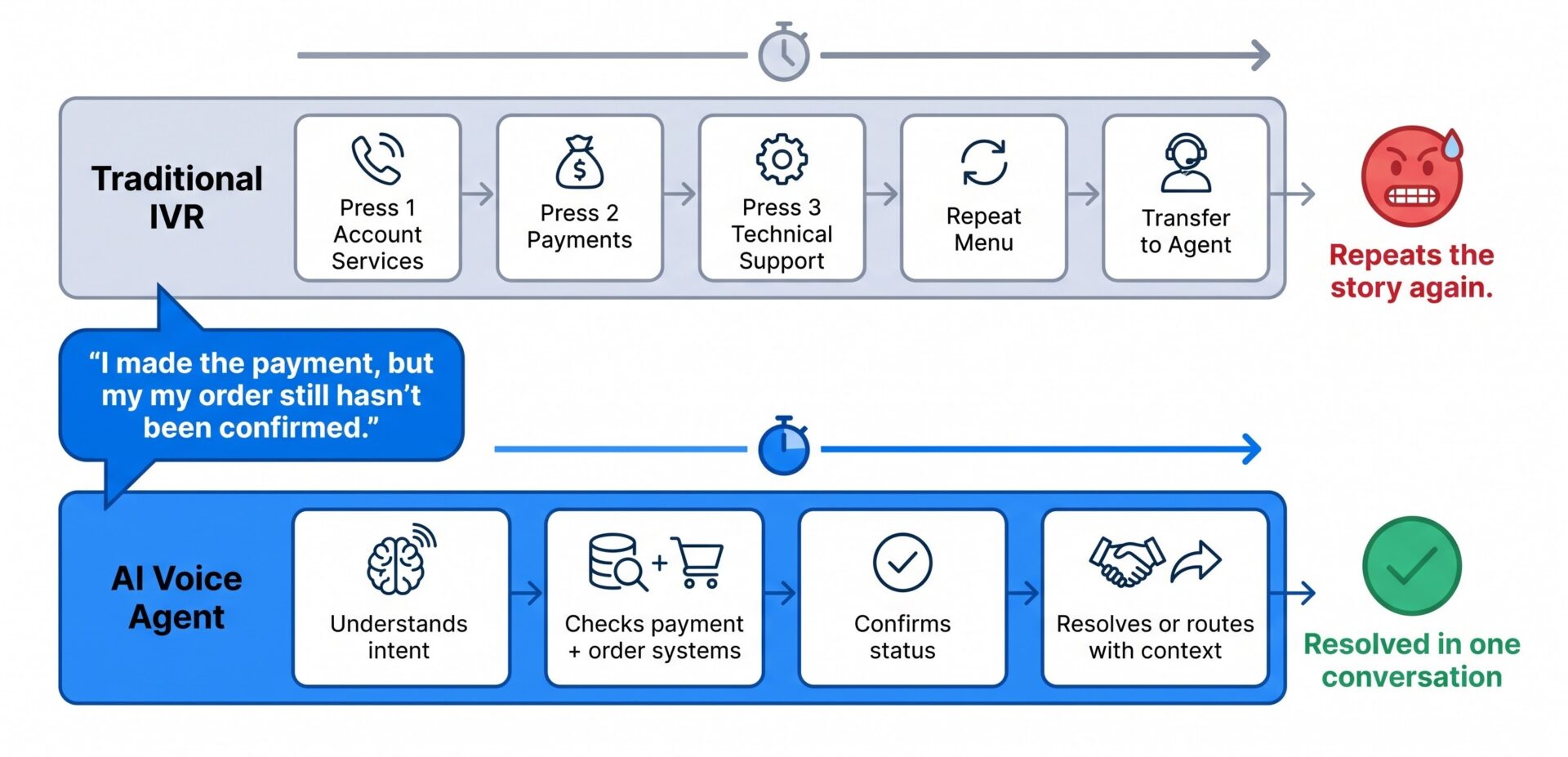
A typical IVR expects customers to follow the company’s structure:
“Press 1 for account services.”
“Press 2 for payments.”
“Press 3 for technical support.”
But customers do not necessarily think in those categories.
A customer may say:
“I made the payment, but my order still hasn’t been confirmed.”
Sounds simple, right?
But that one sentence could involve payments, order processing, customer support, and even fraud checks behind the scenes.
Here’s what an AI voice agent would do- it can understand the customer’s actual need rather than forcing them through a predefined menu.
Modern voice AI lets customers just talk naturally instead of dealing with rigid menus and endless “Press 1, Press 2” moments.
This becomes especially valuable in multilingual markets, where customers may communicate in different languages, accents, dialects, or even switch between languages during the same conversation. A caller might start in English, switch to Hindi or Spanish while explaining an issue, or use a regional expression without giving it a second thought.
So, for enterprises serving customers across different globes, this flexibility can make the whole experience more accessible, natural, and way less frustrating.
But the objective is not necessarily to eliminate IVR completely.
Instead, organisations can use AI-powered conversations when customers need more than basic menu options. Basically, less menu-hopping and more “just tell me what you need.”
2. Core Capabilities of an Enterprise-Ready AI Voice Agent
Not all AI voice agents are built to handle the real deal, especially when you take them into an enterprise environment. So, instead of getting caught up in vendor names, it makes more sense to look at what the AI can actually do.
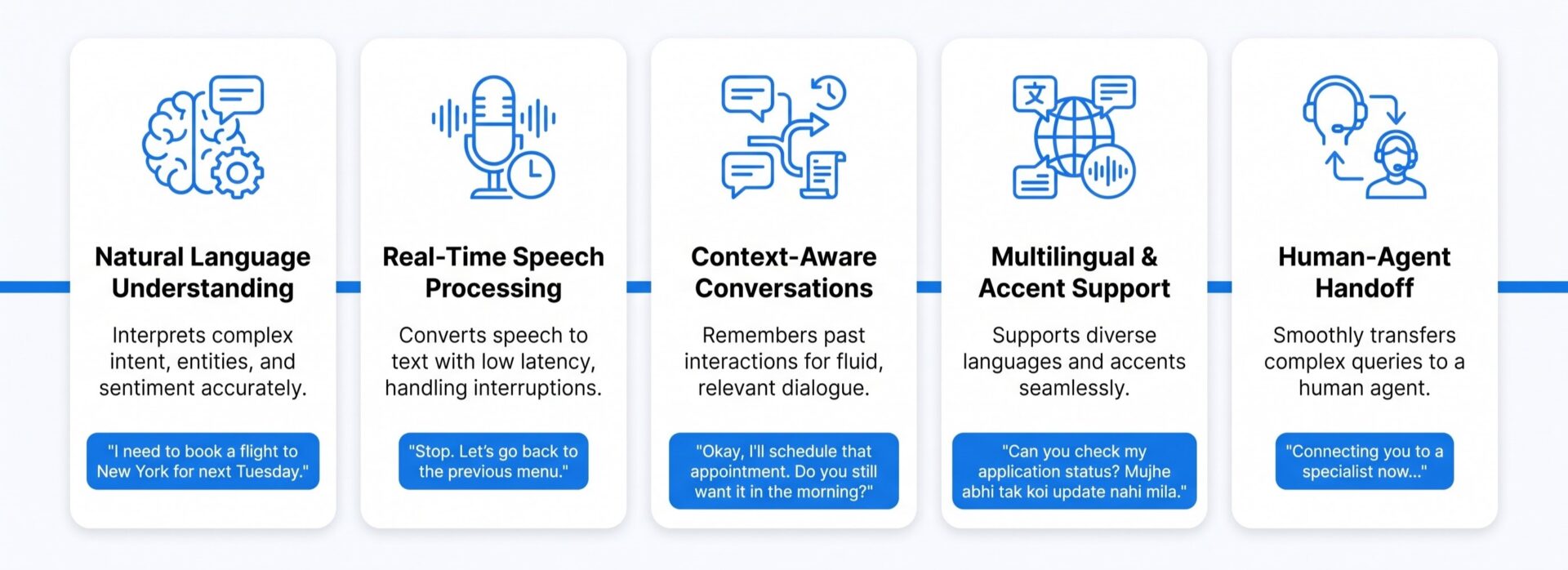
Natural Language Understanding
Let’s start with the basics: can the AI actually understand people?
Customers rarely stick to a perfect script. They’ll say things in their own way, use casual language, change their sentence halfway through, or simply explain what they need.
For example, instead of saying:
“Request appointment cancellation.”
A customer says:
“I won’t be able to come tomorrow. Can you cancel my appointment?”
Although both mean the same thing, the wording is completely different.
Thus, a good AI voice agent must get the context, understand the intent, and respond accordingly. It should not make the customer repeat themselves or go through a whole menu maze.
If the agent has the ability of natural language understanding, it can pick up on different ways people speak, casual phrases, unclear requests, and the actual intent behind their words.
However, the agent should first be tested with real customer conversations and different scenarios, rather than just perfectly polished examples shown in a vendor demo.
Real-Time Speech Processing
Would you talk to an AI that takes time to reply after every sentence?
No! Because that awkward pause can quickly make the conversation feel robotic and frustrating.
This is where latency matters. AI voice agents must listen, understand, respond, and handle interruptions quickly. This makes the conversation feel smooth, not like a bunch of disconnected commands.
Moreover, modern voice AI is shifting more towards speech to speech processing to cut down on response delays. Lower latency means faster replies, smoother turn-taking and ultimately, a conversation that feels much more natural overall.
Context-Aware Conversations
Imagine giving a voice agent your name, booking reference, and issue — then being asked for all three again two minutes later.
Customer: “I want to change my flight.” Agent: “Which flight would you like to change?” Customer: “The London to Paris one tomorrow evening.” The agent should resolve “the London to Paris one” against what is already on the table.
Multilingual, Accent, and Dialect Support
In a globally connected world, customers may naturally switch between languages depending on the situation.
A customer might begin a conversation in English, switch to another language while explaining the problem, or use a regional expression without even thinking about it.
For example:
Customer: “Can you check my application status? Mujhe abhi tak koi update nahi mila.”
Ideally, an enterprise AI voice agent should understand the meaning of the complete conversation instead of treating the language switch as a problem.
This matters because language is not just about translation. It is also about understanding how people actually speak.
A caller can have a regional accent, speak quickly, use local expressions, or mix English with their native language. The AI needs to handle all of this without constantly asking, “Could you please repeat that?”
So, when evaluating voice AI, don’t just ask:
“Does it support Hindi?”
Ask:
“How accurately does it understand our customers speaking Hindi?”
That’s the real test.
Human-Agent Handoff
Here’s something that businesses generally get wrong: the best AI voice agent isn’t necessarily the one that has to handle every single conversation.
Sometimes, a human is simply the better option.
Suppose a customer is extremely frustrated, the issue is sensitive, and the AI is unsure about what the customer needs, or a decision requires human approval. In such cases, the agent should know when to step back.
And the handoff should not feel like starting the whole conversation from zero.
So, in an ideal scenario, the human employee should receive the customer’s details, the reason for the call, important information already collected, and a short conversation summary.
That way, the customer doesn’t have to repeat the same story all over again.
AI handles the routine. Humans handle the moments that need human judgement.
That’s the sweet spot.
3. AI Voice Agent Architecture: How Enterprise Voice AI Works
A customer may simply hear a voice on the other end of the call, but there’s a lot happening behind the scenes.
A typical AI voice agent architecture can look something like this:
Caller → Speech Recognition → AI/NLP → Intent & Context → Business Logic → APIs → Response Generation → Voice Output
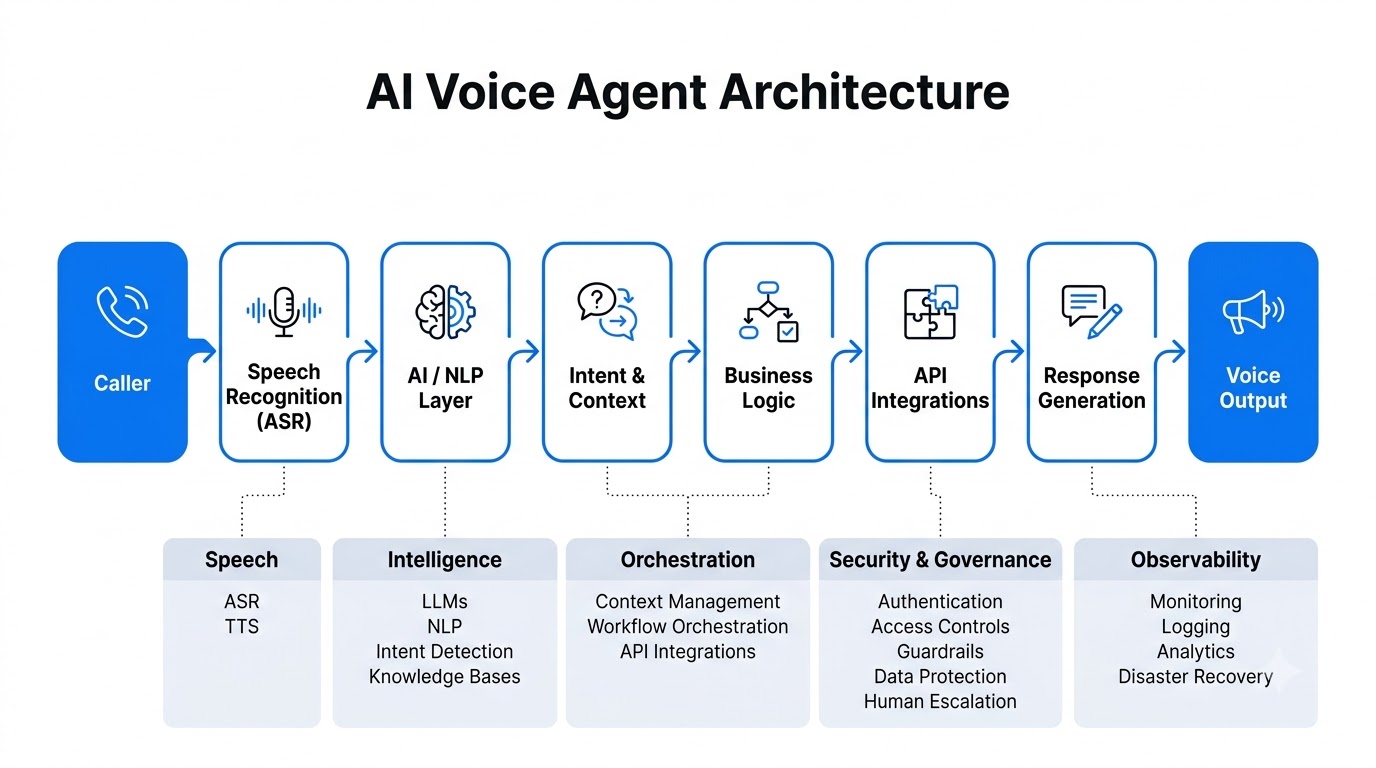
First, speech recognition processes what the caller says. The AI and language layer then works out what the caller actually means.
The context layer remembers what’s going on in the conversation, while the business logic figures out what to do next.
For example, if a customer asks, “Where’s my order?”, the AI agent can use an API to quickly check the order status. If they say, “Can I reschedule my appointment?”, the workflow layer connects to the company’s scheduling system and gets it done.
The response is then generated and delivered back to the customer through speech.
A more advanced enterprise setup can also include:
- Automatic Speech Recognition (ASR)
- Large Language Models (LLMs)
- Natural Language Processing (NLP)
- Intent detection
- Context management
- Text-to-Speech (TTS)
- Workflow orchestration
- API integrations
- Authentication
- Access controls
- Monitoring
- Logging
- Analytics
- Knowledge bases
- Guardrails
- Human escalation
- Data protection
- Disaster recovery
This is where a simple voice bot starts becoming a proper enterprise platform.
But how does that work?
4. From Conversation to Action: Integrating AI Voice Agents With Business Systems
The real value of an AI voice agent comes from what it can do after understanding a customer’s request. Once the agent connects with CRM, ERP, databases, and other business systems, it can turn a conversation into an actual action.
Let’s take real estate as an example.
A potential buyer says:
“I’m looking for a three-bedroom apartment in central London for under £800,000.”
As part of response, an AI voice agent for real estate would ask some follow-up questions, collect the buyer’s preferences, check available properties, update the CRM, and even schedule a site visit.
Pretty useful, right?
But there’s a catch: the voice agent can’t do all of this on its own. It needs access to the right business systems and APIs to pull out information and perform actions.
These integrations could include:
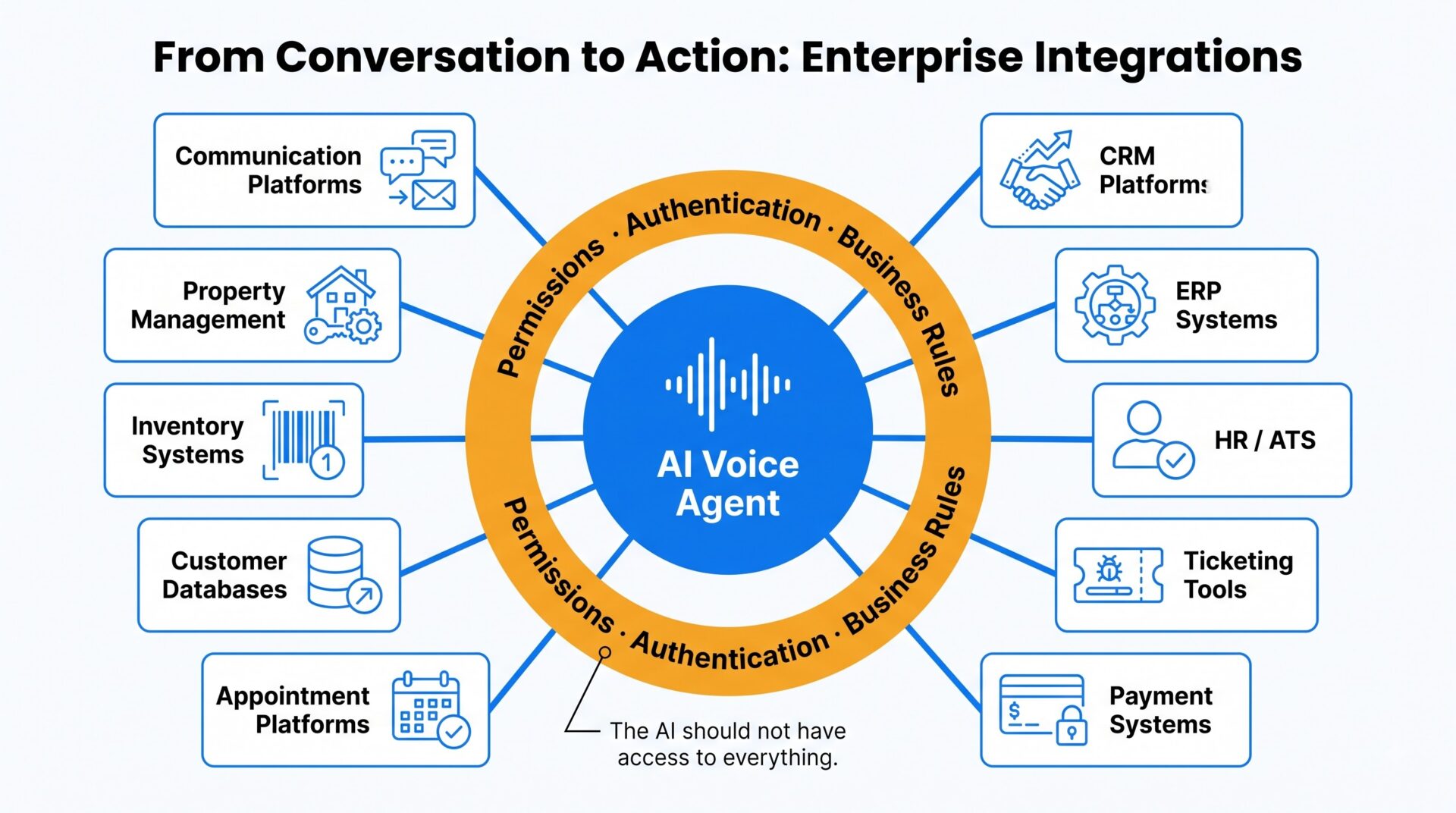
- CRM platforms
- ERP systems
- HR systems
- Ticketing tools
- Payment systems
- Appointment platforms
- Customer databases
- Inventory systems
- Property management systems
- Communication platforms
The same concept works for recruitment too. An AI voice agent HR recruitment workflow can connect with an applicant tracking system to collect candidate details and manage important recruitment tasks. From scheduling interviews and updating candidate status to sending follow-up notifications, it can take a lot of the repetitive stuff off the HR team’s plate.
But here’s the deal: the AI shouldn’t get access to everything.
APIs, permissions, authentication, and business rules should clearly define what the agent can access and which actions it is allowed to perform.
5. Security, Privacy and Compliance Requirements for Enterprise Voice AI
Voice conversations can contain a lot of sensitive information.
A single customer call could include a name, phone number, address, account information, financial details, health information, employment information, or even authentication details.
So, when it comes to an AI voice agent, security becomes a core requirement for the organisation.
Businesses should definitely look at a few key areas such as:
Data Encryption
Any voice data, transcripts, or other sensitive information should be protected even if it is being transmitted or is stored.
Access Control
Only authorised employees, applications, and services should have the access to recordings, transcripts, customer information, and connected business systems.
Data Retention
Organisations should decide how long recordings and transcripts need to be stored and when they should be deleted.
Auditability
Businesses need a clear digital trail of what happened during a conversation, especially when the AI accessed customer data or took an action.
Secure Integrations
An AI voice agent connects with CRMs, ERPs, payment systems, healthcare platforms, and more. Thus, these connections need strong authentication, limited permissions, and secure APIs so one weak link doesn’t become a bigger problem.
Vendor Risk
The AI provider matters too. Businesses should know how their provider handles customer data, where it is stored, how models process it, which third parties can access it, and what happens if there’s a security incident.
In short, security shouldn’t be something the business thinks about after the voice agent goes live. It needs to be part of the architecture from the beginning.
6. Global Data Protection and Regulatory Considerations for AI Voice Agents
For organisations operating across different regions, data protection is a key part of the AI conversation. Voice interactions may involve sensitive information, which makes privacy and regulatory compliance an important part of the implementation process.
Data protection requirements vary as per the location, industry, customers, and the type of information that is being processed. Based on the use case and jurisdiction, firms may need to consider regulations
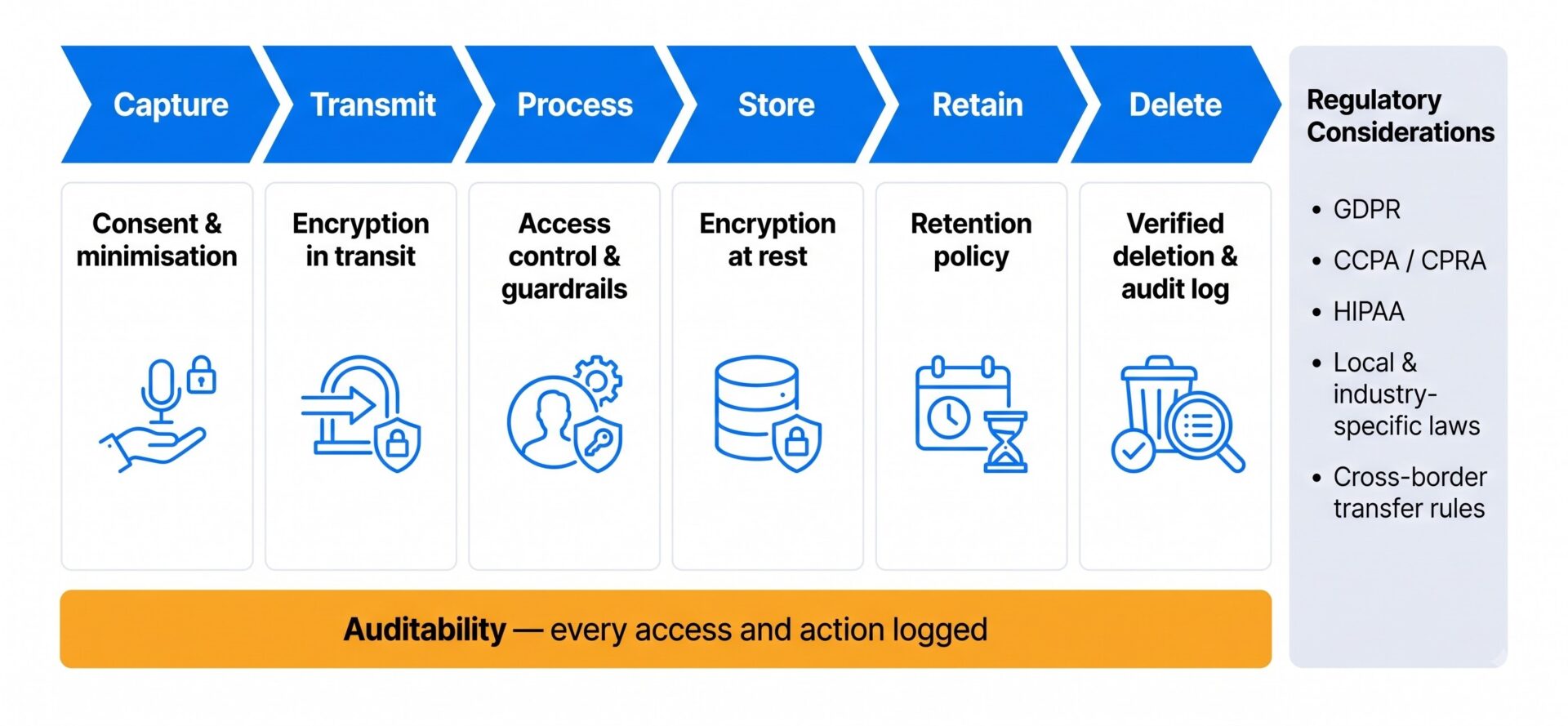
Depending on where the organisation operates and what data it handles, different privacy laws may apply. These may include GDPR, CCPA/CPRA, HIPAA, and other local or industry-specific privacy laws.
So, for businesses deploying an AI voice agent, they must consider privacy across the entire interaction.
Organisations should ask:
- What personal information does the agent collect?
- Why does it need that information?
- Is all of it necessary for the task?
- Where are recordings and transcripts stored?
- Who can access them?
- How long are they retained?
- Are cross-border data transfers involved?
- Which third-party providers process the data?
- How are applicable data-related requests handled?
The important thing to remember is that regulatory compliance isn’t simply a checkbox on a vendor comparison sheet. The organisation’s own use case, data flows, architecture, contracts, and responsibilities matter.
So, technology, security, privacy, and legal teams should work together before an enterprise voice solution goes live.
7. Scalability and Performance: Handling Enterprise-Scale Voice Interactions
A voice agent that works perfectly for 100 calls a day may behave very differently when it suddenly receives 20,000 calls.
Enterprise demand can change quickly.
A bank may see more calls around payment deadlines. A retailer may experience a huge spike during a major sale. A healthcare provider may receive a sudden wave of appointment requests.
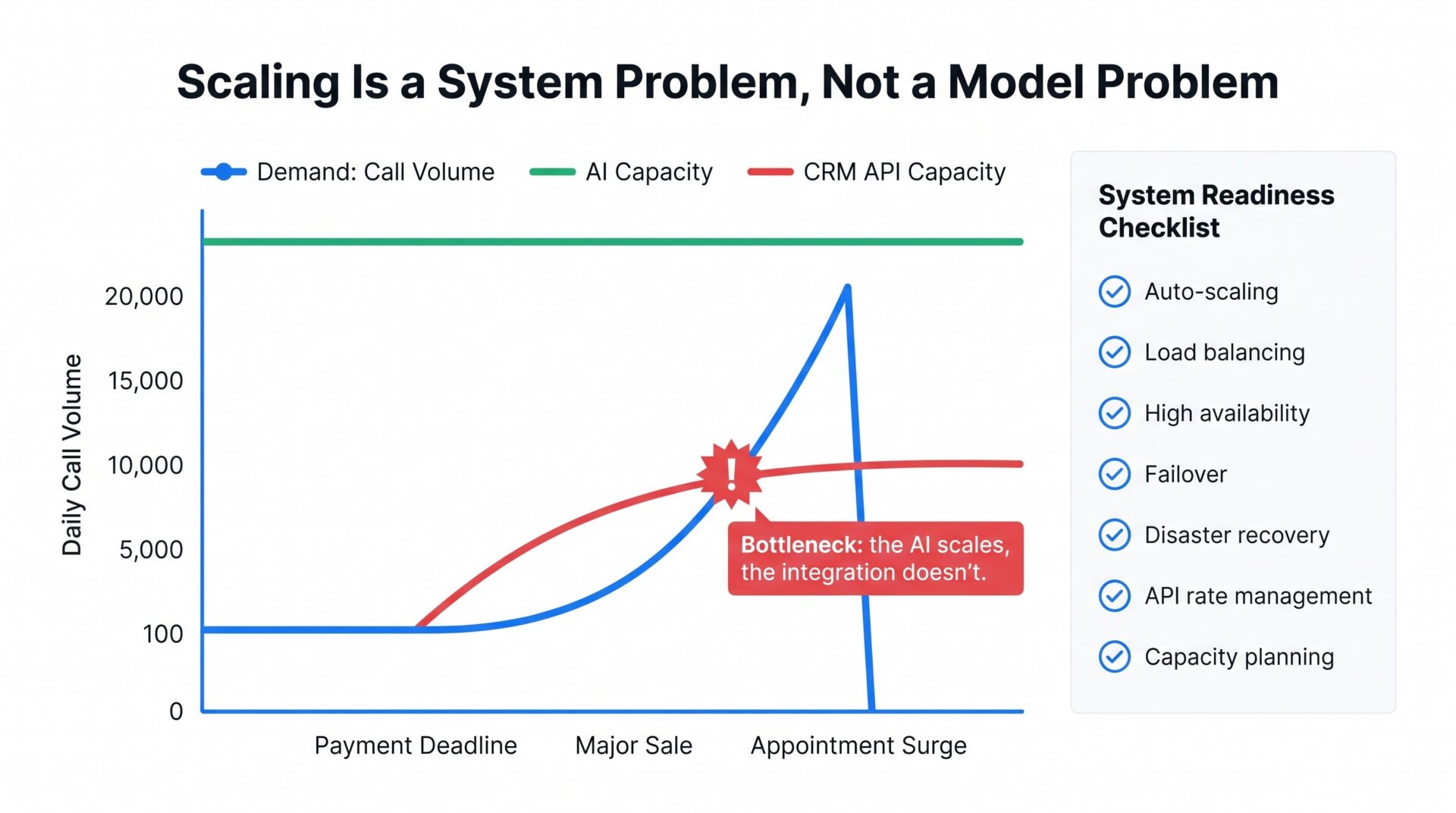
An enterprise AI voice agent therefore needs an architecture that can handle:
- High concurrent call volumes
- Auto-scaling
- Load balancing
- High availability
- Failover
- Monitoring
- Disaster recovery
- API rate management
- Capacity planning
But there’s another thing businesses need to consider.
Even if the AI itself can handle thousands of conversations, what happens if the CRM API slows down? What if the appointment system goes offline?
That’s why businesses need to think about scalability across the whole system, not just the AI model.
8. Accuracy, Latency and Reliability: Key Voice AI Performance Metrics
An AI voice agent can sound super human, but that doesn’t always mean it’s doing a great job.
So, businesses need clear metrics to see what’s working, what’s not, and whether the AI is actually doing its job.
Some important metrics include:
Speech Recognition Accuracy
How accurately does the system understand what customers say?
Intent Accuracy
Does it correctly identify what the customer wants?
Response Latency
How quickly does the agent respond after the customer finishes speaking?
Task Completion Rate
How many eligible requests does the AI successfully complete?
Escalation Rate
How often does the agent transfer a conversation to a human?
Containment Rate
How many suitable interactions are resolved without human involvement?
Error and Fallback Rate
How often does the AI misunderstand the customer or fail to complete the task?
Customer Satisfaction
Most importantly, do customers actually find the experience useful?
These metrics should be considered together.
For example, a very high containment rate might look great on paper. But if customers are struggling to reach a human when they actually need one, that number doesn’t tell the whole story.
The real motive should be successful resolution, not automation just for the sake of automation.
9. AI Voice Agents for Global Languages, Accents and Regional Communication
Undoubtedly, the linguistic diversity is a major plus for voice AI, but it also has its own set of challenges.
For example, a system may work perfectly with standard English during a controlled demo and then struggle when it deals with regional accents, background noise, fast speech, code-switching, local expressions, or poor telephone audio.
That’s why organizations should test AI voice agents with real conversations from the people they plan to serve. The system should be tested across the languages, accents, dialects, and communication styles that their customers actually use.
For example, a customer-support system serving the United States may need very different testing from one serving customers across the United Kingdom, or Australia.
Similarly, a global organisation serving customers across Spain, Mexico, and Argentina may need to test how well the AI understands different regional variations of Spanish.
So, instead of asking:
“Does the AI support Spanish?”
ask:
“How perfectly does it understand our customers when they speak Spanish?”
That’s the real test.
10. Enterprise Use Cases for AI Voice Agents
The strongest business cases for voice AI usually involve repetitive, high-volume workflows where speed and availability matter.
Customer Support
Customer support is one of the most obvious use cases.
An AI voice agent can handle routine questions, order updates, account enquiries, appointment changes, service requests, and basic troubleshooting.
Customers get quicker replies, while human support teams can spend more time on complex issues that actually need their attention.
Lead Qualification
Sales teams can spend a lot of time calling leads that aren’t really ready to buy.
An AI voice sales agent can
- make initial calls,
- ask qualification questions,
- understand requirements, and
- identify high-intent prospects.
Those leads can then be passed to human sales representatives.
The result? Sales teams spend less time on repetitive calls and more time on opportunities that are actually worth pursuing.
Appointment Scheduling
Voice AI can also handle appointment-related tasks such as:
- Booking appointments
- Confirming appointments
- Rescheduling appointments
- Cancelling appointments
- Sending reminders
- Answering basic appointment questions
This can be useful for hospitals, clinics, restaurants, salons, financial services, and professional services.
In healthcare specifically, an AI Voice Agent in Healthcare can handle routine appointment requests and updates, which helps reduce the administrative workload while allowing staff to focus on more complex patient needs.
Sales Follow-Ups
Sales representatives don’t always have the time to follow up with every prospect.
An AI voice agent can
- handle routine follow-ups,
- check whether a prospect is still interested,
- collect responses, and
- schedule the next conversation.
That allows sales teams to focus on prospects where human involvement can actually make a difference.
Customer Verification
Voice workflows can support certain customer verification processes when combined with suitable authentication and security controls.
However, voice should not automatically be treated as sufficient authentication for every high-risk transaction. The required level of verification should depend on the business process and its risk.
Property Enquiry Management
Someone looking for a property usually has a few things in mind: budget, location, property type, and timing. An AI voice agent can
- ask the right questions,
- understand what the buyer or tenant wants,
- answer basic property-related queries, and
- book a site visit.
It can then push the details to the CRM, giving sales teams a clear picture of which leads are worth following up on.
Order and Delivery Updates
E-commerce and retail businesses deal with plenty of “Where’s my order?” calls. But why make customers wait for an agent to connect?
Voice AI can check the order system and share a quick update on the delivery status. It can also help with simple returns, cancellations, and common post-purchase questions. That means fewer repetitive calls for support teams and faster answers for customers.
Claim and Application Updates
Banks and insurance companies generally get repeated calls asking about application or claim status.
Voice AI can check the status, collect basic details, answer common questions, and connect the customer with the right team when things get more complicated.
Candidate Screening and Interview Scheduling
Recruiters have plenty on their plate, and repetitive candidate calls can eat up a lot of their time.
An AI voice agent can collect basic candidate details, ask a few screening questions, check availability, schedule interviews, send reminders, and share application updates. This frees recruiters up to focus on finding and evaluating the right candidates.
Reservation and Booking Management
From hotel rooms to restaurant tables, booking-related calls can pile up quickly, especially during busy hours.
A voice agent can take care of routine reservations, confirm bookings, handle changes or cancellations, and answer basic questions. Customers get a quick response, while staff focuses on guests and other tasks instead of picking up every call.
Payment and Collection Calls
Businesses can use voice automation for payment reminders, due-date notifications, and collection-related calls.
Because these conversations may involve financial information and sensitive customer situations, they require strong security and governance.
So, the bigger idea is simple: the voice agent shouldn’t sit separately as just another calling tool. It should become part of the larger business workflow.
11. Human-in-the-Loop: When Should an AI Voice Agent Escalate to Humans?
There’s a common misconception that a successful AI deployment is one where the AI handles 100% of conversations.
That’s not necessarily the goal.
Some situations simply need a human.
An enterprise AI voice agent should consider escalating when:
- The customer asks to speak with a human
- The AI cannot confidently understand the request
- The issue involves a complex exception
- The customer is highly frustrated
- The conversation involves sensitive circumstances
- A high-risk decision is required
- The request falls outside the AI’s permissions
- Human approval is required
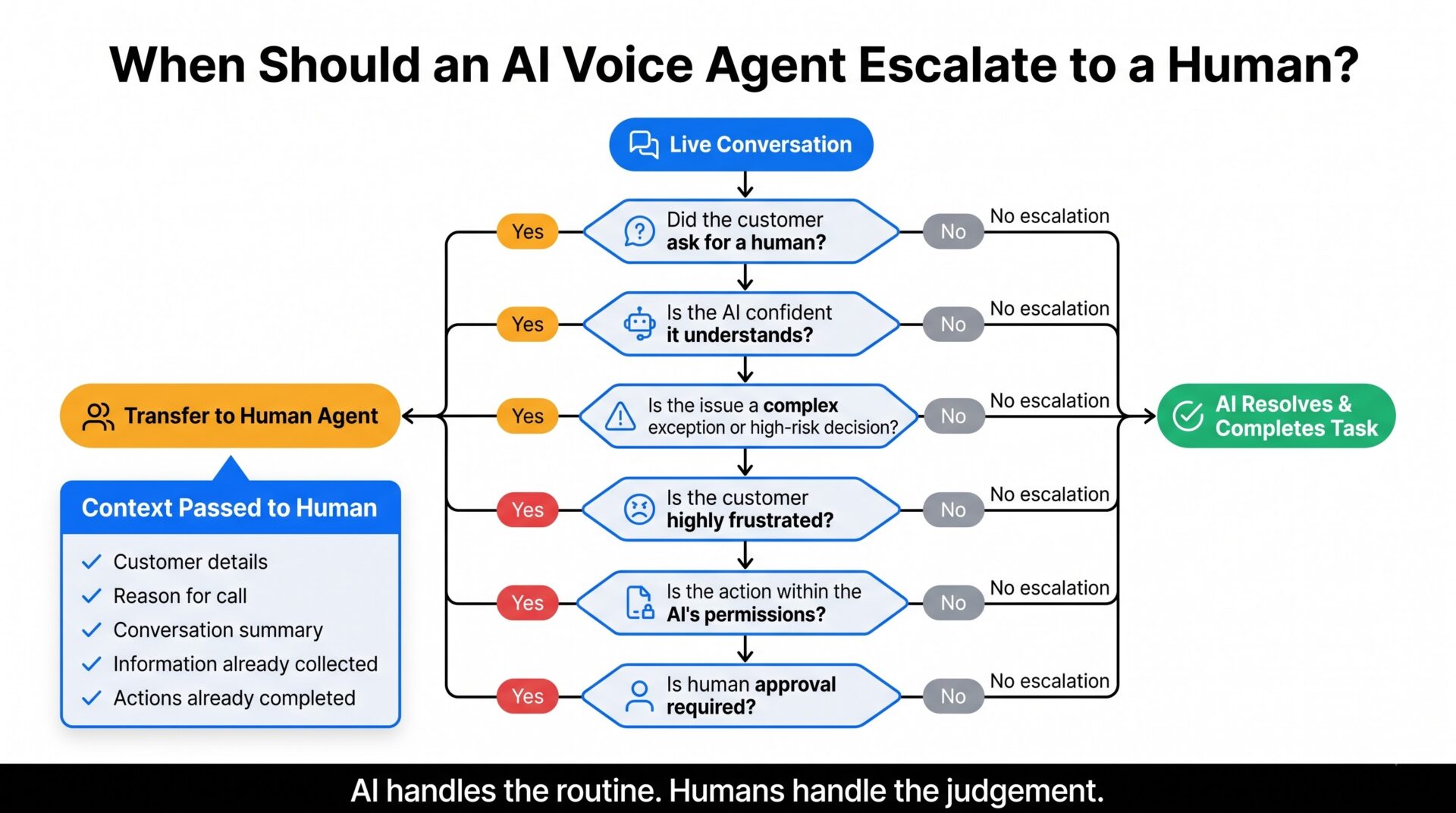
The handoff should also preserve context.
The employee should ideally receive the customer details, reason for the call, conversation summary, information already collected, and actions already completed.
That way, the customer doesn’t have to explain everything again.
AI handles the routine. Humans step in when human judgement matters.
12. How to Measure AI Voice Agent ROI for Your Enterprise
The ROI of an AI voice agent should always be connected to a real business problem.
Suppose a company receives thousands of routine calls every month. If the agent can successfully resolve a meaningful share of eligible interactions, the organisation could reduce pressure on its contact centre while also offering support outside regular working hours.
But cost savings are only one part of the picture.
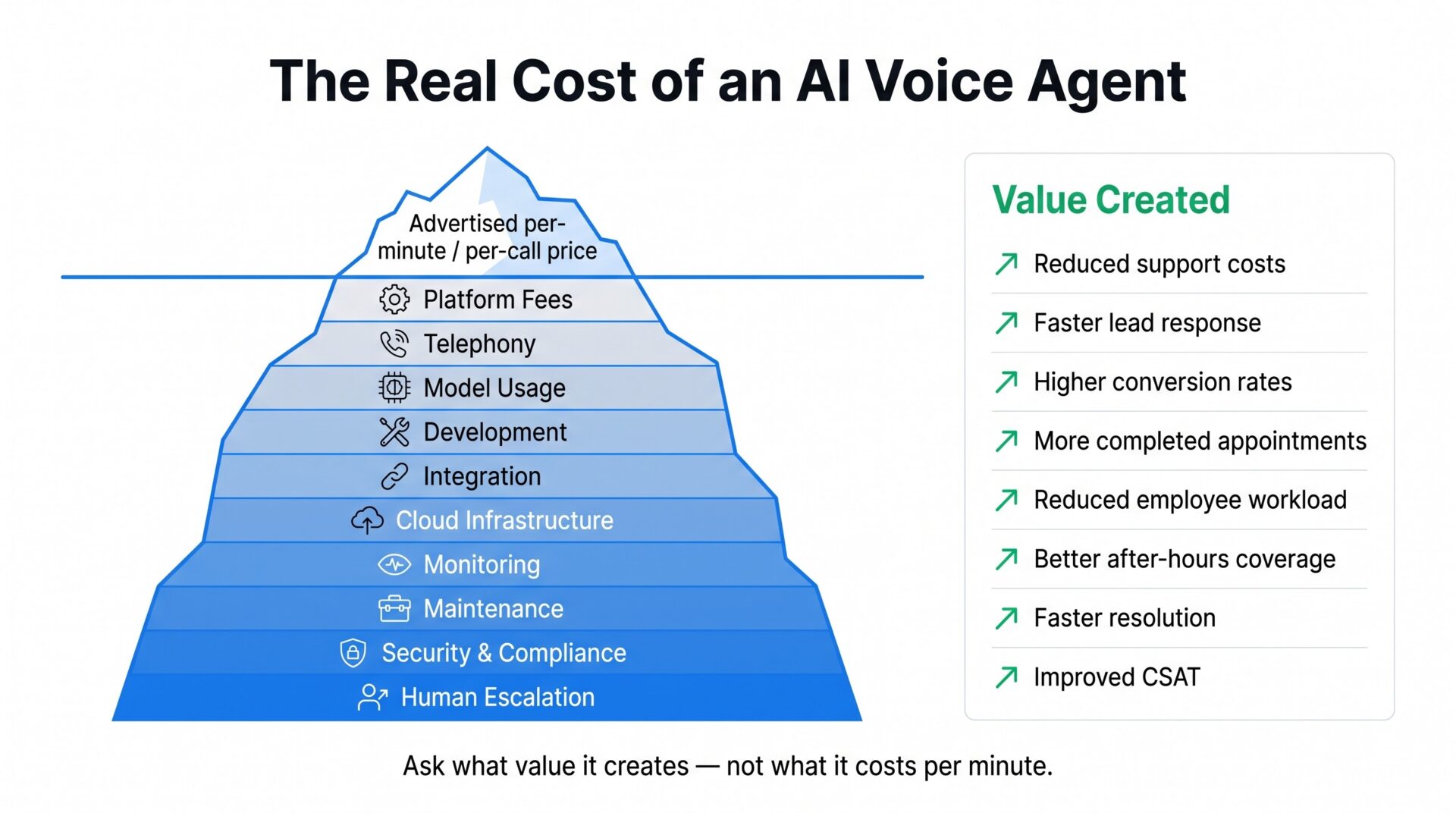
Businesses can also look at:
- Reduced support costs
- Faster lead response
- Higher conversion rates
- More completed appointments
- Reduced employee workload
- Better after-hours coverage
- Faster customer resolution
- Improved customer satisfaction
When comparing AI voice agent pricing, businesses should also look beyond the advertised per-minute or per-call cost.
The total cost may include platform fees, telephony, model usage, development, integration, cloud infrastructure, monitoring, maintenance, security, and human escalation.
So instead of asking only:
“How much does an AI voice agent cost?”
a better question is:
“What business value will this AI voice agent create compared with its total cost?”
That gives decision-makers a much clearer view of ROI.
13. Enterprise AI Voice Agent vs Traditional IVR: Key Differences
Here’s a quick side-by-side look at how enterprise AI powered voice agents compare with traditional IVR systems.
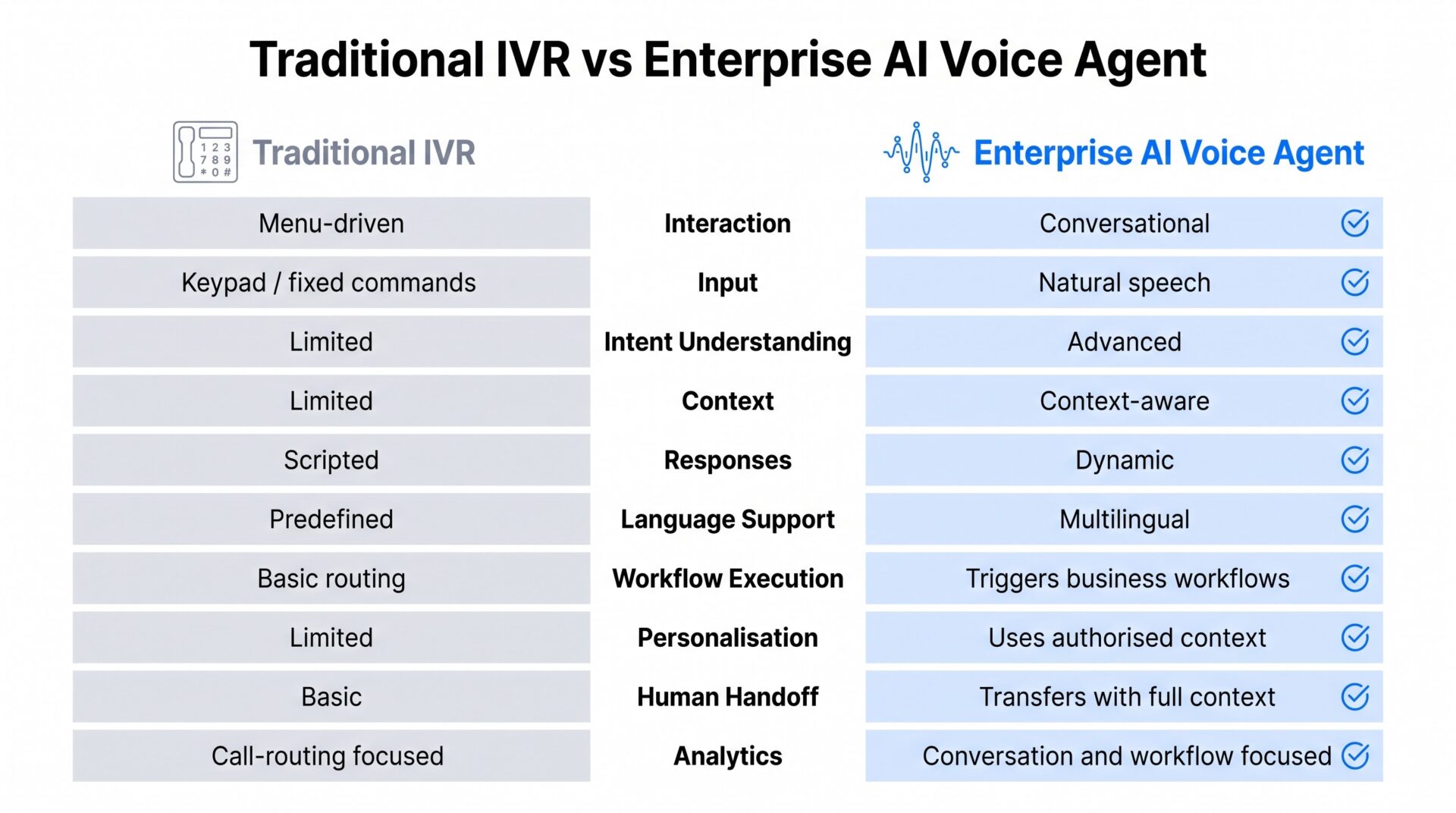
This doesn’t mean traditional IVR is useless.
For simple call routing, it can still be practical, predictable, and cost-effective.
The advantage of an enterprise AI voice agent becomes clearer when customers need to explain something in their own words, access information, or complete a business task.
In many cases, the smartest approach may be IVR where it works and conversational AI where it adds real value.
14. How to Evaluate an AI Voice Agent Before Enterprise Deployment
Vendor demos show ideal conditions. Real customers interrupt, change their minds, switch languages, ask unexpected questions, and get frustrated.
- Test real conversations, not vendor scripts
- Test the languages, accents and code-switching your customers actually use
- Measure latency
- Test interruptions
- Test edge cases — unclear speech, incomplete information, contradictory requests, angry callers
- Test integrations against CRM, ERP, ticketing, payment and appointment systems
- Evaluate security — authentication, encryption, access control, storage, logging, retention, vendor practices
- Test human escalation with context preserved
- Review analytics
- Calculate total cost, not per-minute price
15. Enterprise AI Voice Agent Implementation Roadmap for Organisations
Trying to automate everything on day one might sound ambitious, but it usually isn’t the best move.
A better strategy is to start with one valuable use case, learn from real conversations, improve the system, and then scale it gradually.
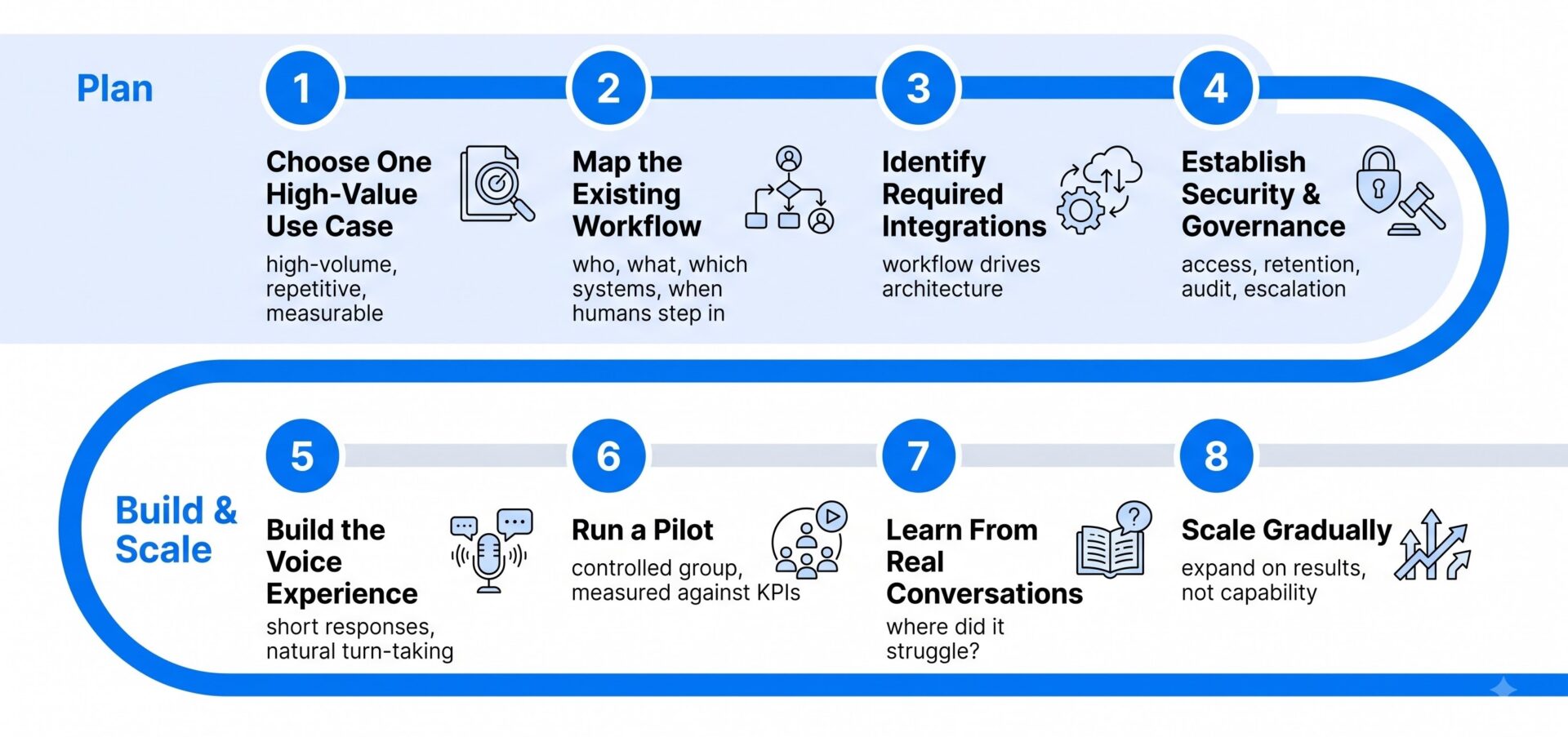
Step 1: Choose One High-Value Use Case
Start with a workflow that is high-volume, repetitive, measurable, and suitable for voice.
Appointment scheduling, lead qualification, order tracking, and routine customer support can all be good starting points.
Step 2: Map the Existing Workflow
Understand what happens today.
Who receives the call? What information do they collect? Which systems do they check? What decisions do they make? When does a human step in?
This helps define exactly where the AI should fit.
Step 3: Identify Required Integrations
List every system the AI needs to access.
The business workflow should drive the architecture instead of building the AI first and worrying about integrations later.
Step 4: Establish Security and Governance
Define data access, permissions, retention, monitoring, escalation, privacy, and audit requirements before production deployment.
Step 5: Build the Voice Experience
Don’t simply take a written chatbot script and make it speak.
Voice interactions need shorter responses, natural turn-taking, clear questions, interruption handling, and an easy path to human support.
Step 6: Run a Pilot
Start with a controlled workflow, customer group, or location.
Then measure the results against predefined KPIs.
Step 7: Learn From Real Conversations
Look at where the AI struggled.
Did it misunderstand the customer? Did it give an incomplete response? Did the customer ask for a human? Did an integration fail?
These conversations can provide valuable insights for improving the system.
Step 8: Scale Gradually
Once the system performs reliably, expand the deployment based on actual results rather than simply scaling because the technology allows it.
16. The Future of Enterprise Voice AI
The future of AI voice agents isn’t just about making AI voices sound more human.
The bigger shift is from conversation to action.
Customers don’t really care which AI model is powering the system. They care whether they can say:
“Book my appointment for Friday.”
and actually get the appointment booked.
Or:
“Check my refund status.”
and receive a useful answer.
Or:
“I’m looking for a three-bedroom apartment.”
and get the right next step.
That’s where enterprise voice AI is heading.
Voice systems are becoming more closely connected with business workflows, APIs, knowledge bases, CRMs, and other enterprise applications.
For global organisations, multilingual communication will be a major part of this shift. Future voice systems will need to understand not only different languages but also the way people actually communicate- regional accents, mixed-language sentences, informal expressions, and quick switching between languages.
At the same time, governance will become even more important. As voice agents gain access to more enterprise systems, organisations will need clear answers to questions such as:
What can the AI see?
What can it change?
What decisions can it make?
When does a human need to approve the action?
That is the real difference between a voice bot and an AI agent.
A voice agent is not simply a voice interface. It can become an intelligent entry point into an organisation’s business processes.
17. Building an Enterprise-Ready AI Voice Agent With the Right Development Partner
By now, one thing should be clear: building an enterprise AI voice agent is not simply about connecting a speech API to an LLM and calling it a day.
The real challenge is making all the moving parts work together.
The voice experience needs to connect with the AI model, business logic, CRM, APIs, security controls, analytics, and human handoff process. More importantly, all of these pieces need to fit the organisation’s actual workflows.
That’s where custom AI development can make a real difference.
With AI Agent Development Services, Durapid helps organisations move from an AI idea or proof of concept toward a more complete enterprise solution, including agent development, integrations, workflows, and deployment.
The goal isn’t to add AI simply because AI is trending. It’s to build something that solves a real business problem and creates measurable value.
Conclusion: Building a Reliable and Enterprise-Ready AI Voice Agent
An enterprise-ready voice AI needs to get customers right, keep the conversation on track, respond fast, handle different languages and accents, securely plug into business systems, manage high call volumes, keep personal data safe, and know when it’s time to hand things off to a human.
The right implementation starts with the business problem, not the tech hype.
Organisations should first spot where voice interactions are repetitive, high-volume, time-sensitive, and easy to automate. From there, they can map out the right integrations, security checks, performance goals, human handoffs, and compliance rules needed to make the solution production-ready and actually work IRL.
The most successful AI voice agents won’t necessarily be the ones trying to replace humans completely.
They’ll be the ones that handle routine conversations efficiently, give employees better context, and bring humans into the conversation exactly when human judgement matters.
That’s what makes an AI voice agent truly enterprise-ready. Not just the ability to speak, but the ability to understand, act responsibly, integrate securely, scale reliably, and deliver a real business outcome.
For organisations exploring conversational AI beyond voice, Durapid’s guide on What Is an AI Chatbot provides a broader look at conversational AI and its business applications.
The future isn’t just AI that talks.
It’s AI that gets things done.

Recent Blog

Asset Management Software for CFOs: From Depreciation to Capital Planning
September 29, 2026-
Why Voice AI Is Different From Chatbots in Recruitment?
September 17, 2026