Azure AI for U.S. Hospitals: An Implementation Guide
In 2023, 38% of physicians told the American Medical Association they used AI in their practice. In the AMA’s 2026 physician survey, that number was 81%. With four in five physicians already using it, the question for a hospital is no longer whether AI shows up. It’s whether healthcare AI can be made reliable, safe and genuinely useful inside a clinical workflow, with real patient records, under HIPAA.
Sit in on any hospital leadership meeting about AI and you’ll hear the tension. A physician wants to keep the AI scribe that drafted her notes during a trial. The IT director wants to know where the audio recordings ended up. The CFO likes the idea of a readmission model, and the hospitalists want to know who validated it, and on which patients. Everyone in that room has a point. A tool that looks excellent in a vendor demo meets a very different environment on day one: fragmented records, a decade-old interface engine, and clinicians with no spare minutes to supervise software.
That gap is what this guide is about. Microsoft Azure gives hospitals most of the raw material: AI models, cloud infrastructure, healthcare data services, identity and security controls, and development tools. It does not give them a working clinical application. Someone still has to design the integrations, decide what data the model may see, test its output against real cases, train staff and keep watching after go-live.
At Durapid Technologies, that is the work we do. We treat AI development, data engineering, cloud modernization and integration as one engineering problem rather than four separate projects. What follows is how we would advise a U.S. hospital to approach Azure AI heading into 2027: which use cases are worth starting with, what HIPAA compliance actually requires on Azure, where EHR integration tends to go wrong, and what the real costs look like.
Planning an AI initiative for your hospital?
Durapid’s AI consulting services start with an assessment of your use cases, infrastructure, integration requirements and governance needs, before anyone writes code.
Key takeaways
- Azure supplies the foundation, not the finished solution. Secure implementation, EHR integration, validation and ongoing governance are still the hospital’s job.
- The opportunities span clinical and administrative work: documentation, predictive analytics, imaging, billing, patient engagement and hospital operations.
- HIPAA-eligible does not mean HIPAA-compliant. Verify your Business Associate Agreement, service configuration, data flows and organizational safeguards yourself.
- Start with one measurable use case. A tightly scoped pilot tells you more than a sprawling AI program with no clear owner.
- Implementation experience matters. You need engineers who understand AI, Azure, healthcare data and the reality of working around existing clinical systems.
Contents
- Why hospital AI projects stall before they start
- What Azure AI is, and why U.S. hospitals keep choosing Microsoft
- How is AI used in healthcare? Six hospital use cases
- The Azure AI tools hospitals are working with heading into 2027
- HIPAA compliance on Azure: what to verify before go-live
- EHR integration with Epic and Oracle Health (Cerner)
- A seven-step implementation plan
- Costs and ROI
- Common adoption problems and how to fix them
- Frequently asked questions
- Conclusion
1. Why hospital AI projects stall before they start
There’s no shortage of problems for AI to work on. Physicians finish their notes at home after a full clinic day. Billing teams chase claims through payer portals. Patient data sits in systems that were never built to talk to each other, and IT is asked to improve efficiency without touching anything patient care depends on.
So the ideas come easily. The trouble shows up later, and it is rarely the algorithm.
Take an assistant that summarizes a patient’s history before a visit. On a clean sample record, it does well. Then it meets a real patient: six encounters across two health systems, a medication list that contradicts itself, and an outside discharge summary that arrived as a scanned PDF. Now the assistant needs reliable access to the right data, a way to flag what it couldn’t see, and a way for the clinician to check its claims against the chart. Without those, you have a capable model producing summaries nobody is willing to sign off on.
The hard part is turning an AI demo into a clinical workflow someone is accountable for. Most of the risk can be retired by answering four questions at the very start:
- Who will use this, and at what point in their day?
- Which decision does it support, and which decisions is it kept away from?
- Where does each piece of data come from, and who owns its quality?
- When the output is wrong, who notices, and who is responsible?
A team that can answer those in writing is far less likely to be redesigning the project six months in.
2. What Azure AI is, and why U.S. hospitals keep choosing Microsoft
A set of building blocks, not a product
Azure AI is a loose label for the artificial intelligence Microsoft offers through Azure: AI models, development platforms and supporting cloud services. For a hospital, the useful pieces fall into a few groups:
- Language models for documentation assistants and conversational tools
- Machine learning for prediction and healthcare analytics
- Speech recognition and workflow automation
- Services for storing, processing and exchanging healthcare data
- Tooling to deploy, monitor and govern AI applications
Nobody buys Azure AI and switches it on. A working solution combines several of these services with what the hospital already runs: its EHR, identity system, data infrastructure and operational applications.
Why not just use a general-purpose chatbot?
A consumer chatbot can write a passable medical summary. That is a long way from being allowed to read a patient’s full history or write into the EHR.
What Azure adds is control around the model. Identity and access management, private networking, deployment options and monitoring let a hospital decide exactly what an AI application can see and do. A simple example is an internal assistant that answers staff questions only from approved clinical policies, and cites the policy it used. It still needs accuracy testing and permission controls, and it still has to be kept from drifting into clinical recommendations. But it runs on the hospital’s rules rather than as an open-ended chatbot.
Why Microsoft, specifically
Familiarity is a large part of it. Many U.S. health systems already run Microsoft for identity, collaboration, analytics and cloud hosting, so building AI in the same ecosystem removes a layer of integration and governance decisions. Microsoft also brings mature enterprise identity tooling, developer tools, healthcare interoperability services and an established cloud compliance program.
Familiarity alone is a weak reason to choose a platform, though. Each model and service still has to be checked for availability, architectural fit, security requirements, commercial terms and suitability for the task in front of you.
HIPAA-eligible is not the same as HIPAA-compliant
Microsoft offers a HIPAA Business Associate Agreement that covers in-scope Azure services. That makes those services eligible for use with protected health information (PHI). It does not make the application you build compliant, and a covered service can still be configured badly. Before any PHI flows, confirm which services and features are involved, what the contract covers and which security controls are in place. Section 5 goes through this in detail.
3. How is AI used in healthcare? Six hospital use cases
The right starting point depends on two things: which operational problem hurts most, and how much clinical risk the hospital is willing to take on in its first project. AI in healthcare splits into a handful of subcategories, from clinical documentation and decision support to operations, billing and patient engagement. These six cover most of what U.S. hospitals are evaluating today.
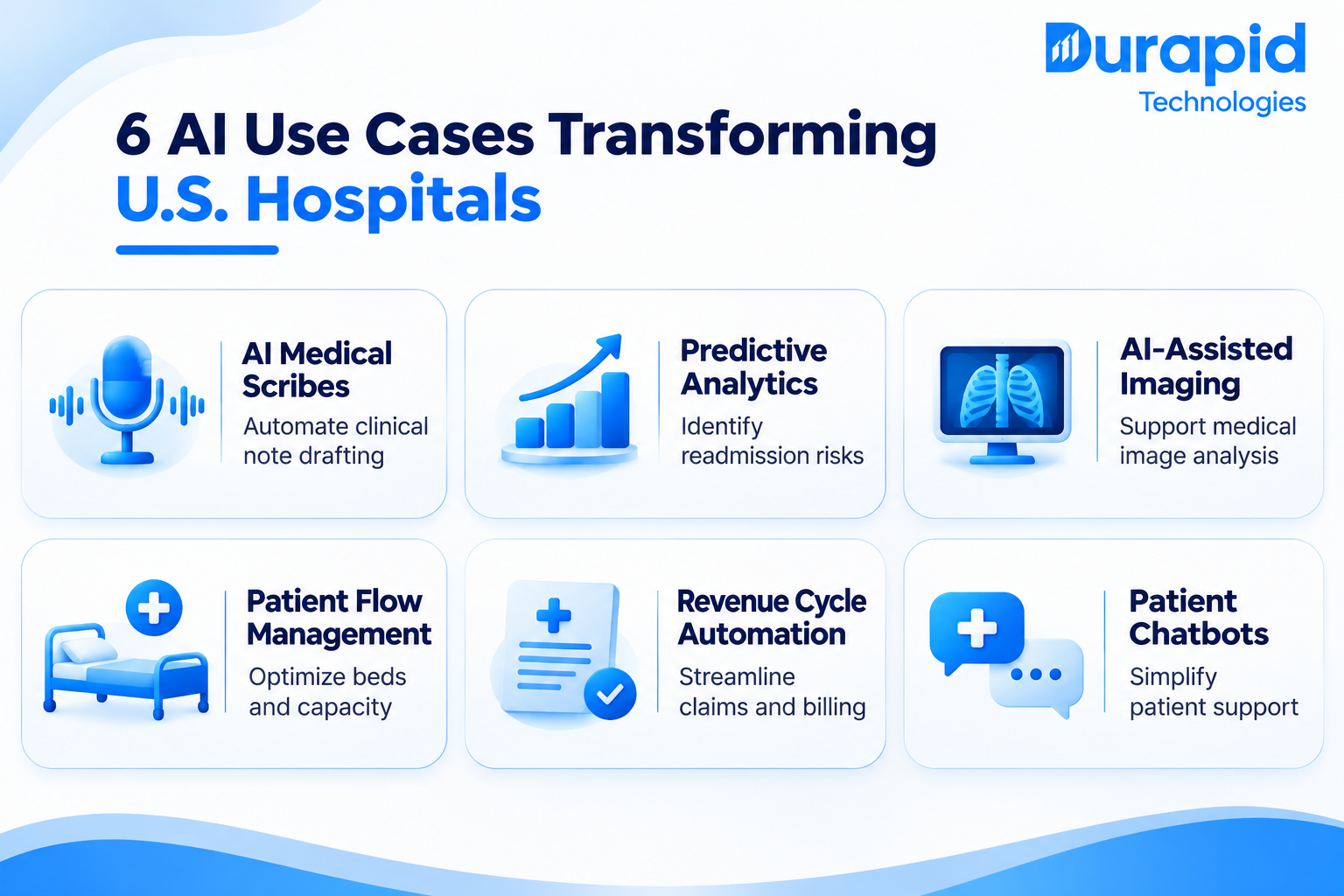
1. AI medical scribes
Documentation is usually the first thing physicians ask about, and for good reason. An AI medical scribe captures an authorized patient conversation, transcribes it, pulls out the clinically relevant details and drafts a structured note for the physician to review.
In a custom build, the workflow usually runs like this:
- Record the consultation, with the patient notified and the required permissions in place.
- Convert speech to text.
- Generate a draft clinical note.
- Show the draft to the clinician for review and correction.
- File the approved note through an authorized EHR workflow.
Azure Speech and Azure OpenAI models can handle steps two and three. The harder engineering is everywhere else. Drug names get misheard. Two voices get attributed to the wrong speaker. A beeping monitor in the exam room degrades the audio. The physician is responsible for every word that reaches the chart, so the review step can’t become a formality.
In a pilot, measure how long physicians spend editing drafts, how many factual errors they catch, how satisfied they are and whether note quality holds up. The number of notes generated tells you very little.
2. Predictive analytics in healthcare: outcomes and readmissions
Predictive analytics in healthcare uses historical and current data to estimate how likely something is to happen. The classic hospital example is flagging patients who need extra discharge planning or follow-up to avoid readmission. Inputs typically include prior admissions, diagnoses, medications, lab results and care history, and Azure Machine Learning can support building, deploying and monitoring the model.
A prediction is not a clinical conclusion. It has to be tested across the patient populations the hospital actually serves, with a hard look at bias. And a readmission alert is worthless if nobody owns the follow-up, so decide who acts on the score, and how, before the model goes live.
3. Imaging and AI-assisted diagnosis
This is the most mature corner of clinical AI. The U.S. Food and Drug Administration lists more than 1,600 AI-enabled medical devices authorized for marketing in the United States as of September 2026, across many specialties, with radiology prominent among them.
Azure Health Data Services includes a DICOM service for managing imaging data, which supports secure imaging workflows and integration with imaging AI applications. One distinction matters a great deal: running an imaging application on Azure has no bearing on whether its diagnostic function is FDA-authorized. Intended use, device regulations, vendor authorization and evidence of diagnostic performance all need their own assessment.
4. Patient flow and bed management
During a high-demand week, finding a bed means coordinating emergency admissions, transfers, discharge planning, housekeeping and staffing at the same time. Analytics can estimate discharge timing, show where a bottleneck is forming and support capacity planning.
Picture a dashboard at 10 a.m. showing that delayed discharges on two medical floors are going to collide with the afternoon’s emergency admissions. The bed management team now has hours of warning instead of finding out at 3 p.m. The model isn’t deciding when anyone goes home. It’s giving the people who make that call better visibility, earlier.
5. Revenue cycle and billing automation
Revenue cycle teams process heavy volumes of claims, billing records, payer correspondence and supporting documentation, and much of the work is repetitive sorting and checking. AI can help classify documents, flag missing information, assist with coding review, summarize claim status and route work queues. A system that catches a claim missing its supporting documentation before submission saves a denial, a resubmission and the staff time in between.
Coding accuracy, payer rules and audit trails still apply. AI recommendations belong inside the existing billing and compliance review process, not around it.
6. Patient-facing chatbots and triage
Much of what patients ask has nothing to do with clinical judgment: appointment times, preparation instructions, refill processes, which department to call. A well-built chatbot can answer those questions from approved hospital content and send everything else to the right person.
Symptom assessment and triage are a different category. They need much stronger clinical validation, clear escalation paths and regulatory review. For medical chatbots HIPAA compliant ,the priorities are authenticated access, approved information sources, careful PHI handling and a reliable handoff to a human. The aim is to make the hospital easier to reach, without putting a script between a patient and a clinician.
4. The Azure AI tools hospitals are working with heading into 2027
Hospitals comparing AI in healthcare tools on Azure usually end up looking at the five below. Which ones you need depends on the workflow: a documentation assistant and a readmission model share very little architecture.
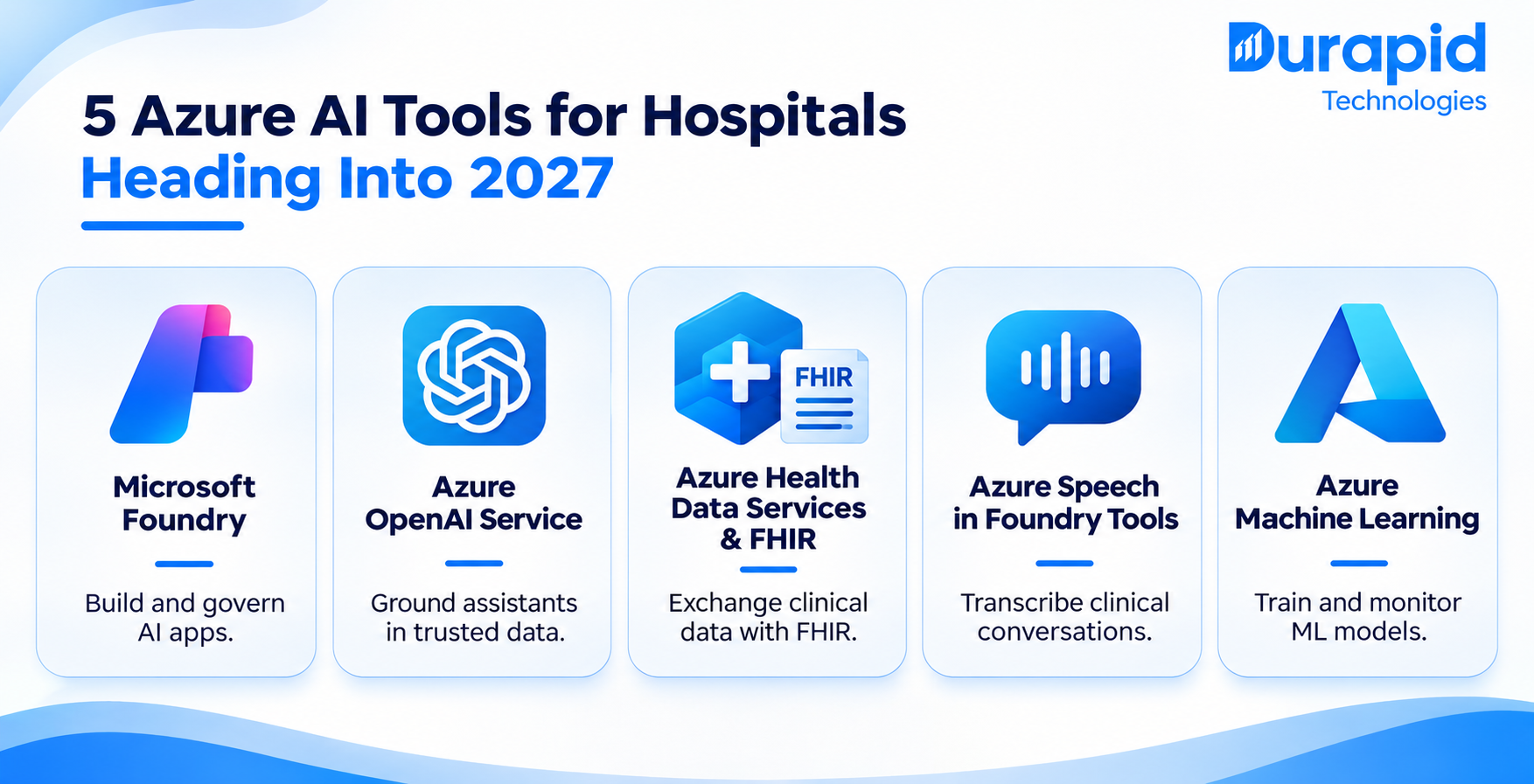
Microsoft Foundry (formerly Azure AI Foundry)
Azure AI Foundry is now called Microsoft Foundry. The platform has been renamed twice, from Azure AI Studio to Azure AI Foundry to Microsoft Foundry, so expect to see all three names in documentation, product conversations and search results.
Foundry brings models, agents, development tools, evaluation capabilities and enterprise controls into one place. A hospital team might use it to prototype a clinical-policy assistant, compare a few models side by side and run evaluations on the answers before anything reaches staff. The model catalog is broad, and that is also the catch: not every model in it is cleared for PHI, and terms differ by model and feature. Check each one. Microsoft’s Foundry documentation covers the current capabilities.
Azure OpenAI Service
Azure OpenAI provides OpenAI models inside Microsoft’s Azure environment, for summarization, document processing, conversational assistants and other approved tasks.
For clinical use, the pattern that matters most is retrieval-augmented generation (RAG). Say a nurse asks about the hospital’s sepsis escalation protocol. Instead of answering from the model’s general knowledge, the application first retrieves the relevant approved documents and answers from them, with citations the nurse can open and check. RAG makes answers traceable. It does not stop a model from misreading a source or inventing a detail, so testing still matters.
Azure Health Data Services and FHIR
AI is only as good as the patient data it receives. Azure Health Data Services manages and exchanges healthcare information using interoperability standards: the FHIR service handles structured clinical data, and the DICOM service handles medical imaging.
If you’re planning for 2027: the older standalone Azure API for FHIR was retired in September 2026. New implementations should use the FHIR service within Azure Health Data Services.
Azure AI Speech
Azure Speech handles speech-to-text for dictation, transcription of authorized clinical conversations and other audio-based documentation. It’s one component of a medical scribe, not the scribe itself. Consent, speaker identification, medical vocabulary, transcription accuracy, secure audio handling and clinician review all have to be built around it.
Azure Machine Learning
Azure Machine Learning covers the full model lifecycle, from experiments and training through deployment and monitoring. In a hospital, that might mean admission-demand forecasting, data-quality checks or carefully validated prediction models.
The monitoring side deserves more attention than it usually gets. Patient populations shift. Documentation habits change. A new EHR template alters how a field gets filled in. A model that tested well last year can degrade quietly, and drift monitoring is how you catch it before clinicians lose trust in it.
5. HIPAA compliance on Azure: what to verify before go-live
Is Azure AI HIPAA compliant?
Azure provides HIPAA-eligible services and contractual safeguards. Using them does not, by itself, make your HIPAA compliant AI solution.
Compliance belongs to the whole environment: the services you choose, the contracts behind them, the security configuration, how your workforce handles data, where the data flows and what your policies say. The U.S. Department of Health and Human Services confirms that covered entities can use cloud providers to handle electronic PHI, provided an appropriate Business Associate Agreement is in place and the HIPAA requirements are met.
Microsoft’s Business Associate Agreement
A Business Associate Agreement (BAA) sets out who is responsible for what when a service provider handles PHI on behalf of a covered entity or business associate. Microsoft includes BAA terms for qualifying services within its contractual framework. Before deployment, confirm:
- The relevant Microsoft agreement and BAA apply to your organization.
- Every service and feature that touches PHI is within scope.
- Any other technology vendors or subcontractors in the data path have their own BAAs.
- How data is processed, retained, accessed and deleted.
- The deployment architecture satisfies your internal legal and security requirements.
A BAA is required in many healthcare cloud arrangements. It is never a substitute for technical safeguards.
Encryption, access controls and audit logging
Security has to be designed in from the first sprint, not added before go-live. The usual Azure toolkit includes Microsoft Entra ID for identity, Azure Key Vault for secrets, private networking, encryption controls and monitoring services.
Least-privilege access is where AI applications most often slip. A billing administrator and a hospitalist may use the same AI tool, but the billing administrator shouldn’t be able to read detailed clinical notes through it. Audit logs need to support an investigation without turning into an unprotected second copy of patient data. Prompts, model outputs, logs, backups and temporary files can all contain PHI, and each one needs its own access and retention rule.
What Microsoft handles and what the hospital configures
Under the shared responsibility model, Microsoft operates and secures its covered cloud services within their service and contractual boundaries. How your application uses those services is your responsibility: permissions, permitted data uses, risk assessments, workforce and vendor management, retention and incident response.
Read Microsoft’s current data privacy documentation for Azure OpenAI and the other models sold through Azure. Microsoft states that customer prompts and outputs are not used to train foundation models without permission or instruction. You still need to understand how data processing and abuse monitoring work for your particular configuration.
Different departments need different safeguards
An appointment chatbot touches far less clinical data than a medical scribe. A predictive model may need years of historical records and heavier governance. One security configuration won’t fit all three, which is why HIPAA-compliant AI solutions should be designed around each specific workflow.
HIPAA isn’t the only rulebook, either. State privacy laws, retention requirements, professional obligations and, for some functions, FDA oversight may apply. Moving a workload to Azure gives you a secure foundation to build on. Clinical safety and regulatory responsibility stay with the hospital.
6. EHR integration: connecting Azure AI to Epic and Oracle Health (Cerner)
EHR integration is where a hospital AI project either becomes genuinely useful or gets stuck. A documentation assistant that can’t see the patient’s context adds little. A prediction model fed outdated records produces confident, misleading answers.
What FHIR is and why it matters
FHIR (Fast Healthcare Interoperability Resources) is HL7’s standard for exchanging healthcare data. It represents patients, observations, medications, encounters and other clinical information as standard resources, which reduces the amount of fully custom integration work a hospital has to fund. What it can’t promise is that every data element you need is exposed, or that two EHRs implement the same workflow the same way.
Integrating Azure AI with an existing EHR, step by step
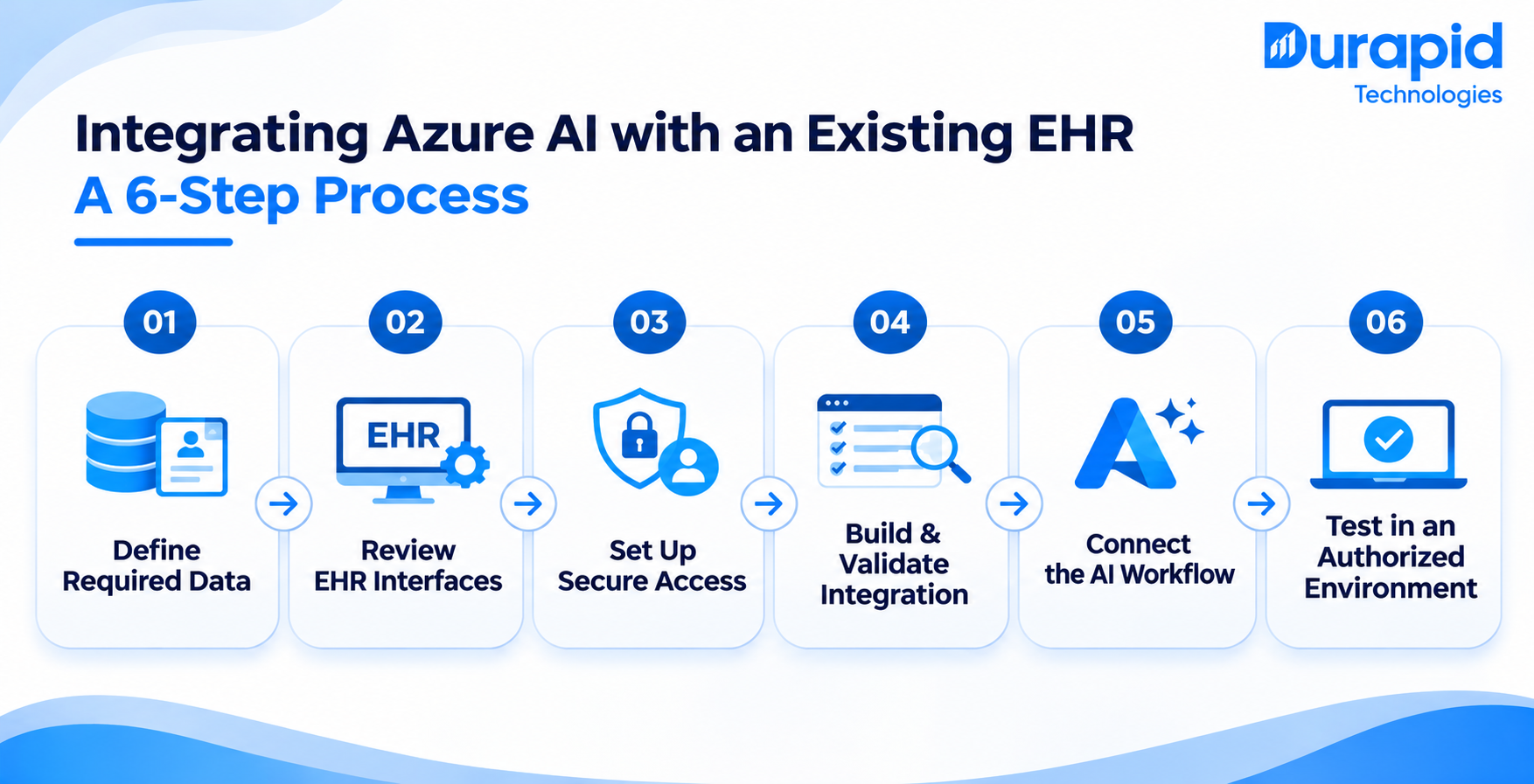
- Define the data. List exactly which patient records, observations or documents the application needs, and nothing beyond that.
- Review the EHR’s interfaces. Check the FHIR APIs, SMART on FHIR authorization, vendor-specific APIs and the vendor’s integration requirements.
- Set up secure authentication. Register the application, define access scopes, establish user context and apply identity controls.
- Build and validate the integration. Map the data, handle incomplete records and verify that patients and encounters match correctly.
- Connect the AI workflow. Limit what data reaches the model and control where results can be displayed or written back.
- Test in an authorized environment. Validate function, security, clinical accuracy and failure handling before the application gets production access.
Epic publishes developer resources through Epic on FHIR, and Oracle Health documents FHIR R4 APIs for its Millennium platform. Cerner is now part of Oracle Health, though plenty of hospitals still call their system Cerner. Permissions, available endpoints, write-back capabilities and deployment requirements always need confirming with the EHR vendor and the hospital’s IT team.
Where EHR integration goes wrong
API connectivity is usually the easy part. The real problems are inconsistent terminology, gaps in historical data, identifiers that don’t match across systems, permissions narrower than the use case needs, and workflows that still run through older interfaces. An API can work exactly as documented and still return too little information for the AI task you designed.
That’s the gap good AI integration is meant to close. Our approach at Durapid is to connect AI to the applications, data pipelines and workflows a hospital already runs, rather than replacing systems that work. In healthcare, that has to go hand in hand with clinical validation, coordination with the EHR vendor and governance the hospital defines.
7. How to implement Azure AI in a U.S. hospital: a seven-step plan
A hospital AI implementation is part technology project, part clinical operations change and part compliance exercise. Here is the sequence we recommend.
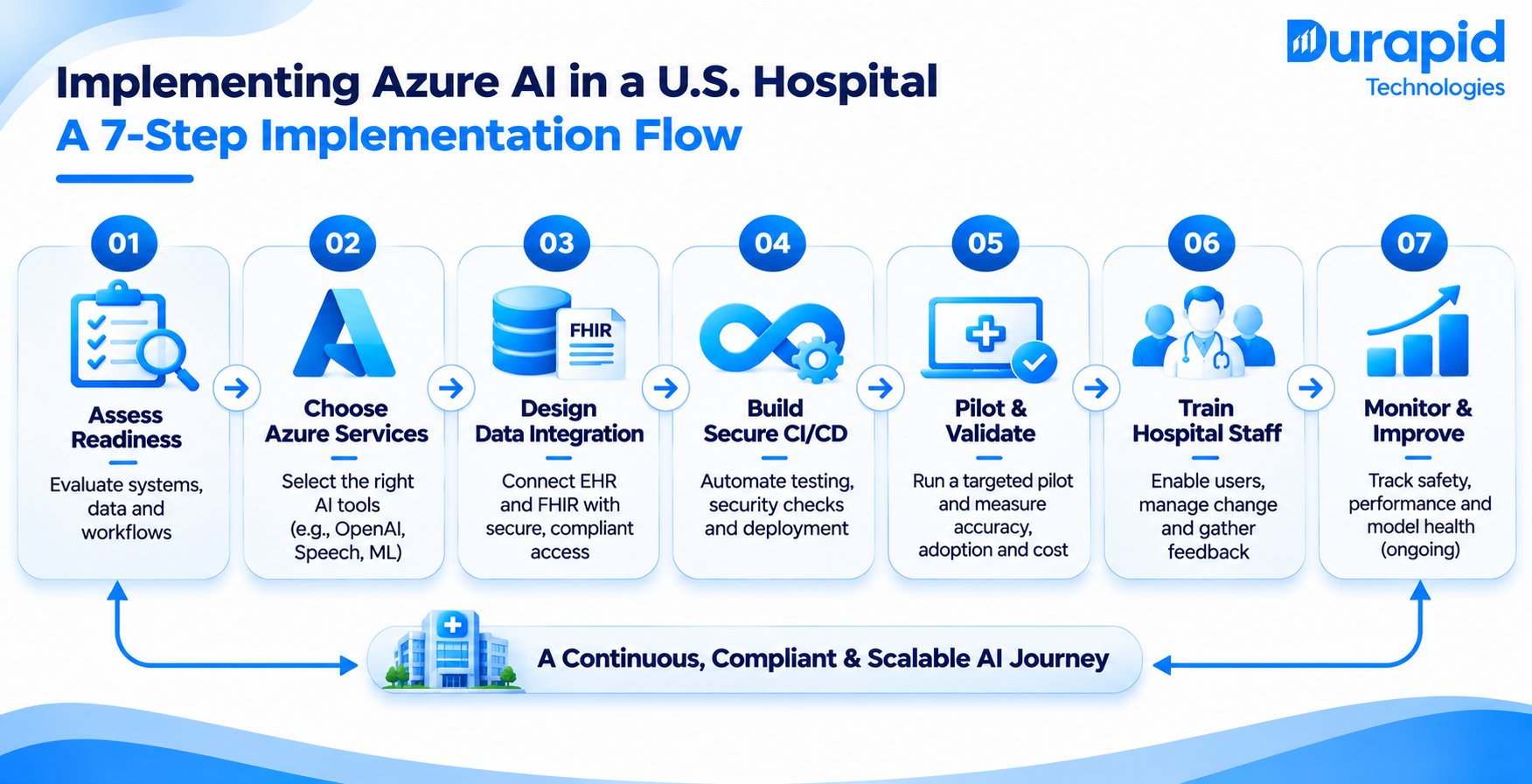
Step 1: Assess readiness
Before buying services or training a model, map what’s already there: EHR architecture, integration interfaces, available data, cloud infrastructure, security controls and the clinical workflow you want to change. Be specific about which departments will use the tool and what problem it solves for them.
Look underneath the stated problem, too. If physicians spend too long correcting documentation, the cause may be poor templates, an awkward workflow or bad data rather than a missing AI tool. AI might still help, but you want to know what you’re fixing. The assessment should end with a defined use case, a risk assessment, success metrics and a first roadmap.
Step 2: Choose the right Azure services
Pick tools for the job, not for their novelty. A medical scribe needs speech recognition and a language model. A readmission model leans on data engineering, feature development and Azure Machine Learning. A policy assistant needs a language model plus retrieval from approved documents, which a team can prototype and evaluate in Azure AI Foundry (now Microsoft Foundry).
For each one, weigh the accuracy you need, expected volume, running costs, security constraints, model availability and applicable regulation. This is where Durapid’s AI consulting and architecture planning do most of their work: turning a business objective into a technical design that will hold up in production.
Step 3: Design the data pipeline and FHIR integration
Identify the authoritative source for each type of data and how it moves between systems. For an approved hospital AI assistant, an illustrative flow looks like this:
EHR or clinical source → Secure API/FHIR integration → Data validation and access controls → Approved Azure AI service → Human review → Authorized clinical workflow
Not every application needs a central FHIR repository. Some can securely retrieve only what they need at the moment of use, which fits data minimization far better than copying records into yet another store. Whichever design you choose, set policies for retention, access, provenance and deletion up front.
Step 4: Build a secure CI/CD pipeline
The first working version is where the engineering starts, not where it ends. The application will need updates, security fixes, regression tests and controlled releases, and a continuous integration and continuous delivery (CI/CD) pipeline is how you manage those changes without breaking anything clinical.
For healthcare, the pipeline should include automated security scanning, infrastructure-as-code review, separate development and production environments, controlled secrets and deployment approvals. AI brings requirements of its own: versioned models and prompts, evaluation datasets and tests that catch unexpected changes in output. Automation should never become a way around clinical safety checks.
Durapid’s Azure DevOps services cover the engineering side of CI/CD for healthcare structured development, testing, release management and monitoring. The hospital’s clinical risk and compliance controls then sit on top of it.
Step 5: Pilot before a full rollout
Start small and well defined: one outpatient department, a few trained physicians, one documentation workflow. Compare the results against an agreed baseline using measures like these:
- Documentation time and editing effort
- Output accuracy and the severity of errors found
- Physician adoption and satisfaction
- Workflow interruptions and escalation rates
- Security incidents and unexpected data exposure
- Total operating cost per completed task
Higher-risk clinical applications need more, including performance checks across relevant patient populations. Agree in advance what result means continue, what means redesign and what means stop.
Step 6: Train staff and manage the change
Clinicians need to know what the system does, what it can’t do and how to report a problem. They also want a say in the decision. The AMA’s 2026 research found that 85% of surveyed physicians want to be consulted or involved in decisions about AI adoption, which is a strong case for bringing them in at the design stage instead of handing them a finished tool.
Train with real scenarios: common errors, privacy expectations, escalation and who is accountable for the output. Department champions help a great deal, but only when they’re given protected time and real authority, not just a title.
Step 7: Monitor, evaluate and improve
Go-live is where operational responsibility begins. Monitor technical reliability, data quality, accuracy, latency, usage, security and clinical outcomes. Watch predictive models for drift as patient populations change. Test generative AI applications for unsupported statements, wrong summaries, prompt-injection vulnerabilities and behavior changes after model updates.
Then decide who reviews the findings, who has authority to pause the system and what triggers a new clinical validation. Monitoring belongs in patient safety and operational governance, not on an IT dashboard that nobody outside IT ever opens.
8. How much does Azure AI implementation cost a U.S. hospital?
There is no standard price. A chatbot answering approved administrative questions and a documentation platform connected to several clinical systems have almost nothing in common on cost. The bill is shaped by the models you pick, infrastructure, data volume, integration complexity, staffing, regulatory work and usage.
What hospitals actually pay for on Azure
Microsoft prices its AI and healthcare services differently, and the main components look like this:
| Component | What drives the bill |
| Azure OpenAI | Input and output tokens for consumption-based deployments |
| Provisioned AI model capacity | Reserved throughput, billed by allocated capacity and terms |
| Azure Speech | Audio processing, transcription features and any model hosting |
| Azure Health Data Services | Storage, API requests and data operations |
| Azure Machine Learning | Compute, training, inference hosting and related infrastructure |
| Supporting Azure infrastructure | Storage, networking, security, monitoring and application hosting |
Consumption pricing usually suits development and low-volume use. Provisioned throughput can make sense once demand is steady and predictable. Build region-specific estimates from Microsoft’s current Azure OpenAI pricing and Azure Health Data Services pricing pages, and expect published rates, availability and discounts to change.
The costs that don’t show up in the pricing calculator
The model is often not the largest line item. Budget for EHR integration, data preparation, security design, clinical testing, legal review, user training, vendor coordination and ongoing support. Plenty of systems are cheap to demo and expensive to run securely across several departments.
A quick sizing exercise shows why. Take a hypothetical documentation program for 100 clinicians, each completing 12 eligible encounters a day over 20 working days. That’s 24,000 potential documentation events a month. To cost it properly, the team needs average audio length, transcription usage, model input and output volumes, hosting, storage, clinician review time and support. Treat this as a workload-sizing illustration, not a vendor quote or a promise of savings.
Measuring the ROI of Azure AI
Vendor-reported productivity gains are not savings until you’ve measured them in your own hospital. Define the return separately for each use case:
- AI medical scribe: actual reduction in documentation time, net of correction effort and operating costs.
- Revenue cycle automation: preventable errors, rework, processing time and claim outcomes.
- Predictive analytics: whether interventions and outcomes improved, not just whether the predictions were statistically accurate.
The calculation itself is simple:
ROI (%) = [(Verified benefits − Total implementation and operating costs) ÷ Total implementation and operating costs] × 100
The hard part is establishing which benefits are real, attributable to the AI and worth money.
Is Azure AI worth it for small and mid-size hospitals?
It can be, if the scope is realistic. A smaller hospital usually gets more from one well-chosen administrative workflow than from an enterprise AI platform it can’t fully staff. Where internal engineering capacity is thin, a specialist implementation partner or a dedicated engineering team can fill the gap without building every capability in-house.
Speed of adoption is a poor yardstick here. Ask instead whether the application solves a problem big enough to justify what it will cost over its whole life.
9. Common problems in hospital Azure AI adoption, and how to fix them
1. Legacy EHR systems that don’t communicate easily
Most healthcare organizations run older systems alongside modern cloud applications. Some data is reachable through FHIR APIs, while other workflows still depend on vendor-specific interfaces or older standards.
What helps: Start with an integration assessment. Confirm which interfaces are actually supported, build reliable data mappings and resist replacing core systems that already work.
2. Data quality that drags down AI performance
Incomplete records, inconsistent coding, duplicates and outdated documentation all degrade AI output, and a more advanced model can’t repair unreliable source data.
What helps: Assign data ownership, then put validation rules, quality monitoring and provenance tracking in place, along with a defined way of handling missing information, before production.
3. Clinicians who stop using the tool
An AI application can work perfectly on a technical level and still add work. If physicians keep correcting generated notes or switching between screens, usage drops off within weeks.
What helps: Involve clinical users in the design, measure usability, cut workflow interruptions and act on feedback during the pilot, while people are still paying attention.
4. Regulatory and compliance roadblocks
HIPAA, state privacy laws, contractual obligations, clinical safety requirements and, where relevant, FDA rules can all shape deployment decisions. The HTI-1 rule (Health Data, Technology, and Interoperability) also introduced algorithm transparency requirements for certain predictive decision-support features in certified health IT.
What helps: Bring compliance, clinical safety, information security and legal into the project early. Pin down the intended use and the obligations that follow from it while the design is still easy to change.
5. Departments that want different things
IT cares about integration and security. Physicians care about care quality and workflow. Finance wants a credible business case. All three are legitimate, and a project that serves only one of them stalls.
What helps: Agree on shared success measures, appoint an executive sponsor, give clinical leaders real influence and be honest about what the technology can and can’t do. People sustain systems they helped define.
10. Frequently asked questions
What is Azure AI Foundry, and how do hospitals use it?
Azure AI Foundry, now called Microsoft Foundry, is Microsoft’s platform for building and managing AI models, agents and applications. Hospitals evaluate it for approved workflows such as document summarization, internal knowledge assistants and workflow automation. Clinical suitability, compliance eligibility, model performance and data handling still have to be assessed for each implementation.
Is Microsoft Azure HIPAA compliant for patient data?
Microsoft offers HIPAA-eligible Azure services and Business Associate Agreement terms, which lets hospitals process PHI in properly designed environments. Compliance itself depends on the hospital’s full application: its configuration, contracts, administrative procedures and security controls. Azure does not make an application HIPAA compliant automatically.
How long does it take to implement Azure AI in a hospital?
It varies widely. A narrowly scoped, low-risk pilot can take anywhere from several weeks to a few months if systems and approvals are ready. Complex EHR integrations, sensitive clinical workflows, regulatory review and multi-department rollouts take considerably longer. A credible timeline comes after a readiness and dependency assessment, not before.
What’s the difference between Azure OpenAI and Azure AI Foundry?
Azure OpenAI provides access to OpenAI models through Azure. Azure AI Foundry, now Microsoft Foundry, is the broader environment for working with models, agents, development tools, evaluations and enterprise management. Put simply, Azure OpenAI supplies model capability, and Foundry supports the wider job of building and managing AI applications.
How much does Azure AI cost for a mid-size U.S. hospital?
There’s no reliable single figure. Cost depends on the number of users, model usage, speech processing, infrastructure, data storage, integrations and ongoing support. Estimate monthly consumption for your chosen region and deployment options, then add implementation, clinical validation, security and maintenance costs.
Can Azure AI integrate with Epic?
Yes. Azure-based applications can integrate with supported Epic interfaces, including Epic’s FHIR APIs. What’s possible depends on the hospital’s Epic environment, approved application access, available resources and integration arrangements. Evaluate read and write permissions separately, each with its own clinical workflow and security controls.
What is an AI medical scribe, and how does it work on Azure?
An AI medical scribe turns authorized clinical conversations or dictation into draft documentation. A custom Azure build may combine speech recognition, language models, secure application infrastructure and EHR integration. Clinicians review and approve every note before it becomes part of the medical record.
How are U.S. hospitals using predictive analytics today?
Common uses include readmission risk, patient-flow forecasting, resource planning and other approved clinical or operational tasks. Models analyze relevant data to estimate likely outcomes, and hospitals have to validate those predictions, monitor fairness and performance, and decide how staff should respond. The value lies in better decisions and interventions. A prediction on its own changes nothing.
What are the biggest risks of AI adoption in healthcare?
The main ones are inaccurate output, PHI exposure, biased predictions, weak integration, insufficient clinical validation, unclear accountability and low user adoption. Some clinical AI functions also need specific regulatory review. Risk-based design, sound contractual and security controls, independent validation, staff training, human oversight and ongoing monitoring all reduce that exposure.
11. Conclusion: the model is rarely what decides success
AI can do real good in U.S. hospitals. It can take hours of documentation off physicians’ plates, cut administrative friction, put information in front of the right people faster and give operations teams a clearer view of what’s coming.
But when a hospital AI project falls short, the model is seldom the reason. The project falls short on the data pipeline, the access controls, the EHR integration, unclear accountability or the lack of monitoring after launch. Azure supplies most of the building blocks. Making them work inside a hospital with decades of existing systems and a full patient census is engineering and governance work, and that is where the outcome gets decided.
How Durapid Technologies can help
As a Microsoft Solutions Partner for Data & AI, Durapid Technologies works across enterprise AI development, data engineering, cloud modernization, software integration and DevOps. For healthcare organizations exploring Azure AI, that means:
- AI strategy and development: assessing use cases, designing the right architecture and building AI-powered applications.
- Enterprise integration: connecting AI to existing data platforms, applications and approved system interfaces.
- Cloud and DevOps engineering: building scalable Azure infrastructure with controlled development and deployment pipelines.
- Engineering talent: dedicated AI, data engineering, cloud and software specialists through our IT staff augmentation services.
Whether you’re scoping a documentation assistant, planning a healthcare analytics program or building an AI implementation team, the starting point is the same: pick a problem that matters, and build something your organization can run responsibly long after go-live.
Ready to take your healthcare AI initiative past the proof of concept? Talk to Durapid Technologies about your Azure AI requirements, your current technology environment or the specialized engineering talent you need.

Recent Blog

Azure AI for U.S. Hospitals: An Implementation Guide
November 19, 2026-
Why Forward-Deployed Engineers Are Becoming the New AI Hiring Priority
November 16, 2026 -
How Voice AI Connects Calls With Sales Operations
October 15, 2026 -
How GCCs Can Scale Engineering Teams with Staff Augmentation?
October 10, 2026