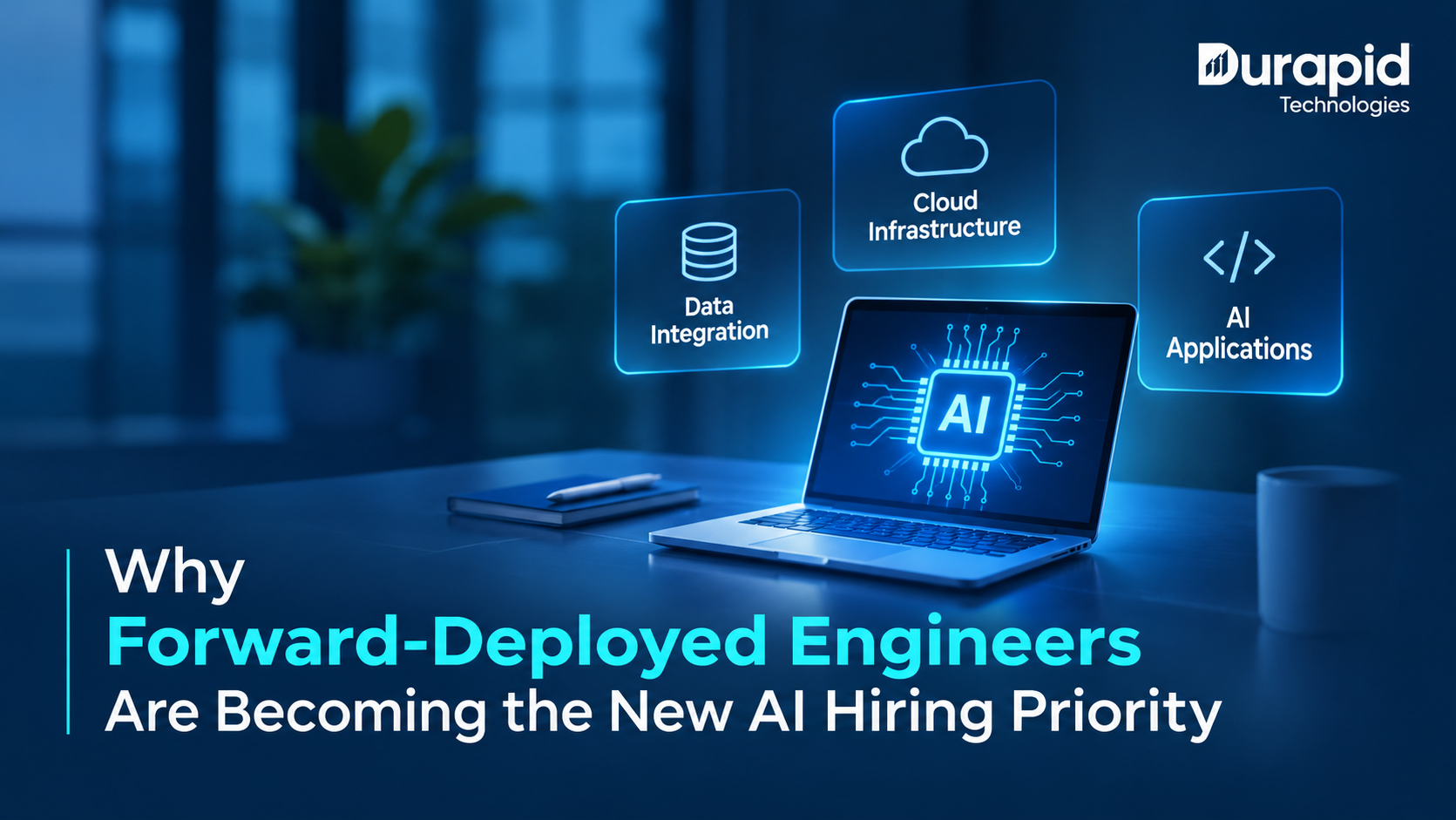
Why Forward-Deployed Engineers Are Becoming the New AI Hiring Priority
Ask any enterprise technology leader about their AI pilot and you’ll hear a good story. Ask what happened when it met the ERP, the permissions model and four hundred employees, and the story usually gets longer.
McKinsey’s State of AI in 2026 puts numbers on that gap. Eighty-nine percent of surveyed organizations use AI regularly in at least one business function, yet only 44% say it is scaling across the enterprise. The models improved a great deal over the past year. The share of companies seeing a real financial return barely moved. Whatever is holding companies back, it isn’t mainly the model.
That gap is where Forward-Deployed Engineers come in. Forward-Deployed Engineers are customer-facing software engineers who build, integrate and deploy technology inside a customer’s own business environment, and stay accountable for how it performs in production. A product engineer builds features for many customers. An FDE works with one customer at a time, learns how its work actually gets done, and stays until the software holds up in that environment: the integrations, the messy data, the approval rules nobody wrote down.
For companies buying or building AI, the useful question has changed. It used to be which model to choose. Now it is who will make that model work with everything else the business runs on.
Looking to build an AI team for your enterprise?
Connect with Durapid’s experts to scope the Forward-Deployed Engineers your deployment actually needs.
Understanding Forward-Deployed Engineering: The Concept Behind the Role
Ask five people “what is a forward deployed engineer?” and you’ll hear everything from “a consultant who codes” to “a product engineer on loan.” Neither is quite right. The role rests on a simple observation: software tends to fail at the point where it meets a real organization, so you put an engineer at that point and keep them there.
What Is a Forward-Deployed Engineer?
A forward-deployed engineer is a customer-facing software engineer who builds, integrates and deploys technical solutions inside a customer’s business environment. The job needs strong programming skills, plus a working knowledge of how the customer’s operations, infrastructure and constraints fit together. FDEs stay with the work through discovery, integration, deployment and the months of adjustment after go-live.
Take a hospital introducing AI document processing. A product team can build a tool that extracts fields from discharge summaries and lab reports. The hospital still has a different set of questions to answer. Who checks the extracted values? Where are they stored, and under which access rules? Which system of record do they update? What happens to a scanned page the model can’t read?
Those answers decide whether clinicians ever trust the output. The FDE is the person who works them out, together with the hospital’s IT, compliance and clinical operations teams.
How the Role Originated at Palantir
Palantir made forward-deployed engineering a recognised discipline. Its early customers were intelligence, defense and government agencies with sensitive, fragmented data and environments no vendor could reproduce in its own office. Shipping software and waiting for feedback wasn’t an option.
So Palantir sent engineers to the customer. These Forward Deployed Software Engineers (FDSEs) sat with analysts and operators, configured the platform against live data, and wrote whatever code was missing to make it useful there. What they learned in the field went back to the core product team.
That loop, where the field shapes the product and the product makes the field work faster, is the idea most AI companies are now borrowing.
Why AI Changed the Definition of Technical Hiring
A few years ago, “AI engineer” usually meant someone who trained models. Today most enterprises reach strong models through an API. Training is no longer where most of the work sits. The work is fitting those models into systems, data and processes that were never designed for them.
That shifts what companies hire for. The scarce engineer understands LLMs well enough to know their failure modes, writes production integration code, reads a data model quickly, and can explain a trade-off to a finance director. Before the current wave of AI, those skills rarely appeared in the same job description. Now they describe one role.
FDE vs. Traditional Software Engineer: A Fundamental Shift
The two roles share most of their technical skills. What differs is who they build for, and how much of the problem is defined when they start.
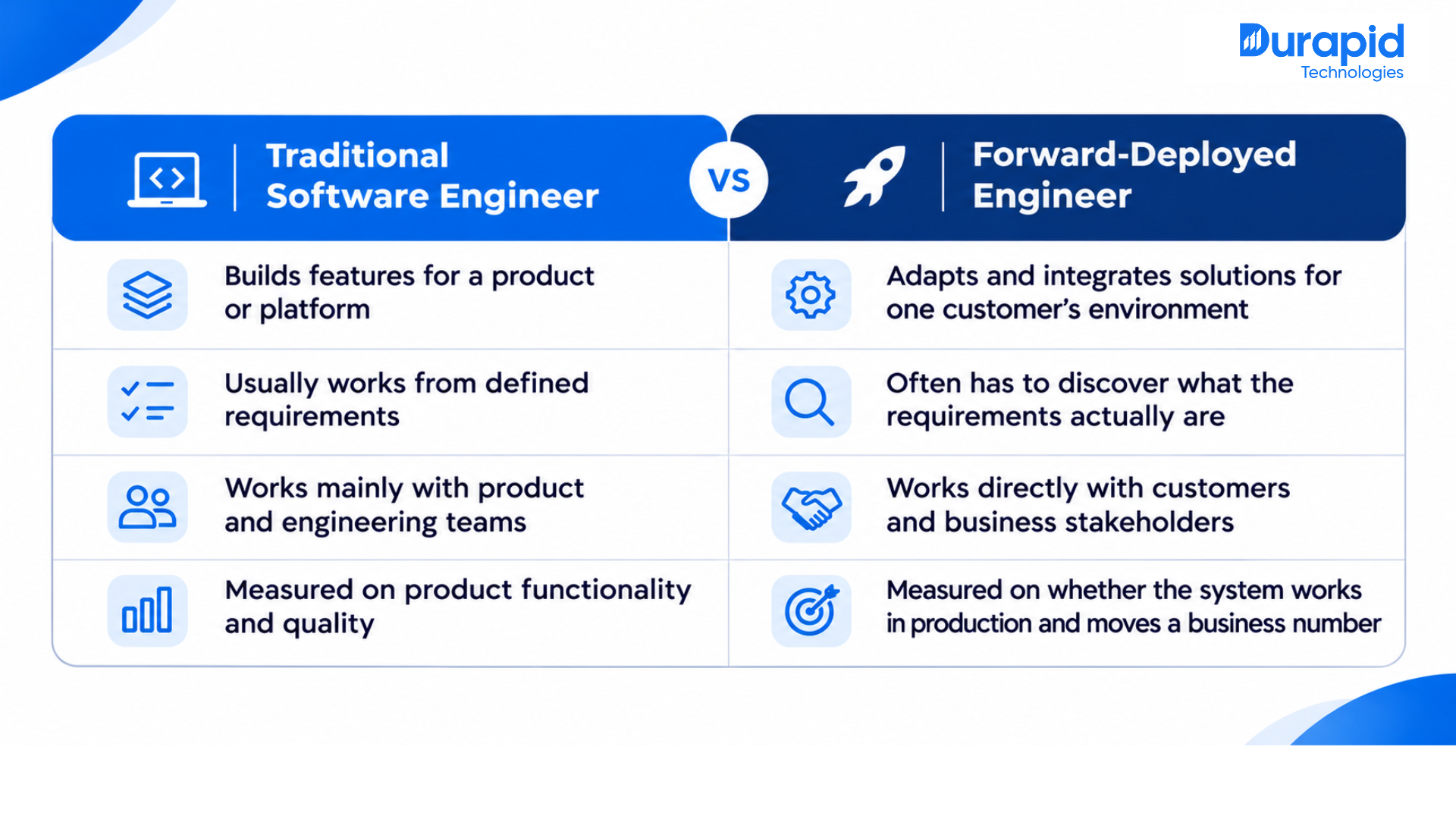
Neither role is better, and most serious AI programs need both. For buyers, the distinction answers a practical question: does this project need more product developers, or someone to own the customer-specific work between the product and the business?
Why AI Companies Are Prioritizing Forward-Deployed Engineers in 2026
Enterprise buyers have seen enough demos. They now ask whether the system will run on their data, inside their stack, and change a number on a report someone already tracks. Saying yes is an engineering problem, and much of it can’t be solved from inside a vendor’s office.
AI Products Cannot Be Shipped and Forgotten
A proof of concept is a controlled experiment. The dataset is hand-picked, the users are friendly, and the edge cases haven’t shown up yet.
Production removes those advantages. Invoices arrive as scanned PDFs, emailed spreadsheets and photos taken on a phone. An upstream API adds a field without warning. One department fills in a form differently from the other three. A model provider ships an update and a prompt that worked last month starts drifting.
Traditional software can often be released and maintained on a quarterly cycle. AI systems need someone watching them in context, tracing failures, adjusting retrieval and prompts, and re-running evaluations as conditions change. FDEs are that someone.
Enterprise Clients Demand On-the-Ground Technical Expertise
Picture an AI assistant for customer service. The model can understand the customer’s question. To answer it, the assistant also needs the account record, the last three interactions, the current refund policy and write access to the ticketing system. If any of those is missing or unreliable, the customer gets a confident, polite and wrong reply.
A bigger model won’t fix that. It takes engineers who understand APIs, databases, authentication, cloud infrastructure and monitoring, along with the business process the assistant sits in. Enterprise buyers know this now, and more of them want those engineers named in the contract. It is also why AI deployment so often turns into digital transformation work, modernizing the systems the AI depends on.
FDEs Directly Reduce Churn and Accelerate Revenue
For AI vendors, this is a commercial question as much as a technical one. Most enterprise AI is sold on subscriptions, seats or usage. A deployment that stalls at the pilot stage generates little usage and is hard to renew. One that reaches production in a real workflow usually spreads to the next team.
FDEs sit at exactly that point. They turn a signed pilot into a system people use every day, and they are the first to spot the adjacent workflow where the same pattern would pay off. That is how a single use case becomes an account that grows. What they learn also feeds the product, so the next customer’s deployment goes faster.
The Rise of Agentic AI Is Making FDEs Non-Negotiable
Agents raise the stakes because they act. A chatbot that gives a wrong answer wastes a minute of someone’s time. An agent that takes a wrong action changes a record.
Take an agent in procurement. An invoice arrives. The agent finds the purchase order, checks the goods receipt, confirms the amounts match and queues the payment. In a demo, all of that takes seconds.
Then real invoices arrive. A supplier bills against a PO that was amended last week, and the agent pulls the original. Another invoice comes in with new bank details for a long-standing vendor. Anyone in accounts payable would stop on that one, because changed bank details are one of the oldest moves in invoice fraud. Does the agent stop? Only if someone built it to.
In June 2025, Gartner predicted that more than 40% of agentic AI projects would be canceled by the end of 2027 because of rising costs, unclear business value or weak risk controls. It is a forecast, not a count of failures. Gartner’s own explanation is the useful part: organizations underestimate the cost and complexity of running agents at scale, so projects stall before production. Neither is a model problem.
The scarce engineer, then, isn’t the one who can build an agent. It’s the one who knows where the ERP keeps amended POs, which approvals finance will never hand over, and what the agent should do when it isn’t sure.
Core Responsibilities of a Forward-Deployed Engineer in AI
In one week, an FDE might run a discovery workshop, sketch an integration design, write production code, chase a failing API call at 6 p.m., and explain to a finance director why the agent asks for approval on certain invoices. What sets the role apart is continuity. The person who heard the original problem is still there when the system goes live, so context doesn’t get lost at every handoff.
On-Site Implementation and System Integration
The first weeks involve very little code. The FDE maps the workflow as it actually runs, which is rarely how the process document describes it. They study the architecture, find where the data really lives, and ask the people doing the work what slows them down.
Integration starts from there. Connecting an AI assistant to an enterprise CRM, for instance, means API work, authentication, field mapping, role-based access and testing as each type of user. Some of those dependencies belong to other teams. A good FDE treats them as their own problem anyway, because the deployment fails either way. Durapid’s cloud application services support the cloud integration, modernization and deployment work that usually comes with these projects.
Custom Development and Client-Specific Engineering
No product covers every customer’s edge cases. FDEs write the code that closes the gap: custom APIs, connectors to in-house systems, retrieval-augmented generation (RAG) pipelines tuned to the customer’s documents, agent configurations, and the small internal tools that make a workflow usable.
The discipline is in keeping this code maintainable. Client-specific work that only one engineer understands becomes a liability the day that engineer moves on. The best FDEs build on the vendor’s platform where they can, document what they add, and push anything reusable back to the product team.
Model Fine-Tuning and Data Pipeline Management
The data underneath decides most of the outcome. If a knowledge assistant quotes last year’s leave policy, the model is rarely to blame. The cause is usually stale ingestion, missing metadata, weak retrieval logic or a permissions gap. An experienced FDE checks those first.
Fine-tuning has its place, for example when a model has to learn a domain’s vocabulary or a strict output format. It is also often the most expensive fix for what turns out to be a data problem. The FDE’s job is to find the real cause, choose a fix the customer’s team can maintain, and set up evaluation suites, logging and monitoring so drift shows up on a dashboard before a user complains.
Stakeholder Communication and Change Management
An AI system changes how people work, and people notice. Approval steps move. Some tasks disappear and new review tasks appear. If nobody explains why, adoption stalls no matter how good the model is.
FDEs keep business owners informed in plain language, train the first users, and recruit internal champions who can support their colleagues. They also watch for problems that never show up as bugs. Sometimes a system is accurate but slow to review, with staff spending ten minutes checking each output that saves them twelve. Fixing that review step can be worth more than any new feature.
That mix of engineering judgement and plain conversation is what separates an effective FDE from someone who has only built prototypes.
Real-World Examples of Forward-Deployed Engineering in Action
The companies building frontier AI have reached the same conclusion from different directions: selling access to a model isn’t enough. How each one uses FDEs shows what the role can be, and what an enterprise outside the AI industry might need for itself.
Palantir’s FDE Model in Government and Defense
In government and defense work, Palantir’s FDSEs often work alongside the analysts and operators who use the software, inside environments with strict security rules and data that can’t leave the building. They configure the platform against live operational data, build the workflows each unit needs, and adapt them as missions change.
That model proved customer-facing engineers could be central to how a product is delivered, not a support function behind it. Palantir has since carried the same approach into healthcare and commercial customers. The lesson for anyone deploying AI is simple: you can’t build software that fits an operation you’ve never looked at closely.
OpenAI’s Enterprise Deployment Strategy
In May 2026, OpenAI turned its FDE practice into a business of its own. It launched the OpenAI Deployment Company with more than $4 billion in initial investment, majority-owned by OpenAI and backed by 19 investment firms, consultancies and system integrators. It also agreed to acquire Tomoro, an applied AI consultancy, adding about 150 forward-deployed engineers and deployment specialists.
Engagements start with a diagnostic of where AI can create value. Engineers then pick a small number of priority workflows and design, build, test and deploy systems connected to the customer’s infrastructure.
When the company behind one of the best-known models builds a services arm around engineers, the bottleneck has clearly moved downstream. For enterprises, the message is that deployment expertise is a separate capability from model access. Most companies also run more than one platform, more than one cloud and more than one model.
Glean’s FDE-Driven Enterprise Search Adoption
Glean started as enterprise search and has grown into a broader Work AI platform. Search across a company’s tools only earns trust when connectors, permissions and relevance are right for that company, which makes deployment quality central to adoption.
Glean now takes that further with a team of founding forward-deployed engineers. They work in pods with forward-deployed product managers, directly with the C-suite at strategic customers, to find unsolved business problems and build new product surfaces. The useful parts ship to every Glean customer.
Other Notable Examples
The pattern now reaches the hyperscalers. A Google forward deployed engineer on Google Cloud’s generative AI team is described in its job listings as an embedded builder who closes the gap between frontier AI products and what actually works in production at a customer. Google hires forward deployed engineers for this work in New York, Singapore, Sydney and Bengaluru, among other locations. Day to day, they write the code that connects Gemini and Vertex AI to a customer’s APIs, legacy data stores and security perimeters.
Scale AI – Data Labeling to AI Implementation
Scale AI built its business on labeling the training data that AI models learn from. It has since moved closer to deployment, using forward-deployed engineers in its public-sector work to build and deploy AI applications with government customers whose operational and security requirements rule out off-the-shelf tools.
Cohere – LLM Deployment for Enterprise Clients
Cohere deploys its models in regulated settings, including private-cloud and on-premise environments. It has argued publicly that FDEs should build capability, not dependency. Its engineers co-build with customer teams through architecture, integration, testing and troubleshooting, so those teams can run, evaluate and extend the system on their own. For any enterprise worried about vendor lock-in, that’s the question to ask every implementation partner.
Durapid – AI Agent Deployment for Healthcare and Enterprise
Durapid applies the same forward-deployed principles in healthcare and enterprise operations. Our healthcare work includes hospital asset management and data-driven operational systems, where data from several departments has to feed dashboards and workflows that finance, operations and maintenance teams all rely on. That integration and data groundwork is exactly what an AI agent depends on, and it is where we start when we scope agent deployments. The section on Durapid’s role below covers how we approach this in more detail.
Benefits of Hiring Forward-Deployed Engineers for Enterprise AI
The case for FDEs is not that they write better code than other engineers. It’s that they stand where most AI value is won or lost: between a capable system and the organization that has to use it.
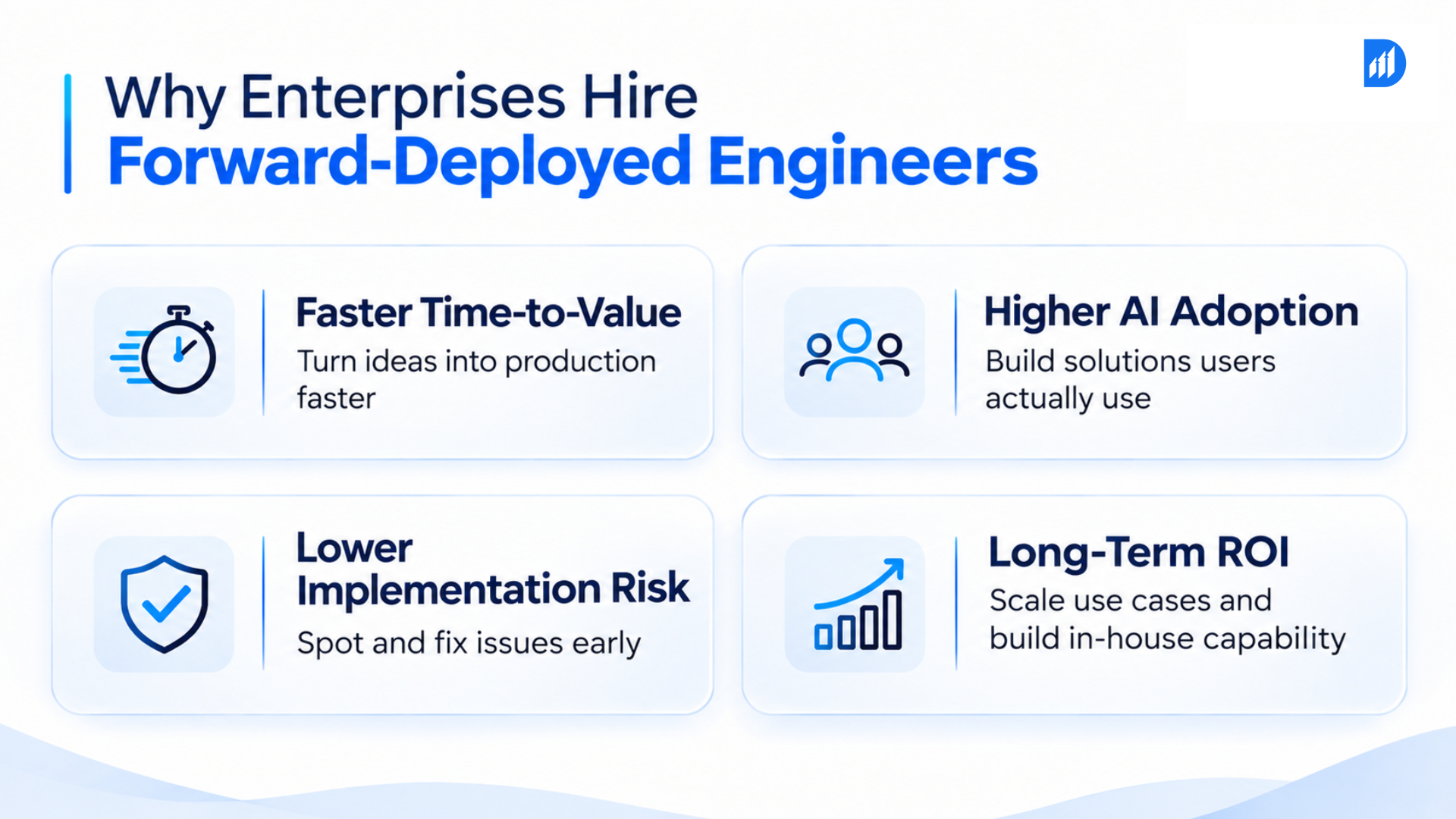
Faster Time-to-Value for AI Investments
In a typical vendor setup, an issue raised in a customer meeting becomes a ticket, then a triage call, then a fix in the next release. Weeks pass. An FDE shortens that loop to days, because the person who hears the problem can also open the code, trace the integration and test a change with the same users.
The gain compounds. Each short loop removes another reason the pilot can’t go live, so the date of first production use moves forward and the investment starts paying back sooner.
Higher AI Adoption Rates Across the Organization
Take an internal help desk assistant that employees have started to ignore. The complaint reaches IT as “the AI isn’t accurate.” That isn’t something an engineer can fix.
An FDE who sits with the users turns it into something fixable. Maybe retrieval is surfacing archived policy pages. Maybe half the HR knowledge base sits behind a permission the assistant doesn’t have. Maybe people ask questions in a way the prompt never anticipated. Each has a specific fix, and the FDE can test it with the same users the following week.
The milestone that matters to a business isn’t the first demo. It’s the week employees start using the system without being reminded to.
Reduced Implementation Risk and Project Failure
Because they see the architecture in context, FDEs catch expensive problems while they’re still cheap to fix: an integration pattern that won’t scale, a permission model that leaks, a data source nobody owns. Found in week three, that’s a design change. Found after rollout to two thousand users, it’s an incident and possibly a cancelled project.
They also make success measurable from the start. For document processing, that could mean time per document, extraction accuracy, the share of records needing manual review and the failure rate. For customer service, resolution time, escalation rate, satisfaction scores and cost per contact. Clear numbers make it obvious early whether a project is on track.
Strategic Account Growth and Long-Term ROI
The first use case is rarely the most valuable one. Once an FDE knows how the business runs, they can see where the same pattern applies next, such as a second document type, a neighbouring approval flow or another region. Expansion built on a working deployment is cheaper and safer than a new pilot from scratch.
Long-term ROI also depends on what stays behind. FDEs who document their work and build capability in the customer’s own team leave a system the organization can run and extend after the engagement ends.
Challenges of Deploying AI Without Forward-Deployed Engineers
AI projects rarely fail in dramatic ways. They fail for unremarkable reasons that nobody close enough to the work caught in time. These four come up again and again when no one owns the space between the AI system and the business.
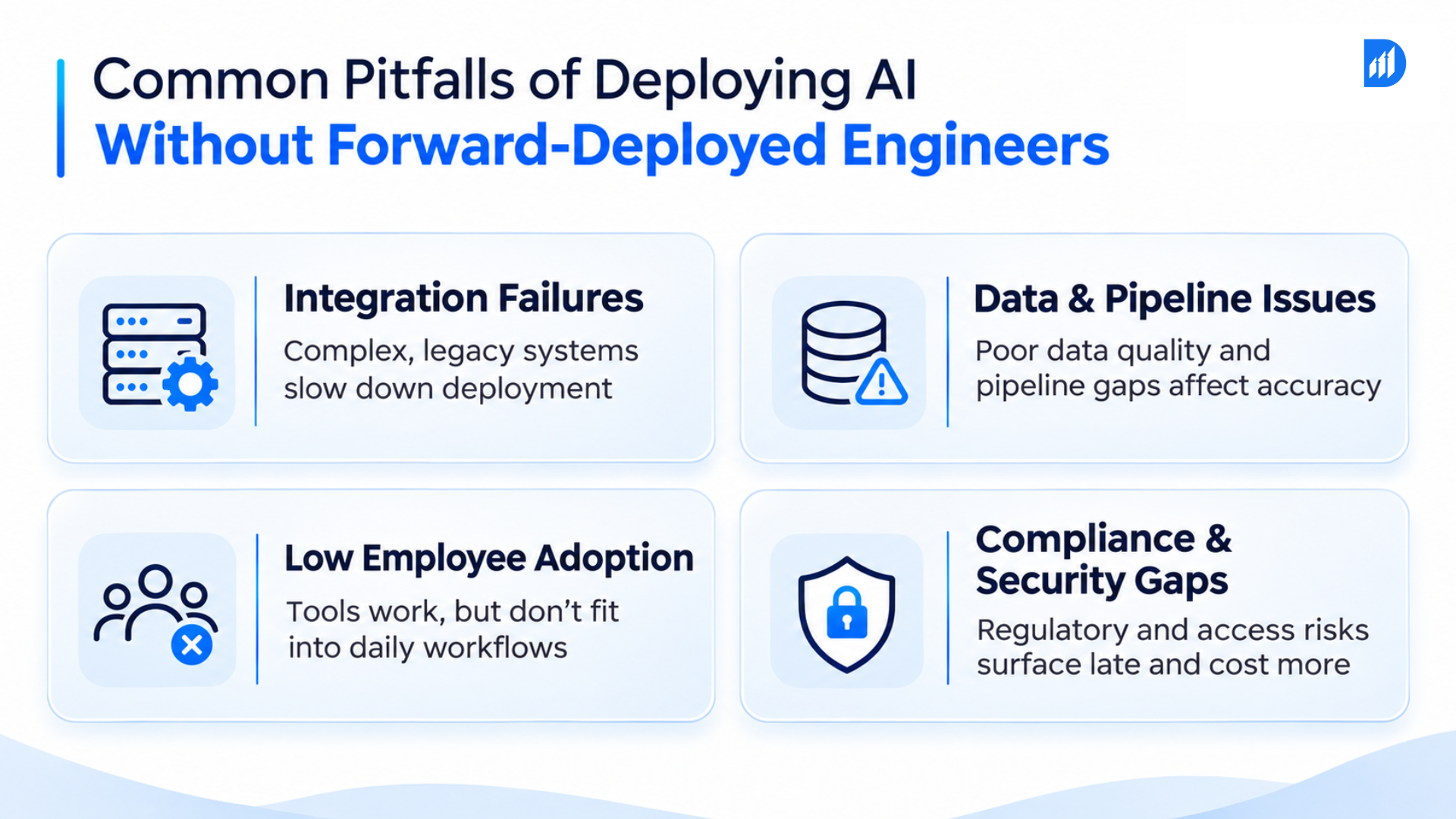
1. Integration Failures with Legacy Systems
Most enterprise estates are layers of decisions made by different teams over many years: an on-premise database here, a SaaS platform there, an internal API that one person understands. None of it was built with AI in mind.
Without an engineer who maps those systems first, the integration that was scoped as “a two-week job” takes a quarter. Timeouts, undocumented fields and batch jobs that only run overnight surface one at a time. Each becomes a ticket between the vendor and internal IT, and nobody owns the whole chain.
2. Data Quality and Pipeline Breakdowns
Duplicate customer records, half-empty fields and three date formats in one table will undermine a capable model faster than any prompt can make up for. Ingestion pipelines that worked in the pilot quietly fall behind in production, and the assistant starts answering from stale documents.
The symptom shows up as “the AI is wrong,” so teams often respond by switching models or rewriting prompts. Without someone tracing the problem back to the pipeline, they fix the wrong layer and the trust problem gets worse.
3. Low Employee Adoption of AI Tools
Some systems work exactly as designed and still go unused, because using them adds steps to someone’s day. Output that needs heavy review, a tool that lives in yet another browser tab, an approval that now takes two clicks instead of one: each is a small reason to go back to the old way.
These problems never appear in a test report. You find them by watching people work, which is precisely the part of the job a remote vendor team can’t do.
4. Compliance and Security Gaps in Regulated Industries
In healthcare, banking and insurance, an AI system has to respect identity management, access restrictions, audit trails and data residency from the first day. A model that can see records its user shouldn’t, or an agent whose actions aren’t logged, can stop a deployment at the security review or, worse, after go-live.
Without an engineer working directly with the security and compliance teams, these requirements surface late and expensively. This is also where Durapid’s data engineering, cloud and enterprise software work overlaps most directly with forward-deployed engineering.
Key Skills and Qualifications of a High-Impact Forward-Deployed Engineer
You can’t hire an FDE off a standard developer job description. Plenty of excellent programmers would be unhappy in a customer’s war room, and plenty of good consultants can’t ship production code. The profile you want sits where those two overlap, backed by real production experience.
Technical Skills: LLMs, APIs, Cloud, and Data Engineering
The baseline is solid backend engineering. Python and TypeScript cover most AI integration and service work. Add REST APIs, SQL, Docker, Kubernetes, CI/CD and at least one major cloud. Azure, AWS or Google Cloud experience counts for more when the customer is already committed to one of them.
On the AI side, look for LLM integration, RAG architecture, vector databases, agent frameworks, and above all evaluation: building test sets, tracking regressions and monitoring behaviour after release. Evaluation is the skill that separates people who have run AI in production from people who have only demoed it.
Don’t let the checklist do the hiring, though. A better interview question is “tell me about an integration that broke in production and what you did.” Better still, ask candidates how their agent should fail: what it logs, who it alerts, and what it refuses to do without a human. The answers show quickly who has worked inside real operations. Durapid’s FDE screening follows the same logic, assessing deployment experience, evaluation engineering, legacy integration and customer communication rather than counting frameworks on a CV.
Soft Skills: Communication, Adaptability, and Client Trust
An FDE’s audience changes every few hours. A CTO wants to know why the architecture looks the way it does. An operations manager wants to know why the new workflow is slower on Tuesdays. Both are fair questions, and the FDE has to answer each in the asker’s language without losing track of the build.
Adaptability matters because requirements move as soon as real users touch the system. Trust matters most of all. Customers give FDEs access to sensitive data and production systems, and that only happens with someone who is candid about risks, says “I don’t know yet” when it’s true, and delivers what they commit to.
Industry Knowledge: Why Domain Expertise Matters in Healthcare and Finance
Domain knowledge shortens everything. An engineer who already knows why healthcare data needs audit trails and strict access controls, or why a bank won’t let an agent touch a ledger without dual approval, designs for those rules from day one. One who doesn’t finds out at the security review.
In healthcare, that means understanding patient data handling, clinical workflows and why a wrong extraction can matter more than a slow one. In finance, it means reconciliation, segregation of duties and the regulators who will eventually ask how the system made a decision.
FDE vs. Solutions Engineer vs. Customer Success Manager
These three roles often work the same accounts, and in smaller companies one person may cover two of them. The dividing line is who owns the working code.
| Role | Primary focus |
| Forward-Deployed Engineer | Builds, integrates and improves the solution inside the customer’s environment, and owns it in production |
| Solutions Engineer | Scopes technical requirements and designs the solution, mostly during pre-sales and early adoption |
| Customer Success Manager | Owns the relationship, adoption, renewals and long-term account outcomes |
For hiring managers, titles won’t tell you much. Ask what the candidate personally shipped, debugged and stayed accountable for after go-live.
The Future of Forward-Deployed Engineering in an Agentic AI World
As AI systems move from answering questions to taking actions, the hard engineering problem moves too. Producing a good response is largely solved. Operating safely inside a business process that has rules, exceptions and auditors is not.
How Agentic AI Amplifies the Demand for FDEs
Agent adoption is moving fastest where systems are most complex. In McKinsey’s 2026 survey, the share of respondents from organizations with more than $1 billion in revenue reporting that they are scaling AI agents rose from 27% to 40% in a year, while smaller organizations stayed flat at 22%.
Every agent that reaches production multiplies the integration work. It needs credentials for each system it touches, rules for each action it can take, and a defined path for every situation it wasn’t designed for. A chatbot needs one integration done well. An agent working across procurement, finance and inventory needs a dozen, and each is a design decision someone has to own. Demand for engineers who can make those decisions will rise with agent adoption.
FDEs as AI Governance Partners, Not Just Implementers
Every agent needs a written answer to one question: what is it allowed to do on its own? Reading a supplier record might be fine. Updating a payment ledger or emailing customer data outside the company should need a person’s sign-off.
FDEs turn those answers into working controls: authorization scopes, validation steps, audit logs, evaluation suites and alerts. They also design what happens when something goes wrong, such as an API timing out halfway through a task or an agent meeting a case it was never shown. A good agent stops cleanly and hands over. A bad one guesses.
That makes the FDE a governance partner for risk, compliance and business owners, not only a builder. The goal was never maximum autonomy. It’s automation people can follow, check and switch off.
Salary Trends and Career Path for Forward-Deployed Engineers in 2026
The market prices the mix of technical depth and customer responsibility highly. OpenAI’s New York FDE listings in 2026 have advertised base ranges such as 220,000–280,000 for a life sciences FDE and 230,000–385,000 for a platform engineer within the FDE group, both plus equity. A Google Cloud Forward Deployed Engineer IV role in New York lists 207,000–300,000 plus equity, and Glean’s founding FDE role lists 160,000–270,000.
These are advertised ranges at a few well-funded US AI companies, not market averages. Pay varies widely by seniority, location, industry and how much customer ownership the role carries.
The career paths are getting clearer: senior and staff FDE, AI solutions architect, technical delivery lead, or applied AI engineering manager. For enterprises, those salaries raise a practical question. Is a permanent hire the best way to get this capability, or just the most familiar one?
How Enterprises Should Build or Hire Their FDE Function
An organization shipping AI continuously, across several business units, has a good case for an internal FDE team. A company deploying its first production agent usually doesn’t need every one of those skills on the payroll permanently.
A blended model often fits better. The enterprise keeps ownership of the product and the roadmap. It brings in a Forward-Deployed Engineer for integration, an AI engineer for the application layer and a cloud specialist for deployment and monitoring, for as long as the work needs them.
That is where IT outsourcing and staff augmentation earns its place. Durapid helps companies shape the staffing model around the actual project, so a six-month deployment doesn’t turn into three permanent hires by default.
Durapid’s Role in Forward-Deployed AI for Enterprises
Choosing the technology is the easy decision. The harder one is who will connect it to your systems, deal with your data and still be accountable when the first production incident happens. Durapid Technologies covers that ground through enterprise AI development, data engineering, cloud services, custom software and technical staffing, including dedicated Forward-Deployed Engineers.
AI Agent Deployment for Healthcare Providers
Durapid has built healthcare-focused applications, including hospital asset management and data-driven operational systems. In hospital asset management, equipment data comes from several departments and has to feed workflows and dashboards that finance, operations and maintenance teams all use. The dashboard is the visible part. The real work is making the data reliable, the permissions correct and the interface fit how each team actually works.
That groundwork is what an AI agent in a hospital depends on. An agent could help staff find equipment history, summarize maintenance records or draft operational reports. Before it went live, we would work through data quality, system access, retrieval accuracy, patient data security, audit logging and validation with the hospital’s own teams. To be clear, this describes how our healthcare engineering experience applies to agent deployment. It is not a description of AI agent features delivered in an existing hospital engagement.
Generative AI Integration for Enterprise Operations
Our AI development services include custom AI applications, LLM integration, AI agents, intelligent automation and implementation support. In practice, the work around the model often takes longer than the model itself.
A knowledge assistant needs secure document retrieval, single sign-on, connections to internal applications, an evaluation framework and monitoring. An agent acting across finance, procurement or customer engagement systems also needs decisions on what it can access, how it calls each API, what it does with exceptions and when it stops to ask a person. Because we work across application development, cloud platforms and data engineering, we treat these as one design problem, not three separate vendor tickets.
GCC and Staff Augmentation for AI-First Teams
Some teams need one engineer to unblock a stalled deployment. Others need a small group covering application development, data pipelines, cloud infrastructure and AI evaluation together. Durapid’s Forward-Deployed Engineer hiring services offer four engagement models:
- Dedicated FDE placement: one engineer embedded in your existing development team for ongoing implementation work.
- Small forward-deployed team: several specialists for projects that span connected applications, integration and monitoring.
- Project-based engagement: a defined deliverable with clear acceptance criteria.
- Staff augmentation: extra engineering capacity for teams that already have their architecture and technical leadership in place.
For companies building out Global Capability Centers or distributed engineering teams, these models add specialist AI implementation skills without turning every requirement into a permanent hire. Our screening looks at production engineering experience, LLM evaluation, problem-solving and customer communication, so the engineer matches the job, whether that’s deploying a RAG application, connecting an agent to an ERP or fixing a production workflow that already exists.
Microsoft Solutions Partner Advantage in AI Deployment
Durapid is a Microsoft Solutions Partner for Data & AI, which matters most to organizations building on Azure. An Azure AI deployment typically combines data pipelines, application services, identity, model access, logging and deployment infrastructure. All of it has to work together, often alongside business applications older than the cloud. Our wider work as a software development company means AI development and staffing decisions are made against your full architecture, not in isolation from it.
Looking to hire Forward-Deployed Engineers for your enterprise AI project?
Talk to Durapid Technologies about your technology stack, your deployment requirements and the engineering talent needed to get your AI initiative into production.
FAQs
What is a Forward-Deployed Engineer in AI?
A Forward-Deployed Engineer is a customer-facing software engineer who builds, integrates and deploys AI systems inside a real business environment. Unlike product engineers, FDEs work directly with customer teams, discover the actual requirements, solve integration problems and stay accountable for how the system performs in production.
Why are AI companies hiring Forward-Deployed Engineers in 2026?
Access to a strong model no longer sets anyone apart. Getting it to work on a customer’s data, inside their systems and under their rules does. FDEs close the gap between prototype and production, which is why AI companies such as OpenAI, Google, Glean and Cohere have built dedicated FDE functions.
What skills does a Forward-Deployed Engineer need?
Strong backend programming, API and integration work, cloud infrastructure and data engineering form the base. AI-focused FDEs also need hands-on experience with LLMs, RAG, agents and, above all, evaluation and production monitoring. Clear communication with non-technical stakeholders matters as much as any of these.
Which industries need Forward-Deployed Engineers the most?
The need is greatest where systems are complex and mistakes are costly: healthcare, banking and financial services, insurance, government, manufacturing, logistics and enterprise SaaS. In all of these, AI has to fit existing systems and meet security and compliance rules from day one.
Can a mid-size enterprise afford a Forward-Deployed Engineer?
Yes. FDE capability doesn’t require a permanent team. A mid-size company can use a project-based engagement, a dedicated contract engineer or staff augmentation, depending on the scope, the technical complexity and the budget.
How does Durapid help enterprises with Forward-Deployed AI implementation?
Durapid Technologies supports enterprise AI through AI development, application integration, cloud engineering, data engineering and specialist IT staffing. Its Forward-Deployed Engineer hiring offering includes dedicated placements, small engineering teams, project engagements and staff augmentation, so enterprises can choose the model that fits their deployment.

Recent Blog

Why Forward-Deployed Engineers Are Becoming the New AI Hiring Priority
November 16, 2026-
How Voice AI Connects Calls With Sales Operations
October 15, 2026 -
How GCCs Can Scale Engineering Teams with Staff Augmentation?
October 10, 2026 -
Asset Management Software for CFOs: From Depreciation to Capital Planning
September 29, 2026