AI in Procurement: Benefits, Use Cases, Challenges & Future Trends in 2026
The procurement department stands as the essential part of business operations yet requires businesses to dedicate extensive resources for its execution. Procurement teams need to handle all aspects of their work: selecting suppliers, managing contracts, processing invoices, forecasting demand, while maintaining cost efficiency and supply chain operations. The operational demands of businesses require advanced procurement solutions because current methodologies cannot handle increasing operational demands during expanding business operations.
The implementation of AI in procurement processes is currently bringing about significant changes to the procurement sector. Organizations utilize artificial intelligence to streamline their procurement operations by automating repetitive tasks, which boosts their decision-making capabilities. It also improves supplier partnerships while decreasing procurement errors throughout the entire process. The process which used to rely on manual approvals, spreadsheets, and reactive planning now operates with greater speed through data-driven methods. This shift is especially important for industries adopting AI for manufacturing, where procurement efficiency directly impacts production timelines, inventory management, and supply chain performance.
Why Procurement Teams Are Turning to AI Right Now
Businesses in 2026 will establish AI-based procurement systems which strengthen their operations beyond basic automation. The modern procurement software system which uses AI enables organizations to process extensive data streams in real time. It also helps forecast demand changes, detect supplier threats, optimize sourcing approaches, and discover procurement fraud before it develops into significant problems. As a result, companies achieve better inventory control and decreased operational interruptions through the implementation of AI in their logistics and supply chain management systems.
The increase in generative AI technology now transforms procurement processes by enabling organizations to conduct contract assessments, vendor interactions, financial evaluations, and documentation of their procurement activities. Organizations can now use advanced procurement tools together with AI sourcing platforms, which deliver improvements through enhanced precision, faster results, and reduced expenses. In short, the blog will examine the actual meaning of AI in procurement, the functioning relationship between procurement systems and supply chains, the various AI technologies used, their business advantages, and which emerging trends will dominate AI-based procurement processes until 2026.
Most procurement teams are sitting on a data goldmine they never fully use. Supplier invoices, contract terms, spend histories, and compliance records all exist, but enterprises spend 9.5% of total purchase value in inefficiencies because they need to extract usable insights through manual work, according to McKinsey Global Institute. As a result, AI in procurement serves as the solution which permanently resolves that existing problem.
What is Procurement?
Procurement represents the complete process which an organization uses to obtain, assess, establish contracts, purchase, and supervise all necessary suppliers and services for its operations. The system includes direct procurement, which involves obtaining raw materials and production inputs, along with indirect procurement, which includes acquiring IT resources, facility services, and professional expertise.
For large enterprises, annual procurement expenditures usually reach over 60% of total revenue. This makes it one of the most effective areas for cost control and operational risk management. Consequently, the current system creates operational problems because its size generates waste which accumulates at a faster rate.
What is AI in Procurement?
AI in procurement refers to the application of machine learning, natural language processing, computer vision, and predictive analytics for automating and optimizing procurement decision-making throughout the entire lifecycle. The system provides automatic supplier identification, contract assessment, expenditure prediction, and fraud identification capabilities.
AI procurement systems use historical data to create new purchasing patterns. They produce buying recommendations that manual reviews by humans cannot discover. Moreover, the global AI in procurement market is expected to grow to USD 9.4 billion by 2030, with a compound annual growth rate of 38.6%.
What is the Supply Chain and How Does It Connect to Procurement?
A supply chain consists of all connections between organizations, their linked assets, and the technologies which work together to produce goods that move from initial materials until they reach their final destination. The upstream entry point of this network begins with procurement because it decides which suppliers will enter the supply chain, under what conditions, at what cost.
The effects of poor procurement decisions reach all parts of the organization. For instance, the production schedule faces delays because of a single incorrectly set up supplier agreement, which also results in logistics expenses increasing between 15% and 22%. That is why AI for supply chain optimization frequently starts with AI-driven procurement improvements. The Durapid organization demonstrates its AI implementation in logistics and supply chain operations through its complete operational process.
Types of Procurement AI
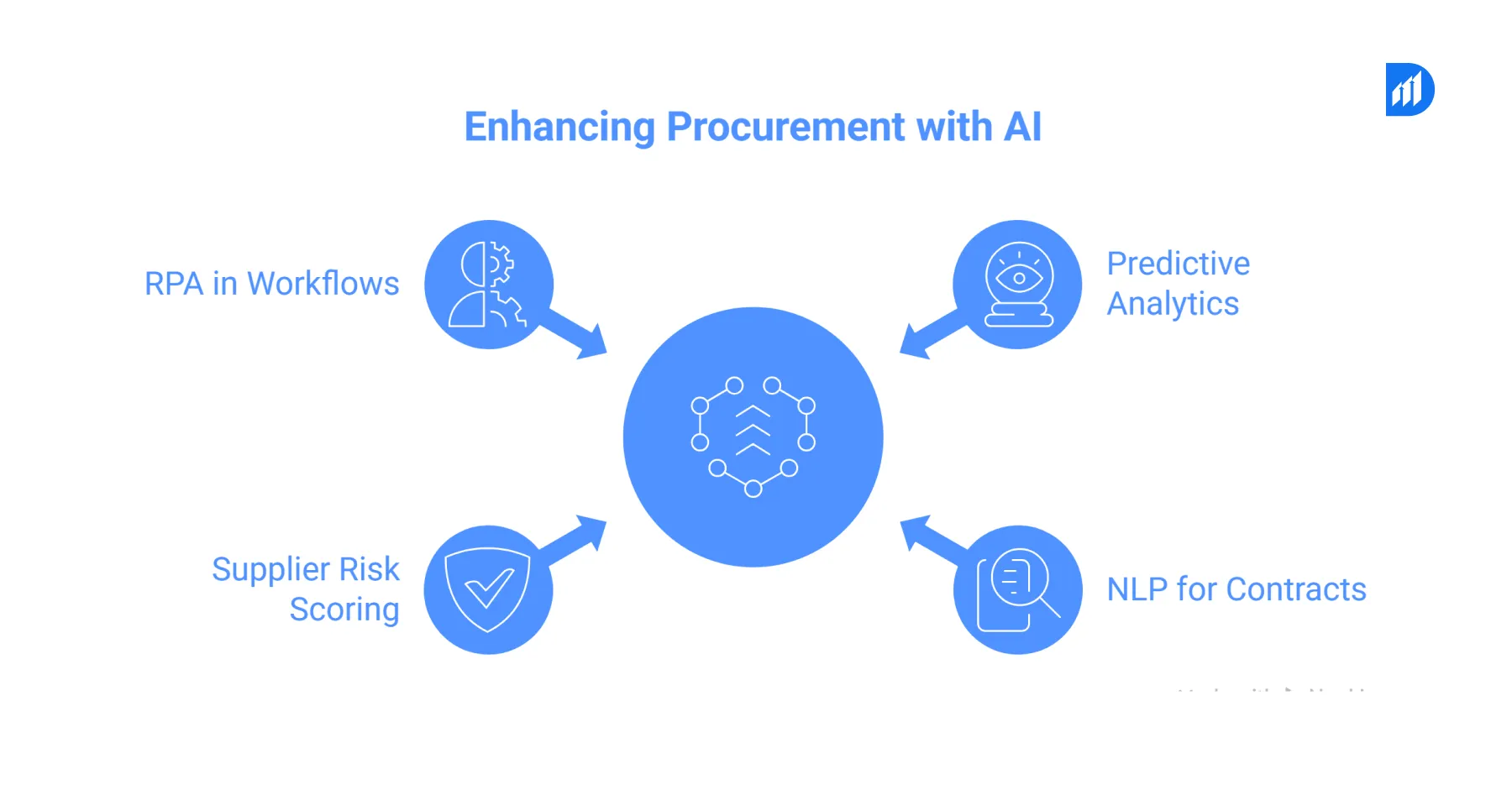
AI in procurement operates through multiple technologies which function together throughout the entire sourcing and purchasing process.
Predictive Analytics and Demand Forecasting
Machine learning models analyze historical spending data, seasonal demand patterns, and macroeconomic indicators to predict future procurement requirements with accurate results. Companies using ML-based demand forecasting report 15 to 20% reductions in excess inventory (Gartner, 2024).
Natural Language Processing for Contract Intelligence
NLP models automatically extract contract terms, classify them, then analyze throughout their entire operation. The legal team which manually reviews 50 contracts each month can utilize NLP-based contract analysis to process 5,000 contracts within the same time frame. It achieves 94% accuracy at clause extraction benchmarks.
Supplier Risk Scoring Models
ML classifiers evaluate supplier financial health, geopolitical risk, delivery performance, and compliance history through their scoring process. These models maintain continuous updating because they receive new data, while static scorecards require procurement teams to update them every three months.
Robotic Process Automation in Procurement Workflows
RPA bots handle repetitive procurement tasks which include purchase order generation, invoice matching, approval routing, and compliance document collection. RPA implementations in procurement report 70 to 80% reduction in manual processing time (Deloitte, 2023).
Reasons Why Enterprises Are Adopting AI in Procurement
Organizations have demonstrated the financial advantages of artificial intelligence applications for their procurement operations. Below are the five operational drivers which create measurable progress.
Cost Reduction Through Spend Visibility
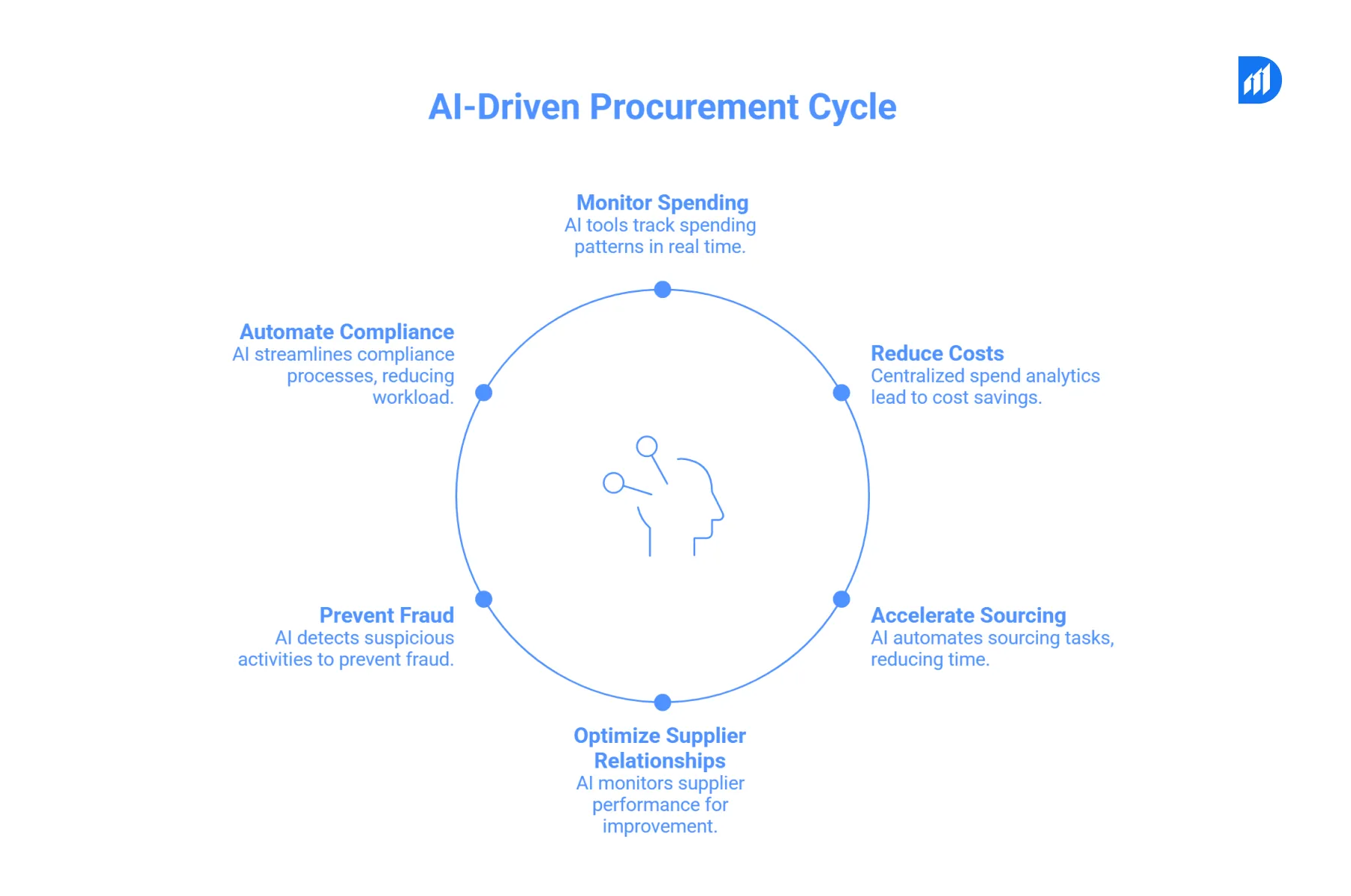
AI procurement tools enable organizations to monitor their spending patterns because they unify spending information from all parts of the organization, tracking expenditures in real time. Companies that centralize spend analytics with AI experience direct cost reductions between 8% and 12% during their initial operating year, according to Hackett Group 2023. For a USD 1 billion enterprise, that means recovering between USD 80 million and USD 120 million.
Faster Sourcing Cycles
Standard RFP procedures require 6 to 14 weeks to complete. In contrast, AI-assisted sourcing tools complete the process in 2 to 4 weeks because they automate all supplier shortlisting, scoring, and communication tasks. Manufacturing companies using AI sourcing tools for procurement report 62% faster time-to-contract for their repeated categories.
Supplier Relationship Optimization
AI systems track supplier performance data throughout the day by monitoring delivery times, quality metrics, and invoice verification rates. Teams with continuous AI monitoring capability detect performance degradation 4 to 6 weeks earlier than teams which depend on quarterly reviews. This allows them to implement solutions before any disruptions take place.
Procurement Fraud Prevention
AI anomaly detection models identify suspicious purchase patterns, duplicate invoices, and vendor collusion signals that human auditors fail to detect. IBM Security data demonstrates that AI-based fraud detection systems in financial workflows achieve 52% better results than traditional rule-based detection systems.
Compliance Automation
Organizations currently face increasing regulatory requirements that mandate suppliers to disclose ESG information, protect data privacy, and comply with trade regulations. Specifically, AI procurement tools create compliance data records while scoring them, which results in a workload reduction reaching between 40% and 60% for procurement staff members.
When NOT to Use AI in Procurement
Most procurement AI content only talks about the benefits. What vendors often do not emphasize enough is that AI procurement tools are only as good as the data behind them. Models trained on fragmented, outdated, or inconsistent procurement data will produce unreliable recommendations and poor forecasting results. This is why understanding artificial intelligence vs machine learning also matters here. While artificial intelligence enables broader automation and decision-making, machine learning models specifically depend on large volumes of clean historical data to improve accuracy over time. In most cases, organizations need at least 24 months of structured procurement transaction data before AI systems can deliver meaningful ROI.
AI also is not ideal for every procurement decision. Highly strategic sourcing decisions still require human judgment, relationship management, and business context that algorithms cannot fully understand. Choosing a sole-source supplier for a critical component often involves political, operational, and long-term strategic considerations that go beyond data analysis. AI should support procurement teams with insights and recommendations, not replace human expertise entirely.
Furthermore, organizations with fewer than 100 suppliers and under USD 50 million in annual procurement spend need to assess whether their implementation costs will deliver actual benefits. In these situations, well-configured procurement software with rules-based automation often delivers comparable results at significantly lower cost.
Challenges of AI in Procurement
The implementation of AI systems for procurement operations encounters real friction. Organizations need to understand their operational difficulties because this knowledge helps them avoid expensive project delays.
Data Quality and Integration Complexity
Procurement data exists in multiple locations: ERP systems, spreadsheets, email communication, and supplier portals. The process of building a unified data layer from multiple sources needs extensive data engineering resources. Data preparation work consumes 60 to 70% of total project time in enterprise implementations.
Change Management and Adoption Resistance
Procurement professionals often see AI tools as threats that diminish their professional expertise. Organizations that skip structured change management programs report adoption rates below 40% at the six-month mark. Successful implementations combine AI system deployment with training programs that teach AI as an analyst’s assistant, not a replacement.
Vendor Lock-in and Integration Risk
Many AI procurement tools function as proprietary systems which restrict access to their APIs. Organizations that use these systems without developing an exit plan often become trapped in the pricing model which vendors establish after two to three years. As a result, organizations should design their systems for interoperability from the beginning, requiring data transferability specifications to be included in all contracts.
Explainability in High-Stakes Decisions
Procurement officers need to create explanations that show their supplier choices to financial and compliance departments. The AI system fails to meet audit requirements when it cannot provide an understandable explanation for its recommendations. Therefore, the recommended approach for sourcing decisions involves using models that have integrated explainability systems instead of pure deep learning methods.
What is Generative AI in Procurement?
Generative AI in procurement uses large language models to create procurement documents, including RFP documents, contract drafts, supplier evaluation summaries, and spend analysis reports, from natural language requests.
This is the fastest-growing segment within AI for procurement. GenAI tools enable enterprises to cut contract drafting time by 65% along with RFP preparation time by 50% according to early corporate test results (Forrester, 2024). Additionally, the integration of Azure OpenAI with enterprise procurement data through retrieval-augmented generation (RAG) pipelines enables procurement teams to conduct natural language queries. They receive structured summary results within seconds.
Durapid’s AI consulting practice uses LangChain, FastAPI, and Azure OpenAI to implement GenAI procurement workflows. These workflows connect enterprise ERP data to conversational procurement interfaces that procurement teams can use without writing a single query.
AI Use Cases in Procurement: What Delivers Measurable ROI
The following table maps the highest-impact AI applications in procurement to quantified outcomes based on enterprise deployment data.
| AI Use Case | Technology Stack | Measured Outcome |
| Automated PO Generation | RPA + ML approval routing | 75% reduction in PO cycle time |
| Spend Analytics | Databricks + Power BI | 10–15% spend reduction in Year 1 |
| Contract Intelligence | NLP + Azure OpenAI | 94% clause extraction accuracy |
| Supplier Risk Scoring | ML classifiers + real-time data feeds | 4–6 weeks earlier risk detection |
| Demand Forecasting | Time-series ML models | 15–20% inventory cost reduction |
| Invoice Matching | Computer vision + RPA | 80% reduction in manual matching time |
| Fraud Detection | Anomaly detection models | 52% fewer false negatives vs. rule-based |
The outcomes above reflect enterprise deployments at the 12-month mark. Results in the first 90 days are typically more modest, since AI models require sufficient transaction volume to improve baseline accuracy.
Best Practices for Implementing AI in Procurement
The following structured implementation approach enables organizations to achieve their operational objectives while protecting against common failure risks.
Step 1: Audit Your Data First
Organizations must conduct data audits before proceeding to assess or purchase new software tools. All procurement data sources need to be documented, their completeness verified, and the data engineering work estimated for establishing a single data stream. The audit process requires between 3 and 6 weeks. It represents the essential work needed before vendor assessment starts.
Step 2: Start With a Specific Use Case
Begin with a bounded situation. Financial results from spend analytics and invoice matching become evident within two months after implementation, without needing complete ERP integration. Organizations should use their first successful project to gain organizational backing, which will then enable them to pursue more advanced predictive sourcing projects.
Step 3: Define Explainability Requirements Early
The organization needs to determine which purchasing decisions must have their rationale documented before choosing an AI procurement system. This shapes the architectural design of the model. It should also function as a mandatory evaluation standard.
Step 4: Build for Interoperability
All procurement AI vendors need to provide open API standards along with systems which permit data to be extracted. Organizations should use Databricks or Snowflake as their primary data storage solution instead of keeping procurement information within a vendor’s restricted database.
Step 5: Integrate With Your Existing ERP and Procurement Software
The use of independent AI tools which function outside the main ERP system leads to separate data repositories. The native AI functions of SAP Ariba, Coupa, and Oracle Procurement provide users with built-in capabilities that work with their existing systems. Durapid designs AI procurement systems which enhance existing SAP ERP systems through its role as an SAP Premium Partner. This integration-first approach becomes vital for teams developing AI solutions in manufacturing and healthcare supply chain operations.
The Future of AI in Procurement in 2026
Three trends will define AI procurement through 2026 and beyond.
Autonomous Procurement Agents
Agentic AI systems built on frameworks like LangChain agents will execute complete procurement workflows end-to-end without human initiation. The system automatically identifies procurement needs, creates a supplier shortlist, develops RFQs, delivers them for supplier assessment, then routes for approval. Early enterprise pilots in tech procurement report 85% reduction in procurement cycle time for tail-spend categories.
Real-Time ESG Compliance Scoring
Global regulatory bodies are increasing their demands for supply chain ESG disclosures. Organizations will require AI systems that perform real-time ESG assessments of their suppliers. This capability will shift from competitive advantage to compliance requirement by 2026. Moreover, organizations that build this capability now reduce the remediation cost of future regulatory compliance by an estimated 40%.
Cross-Enterprise Procurement Intelligence Networks
Procurement teams will use federated AI models to evaluate supplier performance and market rates across different industry consortia while keeping their proprietary information safe. This privacy-preserving procurement intelligence system is currently being used in manufacturing and healthcare supply chain networks. Teams building on top of AI vs. machine learning foundations today will be positioned to plug into these networks as they mature.
Are you ready to establish a procurement system which uses artificial intelligence? The AI consulting team at Durapid has developed AI in procurement solutions for financial services organizations, manufacturing companies, and healthcare providers. Durapid uses its 95+ Databricks-certified professionals, 150+ Microsoft-certified experts, and SAP Premium Partner status to create procurement AI systems which integrate with your current ERP system. Connect with our team to define the requirements for a procurement AI assessment at your organization.
Frequently Asked Questions
What is AI in procurement?
AI in procurement uses technologies like machine learning, NLP, and predictive analytics to automate sourcing, contract analysis, supplier management, and spend tracking across the procurement process.
How does AI improve procurement processes?
AI reduces repetitive manual work, speeds up approvals, improves spend visibility, and helps teams make faster procurement decisions using real-time data and analytics.
Can AI automate purchase orders and approvals?
Yes. AI can automate purchase order creation, invoice matching, and approval workflows using intelligent automation and rule-based systems.
How does AI help reduce procurement costs?
AI identifies unnecessary spending, contract leaks, sourcing inefficiencies, and supplier risks, helping businesses reduce procurement costs and improve budgeting.
Can AI help prevent procurement fraud?
Yes. AI can detect unusual spending patterns, duplicate invoices, suspicious vendor activity, and procurement anomalies much faster than manual systems.
What role does AI play in procurement analytics?
AI helps businesses analyze procurement data, track supplier performance, monitor contract compliance, and generate actionable insights in real time.
What technologies are used in AI procurement solutions?
AI procurement solutions commonly use machine learning, NLP, predictive analytics, generative AI, RPA, Power BI, Databricks, and cloud-based procurement software.
How does AI help with procurement forecasting?
AI analyzes historical spend data, supplier trends, and demand patterns to improve procurement forecasting accuracy and inventory planning.
Recent Blog

Asset Management Software for CFOs: From Depreciation to Capital Planning
September 29, 2026-
Why Voice AI Is Different From Chatbots in Recruitment?
September 17, 2026