AI in Warehouse Automation: Making Warehouses Faster, Smarter, and More Efficient in 2026
Warehouses in 2026 look a whole lot different from what they did a few years back. They’re no longer just huge storage spaces with shelves, forklifts, and endless manual tracking, not quite. A lot of businesses are now leaning on AI warehouse automation so things move quicker, stay smarter, and run more efficiently overall, especially when customer demands keep rising without the whole process slowing down. From managing inventory in real time to cutting delays in shipping and fulfillment, artificial intelligence is quietly changing how warehouses operate in the background.
As industries keep pushing for faster deliveries and more precise operations, warehouse automation solutions are turning from a nice option into basically a necessity. Companies are investing in machine learning, predictive analytics, IoT devices, as well as warehouse robot systems to handle repetitive work and sharpen decision-making. An “AI warehouse” can forecast stock shortages, improve storage layouts, boost order accuracy, and lower operational costs, while also helping the teams stay more productive. Even if some businesses are only exploring the future of warehouse management system technology, they’re still heavily focused on AI driven automation so they can stay competitive in this ever quick market.
In this blog we’ll look at how AI in warehouse automation works, which technologies are powering modern warehouses, what kinds of benefits companies are actually seeing in 2026, and what the future of smart warehouse management will look like moving forward.
What Is AI-Powered Warehouse Automation?
Warehouse automation is no longer a future investment. It is the operational baseline that splits high-performance supply chains from the ones that bleed cost and accuracy. According to McKinsey, warehouses using AI-powered automation can see productivity boosts of 20 to 30 percent within the first year, not “sometime later”. The older approach of manual picking, paper-based inventory, and batch refreshed reporting just can’t keep pace with the velocity or scale that modern fulfillment now expects.
This blog walks through how AI warehouse automation works, what technologies actually power it, when it becomes a smart business move, and why some deployments typically stumble. Whether you are assessing automation solutions for the first time, or you’re expanding an existing system, this guide gives you the technical clarity to move ahead with confidence.
AI-powered warehouse automation kinda brings together machine learning, computer vision, robotic process automation, and live data analytics. The goal is to replace, or at least meaningfully augment, a lot of the manual work that happens in warehouses. It spans pretty much the whole flow, from goods receipt to putaway, then picking, packing, dispatch, and even inventory replenishment.
Meanwhile the usual warehouse management systems (WMS) tend to run on fixed rules. Like if stock drops under X then reorder Y, pretty static. But an AI warehouse system learns from what’s happening in day-to-day operations. It can forecast demand spikes, reroute warehouse robots dynamically, notice quality defects using camera feeds, and shift labor allocation in real time, without waiting for a person to step in. So the end result is more like a self-optimizing setup instead of a warehouse that’s manually managed all the time.
Why Businesses Are Investing in AI Warehouse Automation?
The economics are kind of hard to ignore, you know. Labor makes up roughly 65 percent of total warehouse operating costs, according to Gartner. At the same time, e-commerce order volumes have risen about 143 percent across five years. Delivery windows have also shrunk from days to hours in most markets, like literally.
These two forces, rising labor costs and faster fulfillment expectations, create a lot of strain that manual operations basically cannot absorb. AI in warehouse management tackles both at once. It automates high-volume repetitive work while also boosting the precision and pace of operations that still need human judgment. Companies putting money into AI for supply chain optimization are already noticing real competitive benefits in better fill rates, lower shrinkage, and same-day dispatch.
Key Benefits of AI in Warehouse Operations
The measurable impact of AI warehouse automation spans four core operational areas.
| Benefit Area | Traditional Warehouse | AI-Automated Warehouse |
| Order Accuracy | 96 to 98% (manual pick) | 99.9% with computer vision and robotics |
| Inventory Accuracy | 70 to 80% (cycle counts) | 98 to 99% with real-time RFID and AI |
| Pick Rate | 80 to 120 units per hour | 300 to 600 units per hour (robotic systems) |
| Labor Cost per Unit | Baseline | 40 to 60% reduction |
| Returns Processing Time | 2 to 4 days | 4 to 8 hours (automated inspection) |
These numbers show real deployment outcomes from facilities running robotic picking systems, but also with AI-driven WMS platforms. Like when you see 99.9 percent accuracy, it really turns into fewer returns and reduced penalty chargebacks from retailers, plus stronger customer retention metrics too.
Core Technologies Behind Smart Warehouse Automation
AI warehouse automation isn’t just one technology. It’s more like a stitched together stack of systems, all moving in rhythm. When you see how each layer fits, you can make smarter calls on where to begin first. Then you figure out how to expand later, without getting lost. In practice it’s integrated at the nuts and bolts level, not a single silver bullet, so thinking in layers matters, a lot.
Warehouse Robots and Autonomous Mobile Robots (AMRs)
Warehouse robots really end up in two main buckets. There’s fixed automation like conveyor systems and robotic arms, and then there are autonomous mobile robots, AMRs, that handle navigation on the fly with onboard sensors and AI based pathfinding. The AMR option is kind of the go-to for most new deployments these days. They can reconfigure without messing with the physical facility layout, like at all.
Companies such as Amazon, DHL, and Ocado operate robot warehouse fleets with hundreds to thousands of AMRs. Each warehouse robot keeps talking back to a central AI fleet management platform, which hands out work, settles routing disputes, and keeps tuning travel routes in real time.
Computer Vision and Quality Inspection
Computer vision systems scan items in high speed mode, using cameras together with deep learning models. They are trained to spot defects, validate labels, confirm the measurements, and make sure the counts are right. In practice, one vision station can examine about 1,200 items per minute with accuracy that goes past 99.5 percent. It replaces like five to eight people doing manual checks, at a smaller operating cost overall.
Predictive Analytics and Demand Forecasting
Machine learning models trained on purchase history and seasonality, plus a few outer signals such as weather or promos, tend to create demand estimates within 3 to 5 percent for most SKU groups. That then feeds right into replenishment logic which tries to block stockouts while limiting overstock at the same time.
What’s kind of interesting is how this predictive piece fits in smoothly with the wider AI inventory management plan, not only inside the warehouse area, but also spilling outward into supplier networks too. It’s like the whole supply chain gets a bit more synchronized and less guesswork.
Natural Language Processing and Voice-Directed Picking
Voice driven picking systems powered by NLP let workers receive instructions and confirm jobs hands-free in practice. The error rates on these voice pick tasks are running 67 percent lower than the paper based equivalents. Pick speed also ends up higher by 20 to 25 percent, according to documented deployments.
How AI Is Transforming Inventory Management?
AI inventory management kind of flips things from reactive replenishment to predictive stocking. Instead of placing an order when stock just hits a reorder point, AI systems watch sell-through velocity, supplier lead times, and those probabilistic demand cues. They then place the order at a better, actually optimal moment, and also with the optimal amount.
Real-time inventory visibility is basically the backbone. AI warehouse systems tie barcode scanners, RFID readers, conveyor sensors, and robotic systems into one continuous live data stream. Inventory positions move in milliseconds not in overnight batch cycles. So it cuts out that “shadow inventory” issue where the WMS suggests you have stock when it’s really misplaced, or sitting unprocessed somewhere. For perishable goods, AI models that manage first-expiry-first-out (FEFO) compliance have helped reduce spoilage by about 18 to 22 percent across multiple cold chain deployments.
AI Applications in Modern Warehouse Management
The broadest rollouts of artificial intelligence warehouse technology cover pretty much every step, from the receiving dock all the way to the last-mile handoff. Here are the concrete use cases that tend to show the strongest measured ROI inside enterprise environments, even when the floor is busy and messy.
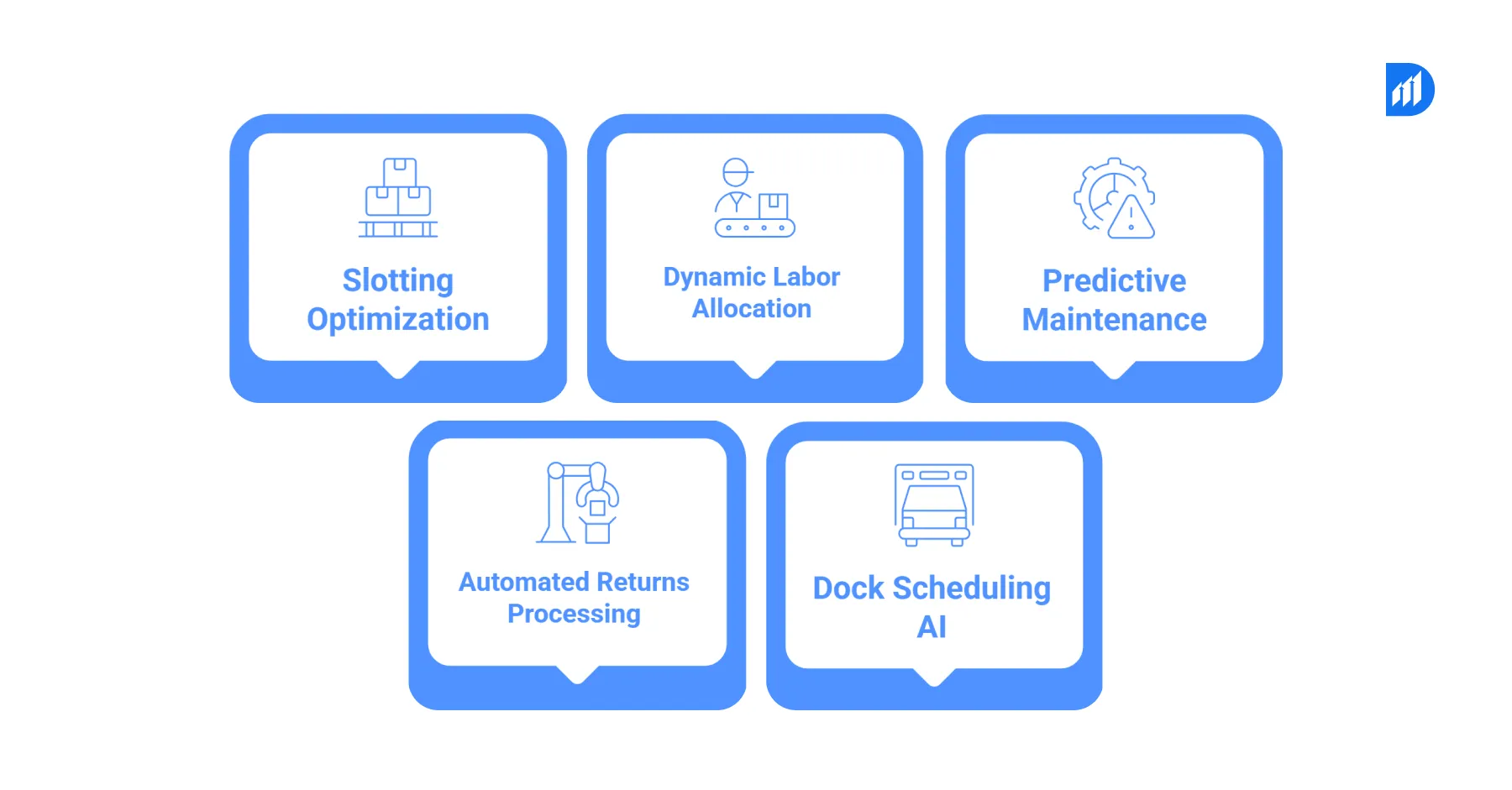
Slotting optimization: AI studies pick frequency plus co occurrence behavior, then places SKUs so the average walking and reach time stays low. With that optimized slotting, travel distance for pickers drops about 20 to 35 percent.
Dynamic labor allocation: Workforce management AI shifts people between areas using live queue depth signals. This helps avoid those sticky bottlenecks without someone constantly hovering with a clipboard.
Predictive maintenance: Sensors on conveyor motors, sorter assemblies, and robotic joints send data into anomaly detection models. These models flag likely trouble roughly 5 to 14 days before a breakdown, which cuts unplanned downtime by around 40 percent.
Automated returns processing: Computer vision checks the return condition, routes items for restock, repair, or disposal, and refreshes inventory records in less than 10 minutes per item.
Dock scheduling AI: Forecasting models line up inbound and outbound truck slot timing to reduce yard congestion. In higher volume settings, this can lower detention fees by about 30 to 50 percent.
How AI Improves Warehouse Efficiency and Accuracy?
AI boosts warehouse efficiency through two separate mechanisms. Kind of like one is about movement and the other is about mistakes. It’s not the same problem, and it does not get fixed with one same technical approach. The wasted motion part is handled via path optimization. AI fleet management systems figure out the shortest collision-free routes for each warehouse robot. They coordinate hundreds of simultaneous moves, trying to get more throughput per square foot. In a 100,000 square foot facility, path optimization on its own can deliver about 15 to 25 percent more picks per shift, even without adding extra hardware.
The error elimination part is more about removing human decision making from repetitive checks. Computer vision, barcode scan confirmation, and weight validation catch picking errors before the items reach the packing station. In AI-assisted pick operations, error rates typically stay under 0.01 percent, compared with roughly 0.5 to 1 percent in manual operations. That’s about a 50 to 100 times improvement in accuracy.
Steps to Implement AI in Warehouse Management
Most enterprise warehouse automation deployments tend to follow a six phase model, like yeah it’s pretty standard. But the sequence does matter. Skipping the data readiness assessment is usually the single most common cause behind deployments that just fail. Take a hard look at where you are now. Do an audit of your current state, then baseline your pick accuracy, your throughput per labor hour, inventory accuracy, and your cost per order. You can’t really measure ROI if you don’t have a verified starting point to compare against.
Next, assess the data infrastructure. AI models need clean, timestamped operational data, otherwise they stumble. So audit your WMS data quality, your sensor coverage, and your integration architecture before you even choose an AI platform. Otherwise you end up buying tools for problems that were already there.Then define the primary use case. Start with your biggest-cost headache, often picking accuracy or inventory visibility, instead of trying to jump straight into full automation in phase one. It’s tempting, but it’s rarely the smart move.
Picking the Right Stack and Running a Pilot
Pick your technology stack. For most enterprise implementations, a setup using Databricks for data processing, a modern WMS API layer, and an AMR platform like Locus Robotics, 6 River Systems, or Geek+ for robot warehouse operations tends to deliver the strongest early ROI.
Pilot in one zone. Run a 60 to 90 day pilot inside a single warehouse zone. Compare results to your baseline and watch for integration failures. Validate model accuracy before you scale beyond that one area. Finally, scale with change management. Deploying tech without workforce retraining consistently underperforms, not by a little, but by a lot. Train staff on exception handling, robot supervision, and AI assisted decision workflows in parallel with the rollout. That way the system actually fits how people work.
Best Practices for AI-Driven Warehouse Automation
Deployments that work tend to line up behind a handful of operational and tech disciplines that most failed efforts just skip mostly. Keep a digital twin going, like a running mirror of your warehouse. It’s a real time simulation of the layout plus inventory state. With that you can trial slotting tweaks, push throughput scenarios, and even plan robot fleet expansions before you touch any physical stuff.
Plan for exception handling from day one. In practice the AI handles about 95 percent of tasks with no back and forth. But the remaining 5 percent, the one that needs real judgment, should have human workflows designed around it. Then train the team on those exact edge cases before going live. Watch for model drift. Demand patterns shift, product mixes change, and operational constraints evolve over time. So schedule quarterly retraining cycles for every predictive model. Keep accuracy metrics under review continuously, not just once in a while.
Embedding Safety Before You Scale
Bring safety systems into the control layer, not on top of it. For robot warehouse deployments you want collision avoidance, load sensing, and emergency stop protocols embedded in the control architecture. If it’s only bolted on after deployment, it’s usually too late and too messy.
Common Challenges in AI Warehouse Implementation
Three failure modes show up over and over across enterprise AI warehouse deployments. If you know them up front the outcome changes a lot, like really fast.
Data quality gaps hit about 70 percent of first time AI warehouse deployments. In a lot of cases, older WMS history has inconsistent SKU identifiers, some missing timestamps, and location codes that are just plain off. That alone can reduce model accuracy before training ever begins. When teams run a dedicated data remediation sprint first, the results usually improve noticeably.
Integration complexity is also almost always underestimated. Trying to connect AMR systems, WMS platforms, ERP data feeds, and IoT sensor networks ends up needing careful API management and an event driven architecture. Kafka based event streaming, whether it’s deployed on Azure or AWS, tends to manage the data volume requirements of large facilities in a much more dependable way.
Why Change Management Gets Overlooked?
Then there’s change resistance from warehouse staff, which is not theoretical, it’s measurable. Deployments that treat AI like a straight replacement tool often create adoption friction. But deployments that position AI as a co-worker, handling repetitive actions while staff manage the complex exceptions, tend to ramp up sooner and land with fewer errors during the transition.
Durapid’s AI/ML Development Services team has already walked through all three of these failure modes across manufacturing, logistics, and retail warehouse deployments. They’re backed by 95+ Databricks certified professionals focused on data pipeline architecture, so the basics are handled before things get fragile.
When NOT to Use AI Warehouse Automation?
Not every warehouse is truly set up for AI automation. If you roll it out too soon it tends to throw money at the problem, with results you can pretty much see coming. It is best to avoid AI-first stuff when your current WMS data is under 12 months old or when there is documented accuracy sitting below 85 percent. You can train models all day, but if the inputs are shaky, the predictions get unreliable. No matter how solid the algorithm underneath really is.
Also, if you are running fewer than 500 daily orders and your SKU mix stays pretty steady, then going all in on full robotic systems usually won’t land ROI inside a 3-year payback window. In those cases, more focused automation like voice-directed picking or AI-assisted demand forecasting often pays back better while using less upfront capital.
Then there is the building itself. Low-ceiling spaces, or facilities with weird, irregular shapes, create physical limits that make AMR deployment hard to justify, or just not practical. Depending on the layout and throughput profile, fixed automation or goods-to-person systems might fit much more naturally in reality.
Cost and ROI of AI Warehouse Automation
Getting initial investment for an enterprise AI warehouse automation rollout can start around $500,000 for very targeted automation. It can also climb to $5 million or even higher if you’re building full robotic systems that include fleet management AI. The spread is pretty wide because facility scale, SKU complexity, and integration expectations can be wildly different from one operation to the next, honestly.
What Drives the Payback Timeline?
On the payback side, most cases land somewhere in the 18 to 36 month window for mid sized facilities pushing about 2,000 or more orders each day. The big ROI movers are pretty consistent. These include lowering labor expenses by roughly 40 to 60 percent, cutting error related losses which often shows up as $5 to $20 saved per incorrect shipment, plus inventory holding cost reduction from improved demand alignment, which helps shrinkage and cash flow.
For a 200,000 square foot building handling around 5,000 orders per day, you typically see total savings of about $3 to $6 million per year once full automation is in place. That’s usually combined from labor improvements, fewer picking or packing mistakes, and reduced shrinkage overall.
Future Trends in AI-Powered Warehouse Management
The future of warehouse management system design seems to be drifting toward fully autonomous, self-optimizing environments. It is already starting to show up in early enterprise adoption, at least as of 2026. A big one is generative AI for operational planning, where large language models are being plugged into WMS data. They can then spit out operational plans, staffing suggestions, and even exception resolution scripts. Most of it runs without the usual manual setup or that kind of fiddly configuration everyone expects. Then there is digital twin orchestration. Basically real time digital twins simulate the whole facility so teams can keep optimizing continuously, test scenarios, and run predictive failure modeling. The level of detail here was kind of impractical before, especially at scale.
Edge AI on robotic hardware is another shift. Moving inference onto the robot itself lowers decision latency from something like 50 to 200 milliseconds in cloud dependent setups down to under 5 milliseconds. With that kind of timing, you get quicker pathfinding and near real time obstacle reaction at the unit level, rather than waiting on network round trips. Finally there is sustainability optimization, where AI is learning how to reduce energy usage across conveyors, HVAC, and lighting based on throughput forecasts. In early documented deployments this is cutting warehouse carbon footprints by roughly 15 to 25 percent, which is honestly not a small swing.
The Future of Smart Warehouses in 2026
In 2026, smart warehouses work like interconnected setups where every real-world action makes data, every data point gets pulled into a model, and every model output nudges an automated call. The distance between AI-enabled sites and older warehouses keeps growing. It shows up in fulfillment speed, cost per order, and customer satisfaction scores.
Groups moving toward this approach are basically pairing warehouse AI with larger AI for manufacturing transformation plans, so they end up with unified intelligent operations, not those isolated automation little islands that never quite talk to each other.
In the end, the warehouses that do well during the next five years won’t be the ones with the most robots. They will be the ones where AI, robotics, and human know how actually work as one coherent system.
Frequently Asked Questions
- What is warehouse automation?
Warehouse automation is basically using technology like AI, robotics, and software to handle tasks that people earlier did manually. Things like picking, packing, sorting, and inventory tracking become faster, smarter, and way more efficient. - How is AI used in warehouse automation?
AI helps warehouses make better decisions in real time. From demand forecasting and inventory tracking to smart routing and predictive maintenance, AI warehouse systems reduce delays and improve overall operations. - What are the benefits of AI in warehouse management?
Better accuracy. Faster fulfillment. Lower costs. Fewer mistakes. AI powered warehouse automation helps businesses save time while improving productivity and inventory management. - How does AI improve warehouse efficiency?
AI optimizes workflows, predicts equipment failures, automates repetitive tasks, and helps warehouse robot systems move more efficiently. Basically, less chaos and smoother operations. - How does warehouse automation reduce operational costs?
It reduces manual labor, minimizes errors, improves inventory accuracy, and speeds up fulfillment. Businesses can process more orders without increasing operational pressure. - How does AI reduce warehouse errors and delays?
AI uses technologies like computer vision and real-time tracking to catch mistakes before orders are shipped. This helps improve accuracy and reduce delays significantly. - What are the challenges of implementing warehouse automation?
The biggest challenges are usually high setup costs, system integration issues, data quality problems, and helping teams adapt to new workflows and technologies. - Can small businesses implement warehouse automation?
Yes, absolutely. Small businesses can start with simpler warehouse automation solutions like AI inventory tracking or voice-assisted systems before scaling further. - What is the future of AI in warehouse automation?
The future of warehouse management system technology is becoming more intelligent, connected, and autonomous. AI will continue handling more warehouse tasks with better speed and accuracy. - How can businesses get started with AI powered warehouse management?
Start small. Identify operational gaps, improve your data systems, run a pilot project, and scale gradually with the right AI and automation partner.

Recent Blog

Asset Management Software for CFOs: From Depreciation to Capital Planning
September 29, 2026-
Why Voice AI Is Different From Chatbots in Recruitment?
September 17, 2026 -
LlamaIndex vs LangChain: Which One to Choose in 2026?
July 29, 2026