AI Inventory Management in Los Angeles: Benefits, Use Cases, and Implementation Strategies
The AI inventory management system has transitioned from its previous status as a supplementary system to become essential for contemporary business operations. It enables companies to operate their warehouses more effectively through its implementation in dynamic markets such as Los Angeles, which suffers financial losses due to minor inventory management errors.
The inventory management process appears straightforward on paper. But it actually leads to continuous issues with overstocking and stockouts that require manual fixes. This situation gets resolved through artificial intelligence management, which brings organizations predictability, automation, and current operational control over their systems. Previously, those systems operated at a minimum level of response.
Companies now develop entire interconnected systems that use AI technologies for Asset Management, AI Marketing Agents, and advanced marketing workflows. Together, these establish operational processes that respond better while increasing productivity throughout their business operations.
This blog will present the operational functions of AI inventory management in actual business situations. It will demonstrate its benefits throughout Los Angeles while providing guidance on effective implementation methods that lead to system improvements without creating new problems.
What Is AI Inventory Management and Why Does It Matter Now?
The financial losses of Los Angeles businesses result from their inability to monitor their unsold inventory. The San Fernando Valley warehouses maintain excessive inventory, which results in lost business resources. Insufficient stock in retail stores from Downtown LA to Santa Monica forces customers to choose other stores. At present, all businesses in Los Angeles which operate in logistics, retail, healthcare, and manufacturing turn to AI inventory management as their solution for operational needs.
AI inventory management uses machine learning models, predictive analytics, and real-time data pipelines to make automated stock management decisions. The system enables automatic inventory management through its ability to handle multiple variables at once. It also replaces manual reorder triggers and spreadsheet-based forecasting. Traditional inventory management systems operate on fixed reorder points. They fail to account for seasonal demand increases, supplier delivery times, and regional purchasing patterns. AI-powered systems use point-of-sale information together with weather data, promotional schedules, and past patterns to establish optimal inventory levels in real time.
The functions of inventory management handled by AI include demand prediction, automatic stock restocking, identification of non-salable items, evaluation of supplier efficiency, and distribution of inventory across different sites. Each function that transitions from manual to automated leads to substantial decreases in both error rates and operational time.
How Fast Is AI Inventory Management Growing?
The numbers make the urgency clear. McKinsey’s State of AI report shows that 78 percent of organizations use AI in their operations. Nearly 50 percent of these organizations implement it for inventory and supply chain management. The global AI inventory management market reached a valuation of 5.7 billion dollars in 2023. It is expected to reach 21 billion dollars by 2028, with a compound annual growth rate of 29.5 percent. For Los Angeles companies operating in the most cargo-intensive areas of the United States, adapting to this change creates a clear strategic advantage.
Where AI Inventory Management Is Making an Impact in Los Angeles?
Los Angeles exists at the point where the Port of LA and a consumer market of 13 million people meet. This combination generates distinct inventory challenges which impact multiple business sectors.
Retail companies along Melrose and the Fashion District manage seasonal collections with high SKU counts. A single wrong purchasing decision across 50 stores can mean millions in markdown losses. AI management systems trained on historical sell-through rates and real-time foot traffic data reduce that risk significantly. Healthcare distributors supplying LA’s hospital networks use AI inventory management to maintain precise stock levels for critical supplies. A stockout in surgical consumables does not just mean lost revenue. It also means delayed procedures. The inventory handling requirements here are non-negotiable. AI systems, therefore, provide the accuracy levels that manual teams simply cannot match.
Manufacturing companies in the City of Industry and Compton are using AI technology to optimize their asset management processes. This helps them synchronize raw material stock with their manufacturing operations. AI models that track 200 supplier signals simultaneously can identify a component shortage 72 hours before it leads to operational halts.
Top Industry Use Cases Driving AI Inventory Management Adoption
AI inventory management is not a single tool. It operates differently across industries, with each use case solving a distinct operational challenge.
Demand Forecasting for E-Commerce: E-commerce sellers operating out of LA’s Inland Empire fulfillment centers use predictive models built on Azure Machine Learning or AWS SageMaker. They forecast SKU-level demand 30 to 90 days out. Machine learning forecasting allows companies to achieve inventory carrying cost reductions between 20 and 25 percent compared to traditional methods.
Automated Replenishment for Retail Chains: AI management systems connect with POS platforms like Shopify or SAP S/4HANA to automatically create purchase orders when inventory levels fall below forecasted safety stock levels. As a result, the system enables buyers to handle 40% less manual work while achieving a 30% reduction in stockout situations.
Expiry and Compliance Tracking for Healthcare: Hospitals and pharmacies in LA use RFID-integrated AI inventory management platforms to track lot numbers, expiry dates, and FDA compliance status throughout the inventory handling process. Artificial intelligence management in this space reduces wastage from expired stock by 18% on average.
Multi-Warehouse Balancing for Logistics: Third-party logistics firms use AI systems to manage inventory across multiple LA warehouses by redistributing stock according to demand patterns in each delivery area. Consequently, this achieves a 22% reduction in inter-facility transfers, which directly lowers transportation expenses.
The table below shows patterns of AI management system adoption by North American enterprises.
| Industry | Key AI Use Case | Reported Improvement |
| Retail | Demand forecasting + auto-replenishment | 20–25% cost reduction |
| Healthcare | Expiry tracking + compliance automation | 18% wastage reduction |
| E-Commerce | SKU-level prediction models | 30% fewer stockouts |
| Manufacturing | Supplier signal monitoring | 72-hr early shortage detection |
| Logistics | Multi-location stock balancing | 22% fewer transfers |
Businesses in LA that match their operational scale with other organizations achieve similar results after 9 to 12 months of complete system usage.
How AI Inventory Management Cuts Costs and Eliminates Stock Issues?
The main financial justification for using AI inventory management comes down to two specific figures. US retailers face annual losses of $471 billion because they maintain excessive inventory levels. Businesses also lose $634 billion through inventory shortages that result in missed sales opportunities. Together, that exceeds $1 trillion in preventable loss every year.
AI-powered inventory management systems attack both problems simultaneously. On the overstock side, AI models use sell-through velocity, markdown history, and seasonal decay curves to create leaner purchasing quantity recommendations. On the understock side, the replenishment models pull from real-time demand signals coming from marketing workflows, promotions, and external events. They stop shelf gaps from emerging before they form. Companies that have implemented AI management systems report a 10 to 15% reduction in total inventory costs within the first year. Toyota’s AI-enhanced supply chain reduced inventory turnover times by 20% in 2024. It also maintained production continuity during the worldwide chip shortage.
For mid-sized LA businesses with $10 million in annual inventory spend, a 15% cost reduction translates to $1.5 million back into operating budgets. That is a clear ROI. It justifies implementation costs in most situations.
Why the Savings Go Beyond Just Numbers?
The financial benefit is only part of the picture. Operational confidence is the other half. When AI inventory management removes the guesswork from purchasing decisions, teams spend less time firefighting stockouts. They also reduce the hours spent manually reconciling inventory data. That recovered time goes back into strategy, not damage control. Additionally, better inventory handling directly improves customer satisfaction scores. Fewer stockouts mean more orders fulfilled on time. In competitive LA markets, that consistency builds the kind of loyalty that is hard to buy through discounting.
When NOT to Use AI Inventory Management?
AI inventory management delivers strong results under specific conditions. It performs best when businesses have clean historical data spanning at least 18 to 24 months. They also need a reasonable SKU count, typically above 50, along with consistent transaction volumes. The inventory management process must generate enough data for the model to learn from.
However, AI systems are not the right fit for every situation. Very early-stage businesses with fewer than 12 months of sales history lack the data depth that AI models require for accurate forecasting. Similarly, businesses with highly erratic demand driven by one-off custom orders cannot generate the repeatable patterns AI needs.
If your current inventory management process runs on disconnected spreadsheets with no integration to your POS or ERP system, deploying AI before fixing that foundation creates noise, not insight. Data infrastructure must come first.
A Step-by-Step Roadmap to AI Inventory Management Implementation
Most AI inventory management projects fail not because of the technology but because of poor sequencing. Here is a practical implementation roadmap that LA enterprises are following successfully.
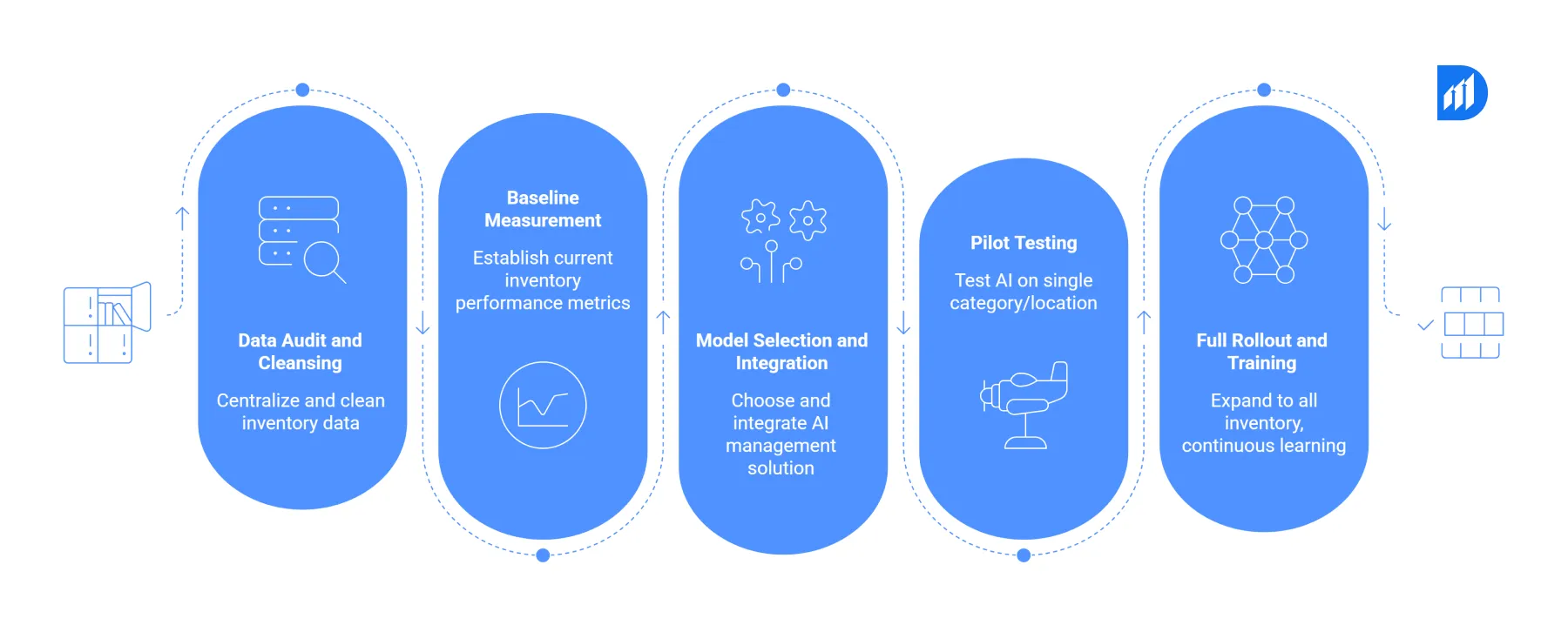
Step 1: Data Audit and Cleansing Pull 24 months of sales, returns, purchase orders, and supplier lead times into a centralized data repository. Platforms like Snowflake or Azure Data Lake provide the capacity to manage the required data volume. Clean duplicate SKUs, standardize unit-of-measure fields, and fill historical gaps from past records.
Step 2: Baseline Measurement Measure your current stockout rate along with your inventory turnover ratio, carrying cost percentage, and order accuracy rate. These become your pre-AI benchmarks. Without them, measuring ROI after implementation is guesswork.
Step 3: Model Selection and Integration Choose between ready-made AI management solutions such as Blue Yonder, RELEX Solutions, and Oracle Fusion, or custom models built on Azure ML or AWS SageMaker. The selection process requires assessment of your ERP environment. It also depends on how complex your demand patterns are. Durapid’s AI/ML Development Services team executes the scoping process as part of their implementation planning.
Testing Before You Scale
Step 4: Pilot on a Single Category or Location Run the AI inventory management system on one product category or one warehouse location for 60 to 90 days. Compare AI-generated reorder recommendations against your existing purchasing methods. Then measure the accuracy of predictions against actual market demand.
Step 5: Full Rollout and Continuous Training Expand to all inventory after confirming positive results from the initial pilot. Set up automated model retraining pipelines through Apache Airflow. This enables the AI to continuously learn from changing demand patterns, seasonal variations, and supplier changes.
The sequenced approach enables businesses to launch faster. They also hit return on investment targets earlier while reducing integration problems. Full deployment without a pilot stage results in a 40% increase in incidents during the first three months.
How E-Commerce, Healthcare, and Manufacturing Use AI for Stock Control?
Each sector has distinct inventory handling challenges that shape how AI models get configured.
E-Commerce: LA-based direct-to-consumer brands use AI marketing agents connected to inventory systems. This ensures promotional campaigns automatically factor in available stock. When a flash sale triggers a 400% demand spike, the AI inventory management system updates replenishment orders in near real time. It does not wait two weeks to identify the supply shortage.
Healthcare: Supply chain directors at LA medical centers integrate AI with their EMR platforms. The system predicts procedure volumes and schedules inventory restocks based on that forecast. This approach connects directly to AI in asset management strategies, where high-value medical equipment usage and consumable stock are managed together.
Manufacturing: Manufacturers in LA County use artificial intelligence management to monitor supplier signals through more than 200 different parameters. Delivery delays, raw material price shifts, and geopolitical disruptions all feed into the AI model. The system recommends safety stock adjustments before the disruption reaches the production floor. This process decreases emergency purchasing expenses by 17 percent on average.
The common thread is integration. AI inventory management only delivers its full value when it connects to the broader data ecosystem, including ERP systems, marketing workflows, supplier portals, and logistics platforms.
FAQs
What is AI inventory management?
It uses machine learning and predictive analytics to automate decisions like demand forecasting, reorder triggers, and multi-location balancing, replacing manual spreadsheets with systems that think ahead instead of reacting later.
How much does AI inventory management reduce costs?
Most companies see around a 10 to 15 percent reduction in inventory costs within the first year. In high-volume industries, this can go up to 25 percent, depending on how inefficient things were before.
Is AI inventory management suitable for small businesses?
It works best when you have at least 18 months of clean sales data and around 50 or more SKUs. If you are just starting out, fix your data foundation first before moving into AI.
Which tools power AI inventory management systems?
Platforms like Blue Yonder, RELEX Solutions, and Oracle Fusion are commonly used, along with custom models on Azure or AWS. These usually connect with ERP systems like SAP S/4HANA to make everything work together.
How long does AI inventory management implementation take?
A proper rollout including data audit, pilot, and full deployment usually takes 3 to 6 months. The timeline mostly depends on how clean your data is and how complex your current system looks.
Ready to fix your inventory operations?
Durapid’s AI and data engineering teams work with LA businesses to design and deploy AI inventory management systems that fit into your existing setup. Talk to them and get a clear roadmap instead of trying to piece things together on your own.

Recent Blog

How Voice AI Connects Calls With Sales Operations
October 15, 2026-
How GCCs Can Scale Engineering Teams with Staff Augmentation?
October 10, 2026 -
Asset Management Software for CFOs: From Depreciation to Capital Planning
September 29, 2026 -
Why Voice AI Is Different From Chatbots in Recruitment?
September 17, 2026