AI-Powered Marketing Workflows: A Step-by-Step Guide for Businesses
Your marketing team sends 10,000 emails which result in 900 email opens. Out of those, only 60 people make a purchase. Your company employed three content writers, ran five marketing campaigns, while conducting market research for four months. Your competitor achieved a 30 percent lead advantage using half of their team. What unique approach do they use to achieve success? The organization employs ai powered marketing platforms that create personalized customer contact methods while managing large-scale marketing operations through automated systems. The guide provides detailed instructions about system operation and building system components. Your audience already interacts with artificial intelligence systems whether you have developed those systems for them or not.
Data exists for every click, every scroll, and every cart abandonment event. The businesses that possess this knowledge can make precise marketing decisions without needing to estimate outcomes. They can forecast future results, much like how analyzing patterns such as boston market locations reveals deeper consumer behavior trends. The solution requires ai powered marketing platforms to provide assistance. Let us now explain the complete system operation.
What Are AI-Powered Marketing Workflows and How Do They Work?
Organizations used to manage their operations through separate systems which delayed information access while requiring staff to perform tasks manually. Organizations now create systems that possess the capacity to learn and improve their performance during continuous operational periods. AI powered marketing platforms and ai powered marketing tools enable businesses to conduct audience targeting while their systems run marketing campaigns without manual intervention. The marketing operations of companies undergo a transformation because of these AI technological advances which operate in background processes. The new system provides advantages that extend beyond operational speed. It also presents new options for managing operations.
Artificial intelligence supports your marketing campaign workflow. It allows you to create strategic plans which adjust to changes in your audience. The guide shows how organizations use generative ai in marketing. They combine it with established market research methods and marketing fundamentals to develop operational systems. These systems deliver both fast results and noticeably advanced intelligence.
Automated marketing workflows which use AI technology execute marketing activities through machine learning, natural language processing, and predictive analytics without requiring ongoing human supervision, especially in the context of AI in E-Commerce. AI-based workflows remain flexible because they learn from actual data instead of following predefined automation rules. They use customer interactions to modify messages and distribute budget depending on real-time customer activity.
The Standard Workflow Structure
The standard workflow process requires four distinct systems: a data ingestion layer that handles CRM, web analytics, and social platforms; an AI decision engine which utilizes Azure OpenAI and AWS SageMaker tools to create its models; a content generation layer that uses generative ai in marketing through GPT-4-based APIs; and a delivery layer that consists of email platforms, ad networks, and CMS systems. The system modules exchange information through APIs and event-driven messaging frameworks which include Apache Kafka.
Why Businesses Are Adopting AI to Streamline Marketing Operations?
According to Salesforce’s State of Marketing report, marketing teams spend almost 60% of their work time on repetitive manual tasks that include scheduling, segmentation, and reporting. AI powered marketing platforms eliminate this drag. Companies using AI in their marketing operations report a 30% reduction in customer acquisition costs and 41% higher revenue per campaign compared to those using rule-based automation alone. Manual campaign setup takes 3 to 5 days for completion. However, ai powered marketing tools reduce that time to less than four hours. The time savings from this process benefit organizations that conduct more than 50 campaigns throughout the year. Enterprises need this operational efficiency because they manage intricate marketing initiatives through various distribution channels. As a result, this strategy has become essential for businesses to remain competitive in their markets.
Key Elements That Make an AI-Driven Marketing Workflow Effective
Not all workflows deliver results, but the ones that do share a consistent foundation built on a few critical components working together seamlessly. At the core, every effective system relies on accurate, centralized data. AI models are only as strong as the data they learn from, which is why platforms like Snowflake and Databricks act as the single source of truth, ensuring every decision is grounded in reliable information.
These workflows are not static. They are activated by real customer behavior and respond dynamically to actual data events such as product page visits, abandoned carts, or pricing inquiries. This event driven approach ensures that every action taken by the system is timely and relevant. What truly differentiates AI driven workflows is their ability to learn continuously. Each campaign feeds performance data back into the system, creating a feedback loop where outcomes directly influence future decisions. Over time, this allows the model to refine predictions, optimize messaging, and improve overall performance without manual intervention. Together, these elements create a system that does not just automate marketing tasks but evolves with every interaction.
When Governance and Modularity Matter
The system requires organizations to establish compliance procedures before any content can reach publication. Organizations operating in regulated sectors such as financial services and healthcare must conduct compliance assessments before their content becomes public. The system also uses a modular design which allows it to create separate components for its operations. Standard connectors link five operational components which include segmentation, content delivery, and analytics functions.
How AI Supports Content Creation, Audience Targeting, and Campaign Automation?
The entire financial structure of marketing operations gets transformed by generative ai in marketing. Content creation with tools like GPT-4 or Claude, connected via API, can produce 200 email variants in the time a copywriter takes to write 5. A/B testing then identifies winners automatically, feeding results back into the model.
Audience targeting uses clustering algorithms like K-means and DBSCAN applied to behavioral, demographic, and purchase data. The system provides 40 active micro-segments which undergo weekly updates instead of three fixed audience groups. HubSpot and Salesforce Marketing Cloud both support this natively through their AI layers, similar to how AI in Healthcare enables dynamic, data-driven segmentation. Campaign automation handles scheduling, budget reallocation, and bid adjustments across Google Ads, Meta, and LinkedIn without human intervention. Platforms like Adobe Marketo Engage and Pardot run these loops 24 hours a day.
A Step-by-Step Process to Build an AI-Based Marketing Workflow
Five separate stages establish the process to create automated marketing workflows that use ai powered marketing platforms.
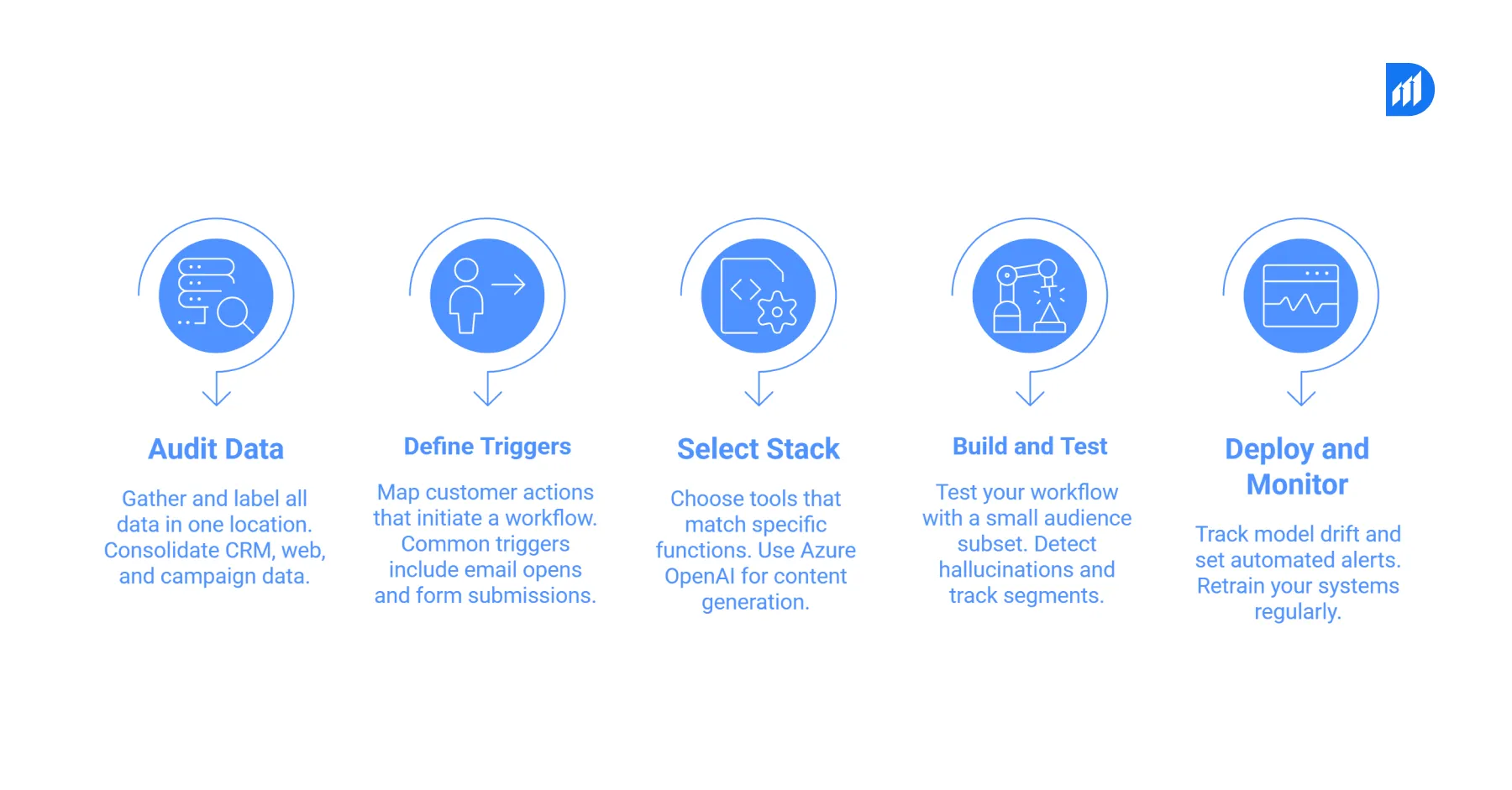
Step 1: Audit Your Data Infrastructure
The first requirement for AI operations requires you to gather all your data into one location with a complete, accurate labeling system. Use Databricks or Azure Data Factory to consolidate CRM, web, and campaign data.
Step 2: Define Your Workflow Triggers
Create a map that includes all customer actions which will initiate a workflow. Common triggers include email opens, form submissions, page visits over 60 seconds, and cart abandonment.
Step 3: Select Your AI and Automation Stack
Select tools which match specific functions. Use Azure OpenAI for content generation, Salesforce Einstein or Marketo for campaign execution, and Power BI for performance dashboards.
Step 4: Build and Test in a Sandbox Environment
Your marketing campaign workflow requires testing through a 5 to 10% audience subset before full implementation. The system needs to detect hallucinations in AI-generated content and track improperly directed segments.
Step 5: Deploy, Monitor, and Retrain
Use MLflow or Azure ML to track model drift. Set automated alerts when click-through rates drop more than 15% from baseline. Retrain your systems at least once every three months.
Using Data and Predictive Insights to Improve Marketing Decisions
Predictive analytics enables marketers to shift from reacting to market changes into creating proactive marketing strategies. Your team now understands upcoming results through predictive analysis instead of examining past month performance data.
Churn prediction models identify customers who have a 70% probability of leaving within the next 30 days. Customers who receive triggered win-back campaigns show three times higher re-engagement rates compared to customers who receive general re-marketing campaigns.
Real-time lead evaluation uses historical conversion data to create lead scoring models which assess inbound leads. AI-scored lead usage by sales teams results in a 50% faster time-to-contact process, along with a 28% rise in closing deals according to Gartner’s research. In addition, Databricks ML and Google Vertex AI operate these models at large scale to analyze millions of customer records within a two-minute timeframe.
How Personalization and Customer Segmentation Improve Engagement?
Generic marketing methods require high costs which do not produce successful results. AI powered marketing platforms test their effectiveness through personalized content which develops into measurable, expandable outcomes. Email systems use dynamic content blocks which modify their content according to each user’s specific actions, their current location, and their previous buying activity. The open rates for personalized emails exceed those of standard emails by 26 percent according to Campaign Monitor 2023. Click-through rates also experience a 14 percent increase.
Demographic information represents only one aspect of segmentation. Behavioral segmentation groups users according to their online activities which include viewing frequency, the types of content they access, and their buying frequency. RFM analysis (Recency, Frequency, Monetary value) combined with ML clustering creates segments your analysts never thought to define manually. Retailers using this approach through platforms like Segment or Twilio Engage report a 22% lift in repeat purchase rates within 90 days of deployment.
Popular Tools Businesses Use for AI-Driven Marketing Automation
The table below shows the most widely adopted tools by function. Before reviewing, note that tool selection depends on your existing tech stack, team size, and data maturity.
| Function | Tool | Best For |
| Content generation | Azure OpenAI / GPT-4 API | Email, ad copy, blogs |
| Campaign automation | HubSpot, Marketo, Pardot | Multi-channel execution |
| Audience segmentation | Segment, Twilio Engage | Real-time behavioral data |
| Analytics and reporting | Power BI, Looker | Dashboard visualization |
| Data management | Snowflake, Databricks | Unified data platform |
| Model deployment | Azure ML, AWS SageMaker | Custom ML models |
Most mid-market companies start with HubSpot or Marketo for campaign automation, then layer in a data platform and AI model infrastructure once the basics are stable.
Common Challenges When Integrating AI into Marketing Processes
The use of ai powered marketing tools leads to operational issues which arise from pushing organizations to adopt them too quickly. Businesses experience data quality problems as their primary difficulty. Models trained on inconsistent CRM data result in both faulty segmentation and operational system failures. A pre-deployment data audit has absolute requirements which organizations must fulfill.
Workflow interruptions occur because of the missing links between old CMS systems and current AI technology. Organizations who use WordPress with their custom-built CRM system spend about 40% of their time implementing API connectors.
Automated processes also create higher risks for organizations to face compliance violations. The healthcare and financial services industries require AI-generated content to undergo regulatory review before it becomes available to users. Organizations will experience audit failures and financial penalties when they lack governance systems.
The excessive use of automation technology creates distance between businesses and their customers. Using AI to send high-frequency email messages without human review results in 35% more subscribers who choose to unsubscribe from the mailing list according to Mailchimp’s internal data from 2023. Organizations should find the right amount of automation which requires them to use manual intervention at key points.
How AI Workflows Help Businesses Scale Marketing Efforts Efficiently?
The main factor which brings return on investment for ai powered marketing platforms comes from their ability to scale. Using ai powered marketing platforms, a group of 10 marketers can manage campaign operations which previously needed 40 staff members. Forrester 2023 reports that lead acquisition costs decrease by 38 percent when businesses operate at greater scale. Moreover, campaign launch time shrinks from days to hours.
AI workflows at businesses which enter new markets enable their teams to conduct localization work while discovering audiences and testing different channels. The three-month market entry pilot operation now completes within three weeks. Our AI Marketing Agents create and implement complete workflow systems which help enterprises achieve fast growth without needing to expand their workforce. Our teams create industry-specific models for digital transformation at companies which operate e-commerce platforms and medical facilities through the use of their internal data.
How Durapid Technologies Helps Businesses Implement Intelligent Marketing Automation?
Durapid Technologies builds ai powered marketing platforms for enterprises across retail, healthcare, financial services, and logistics. Our team creates complete marketing automation systems which match your specific data environment through our 300 developers, 120 certified cloud consultants, and our extensive knowledge of Azure, Databricks, and Power BI.
We do not implement off-the-shelf tools and call it done. Our team assesses your current data systems to find operational deficiencies which we solve by developing custom AI solutions that work with your CRM system, content management tools, and analytics platform.
Our team provides effective solutions which help businesses reduce acquisition costs, speed up their marketing campaigns, and increase their customer conversion rates. Is your business prepared to develop marketing workflows which use artificial intelligence and generate actual results? Contact Durapid Technologies to schedule a strategy call.
Frequently Asked Questions
Q: What are AI-powered marketing workflows?
A: They are systems that don’t just run tasks, they learn, optimize, and personalize everything in real time without you needing to constantly manage them.
Q: How do ai powered marketing platforms differ from traditional automation?
A: Traditional automation follows fixed rules, while AI platforms adapt based on what your audience actually does.
Q: What tools are used in AI-driven marketing workflows?
A: Tools like HubSpot, Marketo, Azure OpenAI, Salesforce Einstein, Databricks, and Power BI each handle different parts of the workflow.
Q: Is generative ai in marketing reliable for content creation?
A: Yes, if guided properly with strong prompts and human checks to keep the output accurate and on brand.
Q: How long does it take to build an AI marketing workflow?
A: Around 4 to 8 weeks for a basic setup, and 3 to 6 months for more advanced and scalable systems.

Recent Blog

How Voice AI Connects Calls With Sales Operations
October 15, 2026-
How GCCs Can Scale Engineering Teams with Staff Augmentation?
October 10, 2026 -
Asset Management Software for CFOs: From Depreciation to Capital Planning
September 29, 2026 -
Why Voice AI Is Different From Chatbots in Recruitment?
September 17, 2026