Why Businesses Should Hire Full Stack AI Developers in 2026
Hire Full Stack AI Developers has suddenly become one of the biggest priorities for businesses in 2026. And honestly, it makes sense. Companies everywhere want AI-powered products now. But most of them quickly notice that building AI applications isn’t as straightforward as just adding ChatGPT to a dashboard and calling it innovation. Modern businesses are trying to build AI copilots, intelligent automation systems, AI agents, recommendation engines, along with custom workflows that actually work in production. The issue is that these systems need more than just AI models, like much more. They require frontend development, backend infrastructure, cloud deployment, APIs, databases, security along with proper LLM Model Integration. All of that working together smoothly, not like random parts glued up. That’s where the role of a full stack AI developer becomes really important.
Instead of hiring separate frontend developers, backend engineers, DevOps teams or AI specialists for each stage, businesses are now choosing AI powered full stack development. It simplifies the whole process. A solid full stack AI engineer can cover multiple layers of the product. They also understand how AI systems behave in real-world environments, not just in polished demos. This shift is also changing the way businesses look at ai development services, along with software development services, kind of overall. Companies don’t really want separate groups anymore, like disconnected teams that struggle to coordinate complicated AI workflows. Instead, they want dedicated AI developers who can build scalable products quicker. Lower development overhead and adjust fast as AI technology keeps evolving.
From startups building SaaS platforms to enterprises placing more focus on custom AI application development, the need for full stack AI development services is rising really quickly. Businesses are actively hunting for an AI software development company that can help them move faster without giving up scalability or product quality. In this blog, we’ll go into why companies are rushing to hire full stack AI developers in 2026.
What Is a Full Stack AI Developer?

A lot of enterprises that went all in on AI over the past three years did this thing. They formed two separate groups. One for data science, another for application development. In other words, models might look fine on paper or in tests, but then in production they basically fall apart. So, the decision to hire full stack AI developers fixes this whole structural mess by merging both skill sets in one person. Someone who can build, deploy and scale AI systems from start to end.
Per LinkedIn’s 2025 Jobs on the Rise report, AI related engineering roles went up 74% year-over-year. Full stack AI engineers showed up in the top five fastest-growing categories worldwide. Companies that adjusted their hiring plan saw time-to-production for AI features drop by 38%. A full stack AI developer is an engineer who manages the full lifecycle of AI-powered applications. That includes data ingestion, model integration, API development, frontend delivery, plus cloud deployment.
Unlike the more traditional full stack developer, they’re comfortable moving across machine learning frameworks, LLM orchestration tools, backend services and frontend components. They don’t throw tasks over the fence between disconnected teams. They take ownership of the whole pipeline, even when stuff gets weird. This is important because AI apps most often break at the integration edges, not inside the model itself. When one developer owns the entire stack, those handoff boundaries get removed while the system holds together better.
Why Businesses Choose to Hire Full Stack AI Developers Over Specialist Teams
The specialist team model sounds good in theory. But in practice, it creates handoff delays, miscommunication between roles, as well as integration failures that slow everything down. That’s why more companies now prefer to hire full stack AI developers who own the full pipeline instead.
Why Full Stack AI Developers Are in High Demand in 2026?
The AI application layer is no longer experimental, like it used to be. Now, enterprises are running production-grade AI across customer support, supply chain forecasting, document processing, alongside fraud prevention. That’s a big part of why businesses hire full stack AI developers. They need people who can keep all of it actually running. AI powered full stack development is basically the approach that makes that possible.
McKinsey’s 2024 State of AI report said 65% of organizations now use AI in at least one business function, up from 33% in 2019. As adoption scales, the need for engineers who can operationalize AI, not just prototype it, has ramped up quicker than the talent supply. Three structural shifts are basically pushing that demand in 2026.
1. LLM-Based Products Need Cross-Functional Engineers
LLM-based products need engineers who really get prompt engineering, vector databases, along with retrieval-augmented generation. The usual backend fundamentals too.
2. Cloud-Native AI Platforms Lowered Infrastructure Complexity
Cloud-native platforms like Microsoft Azure OpenAI, Amazon AWS SageMaker, and Databricks Databricks have lowered the infrastructure hurdle. So one developer can end up owning more of the full stack.
3. Enterprise AI Adoption Is Accelerating
Enterprises that waited on adoption are now speeding up. That creates tight, short-term hiring pressure. Especially in the areas that connect model work to production systems.
Key Skills Every Full Stack AI Developer Should Have
Not every developer that says they’re “AI-ready” can actually ship production systems. So when you hire full stack AI developers, here’s what to actually look for. These capabilities separate real full stack AI engineers from the generalists, the ones with a few ML libraries listed on their resume.
Machine Learning and Model Integration
Practical work with TensorFlow, PyTorch, and Scikit-learn. Real judgment about when to train a custom model versus when to plug in pre-trained capabilities via Microsoft Azure OpenAI or Amazon AWS Bedrock APIs.
LLM Orchestration
Direct experience with LangChain or LlamaIndex, for crafting RAG pipelines, agent workflows, alongside multi model setups. Most traditional developers don’t have this.
Backend and Cloud Infrastructure
Python or Node.js with FastAPI, to build AI service layers. Alongside that, Kubernetes, Docker, and Terraform for deployment across Microsoft Azure or Amazon AWS.
Choosing the Best Cloud Database for AI Applications
Picking the best cloud database for AI full stack products matters a lot, including vector stores like Pinecone or Weaviate. The best cloud database for AI full stack setups really depends on whether you’re doing structured queries or semantic search.
MLOps
CI/CD pipelines for model delivery, together with monitoring using MLflow or Weights & Biases. Automated retraining schedules using Apache Airflow round this out.
What Separates a Strong Full Stack AI Engineer From the Rest?
Beyond technical skills, a strong full stack AI engineer understands how AI behavior changes under real production load. A good AI software development company will vet for this specifically. They plan for it from day one, not after the first outage.
How Full Stack AI Developers Build End-to-End AI Applications?
An AI-powered full stack development process really kind of has a clear pipeline to it. This is exactly what ai powered full stack development looks like in practice. In practice, a solid full stack AI developer sets it up like this:
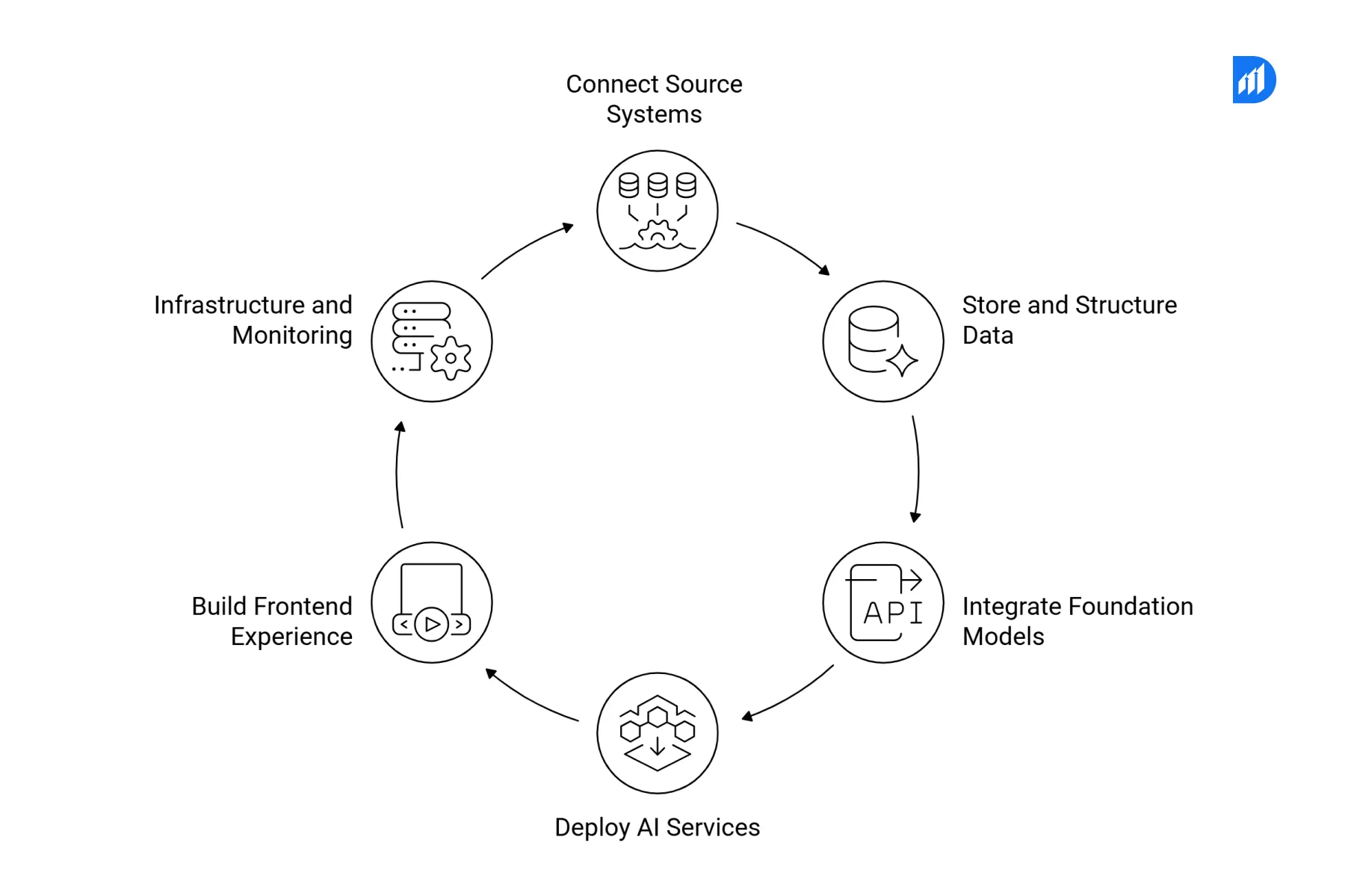
Step 1: Connect Source Systems
First, connect into source systems with Kafka or cloud-native connectors.
Step 2: Store and Structure the Data
Then land the data into a structured lakehouse or a vector store.
Step 3: Integrate Foundation Models
After that, pick and integrate a foundation model through an API using LangChain.
Step 4: Deploy AI Services
The actual AI behavior runs inside a FastAPI microservice, containerized in Docker.
Step 5: Build the Frontend Experience
The React side talks back to it via REST or WebSocket for that streaming feeling.
Step 6: Infrastructure and Monitoring
Deployment lands in Azure Kubernetes Service or AWS ECS, with Terraform defining the infrastructure. Model performance gets tracked through MLflow, not just vibes. That end-to-end ownership is usually why dedicated AI developers deliver faster. When responsibilities get split across multiple roles, everything starts to feel slightly disconnected.
Benefits When You Hire Full Stack AI Developers for Your Business
When businesses hire full stack AI developers, the results are easy to measure. Way easier than piecing together separated specialists. Like, not just “better”, actually measurable. Organizations with an integrated AI development function tend to ship AI features about 40% faster. That’s what Gartner’s 2024 AI Engineering Benchmark says.
Reduced Team Dependency
One full stack AI engineer can replace a three-person setup: data scientist, backend developer, and DevOps engineer. That cuts coordination overhead by an estimated 30 to 45% on mid scale projects. You usually feel it quickly.
Better Production Reliability
Then there’s the “it works in production” part. Systems made by engineers who understand both the model and the infrastructure reduce the weird failures. Integrated teams report around 40% fewer production incidents tied to model-to-API mismatches.
Faster Delivery, Lower Overhead, Better Production Stability
Custom AI application development under this setup tends to come with caching layers, async processing and cost optimized inference from the very start. That’s what makes custom AI application development through a full stack developer model different. So you don’t bolt those things on later.
When NOT to Hire Full Stack AI Developers?
This model has real limits, and if you ignore them it leads to bad outcomes in the end.
Research-Heavy AI Projects
When the AI component needs research-grade model development, custom transformer architectures or novel training approaches, a dedicated ML researcher is a better match.
Advanced Fine-Tuning Requirements
Domain specific fine tuning at scale falls in that bucket too. Full stack AI developers are great at integrating and deploying models. Not so much at inventing new architectures or rethinking the training recipe.
Extremely Large Enterprise Platforms
For very large enterprise systems where frontend, backend, alongside AI complexity all need senior-level depth, a specialized team with clear interfaces still tends to win. The full stack AI developer idea really shines at the product layer, not the platform layer.
Why Startups Prefer Hiring Dedicated Full Stack AI Developers?
Early stage companies that decide to hire full stack AI developers run into a pretty good deal. The model is especially valuable for them. Money limits make a three person specialist squad not workable. Speed to market is existential. On top of that, product direction shifts fast enough that one developer who owns the whole stack can pivot, without the whole cross team negotiation thing.
Startups using dedicated AI developers see 2.3x faster MVP delivery than those relying on on-demand freelance specialists. That’s based on internal benchmarks from Durapid’s 2024 project portfolio. For startups, full stack AI development services work best when the developer stays assigned to one product. Durapid’s AI Development Services practice is set up exactly that way. That shortens feedback loops while accelerating iteration cycles in a measurable way.
Role of Full Stack AI Developers in AI Automation Projects
AI automation is one of the top reasons businesses hire full stack AI developers in the first place. It’s where full stack ai engineers deliver the most concentrated business value. Automating document processing, customer triage, or procurement workflows, you need someone who connects source systems, runs AI inference, then surfaces outcomes inside an operational interface. One person, whole flow. No annoying handoff between three teams. A well scoped automation initiative, led by a full stack AI developer, usually brings real results in about 8 to 14 weeks. The same scope, split across fragmented teams, tends to stretch to 22 to 30 weeks in Durapid’s project history.
Multi-Agent Automation Systems
For more involved multi agent automation architectures, Durapid’s LLM Model Integration practice gives extra depth beyond what one developer handles alone.
Why Durapid Is a Trusted Full Stack AI Development Company?
When businesses look for full stack AI development services, they need more than just a developer list. Durapid’s technical bench is built specifically for the integrated AI development model. With 300+ skilled developers placed, 120+ certified cloud consultants, plus 95+ Databricks-certified professionals, the bench is strong.
Enterprise-Grade AI Delivery Support
Full stack AI developers get quick reach to deep specialization when edge-case requirements pop up. Durapid holds Microsoft Co-sell Partner and SAP Premium Partner status. That basically speeds up enterprise AI rollouts on Azure, plus SAP-integrated surroundings. Clients on Software Development Services engagements get full stack AI developers as part of the integrated delivery squads, not separate project tracks.
Industry-Specific AI Expertise
The industries Durapid serves, financial services, healthcare, logistics, retail, as well as manufacturing, each come with compliance requirements. They need engineers who actually grasp both the AI layer and the enterprise infrastructure underneath it, together.
Build AI Powered Apps a Lot Faster With Durapid
Ready to shift AI from pilot mode to production? Durapid is an AI software development company focused on full stack delivery. Their full stack AI developers cover the whole stack, data, model, API, along with frontend, in one flow. No coordination overhead from split up teams. Reach out to Durapid to size up your next AI development engagement or talk about dedicated developer placement. Either way, they’ll help you figure out the best way to hire full stack AI developers for your team.
Frequently Asked Questions
What’s a full stack AI developer?
It’s like building the whole AI-powered app from start to finish. Data pipelines, then model integration, backend APIs, along with the frontend interface. You’re not doing this big handoff between different specialist teams, like somehow each person has their own silo.
How much does it cost to hire a full stack AI developer in 2026?
If you do it in-house, in the US it’s commonly around $140,000 to $190,000 per year. Through a firm like Durapid, that bill usually drops by 35 to 50%. At the same time, you get access to wider technical infrastructure with less waiting around.
What’s the best cloud database for AI full stack applications?
For normal structured queries, Azure SQL or AWS Aurora are typical choices. For semantic search and RAG style apps, most teams go with Pinecone, Weaviate, or Azure AI Search. Those are the current standard.
How long does it take to build a full stack AI application?
For a production app with one to three AI features, think 10 to 16 weeks with a dedicated full stack AI developer. If it’s simpler automation and not a heavy orchestration setup, it can ship in 6 to 8 weeks, sometimes faster depending on the scope.
What separates AI-powered full stack development from traditional full stack development?
It needs LLM orchestration, model lifecycle management, vector search integration, plus inference cost tuning. Traditional full stack developers are usually strong on the app side. But they don’t cover those AI responsibilities without targeted training. That difference matters a lot.

Recent Blog

How Voice AI Connects Calls With Sales Operations
October 15, 2026-
How GCCs Can Scale Engineering Teams with Staff Augmentation?
October 10, 2026 -
Asset Management Software for CFOs: From Depreciation to Capital Planning
September 29, 2026 -
Why Voice AI Is Different From Chatbots in Recruitment?
September 17, 2026