How Healthcare Companies Tackle Third-Party Risk With Technology and Data
Healthcare companies today don’t just lean on doctors, hospitals, and internal teams to keep things running. They also depend on hundreds of third party vendors, like cloud providers, billing platforms, software partners, data processing tools, Top Healthcare Software Companies, healthcare automation systems, cybersecurity vendors, and outside research partners. All of it helps the whole machine move, but not always in a calm way. And honestly that’s where the problem kind of starts.
Because every one of those third-party connections adds a potential risk. A weak vendor security policy, one outdated system, or a compliance gap that nobody noticed, can suddenly expose sensitive patient data, cause operational disruption, and seriously damage trust. Instantly. For healthcare companies that manage massive amounts of medical records and real-time patient information, third-party risk is no longer some narrow IT thing. It turns into a business survival matter, even when leadership thinks it’s “just integrations”.
What This Means for How Healthcare Companies Operate Today
That’s why top healthcare companies are investing a lot in smarter risk management strategies. These use AI, automation, and real-time analytics. You’ll see predictive monitoring, vendor scoring, automated compliance reviews, and stronger healthcare cybersecurity solutions. The idea is pretty simple but hard to execute: spot trouble before it becomes a full blown crisis. A lot of healthcare data management companies are building systems that give better visibility and tighter protection. Even modern healthcare software development companies are doing the same, focused on more practical operational control across vendor ecosystems.
In this blog, we’ll look at how healthcare organizations are using technology, and yes, actual data, to address third-party risk. The goal is to improve compliance, safeguard patient information, and create more secure healthcare operations in an increasingly connected digital environment.
Why Third-Party Risk Is a Major Challenge in Healthcare
Healthcare companies are kind of sitting on a number that should make every compliance officer pause. 60% of data breaches in the healthcare sector involve a third party, per the Ponemon Institute. The average HIPAA penalty from a single third party vendor incident now exceeds $1.9 million per violation category, which is… pretty wild.
Meanwhile the average healthcare organization manages about 1,300 vendor relationships, according to a 2024 Gartner analysis. Each vendor that touches protected health information (PHI) needs a Business Associate Agreement under HIPAA. But just because there’s a signed BAA, doesn’t automatically mean the vendor is secure. The real issue isn’t whether your vendors carry risk. It’s whether you have the technology, and the data backbone, to detect and contain that risk early enough. Before it turns into a full blown crisis.
Third-party risk in healthcare is basically about the operational, data security, and compliance problems that come up because external vendors, suppliers, and service partners are involved. They may access patient data, link into clinical systems, or deliver services for a healthcare organization.
Back in the day, traditional vendor management was mostly annual questionnaires plus some kind of manual audits. But this setup just can’t keep up with cloud-native integrations, API-first designs, and the fact that software is being changed and shipped continuously. A vendor who “clears” its annual review in January might still bring in a critical weakness by March. Sometimes even from what looks like a routine software update.
Right now, healthcare companies tend to connect to EHR platforms, billing processors, lab systems, cloud storage providers, and medical device manufacturers. Each of those connections becomes a possible entry point for data exposure, compliance breakdown, or operational disruption. Which honestly makes the whole situation more difficult.
The Biggest Risks Healthcare Companies Face From Vendors
Third-party risk in healthcare clusters into four categories, each requiring its own detection and mitigation pathway.
| Risk Category | Example | Potential Impact |
| Cybersecurity | Vendor with weak MFA exposes PHI via API | HIPAA fine + breach notification costs |
| Compliance | Billing vendor fails HITRUST recertification | Audit failure, contract termination risk |
| Operational | Cloud provider outage disrupts EHR access | Care delivery delays, patient safety incidents |
| Financial | Payment processor fraud or overcharging | Revenue leakage, billing inaccuracies |
A single tier vendor assessment form is, kinda ok but it does not really touch on any of those categories with enough depth. For cybersecurity risk you want continuous monitoring tools instead, not just a checkbox. Compliance risk should have automated certification tracking in the background. Operational risk calls for uptime SLA dashboards, sort of day to day visibility. Financial risk should use anomaly detection on the billing data, so strange patterns get caught early.
How Technology Improves Third-Party Risk Management
Modern third party risk management (TPRM) platforms kinda replace those annual questionnaires with continuous, mostly automated monitoring across multiple risk angles. This move away from point-in-time assessment towards real-time risk intelligence is, honestly, the biggest change in how leading healthcare companies handle vendor exposure.
Healthcare organizations that use automated TPRM platforms tend to cut the mean time to detect vendor risk signals, from about 180 days down to under 14 days. That’s roughly a 92% boost in detection speed (Deloitte Healthcare Risk Survey, 2024). In practice the technology stack spans four layers that are easy to say but not always easy to implement:
- Vendor risk scoring engines that pull together signals from dark web feeds, CVE databases, and security rating services like BitSight or SecurityScorecard
- Compliance automation tools that follow BAA expiration dates, HITRUST certification cycles, and SOC 2 report dates. These get compared against a central vendor registry automatically.
- API integrated contract management systems that flag vendors with expiring or non-compliant terms before renewal happens, even if the renewal is “just around the corner”
- Real-time dashboards built on Power BI or Tableau that surface vendor risk trends to compliance officers. No manual data pulls. No spreadsheets nobody wants to maintain.
In healthcare software development, when companies build their own TPRM platforms inside Azure, they usually fall back on Azure Policy for governance enforcement. Microsoft Defender for Cloud watches the vendor connected spaces. Azure Monitor handles API level activity recording. So the setup helps spot risk during the integration step, not only when you’re doing the vendor assessment thing.
Using Data Analytics to Identify High-Risk Vendors
Raw vendor data by itself doesn’t really show much risk, not on its own you know. For healthcare data management companies and the internal data folks, the usual thing is to add analytics layers. These take vendor activity logs, incident write ups, and certification records, then turn all that into risk scores you can actually act on.
A three layer analytics model tends to work quite well for healthcare orgs that have huge vendor portfolios. Tier one is mostly descriptive analytics, it sets a baseline for vendor behavior. Like API call volumes, data transfer trends, how often access happens by user role, plus incident ticket history. Tier two leans into diagnostic analytics, so it can point out which vendor behaviors line up with earlier incidents. Tier three goes further, with predictive models that basically rate vendors on how likely a breach is.
Why Databricks Changes the Speed Equation Here
Companies that use Databricks for vendor risk analytics say they can process vendor activity logs about 8x faster than teams stuck in traditional SQL based data warehouses. Apache Kafka handles ingestion of those real time event streams coming from vendor connected systems. Those events then flow into Databricks Delta Live Tables for continuous updates to the risk score. The teams at the top healthcare software companies using this setup can keep an eye on 500 plus vendor relationships from one workspace. Automated alerts go off whenever a vendor risk score passes a threshold that someone set earlier.
The Role of AI in Healthcare Vendor Risk Monitoring
AI adds another layer of pattern recognition that rules based monitoring just can’t match. Machine learning models trained using past vendor incident data can spot risk signs weeks before a normal review process would even notice it.
In healthcare automation, teams usually lean on three AI techniques for vendor risk monitoring. First, anomaly detection models look for weird, almost off normal data access patterns coming from vendor accounts, like bulk PHI downloads outside usual business hours. Second, natural language processing, or NLP for short, reads through vendor security disclosures, breach notifications, and audit reports. It catches risk language that a human reviewer might skim right past. Third, classification models group vendors into risk tiers using 30 plus behavioral and compliance variables, instead of the static tier one and tier two buckets most organizations still keep using.
When these AI models are deployed on AWS SageMaker or Azure Machine Learning, they hit about 85 to 91% accuracy for predicting vendor related incidents. That’s 30 to 60 days before those issues show up in conventional audits. Healthcare market research companies like Frost and Sullivan observe that AI powered TPRM cuts manual vendor review hours by around 70%. So compliance teams can shift time toward high risk vendor fixes, not just the everyday paperwork and documentation routines.
When NOT to Deploy Automated TPRM Technology
Automated TPRM platforms can deliver pretty strong results for big vendor rosters, but honestly they are not always the right match for every situation. If you know where they fall short you avoid putting money in the wrong places, or assuming the tool can do everything.
For teams with fewer than 50 vendors, enterprise TPRM platforms usually won’t create a meaningful ROI. A simple but structured spreadsheet tracker, plus reminders automated by calendar workflows, is enough at that size. It stays manageable too.
Then you have highly specialized clinical vendors, like niche diagnostic device manufacturers. They may not generate the API activity data or the publicly available security signals that automated scoring engines rely on. In these cases, manual deep dive assessments still end up being more accurate, even if they take more time.
AI based risk scoring is another area where people get overconfident. If you don’t have at least 18 months of historical vendor incident data, the models end up trained on too little. Predictive accuracy often drops under 60%. So the output becomes less reliable than an experienced analyst’s judgment.
Finally, organizations without a dedicated vendor risk owner will find it hard to actually respond to the alerts the automated system throws up. The tech can surface the risk. The humans still have to close the loop and handle it properly.
Building a Centralized Vendor Risk Management Framework
A centralized vendor risk management framework kinda pulls together all vendor information, risk scores, compliance status, and contract details into one governed data space. If you don’t centralize, healthcare companies end up juggling vendor risk through separate spreadsheets, email strings, and tools that live only inside specific departments. That split setup leaves some blind spots, you know, spots nobody really sees until later.
For a mid-sized healthcare organization the framework usually gets built with four layers. First there’s the data ingestion layer. It reaches out to vendor portals, security rating APIs, contract management systems, and internal incident logs. In many deployments, Apache Airflow runs the pipelines and keeps things moving. Then the storage layer sits on a cloud data lakehouse, commonly Azure Data Lake Storage Gen2 or Snowflake, depending on what the org already uses. After that, the analytics layer leans on Databricks notebooks for the risk scoring part. Power BI shows exec dashboards in a way leaders can digest fast. Finally, the action layer kicks off automated workflows in ServiceNow or Jira. Remediation tasks get routed when the risk thresholds are crossed, or if an exception needs attention.
Healthcare orgs that finish the centralization effort often see a 45% cut in time spent on vendor compliance reviews. They also report around a 38% drop in repeat findings tied to the same vendor during external audits. Durapid’s team, with 95+ Databricks-certified professionals and 120+ certified cloud consultants, has designed this architecture pattern for healthcare customers on both Azure and AWS. They typically deliver the initial framework build in about 10 to 14 weeks, which is pretty reasonable if you ask me.
Real-Time Monitoring for Third-Party Compliance and Security
Real-time monitoring nudges the risk management posture from reactive to more preventive. Instead of doing a quarterly vendor security review, healthcare organizations get nonstop telemetry about what vendors do, their current certification status, and whether incidents are popping up.
To do effective real-time monitoring you typically rely on three event streams. The first one captures access and activity logs from identity providers like Azure Active Directory, specifically when vendor accounts reach into clinical systems. The second keeps ingesting security rating feed updates from outside services. They scan vendor public infrastructure for vulnerabilities and push those changes. The third stream watches regulatory filing databases for OCR breach notifications filed with respect to your vendors.
With healthcare automation built on this architecture, average vendor incident detection time drops from 6 weeks to about 72 hours. For context, the average healthcare data breach takes 287 days from breach to containment without real-time tooling (IBM Cost of a Data Breach Report, 2024). Cutting detection time down to 72 hours alone can lower total breach cost by an estimated 30%. And yes, this kind of pipeline also ties directly into Chain Management in healthcare, where supply chain data integration and vendor monitoring seem to run on the same underlying infrastructure.
Key Compliance Requirements Healthcare Vendor Programs Must Address
Healthcare vendor risk programs run inside a pretty specific regulatory environment. Compliance is not really optional. When something goes wrong with vendor related violations, the penalties hit the covered entity, not the actual vendor, which feels kind of backwards but thats how it is.
HIPAA Security Rule: basically says covered entities must verify that every business associate working with PHI keeps up documented technical safeguards, not just “we think they do”.
HITECH Act: pushes HIPAA liability onto business associates more directly. It also bumps the maximum penalties up to $1.9 million per violation category each year.
CMS Conditions of Participation: hospitals have to check that vendors supporting patient care services meet specific operational reliability and security expectations, and these aren’t just vague guidelines.
State-level breach notification laws: there are 48 states with separate notification rules. They don’t line up cleanly with HIPAA when it comes to timing and reach. So you end up with this multi jurisdictional compliance load that nobody loves.
Vendor risk technology helps manage all of that using automated evidence collection. Platforms that integrate with DocuSign, SharePoint, or Box can pull BAA documentation, certification uploads, and audit reports into one centralized compliance repository. Automated expiration alerts also help catch renewals early. So you don’t end up with retroactive compliance gaps that appear after coverage quietly expires.
Steps to Build a Healthcare Vendor Risk Program Using Technology
Healthcare companies that are building or leveling up a vendor risk program really should do it in a sequenced way. Don’t just throw in tech before the governance part is actually in place. Like, you want the rules and ownership first, then you let the tools help you.
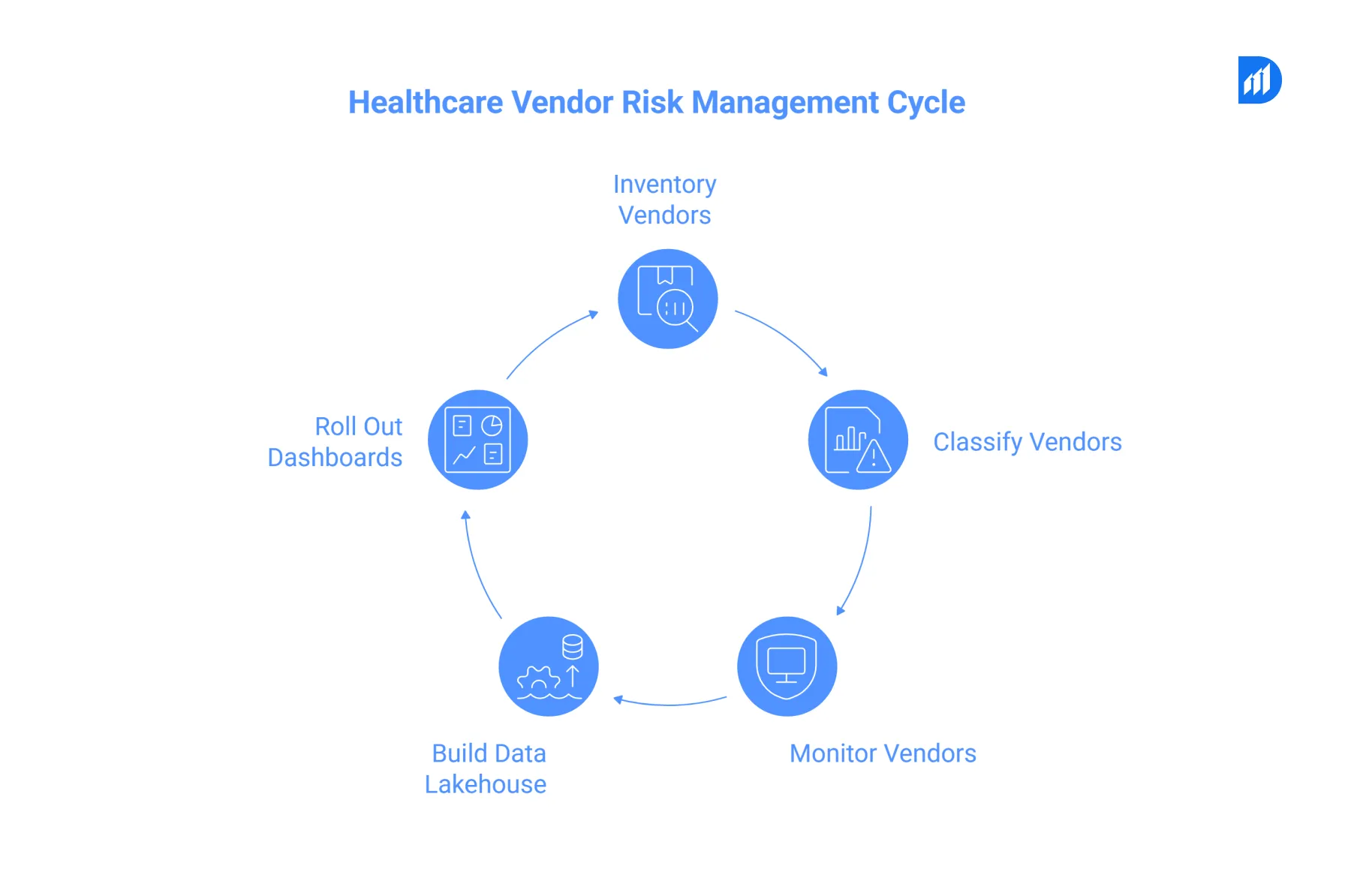
Step 1: Inventory every vendor that has PHI access. You can use API connections into contract management systems, along with EHR audit logs, to produce an end to end vendor list. Most organizations uncover 20 to 30% more vendors than what their manual records say. Which is kind of the usual surprise.
Step 2: Classify vendors into risk tiers using data variables, not by gut feeling or purely subjective assessment. Those variables should cover the data access type, integration depth, certification standing, and also the historical incident rate.
Step 3: Bring in a security rating service such as BitSight or SecurityScorecard for continuous external monitoring of tier-one and tier-two vendors. Then connect that API feed directly into your analytics environment, so the updates don’t just sit there.
Step 4: Build a centralized vendor risk data lakehouse using Databricks on Azure or AWS. Set up Delta tables for vendor profiles, risk scores, compliance standing, and the incident timeline or history.
Step 5: Roll out Power BI dashboards for compliance officers with automated refresh cycles. Configure alert thresholds so they can trigger ServiceNow tickets for remediation tasks when risk scores go past your defined limits.
Benefits of a Data-Driven Third-Party Risk Strategy
Healthcare companies are moving away from the whole manual vendor review thing, toward more data-driven TPRM programs, and measuring outcomes across four areas.
Speed is one big point. Those vendor risk assessments that used to take something like 3 to 4 weeks end up finishing in about 48 to 72 hours. Evidence gets collected automatically and scoring happens right away. Teams running Databricks-based risk pipelines say they’re seeing around 80% faster vendor onboarding review cycles. Which is honestly kind of the whole reason people care.
Coverage meanwhile tends to look very different. With manual efforts, they usually track only 40 to 60% of vendors in an active way. Automated platforms instead keep continuous coverage for 100% of the vendor portfolio, even the long-tail vendors that normally get barely any attention under the older approach.
Accuracy is another area where the contrast shows up. When you use point-in-time questionnaire scoring, there’s a false-negative rate of roughly 35%. So about one in three high-risk vendors can slip through a manual review. When AI-augmented risk scoring is used, that false-negative behavior drops to under 8%.
Cost is where it really adds up. Healthcare organizations with more mature automated TPRM programs typically spend about 52% less on vendor-related breach remediation each year. That’s compared with orgs depending on manual review cycles (Forrester, 2024). On top of that, tools that use AI Marketing Agents along with smart automation are increasingly being plugged into vendor risk workflows. So risk intelligence shows up inside the same tools compliance teams already use every day, instead of being stuck in separate reports.
Build a Vendor Risk Program That Keeps Pace With Your Vendor Portfolio
Third-party risk is not some compliance checkbox thing. It kind of sits in the middle of patient safety, data security, and financial stability. Healthcare companies who lower vendor risk exposure usually do it using real time data, automated monitoring, and AI powered risk scoring, not those annual questionnaires that everyone fills out and then forgets about.
Durapid Technologies works with healthcare organizations to design and deploy vendor risk management architectures on Azure and AWS. With 95+ Databricks certified professionals, 120+ certified cloud consultants, and 150+ Microsoft-certified professionals, our teams build TPRM platforms that provide continuous coverage rather than periodic snapshots. Contact Durapid Technologies to talk through your third-party risk architecture, or explore our healthcare data solutions.
Frequently Asked Questions
What is third-party risk management in healthcare?
It is basically the process of finding, evaluating, and keeping an eye on risks that come in from outside vendors or business associates. These are the parties that touch PHI, or they just connect to clinical systems in some way. A solid program mixes continuous monitoring tech with compliance automation. That way you can handle those 1,000-plus vendor relationships without losing track.
Which regulations require healthcare companies to manage vendor risk?
The HIPAA Security Rule, the HITECH Act, and CMS Conditions of Participation all put obligations on how vendor risk should be managed. HITECH also increases maximum penalties up to $1.9 million per violation category each year. It extends liability more directly to business associates too.
How long does it take to implement a vendor risk management platform?
For most large enterprises, the initial deployment is usually 10 to 16 weeks. If a team leans on pre built Databricks connectors and Azure native monitoring tools, the setup period can drop by about 35 to 40% versus the custom built route.
What data sources feed a healthcare vendor risk scoring model?
You typically pull from security rating feeds like BitSight or SecurityScorecard, CVE repositories, OCR breach notification filings, vendor submitted certification materials, API access logs, and BAA compliance records. For dependable predictive scoring, you want at least 18 months of historical data.
Can smaller healthcare companies afford automated TPRM technology?
Many can. Cloud native platforms on Azure or AWS have lowered the entry cost a lot. There are also modular rollouts, for example starting with Power BI dashboards and Databricks based scoring, which can fit organizations managing roughly 50 to 100 vendors. In a lot of cases the first infrastructure costs sit under $40,000 per year.

Recent Blog

Asset Management Software for CFOs: From Depreciation to Capital Planning
September 29, 2026-
Why Voice AI Is Different From Chatbots in Recruitment?
September 17, 2026