Python Full Stack AI: The Complete Stack Guide (2026)
A year ago, companies were mostly building AI features, sticking a model somewhere and calling it a day. Today they’re building a full AI product, not just something that answers a question but a whole experience that people actually want to use. That shift is a big deal, and it’s part of why more teams are turning to dedicated AI Development Services rather than trying to bolt AI onto whatever they already had.
Anyone can plug an LLM into a chatbot over a weekend, but turning that into something thousands of people can actually use is another game entirely. Suddenly the conversation isn’t just about prompts anymore, it’s about the interface side too, things like React screens that feel natural and backend services that actually stay standing under load. You need FastAPI services that won’t buckle under real traffic, plus retrieval pipelines that pull the correct documents instead of confident nonsense dressed up with good vibes. Then there’s the whole messy web of vector databases, cloud deployment, authentication, monitoring, and AI models that all have to play together as one system, which is exactly where Python Full Stack AI comes in, quietly but effectively.
Python has, in a way, become the language connecting every layer of modern AI applications, powering model inference, orchestrating RAG pipelines, and serving APIs. It also automates workflows and integrates with frameworks like LangChain along with FastAPI, plus modern cloud platforms. Instead of treating AI like a single feature bolted on, developers can build products where intelligence is woven through the entire stack, and that’s exactly why companies aren’t asking anymore whether you can build AI. They’re asking whether you can ship an AI product from frontend to production. In 2026, the biggest bottleneck isn’t training or even building an AI model, it’s connecting every moving part into one experience that actually works reliably, day after day. This guide breaks down what a Python full stack AI developer does and how the RAG pipeline layer works in production, along with when one full stack hire can beat three specialists in practice.
What Is a Python Full Stack AI Developer?
Python full stack AI now powers a lot of the production LLM systems inside enterprises today. But here’s the part people don’t always say out loud: only 48% of AI projects make it into production, and it takes about 8 months, on average, to get from prototype to production, according to Gartner.
In our own experience across BFSI, logistics, and retail, that gap usually shows up because teams do the hiring in a kind of fragmented way. Like they bring in a model builder, then a frontend developer, plus a DevOps engineer separately. And somehow the handoffs get messy, stall the project, or slow it down. A Python full stack AI developer closes that by owning the model plus the API and the interface in one cohesive skill set.
A Python full stack AI developer builds and knits together every layer of an AI product. That is, the model, or the LLM integration layer, the backend API, and the data pipeline. And the frontend interface too, all with Python as the main thread. Not like a traditional full stack developer who usually bolts AI on as an afterthought. Instead, a Python full stack AI developer starts from model behavior first. They design the FastAPI backend, the LangChain or LlamaIndex orchestration layer, and often the React or Streamlit frontend. All while keeping real production LLM constraints in mind from day one. Token limits, latency spikes, and hallucination handling don’t just live in a checklist. They shape the architecture up front, not only the prompt.
How Python Connects AI Models to Production?
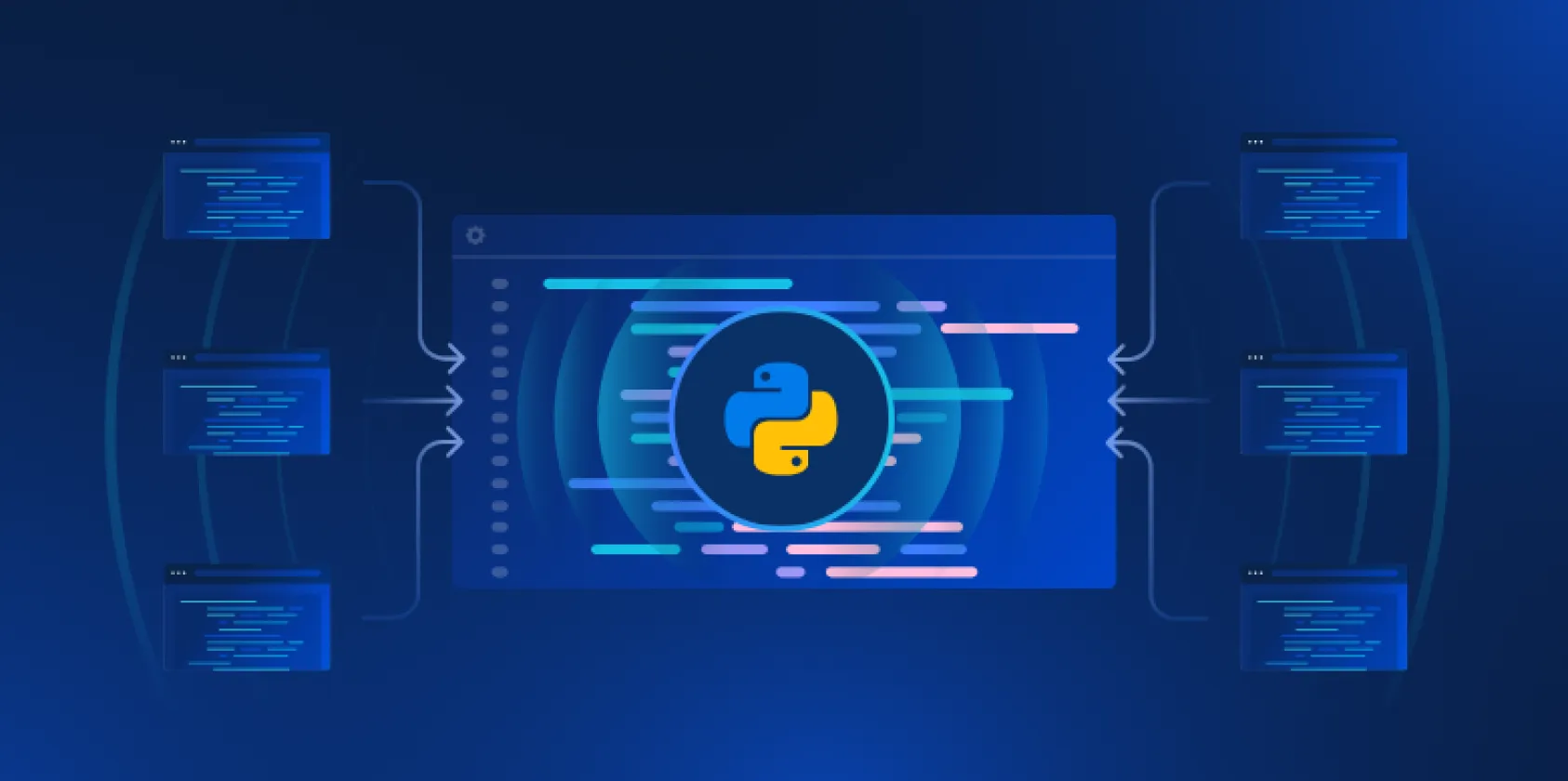
Python sort of ties AI models into production with three connected layers: the inference layer, the orchestration layer, and the serving layer. Each part does its own job, and Python libraries kinda dominate across all three, honestly.
The inference layer is where the model actually runs, could be a hosted API like Azure OpenAI. Or a self-hosted setup on AWS SageMaker. Then comes the orchestration layer, often LangChain or LlamaIndex, which handles prompts, memory, and those tool calls. Last is the serving layer, usually FastAPI or Flask. It shows the whole system up as an API that a frontend can use.
That’s also why full stack Python AI development really matters. If you can reason about all three layers, you can follow a latency problem to the true origin, whether it’s a slow vector query or a prompt that’s not tuned, rather than just guessing around between different teams. It’s also why a lot of teams end up bringing in a dedicated Python AI Developer instead of splitting that reasoning across three specialists who each only see their own layer.
RAG Pipeline Layer: Building Retrieval-Augmented Generation in Python
Retrieval-Augmented Generation, or RAG, is kind of the architecture pattern that helps an LLM answer questions using a company’s own data. It leans on that data instead of only its training material. It usually pulls relevant documents first, then it hands those into the model as context.
Getting this right in Python is one of the top skills people keep asking for in full stack AI development right now, and it’s also the spot where a lot of implementations just fall apart, often because the source documents were never cleaned up in the first place, which is usually a sign a team needs proper data engineering services before RAG even enters the picture.
Why RAG Exists: The Problem With Prompt-Only LLM Responses?
A prompt only LLM doesn’t really have access to a company’s private data, or that proprietary documentation. So if you ask it about some internal policy or last week’s product update, it’ll just guess. And honestly, sometimes it sounds pretty convincing.
RAG fixes this by grabbing the real source documents at query time. Then it grounds the model’s answer in what’s actually there. That’s also why RAG has turned into the default pattern for enterprise chatbots, internal search, and support automation. It’s built with Python, along with GenAI frameworks, kind of depending on your setup.
The Five Stages of a Production Python RAG Pipeline
So a production RAG pipeline in Python kinda moves through five stages, each one needing its own little tuning, you know. Ingestion. You pull Documents from SharePoint, Confluence, or a database then normalize them into text. Chunking. The text then splits into smaller segments that actually fit the model context window, more or less. Embedding. Each chunk turns into a vector, using OpenAI text-embedding-3, or some open-source model. Retrieval. The system then searches the vector database for the most relevant chunks, based on similarity. Generation. Those retrieved chunks get fed into the LLM along with the query, and the model produces a grounded answer.
Skipping tuning on just one of those steps is probably the #1 reason RAG pipelines come back with inaccurate or kind of off-topic answers once they are in production. That holds true even if the base model is totally capable.
Chunking Strategies That Actually Work in Enterprise RAG
Fixed-size chunking, where your text just gets cut every 500 or 1,000 characters no matter what’s actually in it, is usually the quickest way to stand up a RAG pipeline. It’s also the quickest way to wreck retrievals. It slices sentences plus tables in half, and you end up seeing retrieval quality drop pretty fast because of that.
Semantic chunking breaks content at more natural topic edges using sentence embeddings. It tends to do better, like, measurably, especially for technical and policy documents. In one enterprise rollout for a financial services client, moving to semantic chunking with a 15% overlap reduced irrelevant retrievals by about a third. That was across a 200 query evaluation run.
For things like tables plus FAQs, keep the structured material intact as single chunks. Then apply semantic chunking only to the prose parts.
Choosing the Right Vector Database for Your Use Case
The vector database stores document embeddings and handles similarity search at query time. The right choice depends on scale, not brand preference:
| Vector Database | Best Fit | Notes |
| pgvector | Teams already using PostgreSQL | Lowest operational overhead. A great choice for applications handling up to millions of vectors while keeping your existing PostgreSQL infrastructure. |
| Pinecone | Fast-scaling production AI applications | Fully managed vector database built for high query volumes, low latency, and minimal infrastructure management. |
| Azure AI Search | Microsoft ecosystem enterprises | Integrates natively with Azure OpenAI, making it ideal for organizations already invested in the Microsoft cloud stack. |
| Weaviate | Applications requiring hybrid search | Supports both vector similarity and keyword search, delivering more accurate results for enterprise knowledge retrieval. |
For Durapid clients already on Azure, Azure AI Search removes an entire integration layer versus standing up a separate vector database. That shortens delivery by one to two weeks.
Python Full Stack AI Developer Skills
The best Python full stack developer, working in AI, usually covers five skill areas not only “model stuff” or weights knowledge. Like, backend engineering comes first, with FastAPI or Django REST Framework. That’s what makes the AI thing usable as an actual service. Then there is the frontend side too, because even smart demos won’t land if the user experience is flat. Tools like Streamlit and Gradio help ship internal instruments quickly. React combined with a Python backend is what typically powers the customer-facing products.
After that, the job still expects hands-on familiarity with orchestration frameworks such as LangChain or LangGraph. It also expects vector database configuration and practical cloud deployment on Azure or AWS. And yeah, that often means Docker in the pipeline plus Kubernetes for real, not just theoretical diagrams. People learning full stack AI development should see it as one interconnected discipline, not a stack of different certificates you collect separately.
When to Hire a Python Full Stack AI Developer vs Separate Specialists?
A single Python full stack AI developer tends to work best when it’s a well defined product, with a tight crew, like one to three people. And you’re trying to ship just one AI feature inside a 90 day window. When it’s like this, you get speed, fewer handoffs, and the whole thing stays kinda coherent, in a practical way.
But separate specialists start making more sense when the project ends up spanning multiple AI features at high scale. Also when there are regulatory constraints. That means you really need a dedicated MLOps person or a security specialist, not just someone who’s also touching the front end. And if the work needs deep frontend design beyond what a generalist is usually covering, you’ll feel it fast.
We had a fintech client once who needed dedicated model governance expertise for audit reasons. That sort of governance, alongside normal backend work and frontend delivery, is hard to cover reasonably by a single full stack hire. So yeah, this is basically the “when not to use” scenario, worth saying plainly. If your roadmap includes five or more AI products running in parallel, then a full stack generalist becomes a bottleneck. Not an accelerator. Scale the team first, before you scale the roadmap.
Case Study: Logistics Client RAG Deployment
So a mid-sized logistics company, they needed this tool for the dispatchers to query shipment policies, and also carrier contracts. That way they didn’t have to keep opening a document management system. And then one Python full stack AI developer actually built the whole thing, like FastAPI backend, LangChain retrieval, pgvector storage, plus a Streamlit frontend. Then it got deployed on Azure.
It took 6 weeks from kickoff to production, not too bad, honestly. And the query response time was landing under 2 seconds for about 95% of requests. Also, the compliance escalations that were tied to policy questions went down roughly 70% in just the first month.
Building Your Python Full Stack AI Team
honestly it’s the kind of thing that works because it reduces those handoff delays that usually stall most AI projects. That’s right at the moment they should move from prototype to production. Whether you go with one generalist or a small crew, built around Durapid’s AI development services, really comes down to your roadmap. Not only your budget.
If your team has messy source data before RAG, you might need our data engineering services first. That just gets everything turned into production-ready documents. So if you’re scoping a Python full stack AI build, chat with Durapid’s team about a 6 to 12 week delivery timeline for your specific use case. Then we can map what’s best for your next step.
Frequently Asked Questions
What is Python Full Stack AI development?
Python Full Stack AI development means building an AI application across every layer, from the frontend and backend to AI model integration. Instead of relying on separate specialists, one developer connects the user interface, APIs, databases, and AI workflows using Python.
Is Python better than JavaScript for Full Stack AI?
Python is the preferred choice for AI logic and backend development because of frameworks like FastAPI, LangChain, and cloud platforms such as AWS SageMaker and Azure OpenAI. JavaScript, however, remains the stronger option for building modern, interactive user interfaces with frameworks like React and Next.js. Many production AI applications combine both technologies.
How long does it take to learn Python Full Stack AI development?
Developers with prior Python backend experience can typically become production-ready in 4 to 6 months. Most learning focuses on FastAPI, LangChain, Retrieval-Augmented Generation (RAG), prompt engineering, and one vector database such as pgvector or Pinecone.
What’s the difference between a Python AI developer and a Python Full Stack AI developer?
A Python AI developer primarily works on AI model integration, machine learning pipelines, and data processing. A Python Full Stack AI developer goes a step further by also building backend APIs, integrating AI services, and developing frontend applications, enabling them to deliver complete AI-powered products.
Does a RAG application require a GPU in production?
Not always. The retrieval layer, vector search, and orchestration components of a RAG pipeline typically run efficiently on standard CPU infrastructure. A GPU is generally required only when you’re hosting and serving the large language model yourself. If you’re using managed services such as Azure OpenAI or OpenAI APIs, the application can often run without dedicated GPU hardware.

Recent Blog

Asset Management Software for CFOs: From Depreciation to Capital Planning
September 29, 2026-
Why Voice AI Is Different From Chatbots in Recruitment?
September 17, 2026 -
LlamaIndex vs LangChain: Which One to Choose in 2026?
July 29, 2026