ETL Pipelines for SAP and Databricks in Manufacturing Supply Chains
Most manufacturing supply chain decisions run on SAP data that is already six to twelve hours old.
That lag is no longer a reporting inconvenience. McKinsey surveyed 100 global supply chain leaders in 2025, and the finding was blunt. Most companies still understand their supply risk only as far as their tier-one vendors. Respondents also scored forward-looking visibility as their weakest capability of all. The data needed to close that gap already sits inside SAP, in EKKO, MSEG, AUFK, and QALS. What it waits on is a pipeline, which makes this a data engineering services question long before it becomes an analytics one.
What ETL Pipelines for SAP and Databricks Actually Mean in Manufacturing?
An ETL pipeline for SAP and Databricks is a governed data flow. It pulls transactional records from SAP ECC or S/4HANA, then drops them into Delta Lake tables. Cleansing plus business logic follow, so manufacturing supply chain teams get analytics-ready datasets out of the same motion.
Calling it ETL undersells the work in a manufacturing supply chain, because the pipeline does more than move rows around. It rebuilds the business meaning that SAP tables carry natively but that many extraction methods leave behind. A purchase order line in the lakehouse cannot simply sit there. It has to know what a schedule line means, how a confirmation relates to it, what a goods receipt confirms. Only then does supplier reliability become computable from that set of facts.
Traditional SAP Reporting vs Modern Lakehouse Pipelines
Most manufacturers already run SAP BW, SAP Analytics Cloud, or a collection of ABAP reports, all of which remain very good at what they were designed to do. Where they start running out of room is with scale, external data, machine learning. The table below maps both routes across the dimensions that really matter to a supply chain and manufacturing operations team.
| Dimension | SAP BW and classic reporting | SAP to Databricks lakehouse pipeline |
| Data freshness | Nightly or multi-hour batch loads | Incremental loads measured in minutes |
| Non-SAP data | Limited, usually requires staging | Native, joins IoT, EDI, weather, logistics feeds |
| Machine learning | Not designed for it | MLflow, Spark ML, model serving in the same platform |
| Cost profile | Fixed licensing tied to SAP sizing | Elastic compute, storage decoupled |
| History handling | Cube rebuilds for structural change | Delta time travel with schema evolution |
| Governance | SAP authorization objects | Unity Catalog with lineage plus row-level controls |
Neither column is really a verdict. Manufacturers with steady reporting requirements and no advanced analytics roadmap tend to get real value by staying inside SAP. The pipeline becomes worthwhile the moment the questions being asked need data that SAP simply does not own.
The Data Bottlenecks Costing Manufacturers Decision Speed
In a manufacturing supply chain build, the bottleneck is rarely the transformation logic. It is almost always extraction, because production SAP systems are built for transactions rather than analytical scans. A poorly designed pull against MSEG during month-end close will slow the shop floor first, then the dashboard.
The second bottleneck is fragmentation. Procurement drags vendor information into one extract, quality pulls inspection results into another, so nobody can then answer whether defect rates correlate with a supplier plant. Supplier risk intelligence needs those datasets together, in one governed layer with shared keys, and that is the gap a lakehouse pipeline closes.
Why SAP and Databricks Are the Right Stack for Manufacturing ETL?
The two platforms stopped being separate architectural decisions in February 2025. That was when SAP launched Business Data Cloud with Databricks embedded natively as SAP Databricks, a move that led supply chain manufacturing news cycles for weeks. The partnership has since matured into SAP Business Data Cloud Connect. It shares SAP data products into a customer’s own Databricks workspace through Delta Sharing, without copying them.
What SAP Brings as a Data Source?
SAP holds the transactional truth of a manufacturing business, and more importantly it holds the semantics. A material document in MSEG carries a movement type that already encodes whether stock moved into inspection, into production, or out to a customer.
That context is worth protecting, because extraction methods that read raw tables without their associated CDS views hand the lakehouse team a reconstruction job. It can consume weeks of engineering effort before a single dashboard appears, so sequencing matters as much here as it does in any agile SAP implementation.
What Databricks Adds That Legacy Warehousing Cannot?
Databricks contributes three things SAP was never built to provide. It handles semi-structured plus streaming data alongside relational records, so machine sensor telemetry can join a production order without a separate platform. It also supports Python, SQL, or Scala against the same tables. That counts when a data scientist and a reporting analyst need one shared supplier dataset.
Storage sits separately from compute as well. A demand forecasting job needing forty nodes for ninety minutes does not force a permanent increase in SAP sizing. Across databricks manufacturing use cases, that elasticity is what makes the economics work. Predictive maintenance or multi-echelon inventory optimization becomes viable for a manufacturing supply chain of any real scale.
When a Lakehouse Pipeline Is Not the Right Answer?
This architecture is not the correct choice everywhere, and saying so early saves budget. Take a single-plant manufacturer running standard SAP reports for under fifty users, with no machine learning roadmap or significant non-SAP data. The pipeline engineering will cost more than the insight is worth.
Two other situations call for caution. Where SAP master data governance is still maturing, replicating into a lakehouse gives faster access to unreliable numbers, which means better decisions do not follow automatically. Sometimes the requirement is operational rather than analytical, such as writing corrections back into SAP within seconds. An integration layer built on SAP Event Mesh or standard APIs fits far better there.
The Architecture, How SAP and Databricks Work Together
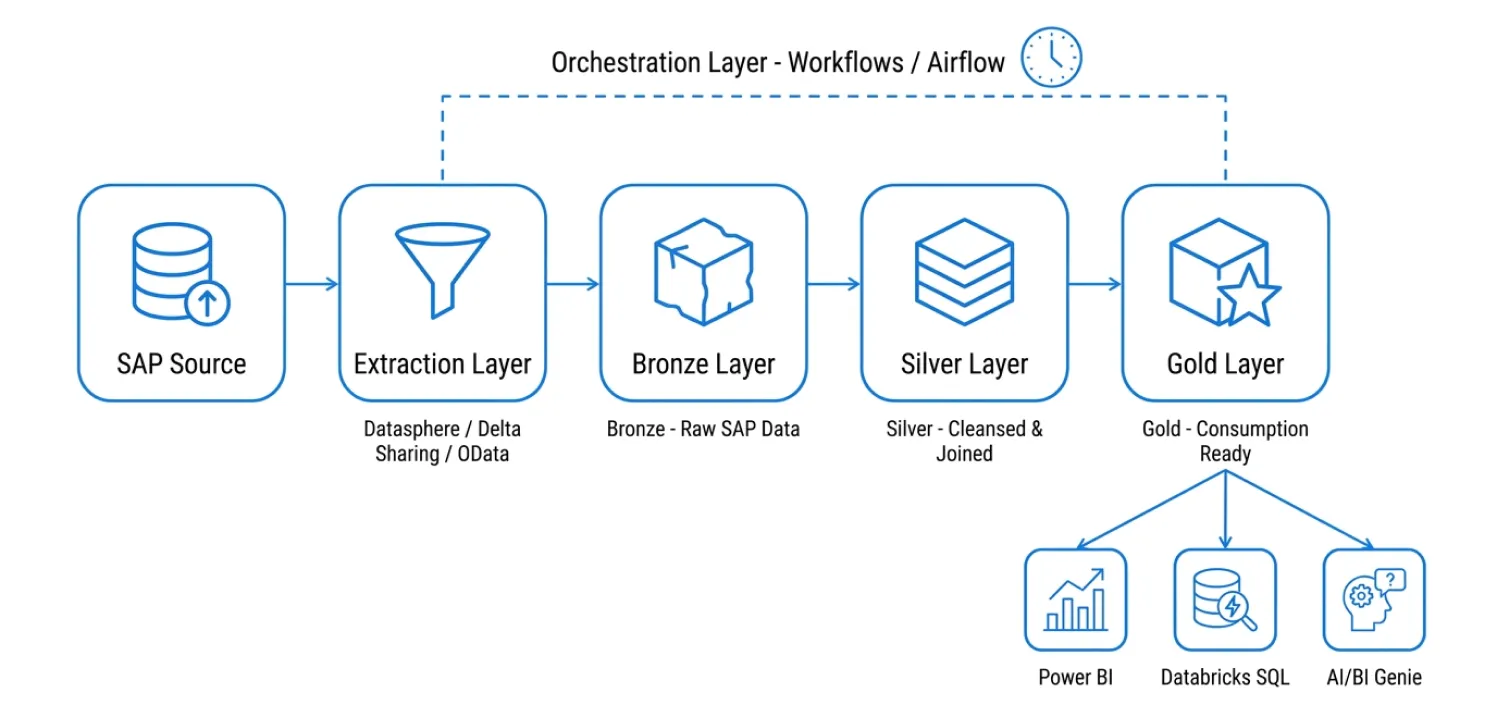
Every manufacturing supply chain build follows the medallion pattern of bronze, silver, gold layers. An extraction layer sits in front of it, with orchestration wrapped around the whole flow, and each layer solves a specific problem. Skipping any of them tends to surface later as a reconciliation dispute with finance.
Extraction Layer and How to Move SAP Data Without Hurting Performance
This is where 2026 changed the rules. SAP Note 3255746 now prohibits third-party applications from using the ODP Data Replication API over RFC. On 9 June 2026 SAP shipped a security patch that technically blocks those calls. A temporary opt-out exists, though it expires in December 2026. The change never dominated supply chain manufacturing news the way tariffs did, yet its operational reach is wider.
Practically, that affects any pipeline running on an ODP-RFC connector, so Azure Data Factory, Qlik Replicate, or a similar tool is now operating on borrowed time. SAP published a self-assessment tool under Note 3439624 in April 2026 that inventories every ODP-RFC dependency in a landscape. Running it is the first task in any current extraction assessment. Compliant paths today include SAP Datasphere replication flows, plus SAP Business Data Cloud Connect with Delta Sharing. ODP over OData also works, as do direct CDS view or table reads through certified connectors.
How the Bronze Layer Lands Raw SAP Data With Full Fidelity?
Bronze holds SAP records exactly as they arrived, with no cleansing or business logic. Column names stay in their original form, so EKPO lands as EKPO rather than as purchase_order_item. Every row carries ingestion metadata such as load timestamp, source system identifier, extraction batch. Full fidelity here is a reconciliation asset, because when a plant controller disputes a gold layer number, the bronze table proves what SAP actually sent.
How the Silver Layer Applies Cleansing, Joins, and Business Logic?
Silver is where SAP structure becomes analytical structure. Header and item tables merge, so EKKO joins EKPO with EKBE to produce one purchase order line carrying its complete goods receipt history. Data types get standardized, while SAP date formats convert to proper timestamps. Leading zeros on material or vendor numbers get normalized before they cause silent join misses.
Business rules land here too. Movement type 101 becomes a goods receipt, 261 becomes a production issue. A deletion indicator becomes an explicit active flag rather than a blank field downstream logic has to guess at.
What the Gold Layer Delivers as Consumption Ready Supply Chain Datasets?
Gold tables answer questions rather than describe systems, which is what supply chain and manufacturing operations teams need from them. A supplier performance table carries on-time delivery percentage, quantity accuracy, quality rejection rate, with average lead time variance split by vendor, plant, month.
These tables feed Power BI, Databricks SQL dashboards, plus AI/BI Genie spaces. Because they arrive aggregated and pre-joined, a manufacturing supply chain manager filtering three years of supplier history gets a response in seconds. The alternative is a scan across raw SAP extracts.
How the Orchestration Layer Handles Scheduling, Retries, and SAP Maintenance Windows?
Orchestration is where production pipelines earn their reliability. Databricks Workflows or Apache Airflow schedules each layer, enforcing dependencies so gold never refreshes on incomplete silver data. Exponential backoff then handles the moments when SAP returns a connection limit response.
Maintenance windows deserve explicit handling of their own. SAP systems go down for transports plus support packages, so a pipeline that treats an expected outage as an incident will train the team to ignore its alerts inside a fortnight.
SAP Data Sources This Pipeline Handles in Manufacturing
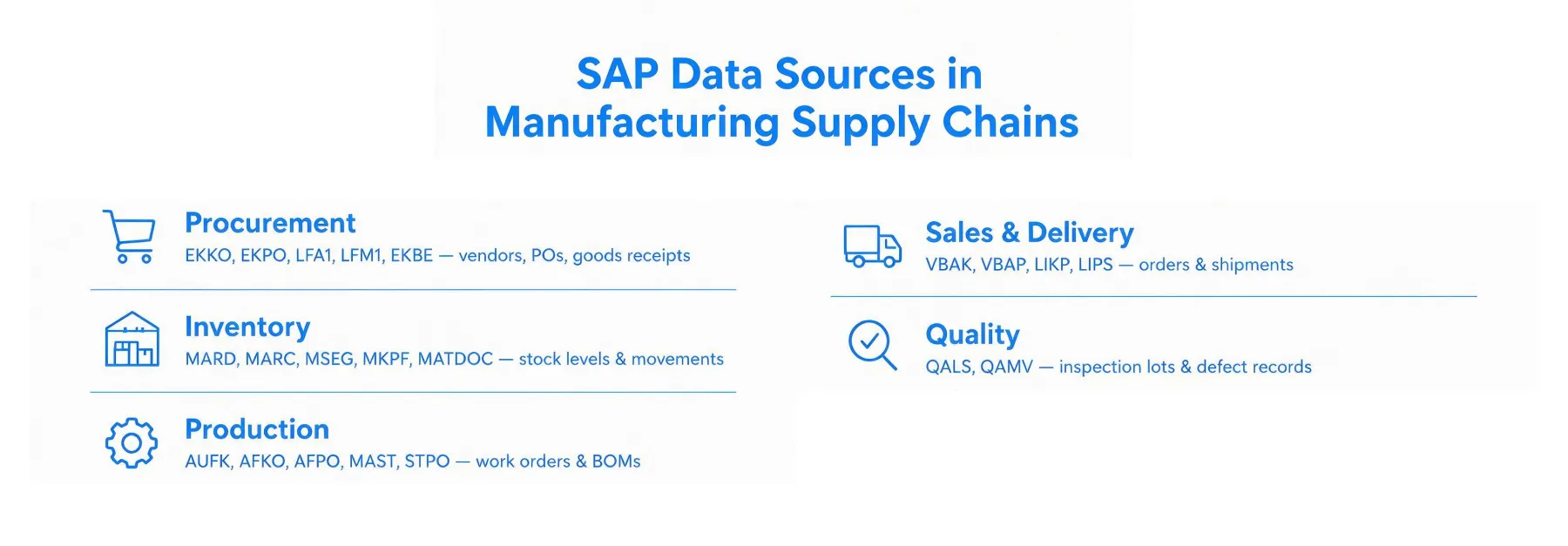
A supply chain in manufacturing spans five functional domains inside SAP, each contributing a distinct slice of the picture.
Procurement, Purchase Orders, Vendors, and Goods Receipts
EKKO plus EKPO carry purchase order headers and items, while LFA1 with LFM1 hold vendor master data. EKBE records the confirmation history that makes on-time delivery measurable, which is why this domain is the foundation of supplier risk intelligence. Delivery reliability, price variance, dependency concentration all derive from it. It is also the domain most teams extend first, usually toward GenAI for procurement once the underlying tables are trustworthy.
Inventory, Stock Levels, Movements, and Warehouse Records
MARD and MARC hold plant plus storage location stock, while MSEG with MKPF record every movement. In S/4HANA these consolidate into MATDOC, which simplifies extraction considerably. Stock ageing, slow-moving inventory, safety stock breaches all come from this layer.
Production, Work Orders, BOMs, and Shop Floor Transactions
AUFK, AFKO, and AFPO describe production orders with their operations, while MAST plus STPO define bills of material. Joining these against inventory movements shows where component shortages actually stopped a line, which is rarely where the planning system predicted.
Sales and Delivery, Orders, Shipments, and Returns
VBAK and VBAP hold sales orders, while LIKP with LIPS hold deliveries. Together they close the loop between what customers requested, then what left the plant. Customer on-time-in-full performance depends entirely on how well this domain joins to production plus inventory.
Quality, Inspection Lots, Defect Records, and Audit Results
QALS and QAMV carry inspection lots with characteristics. Connecting them to vendor batches turns quality from a compliance record into a procurement input. A supplier with acceptable delivery timing but rising defect rates is a risk that neither dataset reveals alone.
How Databricks Turns Raw SAP Data Into Supply Chain Intelligence?
Landing the data is the straightforward part for any supply chain in manufacturing. Modeling it so a procurement director trusts the numbers determines whether the platform gets adopted. That is where most AI and ML solutions roadmaps quietly succeed or stall.
Modeling Supply Chain Entities With dbt and Spark SQL
Most teams model silver plus gold layers in dbt, running on Databricks SQL warehouses. Lakeflow Declarative Pipelines is the alternative where a managed runtime suits the team better. dbt brings version control, testing, documentation to transformation logic, which matters when the definition of on-time delivery has to survive a change of analyst. Keep the modelling grain explicit as well. A supplier delivery fact table at schedule line grain behaves very differently from one at goods receipt grain. Mixing the two is the most common source of double-counted volumes in SAP analytics.
Handling Slowly Changing Dimensions With Delta MERGE
Vendor master records change. Payment terms get renegotiated, addresses move, plants get reassigned, so a dimension that simply overwrites the old value makes historical analysis inaccurate.
Delta Lake MERGE handles this cleanly, writing a Type 2 dimension with valid-from plus valid-to timestamps, adding a current-record flag in one atomic operation. A purchase order raised in 2024 then joins the vendor attributes that were true in 2024, which is the only way lead time trends mean anything.
Data Quality Validation Before Data Reaches Consumption Layers
Validation belongs between silver and gold, not after publication. Expectations in Lakeflow Declarative Pipelines enforce the rules here, and Great Expectations does the same job for teams already standardized on it. Typical rules cover negative order quantities, plus goods receipts dated before their purchase order. Referential integrity between material documents and material master belongs here too.
Route violations to a quarantine table rather than dropping them. Quarantined rows tell the master data team exactly which records need correcting in SAP. The pipeline becomes a data governance instrument rather than a silent filter. Most databricks manufacturing use cases stall at this stage, not at ingestion.
Building the Pipeline From SAP Extraction to Gold Layer
With the architecture settled, a manufacturing supply chain build becomes a sequence of decisions about extraction strategy, modelling, monitoring.
Choosing Your Extraction Method Between Full Load, Delta, and CDC
Full loads suit small master data tables such as vendor plus material master, where a nightly complete refresh costs little. It also removes an entire category of synchronisation concern. Delta extraction uses a change timestamp or document number watermark, suiting large transactional tables where records are appended rather than updated in place.
Change data capture becomes necessary when records update frequently after creation. That describes production orders plus inventory documents in most manufacturing supply chain landscapes. The trade-off is a real one, since CDC delivers the lowest latency while carrying the highest configuration or compliance burden under the current SAP extraction rules.
A Worked Example of a Supplier On-Time Delivery Pipeline
Consider a mid-sized automotive components manufacturer running SAP ECC 6.0 across four plants. It generates roughly 180,000 material documents each month, across a base of about 900 active suppliers. Supplier scorecards were compiled manually in Excel every quarter, which meant a deteriorating vendor was typically identified around eleven weeks after the trend began.
The pipeline extracts EKKO, EKPO, EKBE, LFA1, plus MSEG on a two-hour incremental schedule into bronze Delta tables. Silver joins purchase order schedule lines to their goods receipts, then calculates delivery variance in days against the confirmed date. Gold aggregates on-time delivery percentage, quantity variance, rejection rate by vendor, plant, material group. A Power BI supplier risk dashboard then reads from it through Databricks SQL.
Two-hour data freshness replaced a quarterly manual cycle, so detection of supplier degradation moved from eleven weeks to under four days. The procurement team used the first two quarters of that visibility to renegotiate terms with the six suppliers accounting for most of the delivery variance.
Alerting and Monitoring SAP Sync Lag in Production
Monitor the metric that actually matters, which is the age of the newest record in each gold table rather than whether the last job returned success. A pipeline can complete without errors while silently extracting nothing, because a watermark stalled. Track extraction row counts against SAP-side counts on a weekly reconciliation job. Alert on sync lag thresholds set per domain, then publish freshness timestamps directly on the dashboards. Users who can see how current the data is stop asking whether they can trust it.
Common Challenges and How to Handle Them
Every manufacturing supply chain programme on SAP and Databricks meets the same three constraints. Planning for them early keeps timelines predictable.
SAP Table Complexity and Extraction Performance Constraints
SAP schemas were designed for transactional integrity rather than analytical convenience. A single business object can span a dozen tables, with cryptic names plus client-specific customisation. Budget discovery time accordingly. Mapping the tables your particular configuration actually uses typically takes two to three weeks, making it the most commonly underestimated phase of these projects.
Protect the source system as a design principle. Schedule heavy extractions outside period-end close, use parallel reads bounded by document number ranges rather than unbounded scans. Agree extraction windows with the SAP Basis team before the first pull.
Data Quality and Master Data Gaps
McKinsey’s supply chain research found that only around half of supply chain leaders rate their master data quality as adequate. Manufacturing landscapes assembled through acquisition tend to sit below that line. Duplicate vendor records, inconsistent material group assignment, unmaintained plant hierarchies all distort supplier analytics in ways that look like insight.
Treat this as a parallel workstream rather than a blocker. Publish quarantine reports from day one, agree ownership with the master data team. Let the pipeline surface the discrepancies that a decade of manual reporting quietly worked around.
Security and Compliance When Moving SAP Data to the Lakehouse
SAP authorization objects do not travel with the data. Access control has to be rebuilt in Unity Catalog through catalog, schema, row-level policies. Those align to the same plant and company code boundaries the business already enforces. Column masking then covers pricing or contract terms that only procurement should see.
Regulatory scope matters for manufacturers operating across regions, since GDPR covers vendor contact data while sector rules can restrict cross-border storage. Confirm the residency of every workspace before the first production load. Keep audit lineage enabled as well, so the path from a manufacturing supply chain dashboard figure back to its SAP source document stays provable.
Why Durapid Builds SAP and Databricks ETL Pipelines for Manufacturing?
A manufacturing supply chain pipeline sits at an unusual intersection. Durapid holds SAP Premium Partner status alongside Microsoft Data & AI Partner recognition. On the delivery side that means 95+ Databricks-Certified Professionals plus 150+ Microsoft-Certified Professionals. That combination matters, because most SAP partners are not lakehouse engineers. Most data platform firms, in turn, have never negotiated an extraction window with a Basis team.
If your procurement and supply chain data is still trapped across SAP, spreadsheets, disconnected systems, the next step is not another dashboard. It is a data foundation built for real-time decisions, and anyone tracking supply chain manufacturing news knows the December deadline leaves less room than it did. Talk to Durapid about designing SAP and Databricks ETL pipelines. We turn fragmented data into a scalable analytics platform for your supply chain and manufacturing operations.
Frequently Asked Questions
What is an ETL pipeline for SAP and Databricks?
It is a governed data flow that extracts SAP transactional data into Delta Lake bronze tables. Silver plus gold layers then transform it into analytics-ready manufacturing supply chain datasets.
Which SAP modules does this work with?
MM, SD, PP, QM, and FI cover most manufacturing supply chain requirements, spanning procurement, sales, production, quality, finance. Supplier risk intelligence work usually starts with MM plus QM together.
Can this work with both SAP ECC and S/4HANA?
Yes. ECC uses MKPF plus MSEG for material documents, while S/4HANA consolidates them into MATDOC. Extraction logic differs by table, though the pipeline architecture stays the same.
How long does it take to build?
A first production pipeline covering two SAP domains typically runs 10 to 14 weeks. Two to three of those weeks go to table discovery plus extraction method selection.
How is this different from SAP BW or SAP Analytics Cloud?
SAP BW reports on SAP data with SAP tooling. A Databricks lakehouse joins that data with IoT, EDI, logistics feeds, then runs machine learning on the combined dataset in the same platform.
Which manufacturing industries benefit most?
Automotive, pharmaceuticals, electronics, industrial equipment see the strongest returns from databricks manufacturing use cases. They combine multi-tier supplier networks with strict quality traceability requirements. That mix is common across any supply chain in manufacturing operating to regulated tolerances.

Recent Blog

How Voice AI Connects Calls With Sales Operations
October 15, 2026-
How GCCs Can Scale Engineering Teams with Staff Augmentation?
October 10, 2026 -
Asset Management Software for CFOs: From Depreciation to Capital Planning
September 29, 2026 -
Why Voice AI Is Different From Chatbots in Recruitment?
September 17, 2026