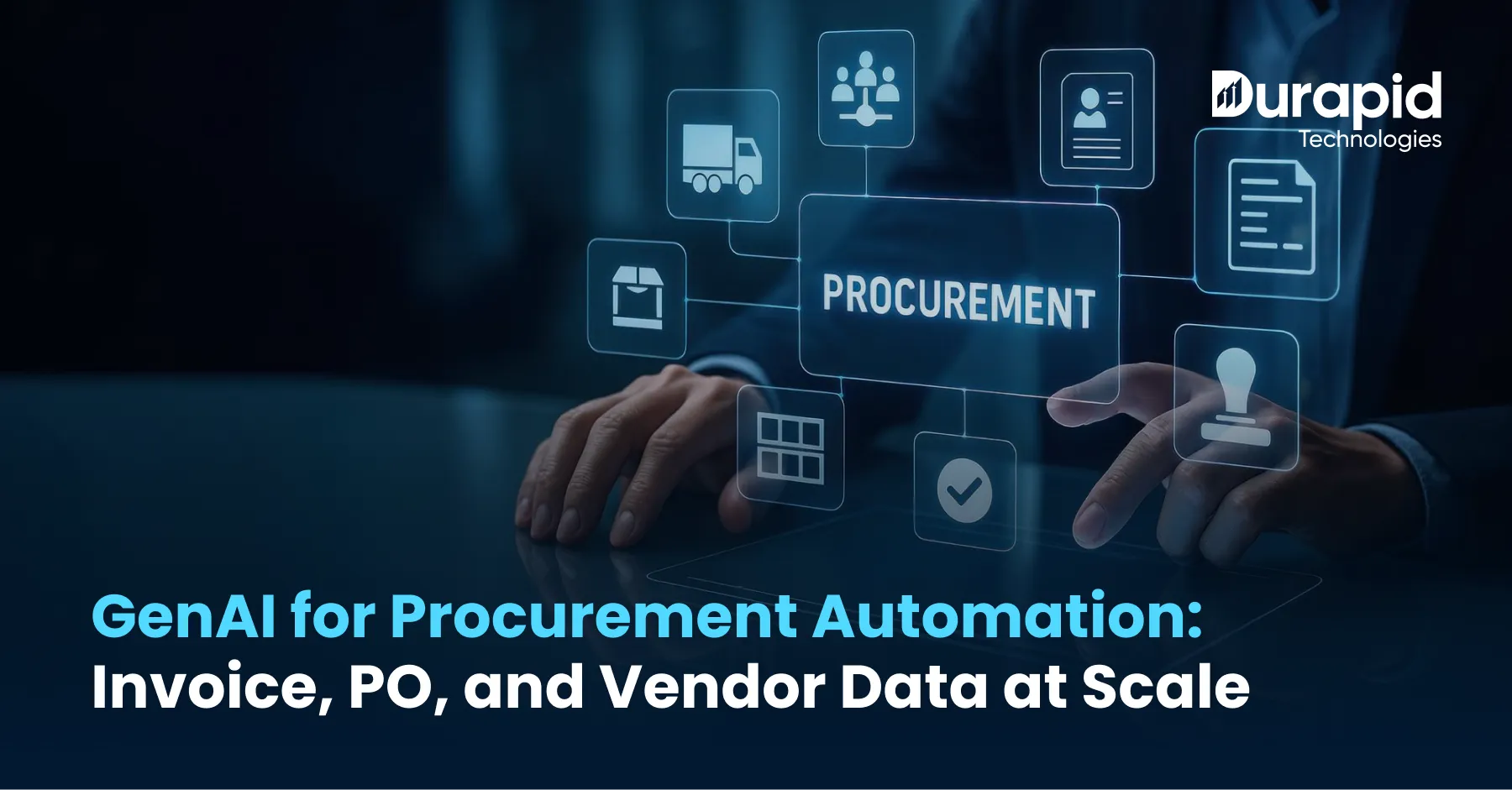
GenAI for Procurement Automation: Invoice, PO, and Vendor Data at Scale
Some procurement teams process invoices in 5 days. Others do it in 5 minutes with GenAI, and when you see the two side by side, the faster team doesn’t look like it’s working harder or spending more, it looks like it’s playing an entirely different game. That’s the real story here. The gap between them was never about money or budget. It was about architecture: how data moves through the procurement function, and whether the system is built to act on it automatically or wait for someone to key it in.
We’ve watched that split slowly grow bigger. Across 90+ enterprise AI projects, the procurement groups that moved away from manual workflows didn’t spend more than their peers. They out-thought them. They stopped treating procurement as a back office cost center, and started treating it like a data intelligence puzzle, if that makes any sense. Then the metrics back it up. GenAI leaders generate 3.7x more ROI than followers, compress invoice handling by 70%, and cut operational costs by about 25-30%. Our data engineering services build the technical bedrock that makes all of this stick.
So the question isn’t if GenAI works for procurement. It does. The real question is whether you’re on the right side of the divide or still doing invoice processing the same way everyone did five years ago.
What GenAI Actually Does in Procurement?
GenAI pulls out structured data from those messy procurement documents. It checks the data against business rules. Then it routes the decision through workflows. None of this needs manual re-keying. Compared with classic RPA, this approach adapts to format variations, handles language diversity, and manages odd exceptions without retraining.
From what we have seen in 90+ enterprise AI projects, companies that treat procurement like a data problem tend to get the fastest ROI. That data sits inside invoices, purchase orders, contracts, and compliance documents. GenAI just unlocks it. If you want specific use cases, explore our detailed AI in Procurement resource.
Invoice Processing Automation: From 5 Days to 5 Minutes

Invoice processing usually needs like 5-7 manual touchpoints, maybe more. Receive, extract, validate against PO, scan for duplicates, flag exceptions, route for approval. Honestly each one adds latency, and then everyone feels it.
GenAI kind of squashes the whole thing. The systems ingest invoices, pull out key fields in seconds, compare them with PO repositories, and auto-flag any mismatch. So handling time drops around 70%.
Uber’s 2025 story shows it working at scale in the real world. They process invoices from thousands of suppliers across 25+ languages using GenAI document processing. They used GPT-4 extraction. What they saw: 2x drop in manual effort, 90% accuracy with 35% landing at 99.5%, about 70% faster handling, roughly 25-30% cost savings versus manual approaches. Meanwhile GenAI handles the diversity that RPA can’t. Multi-language pages, handwritten text, layout variations. It works without weeks of manual rule setup, which is usually where the pain starts.
Purchase Order Automation: From Request to Issued PO Without Manual Intervention
Purchase order creation is one of the most repetitive workflows in procurement. Teams can spend hours pulling info from emails. They check supplier agreements. They send approvals around. Then they manually type up the POs, even though most of those steps follow the same predictable rules. GenAI automates the workflow. It takes messy purchase requests and turns them into structured purchase orders. It routes to the correct approvers. It issues compliant POs with minimal manual intervention. People jump in only when exceptions show up, like when judgment is needed, not for everyday routine handling.
Intelligent Intake: Turning Unstructured Requests Into Structured PO Data
GenAI reads unstructured purchase requests like emails or forms. It pulls out the main attributes: quantity, part number, delivery date, cost center. It validates that info against catalog data while generating structured PO templates within minutes. The results get better when incoming requests are cleaner. But even with partial details, GenAI produces something useful. A draft that a team can act on.
PO Generation: From Approved Requisition to Issued Order
Once it’s structured, GenAI cranks out the final PO. It checks your systems for supplier details. It pulls contract language. It applies pricing rules. It spits out a purchase order that’s ready to issue. There’s a human in the loop for odd cases, but it’s not the default flow. This operates as a closed-loop agent setup that validates against spend guardrails while checking compliance expectations.
Approval Routing: Getting the Right Stakeholder Without Manual Intervention
GenAI handles approvals in a smart way. Smaller POs go to department managers while bigger orders route toward procurement leadership plus finance. When a vendor is flagged as higher risk, it triggers extra compliance checks automatically. As a result, the approvals land in hours not days. The audit trail stays clear so you can see what happened.
Vendor Data Management: Cleaning the Foundation GenAI Depends On

Vendor master data is usually pretty messy. Lots of duplicates, incomplete compliance information, inconsistent names across systems. GenAI really needs that data clean, otherwise it can’t do its job well.
Using fuzzy matching across vendor names, tax IDs, and contact details, GenAI identifies duplicate vendor records and flags missing critical fields. It standardizes naming conventions. It aligns addresses across different geographies. The cleansing doesn’t stop either.It keeps running as new vendor records come in, catching inconsistencies in near real time.
For new vendor onboarding, teams often face 15-20 manual steps every time. GenAI automates the whole thing. It accepts the application and extracts document data. It checks tax IDs against external databases. It fills in whatever fields are still blank. It highlights high-risk vendors for review. The clean vendors can even auto-create in your ERP, which is pretty much the goal.
Vendor risk monitoring is also costly to do manually. However, GenAI monitors continuously using news feeds, financial databases, and internal performance signals. It flags bankruptcy indicators. It spots quality problems. It catches compliance issues the moment they show up. That way it replaces quarterly manual reviews and keeps your Supply Chain Management Services running at peak efficiency.
GenAI for Contract Management: Drafting, Review, and Risk Flagging
GenAI does a bunch of stuff with contract work. It spins up drafts from templates. It reviews non-standard clauses. It flags when a policy rule is violated. It even keeps an eye on expiration dates. When supplier agreements show up, GenAI pulls out the important terms like payment SLAs, price escalation, and termination conditions. It compares everything to your approved template while pointing out any deviations. In practice, this cuts days off legal review time for high-value deals. It can automate boring routine reviews completely.
Supplier Risk Monitoring: From Quarterly Reviews to Continuous Intelligence
Most teams still live with quarterly scorecards for supplier risk. GenAI flips that into real-time monitoring. It tracks performance day by day against SLAs. It watches quality metrics. It flags compliance problems as they appear rather than after the cycle ends. People get notified right away instead of waiting for some review meeting. Consequently, logistics and manufacturing customers have reported around 40% fewer unexpected disruptions. They moved from quarterly manual reviews to continuous monitoring using AI for supplier risk management.
The Architecture Behind Production Procurement GenAI?
Production GenAI usually needs data pipelines, approval workflows, ERP integration, and human-in-the-loop steps for higher risk calls. Since most enterprises run SAP, Oracle, or Coupa, the GenAI layer has to fit in seamlessly. Typically it extracts data from the ERP in near real time. It processes via GenAI pipelines. Then it writes results back without manual glue work.
The setup looks like this: document ingestion from email, APIs, and uploads. Plus preprocessing like OCR for scanned documents and language detection. Then comes model inference using either fine-tuned models or foundation models. After that, post-processing is like business rule validation. There’s also monitoring for model drift and fallback options when confidence is low since you don’t want blind trust. For more context, the Generative AI in Procurement guide explains how multi-agent orchestration helps coordinate these bigger workflows.
Implementation Roadmap: How to Move From Pilot to Production
Pilots fail when teams solve the technical puzzle but skip the operational one. A model working on 100 test invoices looks great. Then it suddenly struggles on 10,000 production invoices, especially when edge cases show up. That’s the part nobody wants to talk about until it hurts.
Start with a thorough audit of your data. Document formats, data quality, integration points, all of it. Do this before you touch the model. Then define success metrics, because speed, accuracy, and cost reduction have different ROI profiles. Following that, build with real data engineering rigor, not just “it runs on my laptop.” Implement human-in-the-loop workflows starting around 60-70% automation. The remaining pieces should be reviewed. Edge cases should be collected so feedback loops back into the system. Most production setups improve by 2-5% each month in year one as they hit more unknowns.
Why Durapid Builds Procurement GenAI That Reaches Production?
We’ve built 90+ enterprise AI projects across BFSI, logistics, and manufacturing. The firms that succeed treat procurement GenAI as a business transformation, not just another technology initiative. Our view is simple. GenAI is only valuable if it reaches production and delivers measurable ROI.
We mix technical depth with procurement domain insight. We have 150+ Microsoft-Certified Professionals and 95+ Databricks-Certified Professionals who design solutions that match your specific ERP, vendor ecosystem, and risk profile. As a Microsoft Data & AI Partner and SAP Premium Partner, we integrate cleanly with SAP, Oracle, and Coupa. We build on Databricks for data pipelines. We use Azure OpenAI for inference. We structure everything around your supply chain management processes.
Get Started With Production Procurement GenAI
GenAI in procurement is being deployed today, and the numbers look real. 2x lift in manual processing efficiency. About 70% less handling time. Roughly 25-30% in cost savings. The gap between leaders and followers is mostly execution, not ideas.
Durapid has built expertise and architecture across 90+ enterprise projects. So we know what tends to hold up when scaled. Let’s talk about your procurement workflow. Maybe start with the obvious question. What is your biggest bottleneck: invoices, POs, vendor data, or contracts? We’ll look at your current state. We’ll find the high-impact openings. Then we’ll craft a roadmap that gets to production GenAI while trimming expenses. Reach out to schedule a consultation.
Frequently Asked Questions
What is GenAI procurement automation?
GenAI procurement automation uses GenAI with large language models to pull out structured info from documents that aren’t neatly formatted. Think invoices, purchase orders, contracts. It checks the data against internal business rules. It pushes choices through workflows so nobody has to re-key everything by hand. Compared with “normal” RPA, GenAI adjusts when formats change. It can deal with weird cases or exceptions instead of just failing hard.
How does AI invoice processing work?
The system ingests invoices in almost any format or language. It uses document understanding models to extract the key fields. Then it matches those fields with existing POs plus receipts. Subsequently, it checks for duplicate invoices. It highlights anything that looks off like amount mismatches or missing identifiers. In production setups, teams are reporting around 90%+ accuracy. About 70% reduction in handling time (Uber, April 2025). Which is kind of the main point.
What is the difference between traditional automation plus GenAI?
Traditional automation often runs on fixed, predefined rules. It breaks down if the supplier changes the layout or a new invoice style shows up. GenAI, by contrast, is designed to handle format variation, language diversity, plus those edge situations. It doesn’t need constant retraining. That makes it more flexible when you have a diverse supplier base.
How long does it take to deploy GenAI for invoice processing?
Most enterprises can go from pilot to production in about 12-16 weeks. The rough breakdown includes data audit (around 2 weeks). Model selection takes about 4 weeks. System integration is 4 weeks. Then UAT for 2 weeks and rollout for the last 2 weeks. If the workflows are simpler and your data is already clean, you can sometimes move faster. Though that depends on the scope.
What ERP systems can Durapid hook up to GenAI procurement with?
We’re set up to integrate with SAP, Oracle, Coupa, and Ariba. The integration pulls transaction details via ERP APIs. It runs it through GenAI pipelines. Then it drops the outputs back into your ERP database basically in place.
Does procurement GenAI need tidy vendor master data?
Not strictly, but it helps a lot. We do vendor cleansing during implementation so you don’t have to chase it later. Once the vendor records are deduplicated and normalized, accuracy rises noticeably.
Which procurement workflows usually bring the quickest ROI from GenAI?
Invoice processing plus vendor data cleansing tend to land ROI within about 6 months. PO automation and contract management can take around 3-6 months. Yet the upside is still strong with roughly 30-40% cycle time improvement. Supplier risk monitoring serves more as an ongoing safeguard. It brings resilience value after go-live.

Recent Blog

How Voice AI Connects Calls With Sales Operations
October 15, 2026-
How GCCs Can Scale Engineering Teams with Staff Augmentation?
October 10, 2026 -
Asset Management Software for CFOs: From Depreciation to Capital Planning
September 29, 2026 -
Why Voice AI Is Different From Chatbots in Recruitment?
September 17, 2026