FastAPI + LangChain: Building Production Python AI Backends
FastAPI Python backends now run most production-grade LLM applications built on LangChain. In our experience delivering AI systems across BFSI, logistics, and e-commerce clients, the projects that survive share one trait. They start with a Python FastAPI backend, built as part of a proper Python Full Stack AI approach. Production constraints get considered from day one, not retrofitted once the demo already works.
This article walks through why that pairing holds up and where it breaks down. It also shows what a working FastAPI Python and LangChain stack looks like under real traffic. The need for this engineering discipline is becoming increasingly clear. Gartner projects that over 40% of agentic AI projects will be canceled by the end of 2027, citing escalating costs and unclear engineering discipline rather than model quality.
What FastAPI and LangChain Actually Do in a Python AI Backend?
A production Python AI backend needs two distinct capabilities working together. One layer handles HTTP requests, validation, and concurrency. The other manages prompts, retrieval, and reasoning over an LLM. FastAPI and LangChain are built for exactly these two roles. Confusing them is where most architecture decisions go wrong.
Teams new to this stack often push orchestration logic into the API layer, or push request validation into the LangChain chain itself. Neither approach holds up at scale. Keeping the fastapi python route separate from the LangChain chain makes the service easier to test, trace, and hand off between engineers.
What FastAPI Brings to AI Backend Development
FastAPI is an ASGI-based Python web framework built on Starlette and Pydantic. It gives a fastapi python API automatic request validation, OpenAPI documentation, along with native async support without extra configuration. This matters for AI workloads because LLM calls are I/O-bound. A blocking Flask-style framework holds a worker hostage for the full duration of every model call. FastAPI, by contrast, frees that worker to serve other requests while it waits on the model provider.
The dependency injection system is another reason fastapi python has become the standard choice for AI teams. Authentication, database sessions, and rate limiting all get declared once, then reused across every route. That structure keeps a growing codebase from turning into duplicated checks scattered across dozens of endpoints.
What LangChain Adds That a Standard Python Framework Cannot
LangChain is not a web framework. It is an orchestration layer for retrieval, prompt chaining, and tool calling on top of an LLM. A plain python fastapi route can call an LLM API directly, but it cannot manage document chunking, vector retrieval, memory, or multi-step reasoning on its own. That kind of orchestration is what LangChain already provides through LCEL chains and the langchain openai integration.
Prompt templates, output parsers, and retriever interfaces are standardized across model providers in LangChain. Switching from OpenAI to Anthropic, for example, usually means changing a handful of lines instead of rewriting the orchestration layer. That portability is hard to replicate manually inside a bare fastapi python service.
How FastAPI and LangChain Work Together in Production?
The two frameworks sit at different layers of the same request. FastAPI owns the network boundary. LangChain owns everything that happens between receiving a validated request and generating a response. This is usually the point where teams bring in full stack AI developers to own both sides properly.
A typical request moves through the stack in a predictable order. The FastAPI route authenticates the caller and validates the payload with a Pydantic schema. It then hands the validated input to a LangChain chain or LangGraph graph. That layer retrieves context, builds the prompt, and calls the model. FastAPI receives the result and serializes it back to the client, streaming tokens if the endpoint supports it.
The Architecture Behind the API Layer, Orchestration Layer, and Retrieval Layer
A working production stack separates cleanly into three layers. The API layer, built in fastapi python, handles authentication, request schemas, along with rate limiting. The orchestration layer, built in LangChain or LangGraph, manages prompt construction, tool calls, and multi-step logic. Whether the langgraph vs langchain choice leans one way or the other matters less than getting this layering right in the first place. The retrieval layer connects to a vector store such as Pgvector, Pinecone, or Databricks Vector Search and returns grounded context before generation.
This separation matters operationally. A slow retrieval call can be traced independently of the LLM call and the API response time, which beats debugging one opaque black box. Each layer can also scale on its own terms. A team can add more Uvicorn workers to handle API traffic without touching the retrieval layer. Swapping the vector store also becomes possible without rewriting a single fastapi python route.
Where This Stack Fits Compared to Node.js or Django
Node.js handles concurrency well but lacks Python’s maturity in the ML and data tooling ecosystem. That gap matters when a service also calls scikit-learn, pandas, or a Databricks notebook output. Django, by contrast, was built for synchronous, admin-heavy applications rather than streaming token-by-token LLM output. A python api built for LLM workloads needs async-first design. That is why FastAPI has become the default choice for teams standardizing on a fastapi framework python stack for GenAI services.
When to Use FastAPI and LangChain, and When Not To
This stack is the right choice when you are building a RAG pipeline in production, a multi-tool agent, or any service where prompt orchestration changes frequently. It also fits cases where that orchestration needs to be testable independently from the API layer. The same goes for teams that already run Python-based data infrastructure, since it shares tooling with Databricks and Airflow pipelines.
Regulated industries benefit as well. A fastapi python service gives compliance teams a clear audit boundary, while LangChain’s tracing shows exactly what the model saw before it answered.
When NOT to Use FastAPI and LangChain
If your use case is a single, fixed prompt with no retrieval, no tool calls, and no chaining, LangChain adds orchestration overhead you do not need. A direct call to the model provider’s SDK inside a fastapi python route is simpler to maintain and debug. Teams building extremely latency-sensitive services, under 50 milliseconds end to end, should evaluate whether Python’s GIL and LangChain’s abstraction layers introduce acceptable overhead first.
Small internal tools with a handful of users rarely justify the full three-layer architecture either. A single python fastapi file with a direct model call is often more maintainable than a full fastapi framework python setup until usage or complexity actually grows.
Building a RAG Endpoint: FastAPI and LangChain in Practice
A mid-sized logistics client running customer support automation needed a python api that answered questions from 40,000 internal shipping policy documents. The team ingested documents through LangChain’s text splitters, embedded them with a Databricks-hosted embedding model, and stored the vectors in Pgvector. Query latency dropped from an average of 8 seconds on the original synchronous prototype to under 1.4 seconds. That happened after the team moved to an async FastAPI endpoint with connection pooling.
The rebuild took roughly six weeks with two engineers. Most of that time went into tuning chunk size and retrieval parameters rather than writing the fastapi python endpoint itself. That is a common pattern across similar RAG rebuilds.
Ingesting Documents, Chunking, and Embedding
Document ingestion uses LangChain’s RecursiveCharacterTextSplitter to break source files into overlapping chunks, typically 500 to 1,000 tokens, before generating embeddings. Chunk size directly affects retrieval quality. Chunks that are too large dilute relevance scores, while chunks that are too small lose the surrounding context the model needs to answer correctly.
Metadata matters just as much as chunk size. Tagging each chunk with its source document, section title, and last-updated date lets the retrieval layer filter results before they reach the langchain openai call. That filtering cuts down on irrelevant context being passed to the model.
Exposing Retrieval-Augmented Generation as a FastAPI Endpoint
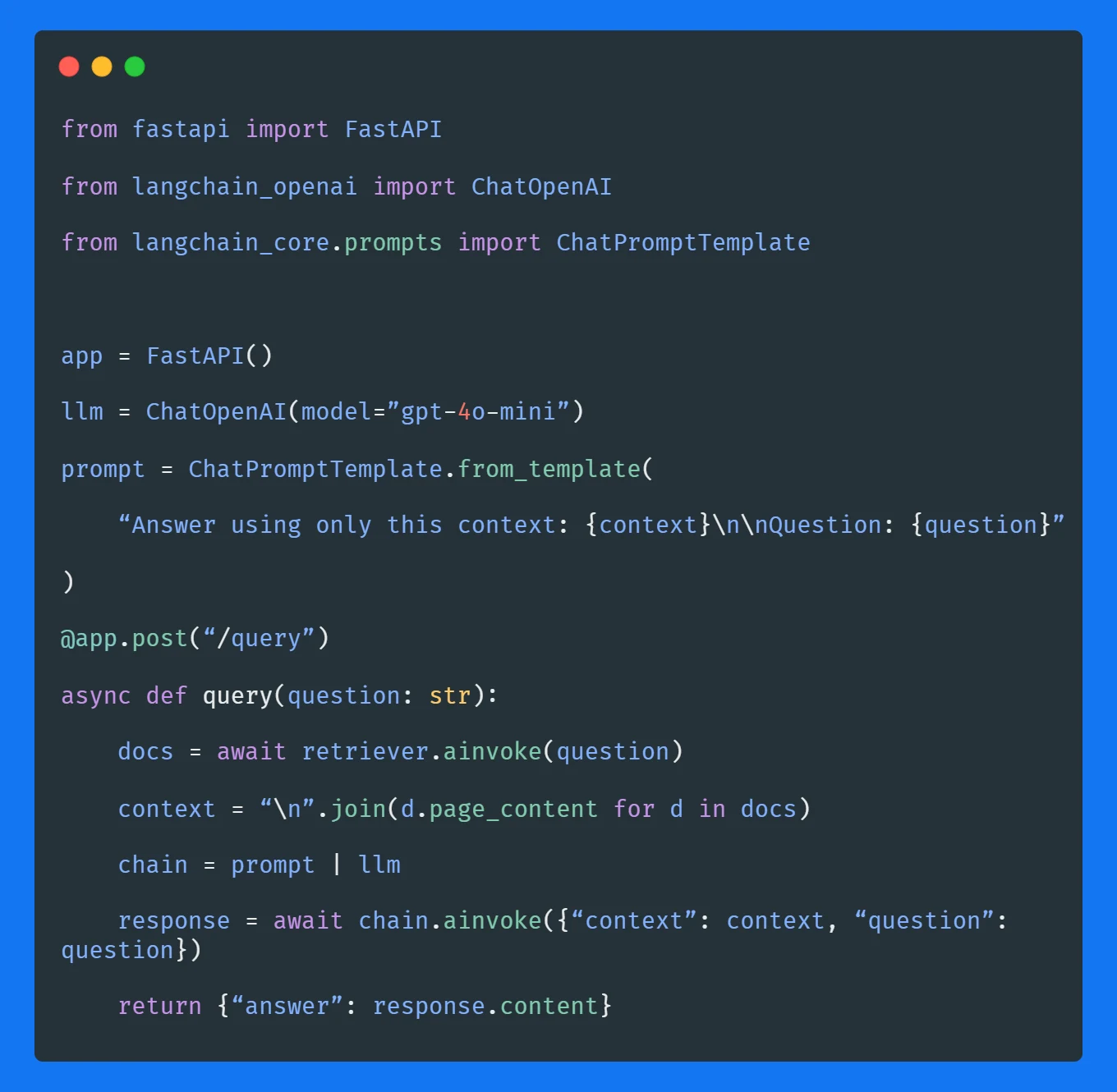
Every step in this endpoint uses the async variant, ainvoke instead of invoke. That choice is what actually delivers the concurrency benefit of a FastAPI service. Calling the synchronous LangChain methods inside an async def route blocks the event loop and quietly erases the performance advantage FastAPI was chosen for.
Making a LangChain Backend Production Ready
A working demo and a production service are not the same deliverable. Production readiness means the service holds up under concurrent load, unauthorized traffic, and partial failures.
Async Endpoints, Rate Limiting, and Authentication
Every route that calls an LLM or a vector store should be declared async def and should await non-blocking clients only. Rate limiting, typically through slowapi or an API gateway, protects against runaway token spend when a client retries aggressively. Authentication should sit at the dependency injection layer, using FastAPI’s Depends, so every route inherits the same validation logic instead of duplicating checks.
Timeouts deserve the same discipline. Every LLM call and vector store query in a FastAPI service should have an explicit timeout. An LLM provider outage without one can leave requests hanging until the client eventually gives up on its own.
Logging and Tracing With LangSmith
LangSmith traces every step of a LangChain chain, including prompt inputs, retrieved documents, token counts, and latency per node. Without this visibility, diagnosing why a RAG pipeline in production returned an incorrect answer means guessing between a retrieval failure and a generation failure. With tracing enabled, that same investigation takes minutes instead of hours.
Structured logging at the FastAPI layer should sit alongside LangSmith rather than replace it. Request IDs generated at the API boundary can pass through to LangSmith traces. That lets an engineer follow one user’s request across both systems during an incident review.
Common Mistakes Teams Make With FastAPI and LangChain
Most production incidents in this stack trace back to a small number of repeatable mistakes, not model quality.
Blocking Calls in Async Endpoints
The single most common failure across client deployments is a synchronous database driver or HTTP client called inside an async def route. This freezes the event loop for every concurrent user, not just the one making the slow call. It often goes unnoticed until traffic scales past a handful of users.
A close second is calling the synchronous LangChain invoke method instead of ainvoke inside an async fastapi python route. This mistake is easy to miss in code review since the endpoint still works correctly. It just quietly loses the concurrency FastAPI was chosen for in the first place.
Unhandled LLM Hallucinations at the API Layer
A fastapi python endpoint that returns raw LLM output without a validation or confidence layer passes hallucinated content directly to end users. Adding a structured output schema with Pydantic catches a meaningful share of these exceptions before the response reaches the client. A groundedness check against the retrieved context adds another layer of protection.
Teams that skip this step often discover the gap only after a customer flags an incorrect answer already delivered in production. Building the validation layer into the FastAPI route from the start is significantly cheaper than retrofitting it after users have already seen the exceptions.
Why Durapid Builds Production AI Backends With FastAPI and LangChain?
Durapid’s engineering teams have shipped fastapi python backends for clients across financial services, logistics, and retail. Each engagement brings its own latency, compliance, and scale requirements. As a Microsoft Data & AI Partner, Durapid has 95+ Databricks-certified professionals on staff. We build retrieval layers that connect directly to a client’s existing data platform. That means no standing up a parallel, disconnected vector store.
If your team is evaluating a python fastapi build for its next AI product, Durapid’s Python Full Stack AI practice can help. The same goes if you’re ready to hire full stack AI developers who have already debugged event loop blocking and retrieval failures in production. We build these systems on FastAPI and LangChain from the first sprint, not as an afterthought.
FAQs
Is FastAPI good for AI and LLM applications?
Yes. FastAPI’s native async support and Pydantic validation make it well suited for I/O-bound LLM calls. It is the most common choice for a fastapi framework python GenAI backend in 2026.
LangGraph vs LangChain, which should I use for my project?
Use LangChain for linear chains and straightforward RAG. Move to LangGraph when you need branching logic, checkpointing, or multi-agent handoffs that a single chain cannot express. The langgraph vs langchain decision usually comes down to how much control the workflow needs over its own state.
Can FastAPI handle streaming LLM responses?
Yes, using StreamingResponse with an async generator that yields tokens as they arrive from the langchain openai integration, rather than waiting for the full completion.
How do I prevent my FastAPI LangChain app from blocking under load?
Use async database drivers like asyncpg, async HTTP clients like httpx, and confirm every LangChain call uses the ainvoke method rather than invoke.
How much does it cost to build a production fastapi python and LangChain backend?
Cost depends mostly on retrieval complexity, not the API layer itself. A focused RAG endpoint like the logistics example above typically takes four to six weeks with a small team. A multi-agent system built on LangGraph can take longer, depending on how many tools and data sources it needs to coordinate.

Recent Blog

LlamaIndex vs LangChain: Which One to Choose in 2026?
July 29, 2026