How to Build a RAG Pipeline That Actually Works in Production
RAG pipeline isn’t that hard to build. Building one people can truly rely on is. Your AI assistant gave the right answer yesterday. Today it confidently points to an old policy from like six months ago, no hesitation at all. The docs are there. The data is there. The model is strong. And still, somewhere between finding the information and writing the response, something small and quiet goes wrong. That’s the piece nobody really discusses.
Most teams celebrate when the demo works. The chatbot answers a few questions, everyone is impressed, and it goes live. But that’s usually where the real challenge begins. Soon, answers start missing context, retrieval slows down, and users begin questioning the AI. More often than not, the LLM isn’t the issue. The RAG pipeline is.
A production-ready RAG system is much more than connecting an LLM to a vector database. Every decision matters, from document chunking and embeddings to retrieval and data freshness. Get those right, and users trust your AI. Miss them, and even the smartest model starts giving unreliable answers. That’s why the best AI teams spend as much time building the RAG pipeline as they do choosing the model.
In this guide, we’ll explore what a RAG pipeline is, why many deployments stumble after launch, and how to build one that’s fast, reliable, and ready for production. You can also explore how this fits into a broader Python Full Stack AI approach to building end-to-end AI applications.
What Is a RAG Pipeline?
Retrieval-Augmented Generation, at first glance, sounds pretty straightforward: you pull in relevant documents, hand them over to an LLM, then you get an answer that’s grounded in your own actual data. Understanding what is a rag pipeline at its core means grasping how it bridges the gap between static training data and dynamic, real-world information. In early prototypes, it looks gorgeous, and behaves usually well. But once you ship, it kinda falls apart. That annoying gap between something “functional” versus “production-grade” is exactly where most enterprise RAG projects end up spending half a year, plus two budgets, sometimes more.
We’ve seen this movie play out across 50+ enterprise AI deployments. The model is rarely the real villain. It’s almost always the retrieval layer, the part of the system that figures out which documents count, how the documents are chunked, how they’re embedded, everything sorted or ranked. When retrieval is broken, you end up feeding irrelevant context. Then the LLM does what it does best: it fills in the blanks, hallucinates based on that off-target material. Users get a response that sounds confident, but it’s completely wrong. You see the outage, the wrongness, the “this should have worked” moment.
Retrieval-Augmented Generation can be described as an architecture that retrieves relevant documents from your data, provides those documents to an LLM as context, and produces answers grounded in that context instead of leaning only on what the model learned during training. The rag pipeline meaning goes beyond simple keyword matching. It’s about semantic understanding, relevance ranking, and ensuring the LLM receives the most pertinent information.
Traditional LLMs rely on what they learned during training. They can’t access new information on their own, which is why outdated answers and hallucinations are common. RAG changes that by retrieving relevant, up-to-date information before the model generates a response. Instead of guessing, the LLM answers using your actual data. This is where the distinction between llm vs rag becomes clear. While an LLM alone generates responses from training data, a rag llm system grounds those responses in real, current information.
Unlike fine-tuning, RAG doesn’t retrain the model. It simply enriches the prompt with fresh context, making it faster, more cost-effective, and far easier to maintain as your data evolves.
Why Enterprises Are Adopting RAG Now
According to McKinsey, around 55% of organizations using generative AI are in fact still experimenting with retrieval-augmented generation. The main reason is pretty straightforward: it lowers hallucinations, keeps responses tied to sources you can actually verify. In sectors that are heavily regulated, such as financial services, healthcare, and legal, that “grounding” really becomes non-negotiable.
Gartner says that companies rolling out RAG setups typically get about a 40% drop in LLM hallucinations. They also get roughly a 35% lift in answer accuracy when the question is domain-specific. This isn’t just some small upgrade. It’s the kind of difference where a rag pipeline llm system is actually usable in practice versus one that nobody trusts after the first few days.
The numbers land well too. Making a fine-tuned model for each specialized area can run about $150K to $500K per model. A RAG pipeline might cost $30K to $80K upfront. It scales fairly horizontally as your data keeps growing. So if an enterprise is juggling 50+ specialized knowledge bases, RAG ends up being the only economically workable path, honestly.
Why Most RAG Pipelines Fail in Production
Failures tend to happen in repeatable ways. Let’s name them straight, one by one.
Poor Document Chunking
First is poor document chunking. It really nukes context. When you cut a 50-page compliance document into 200-word chunks, you lose the whole narrative flow. The retriever might happily serve up chunk 42, but the actual answer is in chunks 40 through 45. The LLM just doesn’t get that thread. You end up with answers that feel incomplete. Sometimes you get this circular loop where the model keeps restating what it already “kind of” saw. In most enterprise RAG setups, you usually want chunks around 500 to 1,200 tokens, with roughly 20% overlap so coherence survives across related documents.
Low-Quality Embeddings
Second, low-quality embeddings break retrieval at the semantic layer. Documents get turned into those 768 or 1,536-dimensional vectors. If the embedding model doesn’t represent meaning well, the retriever can return material that looks close topically, but it’s actually semantically off. A question about “quarterly profit margins” might pull documents about “quarterly earnings calls” because the embeddings mix up surface-level resemblance with real relevance.
Ineffective Retrieval Strategies
Third, retrieval strategies that are ineffective tend to miss nuance. Pure vector similarity, like a dot product between the query embedding versus the document embeddings, can cover broad categories well enough, but it falls apart on specific questions with details. For example, “post-acquisition integration costs in healthcare M&A” might land on a bunch of pages just because they contain “acquisition.” If you don’t do reranking, filtering, or hybrid search, then you’re basically stuffing the signal into noise while hoping the LLM finds it.
Outdated Data and Hallucinations
Hallucinations that come from outdated information slowly chip away trust. In your RAG setup, the system pulls up documents that are weeks or even months old. The LLM then stitches together an answer from that stale context. By the time the people using it realize something is off, the model has already offered bad guidance. Production RAG pipelines really can’t treat recency like a “nice to have.” They need constant ingestion, near-live freshness guarantees.
And this isn’t some weird edge scenario. We’ve run into all of these patterns, again and again, with BFSI, logistics, and retail teams. It’s not a random quirk. It’s the kind of systematic failure that’s built right into the architecture.
Core Components of a Production-Ready RAG Pipeline
A production RAG pipeline has seven layers, all kinda critical.
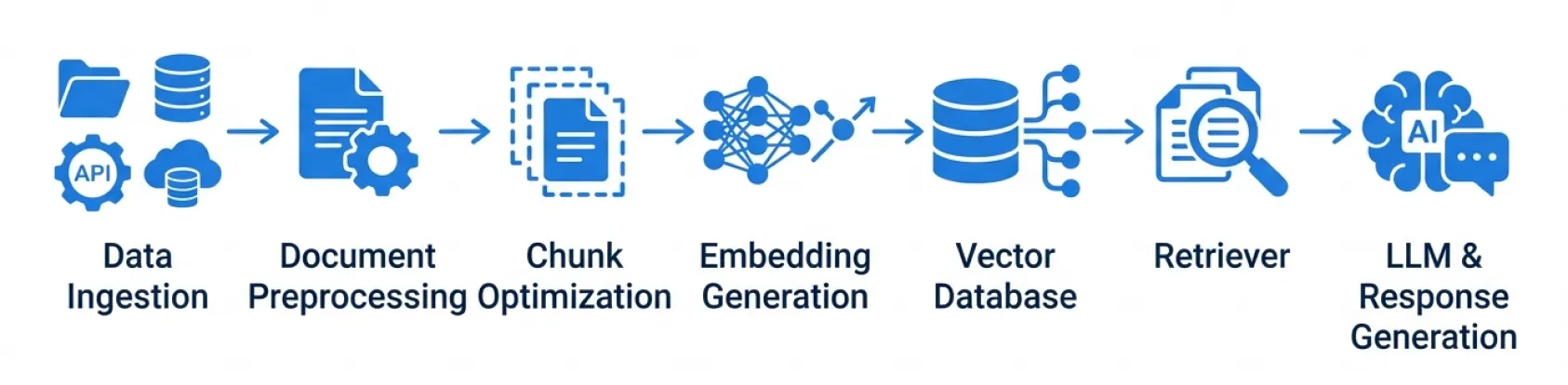
Data Ingestion
Data ingestion deals with raw input: PDFs, databases, APIs, cloud storage. This layer has to normalize formats, pull the text out reliably, keep track of data provenance. If your PDF parser works 95% of the time, it creates silent failures across the whole system.
Document Preprocessing
Document preprocessing cleans, deduplicates, gives structure to the data. Duplicate documents can inflate retrieval results. Unstructured text without metadata makes it basically impossible to filter later. This layer also makes a call on chunking strategy. How to split documents into retrievable segments.
Chunk Optimization
Chunk optimization figures out chunk size, overlap, boundaries. Tiny chunks lose context. Big chunks bloat embeddings, which hikes retrieval costs. Overlapping chunks do add redundancy but also improve coverage. Ideally you use boundary-aware chunking: splitting at sentence or section boundaries instead of just arbitrary token counts. That keeps the meaning more intact.
Embedding Generation
Embedding generation takes text, turns it into vectors where the whole semantic meaning hangs out. High quality embedding models like OpenAI’s text-embedding-3-large or Databricks’ BGE-Large tend to beat older approaches by roughly 15% to 25% on domain-specific retrieval benchmarks. For really specialized areas such as legal, medical, financial, you may want domain-specific embedding models. They often outperform general ones by something like 30% to 40%. It can show up in the results pretty fast.
Vector Database
The vector database stores, fetches those embeddings at scale. Options include Weaviate, Pinecone, Milvus, or Databricks Vector Search. This part is not a “nice to have” thing. A weak or poorly indexed setup leads to latency spikes. Those can cascade into bigger production issues. Most enterprise deployments usually need support for metadata filtering, hybrid search, fault tolerance rather than just raw similarity lookups.
Retriever
The retriever ranks, returns the top K documents. Cosine similarity alone is the basic starting point. In production, teams typically mix BM25 (keyword overlap) with vector similarity. Call it hybrid search. Then add metadata constraints, for example, only return items tagged “Q3 2024.” Finally reranking, re-scoring the candidates using a second model. That stacked retrieval pattern can lift precision by around 20% to 40%, depending on the dataset, query style.
LLM and Response Generation
The LLM does the reasoning, response generation using the retrieved context. This is the last move. Honestly all the earlier optimization becomes pointless if the model hallucinates. Prompt engineering still matters. It’s not just vibes. System prompts that tell the LLM to cite sources, stay grounded, decline anything outside the retrieved context can cut hallucinations by about 30% to 50%, sometimes more if the setup is consistent.
Step-by-Step Guide to Building a Production RAG Pipeline
We’ll sort of walk through the implementation using AWS, Databricks, and LangChain. A pretty realistic enterprise stack.
Step 1: Gather and validate your data. Start with a pilot dataset of 500 to 1,000 documents. Don’t ramp up until retrieval behaves well at the small scale. Make sure your information is in clean, normalized, coherent formats. PDFs should be extractable as text, not like scanned images. Databases should have clear schemas, not “kind of implied” ones. This phase usually lands around 2 to 4 weeks for a typical enterprise knowledge base.
Step 2: Plan your chunking approach. Try three chunk sizes: 300 tokens, 600 tokens, 1,000 tokens. Then you measure retrieval accuracy. Does the top document actually contain the answer? Use something like 30 to 50 representative questions. The chunk size that gets you above 85% retrieval accuracy is your target. Then implement 20% overlap between the chunks.
Step 3: Create embeddings, load them into your vector database. For embeddings use OpenAI’s text-embedding-3-large (1,536 dimensions) or Databricks BGE-Large (1,024 dimensions). Embed your chunks, store them in Weaviate, Pinecone, or Databricks Vector Search. Also include metadata such as source document, publication date, section, data classification. This extra context supports filtering, governance, and makes audits easier.
Step 4: Implement hybrid retrieval. Begin with vector similarity for your top 10 results by embedding match. Then add BM25 keyword search for your top 5 results by keyword match. Merge the two result sets, weighting the vector side at 60% while the keyword side stays at 40%. This hybrid strategy tends to catch both semantic matches, lexical overlap.
Step 5: Add a reranking layer. Take the merged retrieval outputs, like 10 to 15 documents. Push them through a reranking model such as Cohere’s rerank-english-v2.0. The reranker re-scores each document for relevance so the actually useful stuff rises to the top. There’s a tradeoff: expect 50 to 100ms extra latency. But top-1 accuracy usually climbs by 20% to 30%, give or take.
Step 6: Build your LLM prompt. System prompt: “You are a helpful assistant. Answer only based on the provided context. If the answer is not in the context, say so. Always cite the source document.” User prompt: “Context: [retrieved documents]. Question: [user query]. Answer:” Keep it pretty direct, don’t make it too jailbreak-friendly, just keep the format.
Step 7: Add observability. Log every query, retrieval result, generated response, user feedback with no exceptions. Measure latency end-to-end, per component. Track retrieval accuracy. Does the top document actually contain the answer? Monitor hallucination rate. Do users flag false answers? This observability is not negotiable. You can’t improve what you can’t measure.
Choosing the Right Tech Stack
Keep your stack aimed at simplicity, observability, and scalability. Don’t overthink it too much.
LLMs
For production you can choose Claude 3.5 Sonnet, GPT-4o, or Llama 3 depending on what you care about more: costs versus performance. Claude tends to be about 30% cheaper than GPT-4o when you compare roughly the same quality. Llama 3 also lets you run it on your own infrastructure. Whatever you pick, standardize it. Swapping LLMs mid-production tends to cause compatibility hell, usually just snowballs.
Embedding Models
Consider text-embedding-3-large from OpenAI ($0.02 per 1M tokens), BGE-Large (open source), or use a domain-specific embedding model if your use case is specialized. For BFSI, medical, or legal data, a domain-tailored embedding model often outperforms the general ones, pretty consistently.
Vector Databases
Weaviate (self-hosted, open), Pinecone (managed), Milvus (self-hosted), or Databricks Vector Search (AWS/Azure managed). If you’re doing this in an enterprise setting, going managed is usually the smarter call. You dodge a lot of day-to-day ops stuff. Databricks Vector Search also plays really well with the Databricks Lakehouse. You get more or less unified data governance without feeling like you bolted on a sidecar. For organizations tracking technology investments, understanding how Databricks stocks perform can inform long-term infrastructure decisions.
Orchestration and Monitoring
For orchestration, LangChain, LlamaIndex, or Haystack kind of dominate here. A langchain rag pipeline is one of the most common production setups because LangChain turns into an abstraction layer for LLMs, embeddings, and the vector store layer. Switching components later stays painless. It’s also built on FastAPI, which makes the integration smoother than people expect. Building a langchain rag pipeline specifically with LLMs requires careful attention to prompt engineering and retrieval quality.
For monitoring, LangSmith (LangChain’s own monitoring) works well. Or create your own telemetry hooks inside the pipeline. Track things like query latency, retrieval precision, LLM response duration, even the little bits of user feedback. Route those signals into a lightweight dashboard so you can see what’s happening before it turns into a “why is everything slow” incident. This approach connects to broader LLMOps in production practices for managing AI systems at scale.
Best Practices for Production RAG Systems
Get the chunk size, overlap numbers by testing, not by vibes. There isn’t one chunk size that works everywhere. You kinda have to try it in your own setup. Move around in a range like 300 to 1,500 tokens. Then actually measure retrieval accuracy each time. Pick the smallest chunk size that still keeps top-1 above 85%, or close to it.
Do metadata filtering aggressively. Don’t just fetch across all documents hoping for the best. If the query is about “Q3 2024 financials” then filter to items tagged Q3_2024. This alone tends to cut retrieval noise by something like 40% to 60%, depending on your collection.
Use hybrid search as the baseline, by default. Vector-only search can miss the exact keyword flavor you need. BM25-only search often loses the deeper meaning. When you combine them, hybrid usually gets you 30% to 40% better coverage on edge cases than either method on its own. Add reranking if latency lets you. If possible, rerank the top 10 to 15 candidates from retrieval. You typically see precision jump by 20% to 30%. The trade is about 50 to 100ms of extra latency. For a lot of enterprise use cases it’s worth it, no question.
Cache repeat questions. If the same question comes in again, don’t rerun retrieval plus generation like it’s brand new. Cache the full answer for 24 hours. This often reduces LLM expenses by 20% to 30% for knowledge-base style systems.
Secure sensitive data, always. If you’re working with healthcare or financial records, use row-level security on your vector database. Never embed PII directly. Keep PII stored separately, then do the join at retrieval time. That way the embeddings don’t become a privacy risk.
Real-World Production Scenario
A mid-sized BFSI client had 15,000 compliance documents (SOPs, regulations, risk assessments). Their internal team was answering 200 queries per day, mostly by hand, fully manual. We put together a RAG pipeline using Databricks Lakehouse, Databricks Vector Search, Claude 3.5 Sonnet, and LangChain. This is a solid example of how a rag pipeline meaning translates into practical business value.
The setup ingests documents daily via Apache Airflow. We chunk everything at 800 tokens with about 20% overlap so we don’t lose the context. For embeddings we used BGE-Large, kind of domain-specific for financial data. Retrieval is hybrid: vector 60% plus BM25 40%. Then we do reranking. The system prompt explicitly states no answers outside the retrieved context, so the model has a hard boundary there.
After 8 weeks, the system answers around 95% of queries correctly without manual intervention. Average latency ends up 2.3 seconds end-to-end. Hallucination stays under 2% overall. The team moved from 200 queries per day to about 1,200 per day while keeping the same 3-person team. We automated the 95% they were still doing manually. On cost, it was $8K to set up, then roughly $2K per month to run. Mostly embeddings, vector storage, Claude API usage. ROI hits breakeven in about 3 months.
It’s not perfect though. It still produces wrong-ish answers on really ambiguous compliance questions. But the signal to noise is good enough that users actually trust it. That trust feels less like “the LLM magic,” more like the deliberate architecture, the retrieval plus filtering layers doing the heavy lifting.
Common Challenges in Production RAG
Hallucinations
Hallucinations happen when the LLM basically starts making up information that is not actually in the retrieved documents, or only partially supported by it. One mitigation is to be extra explicit in the system prompts: “Answer only using provided context.” Plus doing retrieval quality assurance where you audit your top-100 queries for retrieval accuracy. Then add a user feedback loop. Collect corrections, retrain the reranker. The whole pipeline learns from real behavior, not just guesses.
Stale Data
Stale data shows up when your vector database doesn’t refresh quickly enough for what users need right now. The mitigation here is continuous ingestion using Apache Airflow or Kafka. Keep metadata tagging with ingestion timestamps. Automatically deprecate documents older than a certain threshold.
Latency
Latency becomes a problem when the end-to-end latency is above your acceptable bounds: more than 5 seconds for synchronous use cases. To mitigate this you can reduce the chunk size, implement query caching, and use faster embedding models. Even batch reranking offline so interactive requests stay snappy.
Cost Creep
Cost creep is what you get when embedding costs, LLM API costs start ballooning as usage scales. A solid mitigation plan is caching aggressively, implementing query deduplication, moving to cheaper embedding models, for example BGE-Large instead of text-embedding-3-large. Also consider self-hosted LLMs for high-volume workloads where it makes financial sense.
Retrieval Accuracy Plateau
Retrieval accuracy plateau happens even after tuning when your top-1 accuracy just stalls around 75% to 80%, no matter what you do. Mitigation could include adding metadata filtering, implementing hybrid search, using domain-specific embeddings, doing a careful audit of your chunks for quality. Understanding the nuance between llm vs rag helps clarify when to use alternative approaches. You can also explore RAG vs fine-tuning to understand when alternative approaches might work better.
When NOT to Use RAG
RAG is not, you know, some kind of silver bullet. In a few situations it just doesn’t make sense to lean on it. Try other approaches instead, depending on what you actually need:
- When the data is tiny, it all fits in the prompt context. If your knowledge base is under 5,000 documents, smaller than 500MB, you can just prompt-inject the whole thing. It’s simpler. No vector database, no retrieval latency either. Mostly you trade “engineering” for a bigger context window.
- When your information changes every hour. RAG setups usually refresh embeddings on a daily or weekly cadence. If the data is constantly moving around (real-time stock prices, live sensor streams, those kinds of things), RAG will lag in practice. Better go for streaming architectures rather than retrieval.
- When you need interpretability, like actual evidence. If auditors want you to show exactly why the system returned a certain answer, then RAG helps because you can cite source documents. But if what you need is subsecond, ultra-crisp explanations about decision boundaries, then simpler rule-based systems might fit better.
- When cost is literally the only constraint. RAG pipelines often beat fine-tuning on price. But running at scale still lands you around $2K to $10K per month. If the budget is basically none, a local LLM with no retrieval becomes the fallback, even if it’s less flexible.
Building Production RAG at Scale
RAG is not new. But production RAG (systems that reliably ground LLM outputs in real data, at enterprise scale with observability and governance) still feels like a small slice of the market. Most orgs are kinda stuck in the prototype phase. Understanding what is a rag pipeline at enterprise scale means grasping the infrastructure complexity required to support thousands of concurrent users.
That gap from prototype to production is mostly architecture. It’s the chunking strategy, metadata filtering, reranking, ongoing data validation, observability too. Honestly it’s this unglamorous engineering stuff that separates systems that work from systems that fail silently, without much of a trace.
At Durapid, we’ve built 50+ enterprise RAG systems across BFSI, healthcare, and logistics. We have 300+ engineers with 95+ Databricks-certified professionals who help clients through the whole path: starting from architecture design, moving into production optimization. The playbook works. The patterns are repeatable. The outcomes are measurable. Understanding how to scale AI systems and track their performance is critical. Companies focused on scale AI stock performance and those running production RAG pipelines both understand the importance of robust infrastructure. You can explore how this fits with data engineering services to build the underlying infrastructure for production-grade systems. For enterprise teams also evaluating SAS products or other enterprise software, the principles of rag llm integration apply universally.
If you’re planning a RAG system, or you’re recovering from a prototype that didn’t hold up, let’s connect. We can review your current setup, sketch the route to production, and execute.
FAQ
Q: How long does it take to build a production RAG pipeline?
A: Most enterprise RAG pipelines take 8 to 12 weeks. Data preparation usually takes the longest, while platforms like Databricks can speed up deployment.
Q: What embedding model should I use?
A: OpenAI’s text-embedding-3-large is a strong default. For legal, healthcare, or finance, domain-specific models like BGE-Large often deliver better retrieval accuracy.
Q: How much does a production RAG pipeline cost?
A: Most organizations spend $2,000 to $10,000 per month, depending on query volume, vector storage, and LLM API usage.
Q: Can I use RAG with proprietary LLMs?
A: Yes. RAG works with GPT-4, Claude, Llama, Falcon, and most API-based or self-hosted LLMs.
Q: How do I handle documents larger than token limits?
A: Split them into smaller chunks before indexing. For large documents, hierarchical chunking helps preserve context and improves retrieval quality.

Recent Blog

Asset Management Software for CFOs: From Depreciation to Capital Planning
September 29, 2026-
Why Voice AI Is Different From Chatbots in Recruitment?
September 17, 2026