LLMOps Explained: Managing Large Language Models in Production
The complete process of LLMOps includes all activities which deal with operational management of large language models. These activities span their lifecycle from system deployment through ongoing monitoring to system expansion and system enhancements in artificial intelligence operations. The answer to what is LLMOps exists at the same level as MLOps because LLMOps deals with the specific problems which arise when organizations need to operate LLMs in actual business conditions.
When organizations require LLMOps for their actual projects, this becomes essential because model development serves only as the initial stage. Organizations also need to ensure LLM systems operate continuously through performance management, system updates, and LLM system maintenance.
Enterprise organizations need structured model operations and LLM operations to guarantee their artificial intelligence systems work together with existing systems. These include Enterprise CRM platforms and Mobile Application Development Services built applications without disrupting operational processes or user interactions.
This blog will explain LLMOps through detailed analysis of its meaning and operational processes. It also demonstrates why LLMOps is essential infrastructure for businesses that want to use large language models at high volume without dealing with urgent operational issues.
What Is LLMOps and Why Does It Differ from Standard MLOps?
LLMOps serves as the essential system which determines whether your company AI efforts create actual benefits or silently fail to operate. Most teams discover this the hard way. You spend months fine-tuning a large language model. It scores brilliantly in testing, and then it hits live traffic.
The system experiences latency increases which reach 14 seconds. The actual expenses reach three times the original budget estimate. After three weeks of actual user interactions, the model begins to lose focus on its main topic. According to Gartner, 85% of AI and ML projects fail to move from pilot to production. That is exactly why LLMOps exists as the discipline which helps teams run large language model systems and it has become essential for their work.
It describes the collection of methods and equipment which organizations use to establish, track, and support their large language models during operational activities. It builds on the foundation of MLOps but addresses challenges that traditional ML pipelines simply were not built to handle.
Standard MLOps provides model version management, continuous integration pipelines, delivery pipelines, and drift detection capabilities for structured data models. LLMOps extends that to cover prompt lifecycle management, token cost optimization, hallucination monitoring, RLHF integration, and LLM infrastructure orchestration across GPU clusters. The system needs operational management at a level which surpasses standard operational requirements.
A typical ML model operates with 500,000 parameters while using one CPU. In contrast, a production LLM needs billions of parameters which require distributed GPU systems, specialized batching methods, and equipment that operates with instantaneous delay requirements. These two operational scenarios present their own unique requirements for handling.
Challenges in Managing Large Language Models
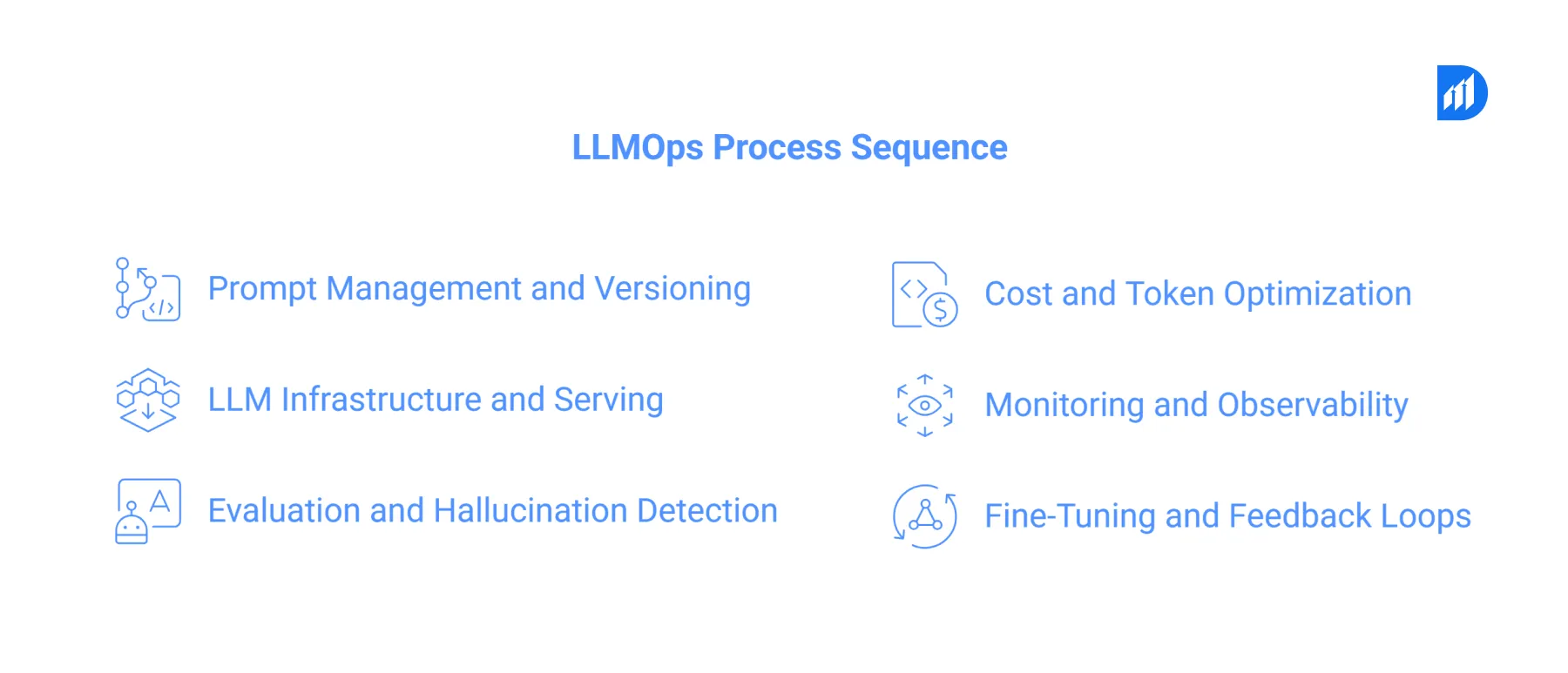
The six fundamental elements of an LLMOps pipeline create its entire operational framework, building on principles similar to What Is MLOps but tailored specifically for large language models. The system provides solutions which help teams solve their problems when they need to move from initial prototypes to fully production grade systems.
Prompt Management and Versioning
The system treats prompts as code elements which need version control because they will modify system behavior and output result quality. Teams using ad-hoc prompt strings in production report 3x higher incident rates than teams with structured prompt registries (Scale AI, 2024). Tools like LangSmith, PromptLayer, and Weights and Biases provide the necessary functions for this specific operational layer.
LLM Infrastructure and Serving
LLM infrastructure covers model deployment, system capacity distribution, and machine resource management. A 70B parameter model deployment needs precise control over its graphics processing unit memory allocation. Teams can use tools like vLLM, Ray Serve, or Triton Inference Server for continuous batching operations. These tools also support key-value cache optimization processes which decrease GPU memory requirements by 40%.
Evaluation and Hallucination Detection
The evaluation of LLM systems requires more than just testing accuracy results. Actual LLM operations in production environments require system testing to verify accuracy of facts, evaluate toxicity levels, and check if the context matches expected standards. The RAGAS and TruLens frameworks maintain evaluation processes which identify content that does not meet established quality requirements before users access the material.
Cost and Token Optimization
The expenses associated with token usage increase at an accelerated pace. One inefficiently designed prompt which operates 100,000 times daily can add $18,000 every month in unnecessary API charges. Therefore, LLMOps employs techniques like prompt compression and response caching through GPTCache. It also uses intelligent model routing directing simple requests to economical smaller models while sending intricate inquiries to advanced frontier models.
Monitoring and Observability
Effective LLM operations require three separate monitoring levels. First, infrastructure monitoring covers GPU utilization, latency, and throughput measurements. Second, model behavior monitoring checks output quality, drift, and topic adherence. Third, business impact monitoring measures task completion rate and user satisfaction. Teams using full-stack LLM observability tools see 55% faster mean time to resolution on production incidents.
Fine-Tuning and Feedback Loops
The best training signal comes from production data. LLMOps pipelines record user feedback while identifying low-quality outputs. They then use selected examples to return curated data for fine-tuning processes. Techniques like LoRA and QLoRA enable teams to perform model fine-tuning on 7B to 13B parameter models through a single A100 GPU setup. As a result, this leads to 70% cost savings when compared to complete parameter updates.
The table below shows how LLMOps components address specific production failure points that standard MLOps pipelines miss:
| LLMOps Component | Problem It Solves | Key Tools |
| Prompt versioning | Untracked prompt changes breaking production | LangSmith, PromptLayer |
| LLM infrastructure | Latency spikes and GPU memory overflow | vLLM, Ray Serve, Triton |
| Hallucination detection | Factually incorrect outputs reaching users | RAGAS, TruLens, Guardrails AI |
| Token optimization | Runaway API costs at scale | GPTCache, model routing |
| LLM observability | Slow incident detection and resolution | LangFuse, Arize Phoenix |
| Fine-tuning pipelines | Model drift and declining output quality | LoRA, QLoRA, Axolotl |
Each component feeds the next. Observability data informs fine-tuning decisions. Token optimization findings, in turn, shape prompt versioning strategy. This is what separates a reactive LLM operations setup from a proactive one.
When to Implement LLMOps: Signals Your Team Is Ready?
Not every LLM project needs enterprise-level LLMOps from the start. However, your organization has reached the point where structured LLM operations are required when the following conditions apply:
- You process more than 10,000 LLM requests every day.
- Multiple teams use a shared model and prompt base for their work.
- Your organization has dealt with production issues caused by prompt drift or unexpected model behavior.
- Your monthly LLM API expenses exceed $5,000 with no cost attribution by team or feature.
- Your AI outputs must follow regulatory and compliance standards.
If three or more of these conditions apply, the need for LLMOps infrastructure is current, not future. Waiting only increases the cost of the eventual fix.
When NOT to Apply Full LLMOps Overhead?
The risk of over-engineering exists for AI projects which have not reached their development stage. Applying complete LLMOps tools to prototypes or internal proof-of-concept projects adds multiple weeks of setup work with no production value. If you conduct initial research work with fewer than 1,000 daily requests and have a single-developer team working on internal software, then the basic system is the right choice.
Start lean. Use version control for your prompts, implement basic latency tracking, and record all your model versions. The basic LLMOps system should expand as your organization experiences higher traffic and more complex operations. This staged approach helps your organization maintain control over its tools while it builds its complete LLM operational capabilities.
LLMOps Architecture for Enterprise-Grade LLM Infrastructure
Enterprise LLM infrastructure typically follows a three-tier architecture: the gateway layer, the orchestration layer, and the model serving layer. The gateway layer performs authentication, rate limiting, and request routing. This layer uses tools like Kong and Azure API Management. The orchestration layer controls prompt assembly, RAG retrieval, memory management, and multi-step reasoning chains. It operates using LangChain, LlamaIndex, and Semantic Kernel. Finally, the model serving layer manages inference, batching, and hardware resource allocation.
Durapid teams implement LLMOps on Azure through Azure OpenAI Service for managed model endpoints. They also use Azure Machine Learning for pipeline orchestration and Azure Monitor with custom LLM metrics. This architecture enables enterprise compliance requirements while keeping 95th percentile request times below 800 milliseconds.
How LLMOps Connects to Broader Enterprise AI Strategy
LLMOps connects upstream to data engineering practices and downstream to enterprise application layers. Organizations which create AI-powered mobile applications require LLM operations with minimal delays because these operations enable fast user interaction. Poorly managed LLM infrastructure adds three to six seconds of latency on mobile networks. That directly impacts user retention rates.
Enterprise CRM platforms, similarly, need LLMOps guardrails to prevent AI-generated product details from reaching customers. This is especially critical when they integrate generative AI for sales assistance or customer support automation. A single unchecked AI response in a customer-facing Enterprise CRM can trigger compliance issues. The resulting brand damage far outweighs the cost of proper LLM operations tooling.
Durapid’s Mobile Application Development Services teams use LLMOps checkpoints inside CI/CD pipelines. They test model updates for latency, quality, and cost impact before users ever access them.
Frequently Asked Questions
What is LLMOps in simple terms?
LLMOps is the set of engineering and operational practices that keep large language models running reliably and cost-effectively in production. Think of it as DevOps, but built specifically for LLMs.
How is LLMOps different from MLOps?
MLOps covers general machine learning model lifecycle management. LLMOps adds prompt management, token cost control, hallucination detection, and LLM-specific infrastructure concerns that standard MLOps tools do not address.
What tools are used in LLMOps?
Common LLMOps tools include LangSmith and PromptLayer for prompt management, vLLM and Ray Serve for model serving, RAGAS and Guardrails AI for evaluation, and LangFuse for observability.
What is model operations for LLMs vs traditional ML?
Model operations for LLMs focus on non-deterministic outputs, token-based cost structures, and continuous prompt optimization. Traditional ML model operations focus on structured predictions, data drift, and batch scoring pipelines.
How much does LLMOps infrastructure cost?
Open-source stacks like vLLM and LangFuse have near-zero licensing costs but require engineering time. Managed platforms like Azure ML or Weights and Biases run from $500 to $5,000 per month. Token optimization practices typically save 30–50% on API costs, often covering the entire tooling budget.
Ready to Build a Production-Grade LLMOps Stack?
Managing large language models in production is solvable with the right architecture, tooling, and operational discipline. Durapid Technologies helps enterprise teams design and implement LLMOps pipelines that cut incident rates, control costs, and keep model quality consistent at scale.
Whether you are deploying your first production LLM or scaling an existing system, Durapid’s certified AI teams bring the hands-on expertise to get it right. Contact us to discuss your LLMOps roadmap today.

Recent Blog

Why Voice AI Is Different From Chatbots in Recruitment?
September 17, 2026-
LlamaIndex vs LangChain: Which One to Choose in 2026?
July 29, 2026