Shopify SAP Integration Benefits: Improve Operations and Accelerate Growth
The SAP integration process transforms your Shopify store into a complete business system. In practice, it enables your company to run its functions and share information for better decisions. No more operating as separate entities.
The basic functions of Shopify let you control orders, monitor stock levels, and interact with clients. But once your business reaches its peak, these two parts of your operation start creating problems. Think delayed information transfer, manual data entry, accounting errors, and systems that cannot share data with one another. As a result, SAP integration has moved from being an optional tech upgrade to an essential business need. Companies now depend on SAP Integration Suite to run their backend systems. SAP Integrated Business Planning handles their operational planning, while Shopify manages the customer-facing side.
The main advantage goes beyond platform connection. It builds a continuous data flow throughout your entire system. This includes order and inventory synchronization, Cloud-Powered Financial Systems, AI for fraud detection, plus analytics from other data systems. This blog explains SAP integration in Shopify. It covers the definition, why businesses need it, the benefits, possible difficulties, and how to implement it right.
What Is SAP (Systems, Applications, and Products) Integration in Shopify?
SAP integration with Shopify enables automatic data transfer between your Shopify storefront and your SAP ERP system. There is no need for manual data exports, data entry, or validation delays. Instead, the system automatically moves data between Shopify and SAP. It tracks orders, product information, customer details, and inventory levels in real time.
When a customer places an order on Shopify, SAP receives it right away. When stock levels drop in the warehouse, Shopify reflects it instantly. The SAP integration suite gives organizations three ways to connect their systems: API connections, middleware platforms, and native connectors. Each method builds a bridge between your customer-facing storefront and your back-office operations. The goal stays the same across all of them: one trustworthy source of information for every part of the business.
What Are the Benefits of SAP Integration?
Your Shopify store is processing thousands of orders. But your SAP ERP is still catching up from last night’s batch export. The current inventory counts show discrepancies. Finance reconciliation takes three full days. The fulfillment team uses outdated spreadsheets.
The problem does not come from technology. It comes from how data moves between systems. SAP integration with Shopify is the fix that turns two disconnected systems into one unified operational engine. Shopify currently powers more than 4 million stores serving customers in over 175 countries. SAP clients account for 84% of worldwide commercial activity. When these two platforms run separately, the cost shows up in order delays, inventory inaccuracies, and lost sales. With proper SAP integration, your entire operation runs on one accurate source of information.
Faster Order Processing and Fewer Errors
The automated process that transfers Shopify orders directly into SAP reduces processing time significantly. It contributes to a 70% improvement in order processing speed. Teams stop copying data between systems. Instead, they focus on fulfillment, customer service, and growth. The direct data connection between Shopify and SAP eliminates manual data input. This reduces order processing errors by up to 80%. For a business handling 1,000 daily orders, that is a clear and measurable shift in reliability.
Real-Time Inventory Accuracy Across All Channels
When Shopify and SAP are linked, stock updates appear instantly across all sales channels. This prevents overselling and helps businesses catch every sales opportunity. Real-time inventory sync between SAP and Shopify achieves 99.9% inventory accuracy. As a result, it prevents customer disappointment from stockouts. This also cuts down on backorders, refund requests, and the customer support volume that follows.
Improved Customer Experience and Satisfaction
Customers can check their orders and track shipments without calling support. The system updates customer accounts to give instant access to order details, full order history, and current shipping status. Additionally, unifying customer data from Shopify and SAP gives businesses a complete view of each customer. This helps deliver more tailored marketing, sales, and support. Happy customers return. Frustrated ones do not.
Built-In Fraud Detection and Transaction Security
SAP integration with Shopify provides real-time order monitoring. Specifically, it automatically flags transactions that look suspicious. SAP’s algorithms process transaction data immediately, scanning for irregular order volumes, billing discrepancies, suspicious shipping addresses, and risky payment methods.
This works well alongside AI for fraud detection, where machine learning builds on top of rule-based systems. It catches new fraud patterns before they grow into real financial losses. You can explore more in our guide on AI for fraud detection in finance.
Financial Accuracy and Faster Reporting
Financial integration enables automatic payment and invoice updates from Shopify into SAP. This, in turn, ensures correct financial reporting. The automated system keeps operations consistent, reduces processing time, and prevents human mistakes. Month-end close cycles now take hours instead of a week. Finance teams work from live data rather than waiting for exports. And with a single system of record tracing all transactions, audits become much simpler.
Why SAP Integration in Shopify Is Required?
Higher order volumes combined with disconnected systems cause operational delays, inventory discrepancies, and fulfillment errors. Teams deal with orders from Shopify that do not reach SAP on time. Inventory accuracy drops across warehouses. Refunds and cancellations go unupdated in finance. Shipping slows down because teams lack real-time visibility.
Cloud ERP held 65% of the global ERP market share in 2024. Businesses moved to it for faster deployment, ongoing software updates, and easier system connections. Clearly, the shift is underway. Businesses that delay SAP integration fall behind on data speed, decision quality, and customer experience. SAP Integrated Business Planning links demand forecasting with supply chain management and financial planning in one cycle. This is where SAP integrated business planning shows its real value. Without Shopify feeding real order data into this system, planning depends on assumptions instead of facts.
To see how cloud-connected systems support compliance and data governance, check our guide on cloud-powered financial systems.
Common Challenges in Shopify SAP Integration
Even well-planned integrations hit real technical obstacles. Spotting them early helps avoid costly surprises mid-project.
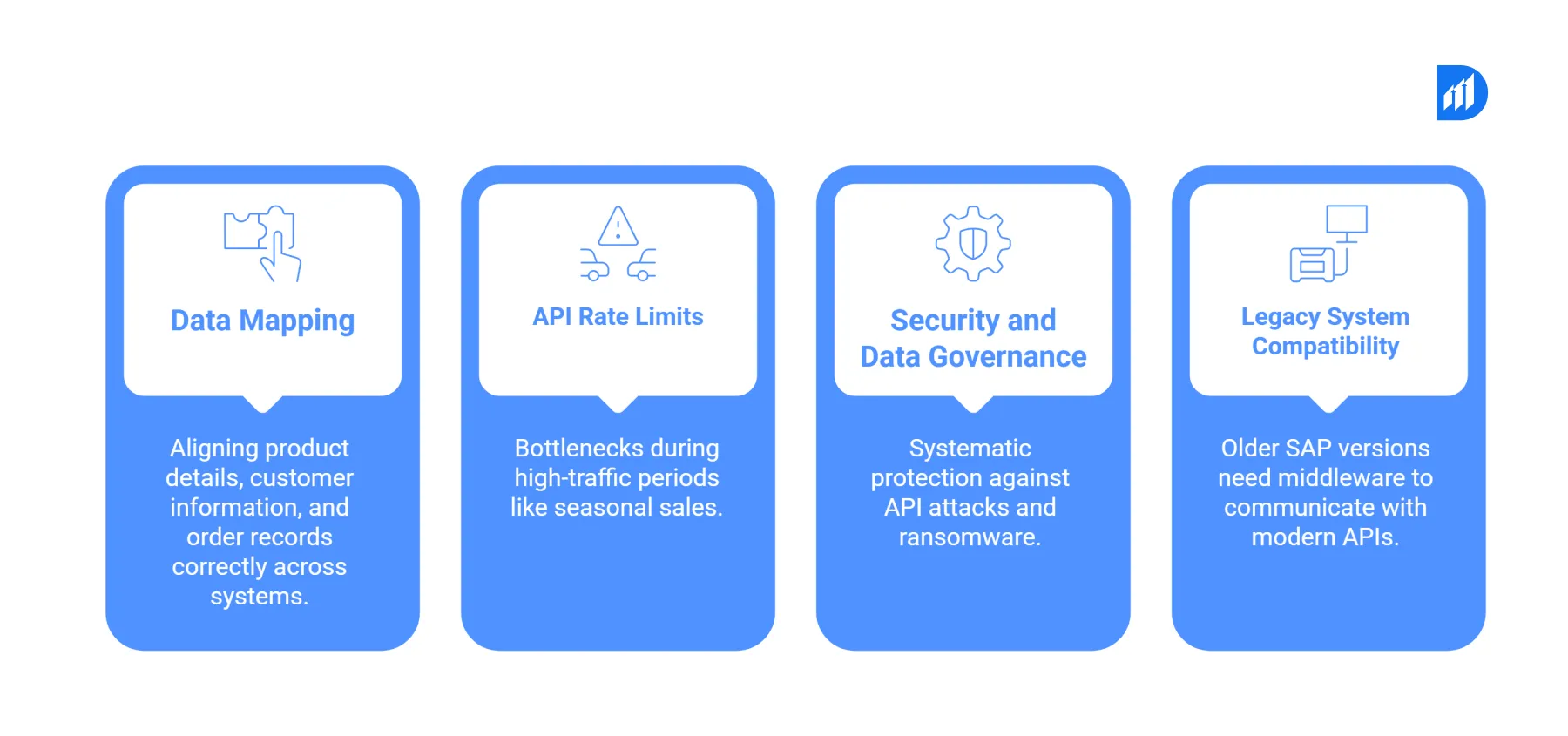
Data mapping is the most common hurdle. Companies must align product details, customer information, and order records correctly across both systems. Some require custom solutions that take significant time and resources to build.
API rate limits create bottlenecks during high-traffic periods like seasonal sales. For instance, Shopify enforces strict API call limits. When queue management fails, integrations break down exactly when you need them most.
Security and data governance need systematic protection. Between January 2023 and December 2024, API attacks hit 150 billion recorded incidents. Furthermore, ransomware attacks against major ERP systems jumped 400% since 2021. Data encryption in transit, role-based access control, and regular connection audits are non-negotiable.
Legacy system compatibility adds another layer of complexity. Many SAP environments run older versions that need middleware to communicate with modern Shopify APIs. Custom connectors or SAP integration suite platforms close this gap.
Before starting a large-scale data migration, it helps to review best practices for cloud data migration tools.
How Durapid Technologies Simplifies Shopify SAP Integration?
Durapid Technologies brings 120+ certified cloud consultants and 95+ Databricks-certified professionals to every integration project. Notably, the process starts with architecture, not code.
Before writing a single line of integration logic, Durapid maps your data flows. It identifies the source of truth for each data type and designs a sync strategy matched to your business volume. Whether you run SAP Business One, SAP S/4HANA, or SAP ECC, the team picks the right method. For example, native connectors work for straightforward setups. iPaaS platforms handle mid-market complexity. Custom API builds cover enterprise-grade needs.
The result is an integration that handles real-time order sync, inventory updates, customer data, and financial reconciliation. No performance issues that typically affect generic connectors. Durapid’s Microsoft co-sell partnership and SAP Premium Partner status ensure your integration meets enterprise compliance requirements from day one. Ready to remove the data gaps between your Shopify store and SAP backend? Contact Durapid Technologies to start your integration assessment.
FAQs
What is Shopify SAP integration?
It is the automated connection between your Shopify ecommerce store and your SAP ERP system. It lets orders, inventory, customer data, and financial records sync in real time without manual entry.
Why should I integrate Shopify with SAP?
It removes manual errors, speeds up fulfillment, and gives your teams live data across every function. Businesses see up to 70% faster order processing and a 40% improvement in customer satisfaction after integration.
What data can be synced between Shopify and SAP?
Orders, inventory levels, product catalogs, and customer records can all sync between both platforms. Pricing, shipping status, invoices, and financial transactions are also included, in both directions.
How much does Shopify SAP integration cost in 2026?
Costs vary by method and complexity. Native connectors start lower but offer less flexibility. Custom API builds and iPaaS platforms scale with your needs. Enterprise implementations typically range from $15,000 to $100,000+ depending on SAP version, data volume, and required customization.
How long does it take to integrate Shopify with SAP?
Simple integrations using pre-built connectors can go live in two to four weeks. Complex enterprise builds with multiple data flows typically take two to four months.
Is Shopify SAP integration secure?
Yes, when built correctly. Best practices include data encryption, OAuth 2.0 authentication, role-based access control, and regular security audits. After all, the average cost of a data breach now reaches nearly $5 million.
How do you handle errors in Shopify SAP integration?
A reliable integration includes automated error logging and retry logic for failed sync events. Alert systems notify your team before issues grow. Additionally, middleware platforms give you a centralized dashboard to monitor all data flows in one place.
What should I look for in a Shopify SAP integration partner?
Look for certified SAP expertise, proven cloud integration experience, and a clear implementation process. A partner with both Microsoft and SAP certifications brings cross-platform knowledge that reduces project risk.
How much does it cost to hire a Shopify developer agency?
Shopify development agencies charge between $75 and $250 per hour depending on region and specialization. Integration-focused projects are often scoped as fixed-price engagements ranging from $10,000 to $150,000 based on scope.

Recent Blog

Why Voice AI Is Different From Chatbots in Recruitment?
September 17, 2026-
LlamaIndex vs LangChain: Which One to Choose in 2026?
July 29, 2026