Supplier Risk Intelligence with Python and LLMs
A 40-day head start before a key supplier fails to deliver is now within reach. That’s the advantage supplier risk intelligence with Python and LLMs offers. By continuously analyzing supplier data and identifying early warning signals, these technologies help procurement teams detect vendor disruptions long before traditional manual reviews would.
In the traditional approach, supplier risk management relies on quarterly reports and spreadsheets, and that reliance introduces a delay of 30 to 60 days between when critical signals actually emerge and when procurement learns about them. Financial distress typically appears in SEC filings weeks after deterioration begins. Because of this lag, by the time procurement learns about problems, mitigation options are limited. For enterprises managing large supplier ecosystems, especially in BFSI, logistics, and manufacturing, the annual cost of preventable disruptions often reaches millions.
With Python combined with large language models, the sequence reverses entirely. A real-time monitoring setup ingests financial filings, adverse media, regulatory records, operational signals, and sanctions lists. Instead of relying on keyword matching, the LLM layer extracts meaning from unstructured documents at scale. Meanwhile, a continuously refreshed risk scoring mechanism routes alerts to procurement within hours, not weeks. Organizations can now detect supplier disruption 40 days earlier and retain options to shift suppliers or adjust plans before a crisis occurs.
The Tier-2 and Tier-3 Visibility Gap
Most enterprises maintain reasonable visibility into tier-one suppliers. According to McKinsey’s 2025 supply chain risk survey, 95% of organizations track tier-one supplier risks. However, only 42% have meaningful visibility into tier-two and deeper supplier tiers. This gap is where most undiscovered supply chain risk concentrates.
A tier-one supplier in financial distress may signal a problem quickly. However, when that supplier’s key component sourcer sits in tier-two and operates under financial strain, procurement often doesn’t detect the issue immediately. They notice only when the tier-one supplier’s costs escalate or lead times extend. As a consequence, by the time action becomes necessary, mitigation options feel constrained. Real-time supplier risk intelligence closes this gap by continuously monitoring deeper supplier networks, not just direct suppliers, thereby reducing surprise disruptions significantly.
What Supplier Risk Intelligence Actually Means in 2026?
Supplier risk intelligence represents the continuous extraction of actionable risk signals from structured and unstructured supplier data. These signals are automatically scored and routed to procurement teams in real-time. This approach differs fundamentally from traditional methods. Rule-based ERP systems flag binary conditions such as late payment or credit drops on quarterly cycles. By contrast, intelligence-driven systems treat supplier risk as a constantly evolving information problem.
Python handles data integration and orchestration, while LLMs extract signals from contracts, financial reports, and news feeds. Subsequently, a scoring engine weights financial risk at 30%, operational risk at 25%, regulatory risk at 25%, and relationship risk at 20%. When any signal shifts, the overall score adjusts within hours. That gap is where most disruptions originate. Processing more than 50 data sources substantially improves supplier visibility.
Why Python and LLMs Work Together for Supplier Risk Management?
Python is the framework of choice for supplier risk systems because the data engineering stack is built for streaming, real-time problems. Pandas normalizes supplier master data. Confluent-kafka ingests live operational streams. Pydantic validates incoming schemas. Asyncio executes concurrent API calls without blocking. Apache Kafka buffers signals across sources, preventing signal loss during traffic spikes. Together, these components form the foundation of production pipelines handling millions of daily events.
LLMs add capabilities that rule-based systems cannot replicate. When parsing supplier contracts, they understand renewal clauses, penalties, and change-of-control language. They compress 1,000 news articles into three actionable risk bullets. Extracting five-year financial trends from 100-page annual reports becomes possible at scale. Most importantly, they distinguish between “minor compliance incident” and “systemic operational failure” in the same story.
The trade-off is straightforward. LLMs can generate inaccurate content. Enterprise systems address this through hybrid retrieval, combining semantic and keyword search with citation checking and re-ranking. These safeguards reduce hallucination rates from 15%+ to under 5%, with a cost of 50 to 100 milliseconds per request. Additionally, graph-based retrieval reduces hallucinations an additional 20-30% on complex, multi-hop reasoning. This investment is essential for high-stakes procurement decisions.
The Four-Layer Architecture
A production supplier risk system operates across distinct layers. The Data Ingestion layer streams data from finance systems, news APIs, regulatory databases, and operational systems. Python’s asyncio fetches data from 20+ sources concurrently. Apache Kafka buffers everything, which prevents signal loss during traffic spikes.
The NLP and LLM Processing layer runs documents through LangChain pipelines. Financial documents are chunked semantically (300 to 1,000 tokens per chunk) guided by 2024 retrieval benchmarks. Embeddings are stored in a vector database. An LLM extracts risk entities, contract terms, financial metrics, and regulatory flags. Hybrid retrieval and citation checking guard accuracy throughout this process. Handling this complex orchestration at scale is precisely the kind of work our data engineering services are built for.
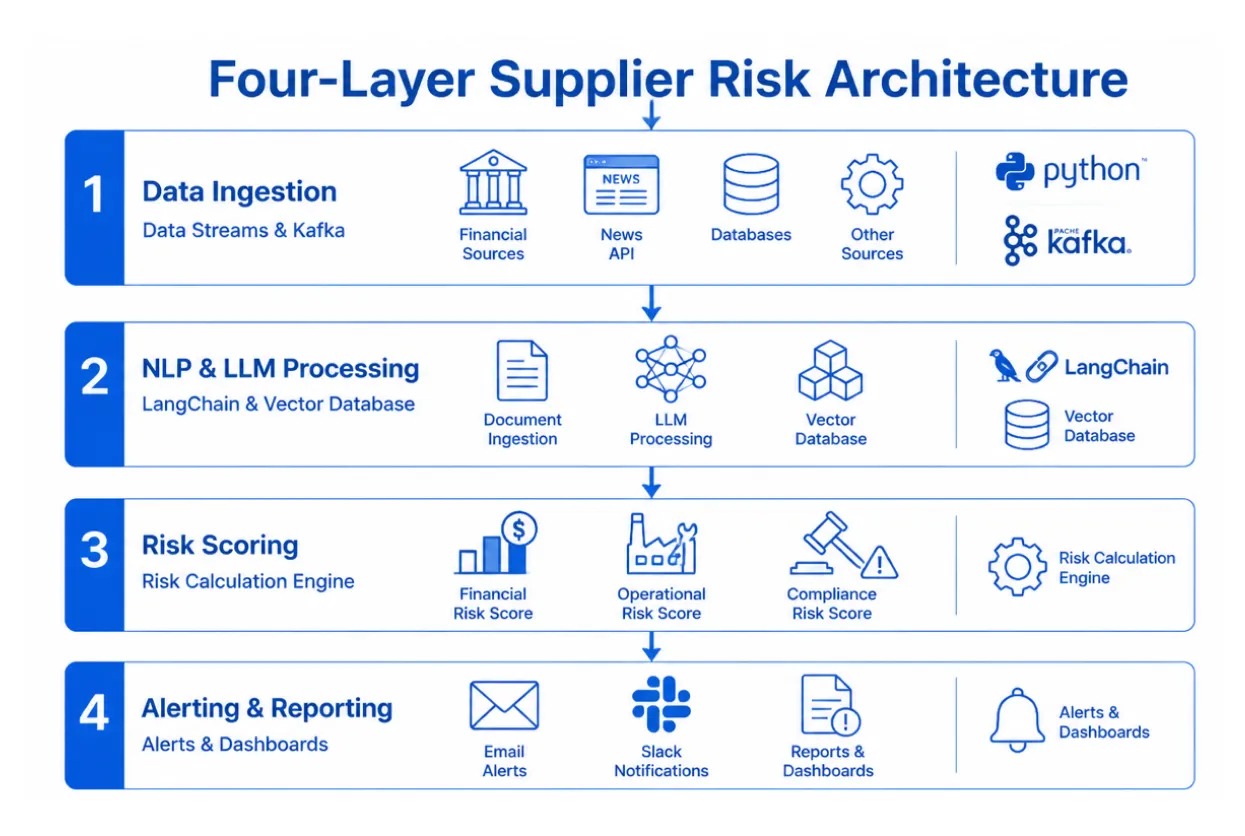
The Risk Scoring layer combines structured with unstructured signals. Financial risk considers debt-to-assets and cash flow trends. Operational risk tracks delivery performance and quality metrics. Regulatory risk aggregates sanctions screening, pending litigation, and adverse media severity. Each dimension is weighted accordingly. The engine recalculates every 4 hours or when high-impact signals arrive.
Finally, the Alerting and Reporting layer delivers intelligence. When a supplier’s risk score crosses a threshold, procurement receives an alert with sourced context via email or Slack. Dashboards rank all suppliers by risk. For high-risk cases, a “Risk Brief” document is auto-generated, summarizing all active signals with citations and timestamps.
Multi-Agent LLM Frameworks for Specialized AI Supplier Risk Monitoring
Recent research published in Scientific Reports introduced a multi-agent large language model framework designed for vendor evaluation and risk-aware procurement decisions. This architecture represents the current frontier in AI-driven supplier risk intelligence. Building and maintaining agent architectures like this one is the focus of our LLM model integration services.
A Financial Viability Agent evaluates liquidity ratios, profitability margins, solvency indicators, and cash flow health to assess supplier financial sustainability. A Risk Exposure Agent monitors geopolitical risk, operational disruption exposure, and compliance concerns across regulatory jurisdictions. Sentiment Analysis Agents analyze news articles, analyst briefings, and social media to gauge market perception and stakeholder confidence. Industry Benchmarking Agents measure performance against industry norms, cost competitiveness, and best-in-class operational metrics. Finally, a Strategy & Decision Agent synthesizes findings into procurement recommendations aligned with organizational objectives and risk tolerance.
The key advantage of this multi-agent approach is that each agent works independently on its domain while contributing to unified risk assessment. When the financial agent flags financial distress, that signal gains contextual weight if the sentiment agent detects negative news or the geopolitical agent identifies tariff exposure. No single risk dimension operates in isolation. Because no single risk dimension operates in isolation, the result is a multi-dimensional, context-aware assessment.
Production implementations using this architecture achieve higher accuracy in identifying suppliers at genuine disruption risk compared with financial-only or rigid rule-based approaches. The framework combines quantitative metrics with qualitative assessment, grounding procurement decisions in both verifiable financial data and contextual market intelligence. Organizations deploying multi-agent systems report 40% fewer false-positive risk alerts than single-dimension monitoring and 3-4 week earlier detection of actual supplier disruption.
Applying LLM Supplier Risk Models to Real Operations
These frameworks deliver value in practice because they handle the complexity of actual supplier ecosystems. When multiple signals converge on a single supplier, the multi-agent system escalates the risk tier immediately rather than treating each signal independently. Beyond dashboards and alerts, this intelligence can also be made conversational. GenAI chatbot development enables procurement teams to query risk assessments directly, surfacing insights without requiring dashboard access.
A Production Case Study
A mid-sized logistics provider managing 800 active suppliers implemented real-time supplier monitoring through our AI and ML solutions.Within six weeks, it flagged a third-party logistics partner showing a 25% on-time delivery drop combined with an 18% debt increase. The procurement team escalated before formal restructuring occurred, and that advance notice cut re-routing costs to a fraction of what an emergency transition would have required, roughly 12%.
Financial services firms apply the system to vendor due diligence as well, where LLM-powered contract review and financial analysis have cut due diligence timelines by roughly two-thirds while improving detection of non-standard contract terms.
Manufacturing companies have identified key component suppliers entering financial distress months after deployment. They negotiated favorable inventory acquisition before suppliers filed for bankruptcy. Retail organizations use real-time supplier monitoring to track compliance and ESG risk. Automated monitoring surfaces certification lapses and regulatory violations before audits discover them.
Real-Time Pipeline Implementation
Apache Kafka forms the backbone of the pipeline. Producers publish signals to topics such as financial_updates, adverse_media_feed, operational_signals, and sanctions_screening. Brokers persist messages, allowing independent parallel consumers to process them. Stream processors aggregate signals in 15-minute windows, recalculating scores when fresh data arrives. LLM consumers process raw content (PDFs, news articles, contracts) through LangChain, extracting risk entities and sending results back to Kafka. This GenAI procurement automation blog details how to architect these flows for your environment.
An alerting consumer monitors threshold crossings. Meanwhile, a dashboard consumer aggregates findings into procurement-friendly views. The latency from financial distress appearing in a filing to procurement receiving the alert should stay under 4 hours. Python’s asyncio and Kafka’s partitioning architecture make this practical. Shopify processes approximately 1.5 million Kafka messages per second at peak traffic, demonstrating that this architecture handles enterprise scale without performance degradation.
Common Production Challenges
Data quality gaps emerge first as a primary concern. Suppliers are registered under multiple legal entities with inconsistent identifiers, creating duplicate master records. While Python’s difflib and fuzzy matching can bridge some gaps, master data curation remains non-negotiable. Weak supplier master data undermines trust in AI risk scores before the system generates its first alert. This foundational issue must be resolved before implementation proceeds.
LLM hallucination requires ongoing management as well. Production systems reduce hallucination rates from 15%+ to under 5% through hybrid retrieval, citation checking, and re-ranking. The 50-100ms overhead is justified by accuracy gains. Production-grade AI systems require defensive layers at multiple levels including improved retrieval quality through hybrid search, disciplined prompt engineering, constrained decoding strategies, and gateway-level governance. Our AI consulting services guide organizations through these technical decisions.
Latency versus completeness represents a genuine trade-off. Real-time updates consume significant compute resources. Most implementations use a hybrid approach with fast scoring every 4 hours and full re-analysis daily. Procurement teams should understand that some signal categories refresh hourly while others update weekly, and whether that mix satisfies their risk tolerance. Transparency about these timing differences prevents misaligned expectations.
Regulatory constraints shape architecture decisions from the beginning. GDPR restricts how you can process supplier personal data. Sanctions screening has specific compliance requirements. These constraints must be engineered in from the start, not bolted on afterward. In regulated sectors like BFSI and healthcare, compliance requirements should be defined before data architecture decisions are finalized.
Implementing AI Supplier Risk Governance and Operational Integration
Deploying AI supplier risk intelligence addresses operational governance as much as technology. The most sophisticated AI model produces no value if procurement teams don’t receive alerts, misunderstand how to respond, or distrust the recommendations. Establishing clear ownership and accountability is the first step. Define who owns the supplier risk framework, who sets risk thresholds for different vendor categories, and who approves actions triggered by high-risk alerts. These answers should be established before alerts start flowing. Most organizations benefit from a cross-functional steering committee including procurement, supply chain, operations, and finance. Together, they define what “risk” means for the business, informed by our BFSI industry page expertise in regulated supplier ecosystems.
Next, define escalation workflows linking risk tiers to actions. When supplier risk scores cross 50, does procurement begin qualifying backup vendors, increase monitoring frequency, or schedule a vendor review call? When risk exceeds 75, are PO approvals automatically routed to the CPO? When a critical supplier reaches 85, does sourcing initiate emergency alternative identification? The risk scoring system is ineffective without these decision rules. Scoring must drive action, not merely create awareness.
Integration with the ERP before deployment is essential. Supplier risk alerts existing outside the ERP procurement workflow create a parallel information channel that most procurement teams ignore. High-risk supplier flags should influence PO approval routing, inventory planning parameters, and alternative vendor activation workflows within the ERP. This integration transforms the system from a reporting tool into an operational system. Finally, establish continuous learning processes. AI supplier risk models improve through feedback. Conduct quarterly or semi-annual reviews comparing predicted risk signals to actual outcomes. Use those comparisons to refine model inputs, adjust risk weights, and revise thresholds. This is not a “deploy and forget” system.
Why Durapid Builds These Systems?
Durapid has deployed supplier risk intelligence systems for logistics providers, BFSI firms, and manufacturers across three continents. Our data engineering teams have built Kafka pipelines handling millions of daily supplier signals. Our AI specialists have implemented LLM-powered document processing systems for financial, legal, and operational documents. We have navigated hallucination risk, latency trade-offs, and data quality challenges at scale, particularly for our Logistics industry page clients managing complex, multi-tier supplier networks.
We build systems that integrate with your existing ERP, procurement, and data warehouse infrastructure. We use Python for data engineering, LLMs for intelligence extraction, and cloud platforms (Azure, AWS) for scaling. Our 150+ Microsoft-Certified Professionals and 95+ Databricks-Certified Professionals understand production-grade supplier risk intelligence, not just demonstrations. If your procurement team manages supplier risk with spreadsheets and quarterly reviews, every critical signal faces a 30-to-60-day detection lag. A real-time intelligent monitoring system compresses that timeline to hours. The cost of that delay during supply chain disruption is measured in millions. The cost of building the system is measured in weeks. Organizations seeking to modernize supplier risk management should begin with a structured implementation roadmap.
Frequently Asked Questions
What is supplier risk intelligence?
Continuous extraction of risk signals from 50+ supplier data sources, including financial filings, news, regulatory databases, and operational metrics. All signals are automatically scored and routed to procurement in real-time.
How do LLMs improve this over rule-based systems?
LLMs understand context, separate useful signal from noise, and integrate multi-source risk narratives. They handle ambiguous language like “going concern uncertainty” as a bankruptcy precursor, which rule-based logic often overlooks.
What data sources feed the system?
Financial sources include SEC filings, credit bureau records, and payment history. Adverse media encompasses news, regulatory databases, and court records. Sanctions data covers OFAC, UN, and EU lists. Operational indicators include delivery performance, quality metrics, and capacity utilization. ESG and compliance signals include certifications and audit outcomes.
How is this different from ERP risk flags?
ERPs flag binary risk states quarterly. Real-time supplier monitoring processes 50+ sources continuously, updates in real-time, and reduces detection latency from weeks to hours.
How long does implementation take?
A proof-of-concept focused on financial risk signals requires 8-12 weeks. A full build with five data sources and LLM document processing takes roughly twice as long, spanning 16 to 20 weeks.
Does it integrate with existing systems?
Yes. The pipeline reads from your ERP, procurement platform, and external sources. Risk scores write back through an API for direct integration.
Which industries benefit most?
BFSI, logistics, manufacturing, and retail organizations manage large supplier ecosystems with high disruption risk. Healthcare and government sectors benefit significantly from compliance-driven supplier risk assessment requirements.

Recent Blog

How Voice AI Connects Calls With Sales Operations
October 15, 2026-
How GCCs Can Scale Engineering Teams with Staff Augmentation?
October 10, 2026 -
Asset Management Software for CFOs: From Depreciation to Capital Planning
September 29, 2026 -
Why Voice AI Is Different From Chatbots in Recruitment?
September 17, 2026