Chatbots to AI Agents: Why New York Enterprises Are Investing in AI-Powered App Development
The existence of an ai agent chatbot emerged as a groundbreaking development for businesses. What began as simple chatbot functionality has evolved into intelligent systems powered by advanced technologies like Generative Adversarial Networks, enabling more dynamic, human-like interactions. The feature has become a standard element. Users expect more than just receiving information. Users seek immediate results. They demand systems that deliver responses together with automatic operations which include functions for booking, recommending, and analyzing. Following up and making improvements throughout time also matter deeply. The transition from chatbot technology to ai agent chatbot technology is experiencing rapid growth due to its wide adoption in New York enterprise ecosystems.
The project aims to create more effective communication channels. It also aims to develop superior technology. The actual distinction between ai agents and chatbots becomes evident through their comparison. Chatbots operate according to pre-established directions. AI agents execute tasks through systemwide control after they understand the existing situation. The current discussion about ai agents vs chatbots and their connection to agentic ai chatbot systems has become practical because it affects the development of modern software applications.
Enterprises are adopting AI solutions which range from intelligent ai assistants handling their work processes to sophisticated systems that use technologies for their product development and marketing operations. New York City businesses require AI solutions which enhance their work processes and create new competitive advantages because their success depends on work speed, operational capacity, and customer experiences. This blog will explain the concept of ai agent chatbot systems which showcase their uniqueness compared to traditional systems while showing their growing importance for enterprise development through agentic AI applications.
What Separates an AI Agent Chatbot From a Traditional Chatbot?
Your customer service team manages 4000 customer inquiries every single day. Your previous ai agent chatbot successfully deflected approximately 30 percent of customer inquiries. Human agents must handle the remaining inquiries because they require extra time to manage duplicate tickets while customers wait for urgent matters. Meanwhile, your competitor has implemented an agentic AI assistant which handles 72 percent of customer inquiries without human intervention. It updates CRM systems, identifies customers who will leave, and only sends difficult cases for human intervention. In New York’s highly competitive business sector, that technological gap functions as a monetary issue, hence revenue loss serves as the core operational problem.
According to Gartner’s AI Adoption Report, by 2027, over 80% of enterprise software will embed some form of AI agent capability. New York enterprises are not waiting. They are already rebuilding their apps around intelligent, autonomous AI systems.
An agentic AI system functions as an advanced AI solution which provides organizations with intelligent automated execution capacity. Such a system needs to equip users with automated intelligent tools which build their own capability through learning processes.
Agentic AI vs Chatbot: Core Difference
An agentic ai vs chatbot comparison comes down to decision-making ability. A traditional chatbot follows a fixed script. It reads a user’s message, matches it to a set intent, and returns a canned response. The system lacks the ability to control outside systems and store previous dialogues and alter its response during the ongoing discussion.
An ai agent chatbot, by contrast, uses large language models (LLMs) like GPT-4o or Claude to reason through a task. It plays a growing role in AI in Product Development by enabling smarter and faster decision-making across systems. It calls APIs, accesses current information, writes to storage systems, and combines various operations without needing user instruction.
Enterprise Comparison Table
Here is a quick breakdown of how ai agents vs chatbots compare across enterprise-critical parameters:
| Parameter | Traditional Chatbot | AI Agent Chatbot |
| Logic Model | Decision tree (if/then) | LLM-based reasoning (ReAct / Chain-of-Thought) |
| Data Access | Static, predefined knowledge base | Live APIs, CRM, ERP, databases |
| Task Execution | Answers only | Executes multi-step workflows |
| Memory | Single session | Persistent, cross-session context |
| Escalation | Transfers to human after failure | Escalates only when trained thresholds are met |
| Integration | Minimal | Azure OpenAI, Salesforce, Databricks, Snowflake |
The table above is not theoretical. Enterprises that have migrated from rule-based bots to agentic AI systems report a 65% drop in ticket escalation rates along with a 40% reduction in average handle time within the first 90 days.
Why Are New York Enterprises Moving Fast on AI Agent Development?
New York has more than 9000 technology companies which generate approximately 147 billion dollars in yearly technology output. The demand for businesses to create advanced digital solutions has originated from Wall Street, healthcare networks, and Fortune 500 logistics companies which function throughout the five boroughs. Three forces are driving investment in ai agent chatbot development here specifically.
Three Key Drivers Behind the Shift
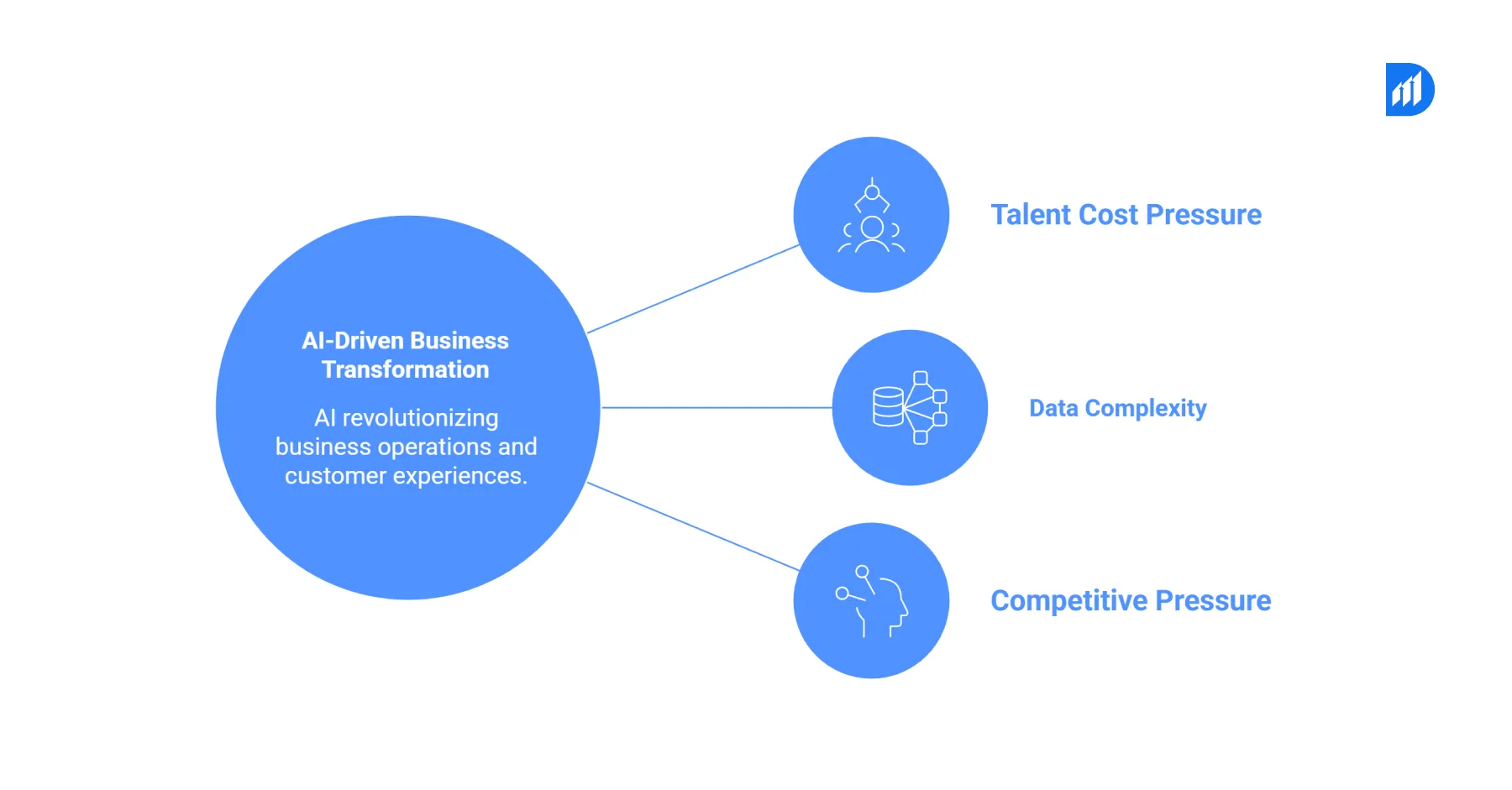
Talent Cost Pressure
First, the talent cost problem. The average customer support agent in New York earns an annual salary of 58000 dollars. The cost to grow a support team by 20 members to handle increased work demands exceeds 1.1 million dollars each year. As a result, an ai assistant deployed on Azure OpenAI can process comparable tasks 24 hours a day at a fraction of that cost.
Data Complexity
Second, data complexity. New York companies maintain extensive data systems which store their complete data collection. AI agents built on platforms like Databricks or Snowflake can pull from multiple sources in real time. A traditional chatbot, however, cannot do this without manual integration work on every query type.
Competitive Pressure
Third, competitive pressure from fintech and healthtech. Startups entering New York’s financial and healthcare sectors ship AI-native apps from day one. In addition, legacy enterprises that rely on old chatbot frameworks lose customers to faster, smarter experiences.
How AI Agents Are Transforming Key New York Industries?
New York’s diverse industrial base creates a perfect setting for businesses to implement enterprise AI solutions, including the growing role of AI Marketing Agents across industries. The following use cases demonstrate how agentic AI chatbot deployments create real business value across sectors.
Financial Services and Banking
An Upper East Side investment bank adopted an ai assistant that connects to Bloomberg Terminal data, client portfolio APIs, and internal risk scoring systems as a replacement for its existing FAQ chatbot. The result: relationship managers receive pre-summarized client briefs before every call. Meeting prep time dropped from 45 minutes to under 8 minutes per session.
AI agents in this sector also handle KYC document validation, compliance checklists, and suspicious activity flagging. For example, one enterprise reported a 38% reduction in false-positive fraud alerts after deploying an ai agent chatbot with contextual reasoning, versus its old rule-based system.
Healthcare and Insurance
The documentation demands placed on New York-Presbyterian and other major health systems pose overwhelming challenges. AI systems which use Epic’s EHR API now record doctor-patient interactions to create organized clinical documentation which they automatically enter into patient medical files. Clinicians save an average of 2.3 hours per day on administrative tasks.
On the insurance side, AI agents handle first notice of loss processing. They pull policy data, check coverage conditions, initiate claim workflows, and send status updates without human intervention.
Retail and E-Commerce
New York retailers with hybrid models use AI agents to personalize the post-purchase experience. The ai assistant for personal use tracks orders, suggests products, and manages returns. One retailer saw a 22% rise in repeat purchases within 60 days.
Marketing and Advertising
AI agents optimize marketing workflows at scale. They monitor campaigns, generate A/B tests, adjust bids, and summarize performance. Agencies report up to 60% reduction in manual reporting work.
The Technical Architecture Behind an Enterprise AI Agent Chatbot
Implementing an ai agent chatbot system requires more than connecting an API. It needs structured architecture across multiple layers.
Core Layers That Power Agentic AI Systems
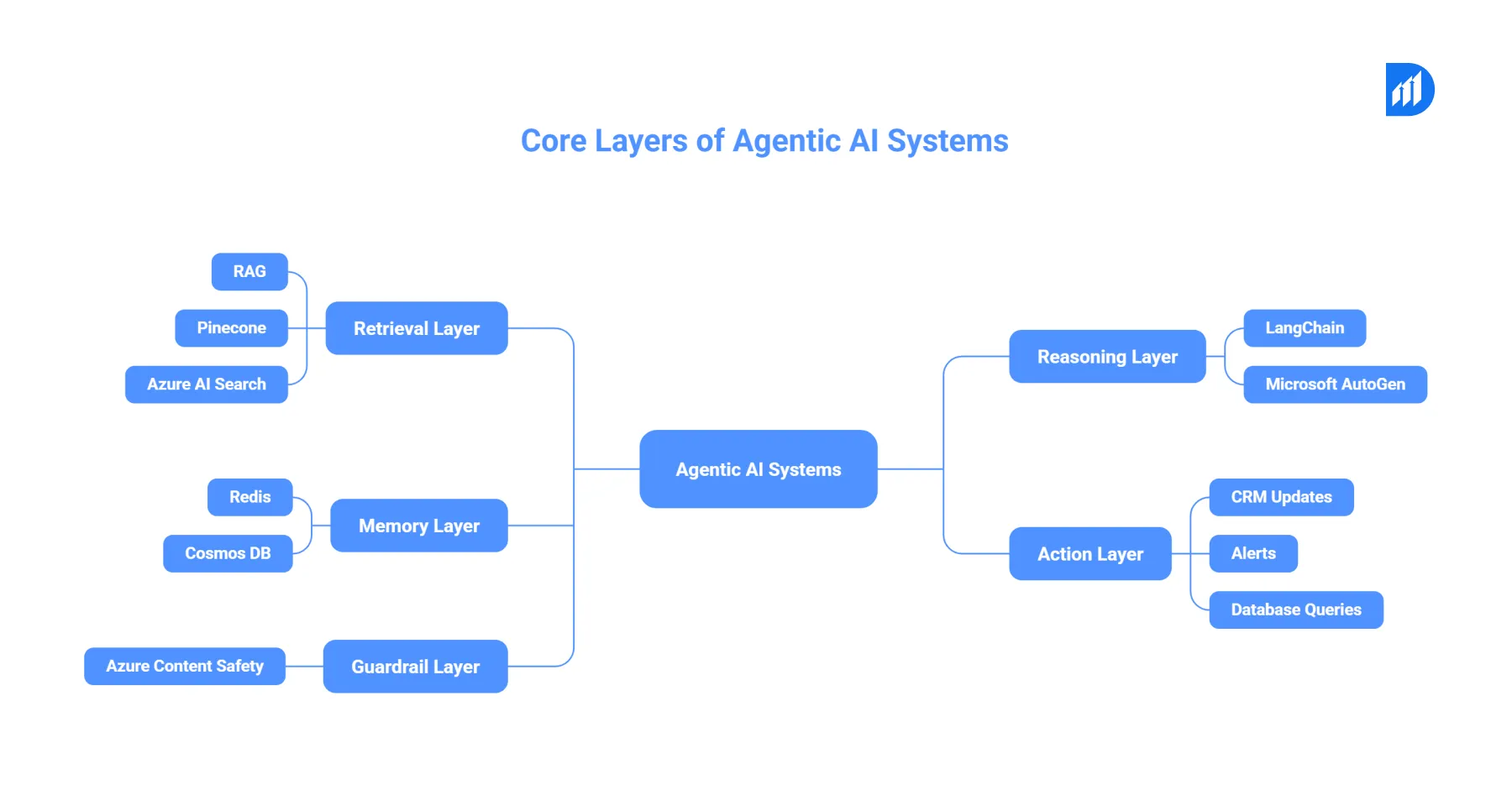
Retrieval Layer
Uses RAG to fetch data from sources like Pinecone and Azure AI Search. It ensures responses are grounded in real-time, relevant, and domain-specific data. This layer reduces hallucinations and improves the factual accuracy of outputs.
Reasoning Layer
Uses frameworks like LangChain and Microsoft AutoGen for multi-step logic. It enables the system to break down complex problems into structured steps. This layer mimics decision-making processes, making interactions more intelligent.
Memory Layer
Stores session data and long-term user context using Redis or Cosmos DB. It helps maintain continuity across conversations and personalized experiences. This layer allows the system to learn user preferences and improve over time.
Action Layer
Executes actions like updating CRM, sending alerts, or querying databases.It transforms insights into real-world outcomes without manual intervention. This layer is key to automation, turning conversations into completed tasks.
Guardrail Layer
Ensures safety and compliance using tools like Azure Content Safety. It monitors outputs to prevent harmful, biased, or non-compliant responses. This layer builds trust by maintaining ethical and secure AI interactions.
When to Use an AI Agent Chatbot and When Not To?
Use an AI Agent Chatbot When
- Workflows span multiple systems
- Tasks require reasoning and decision-making
- Personalization and memory are needed
- Scaling makes manual work expensive
Avoid Using It When
- Use case is simple FAQ
- Data access is restricted
- Workflow is linear and predictable
Measuring the ROI of an AI Agent Chatbot Investment
Enterprises track clear metrics after deployment:
- Cost per resolution drops by 55 to 70 percent
- First contact resolution improves by 30 to 45 percent
- Time to resolution becomes 8x faster
- Customer satisfaction increases by 15 to 25 percent
A Brooklyn logistics company achieved breakeven in 4.5 months and saved over 900000 dollars in the second year.
How Durapid Technologies Builds AI Agent Chatbots for New York Enterprises?
At Durapid Technologies, we design enterprise-grade ai agent chatbot systems tailored for industries such as financial services, healthcare, retail, and AI in manufacturing. Our solutions are built using advanced platforms like Azure OpenAI and AWS Bedrock, along with custom frameworks to meet specific business needs. These systems integrate seamlessly with ERP, CRM, and existing data platforms, ensuring smooth workflows while maintaining compliance, security, and traceability. We focus on real-world deployment by building solutions that operate effectively within your environment. Every system is engineered to deliver measurable business outcomes, including improved efficiency and smarter decision-making, making AI a practical and scalable asset for your organization.
Frequently Asked Questions
What is the main difference between an ai agent chatbot and a traditional chatbot?
A traditional chatbot sticks to scripts and only responds to what it is told. An ai agent chatbot understands context, uses real data, and gets things done across systems.
How do ai agents vs chatbots compare on cost for enterprises?
AI agents cost more to build at first but reduce costs heavily over time. Most businesses recover the investment in a few months.
Can an ai assistant integrate with existing enterprise software like Salesforce or SAP?
Yes, ai assistants integrate with tools like Salesforce and SAP via APIs. This allows real-time data access, updates, and automated workflows across systems.
How do ai chatbots compare to human agents on performance metrics?
AI agents are faster, scalable, and available 24/7. They handle high volumes with consistency, while humans are better for complex or sensitive interactions.
Is agentic ai vs chatbot valid for regulated industries?
Yes, agentic AI supports compliance with features like audit trails, traceability, and control, making it suitable for regulated sectors.

Recent Blog

How Voice AI Connects Calls With Sales Operations
October 15, 2026-
How GCCs Can Scale Engineering Teams with Staff Augmentation?
October 10, 2026 -
Asset Management Software for CFOs: From Depreciation to Capital Planning
September 29, 2026 -
Why Voice AI Is Different From Chatbots in Recruitment?
September 17, 2026