Generative AI in Procurement: A Complete Guide for Enterprise
The procurement process should have operated with straightforward procedures. Instead, it turned into a constant back-and-forth with supplier emails piling up, contract reviews stalling, approvals going in circles, urgent negotiations cutting in line. The data keeps growing. Decisions need to happen fast. Yet the team is buried in manual tasks that slow everything down.
That’s what makes generative AI in procurement such a shift. It doesn’t just tweak a few steps. It directly addresses the productivity gaps teams have been dealing with for years. AI in procurement now gives organizations a real way to make smarter sourcing decisions, faster. The broader Supply Chain Management System is changing too, with new connections forming across every part of the operation. Procurement has evolved into something more capable, with better vendor access, AI-driven execution, plus machine learning built into the process.
When you look at Agent Chaining 101, it gets even more interesting. That’s where you see how systems can manage full process coordination across multiple tasks. This blog breaks down generative AI in procurement through its real enterprise applications, how it’s being used today, and where the future of AI in procurement is actually heading. If procurement still means multiple follow-ups and endless approvals, this is where that starts to change.
What Is Generative AI in Procurement?
Procurement has always been the core system businesses use to control costs. But for a long time, that meant spreadsheets, email chains, and manual supplier calls. That era is ending. Generative AI in procurement is reshaping how organizations buy goods, manage contracts, assess suppliers, and handle disruptions faster than most teams are ready for.
How AI in Procurement Actually Works
AI in procurement uses machine learning, large language models, and predictive analytics to automate or speed up procurement processes. The technology behind tools like ChatGPT, Gemini, and Claude uses generative AI to create content, combine different data sources, generate written documents, and enable natural language interaction with procurement systems.
Traditional procurement software followed fixed rules. Generative AI, however, interprets unclear requests, produces supplier briefs from scratch, and summarizes thousands of contract clauses in seconds. Because of this, procurement now operates as a strategic intelligence center instead of a secondary office function.
Why AI in Procurement Is No Longer Optional?
The data tells a clear story. The Hackett Group’s Enterprise Key Issues Study reports that 89% of executives believe their organizations implement generative AI projects today, a substantial increase from the 16% who reported this use case in the previous year. Moreover, AI will transform operational processes for two-thirds of procurement management professionals over the next five years, according to their own expectations.
The Financial Case
The financial case presents equal strength to its existing evidence. McKinsey discovered that AI-powered decision-making systems have helped teams achieve 10% cost reductions while shortening their supplier evaluation processes by 30%. Gartner predicts that 60% of procurement operations will reach full implementation of AI-powered analytical systems, resulting in 20% extra cost savings over current methods by 2026.
The spending threshold presents a strong argument for teams which handle budgets exceeding billion-dollar limits. Various organizations continue to deal with inconsistent implementation. Gartner’s 2025 Hype Cycle for Procurement places generative AI in the “trough of disillusionment.” Early adopters are seeing benefits. Data quality problems, weak integration practices, and inadequate change management procedures prevent many organizations from reaching their full return on investment. The lesson establishes two main points about AI use in procurement. The team needs to develop a plan for execution.
Core AI Use Cases in Procurement
Organizations use specific AI use cases in procurement to determine their initial investment priorities. Here’s a look at where AI creates the highest impact right now.
Where to Start: High-Impact Use Cases
1. Spend Analytics and Visibility
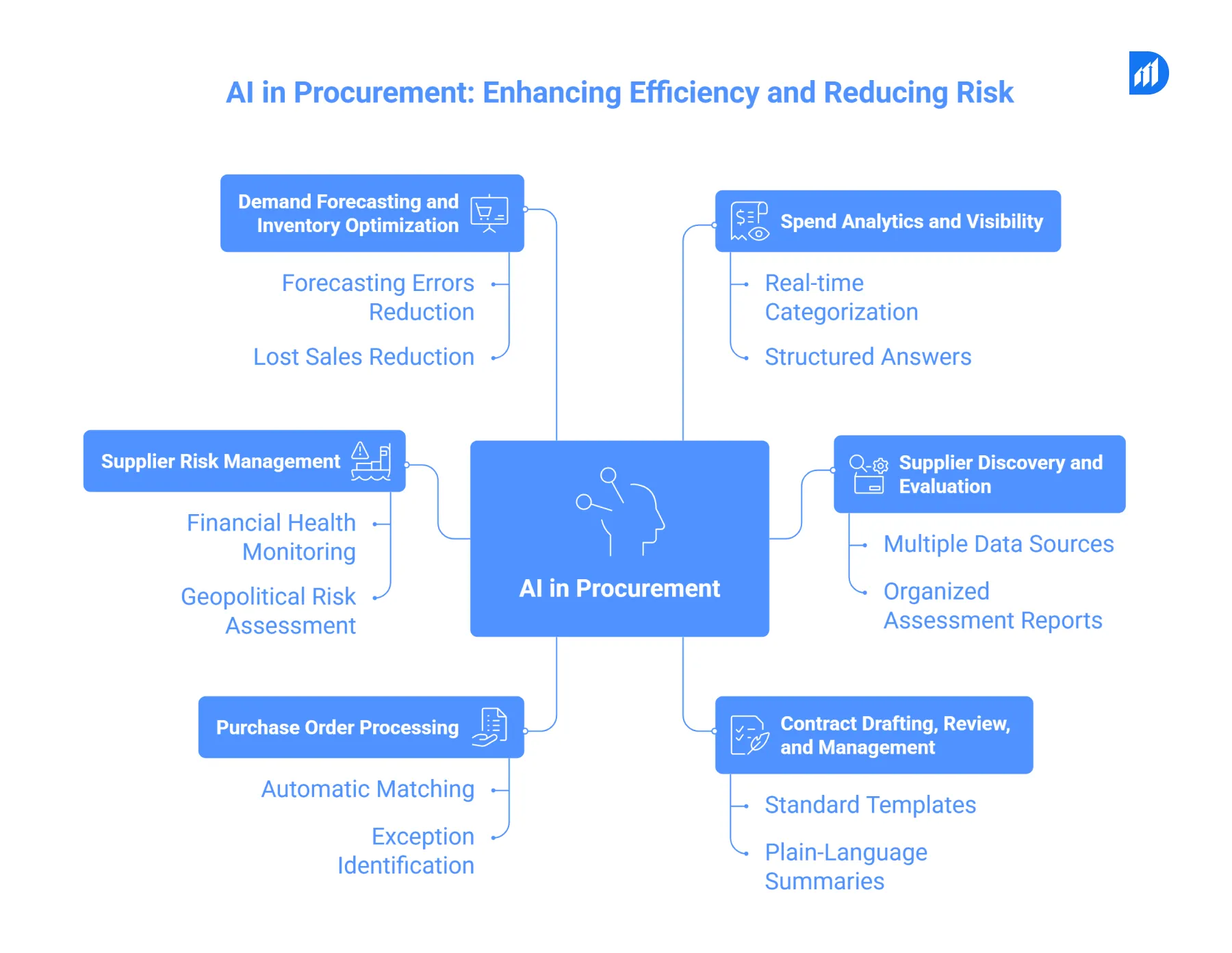
Traditional spend analysis is slow, manual, and usually produces incomplete results. In contrast, AI establishes a new standard, automatically categorizing expenditures by supplier, business unit, and category, in real time. The procurement managers ask their question about which suppliers create the highest tail spend risk and the system provides them with structured answers drawn from current operational data. Without spending information that meets required standards, procurement activities such as sourcing, negotiation, and budgeting work through guesswork.
2. Supplier Discovery and Evaluation
The generative AI system obtains supplier data from multiple sources: web content, internal databases, third-party risk assessment platforms, and ESG compliance systems. The AI sourcing agent selects suitable vendors while delivering an organized assessment report that human evaluators can use instead of the category manager spending multiple days to develop a supplier scorecard. The sourcing intelligence engine from Genpact creates category insights which companies can use to manage their tail spend.
3. Contract Drafting, Review, and Management
The procurement process involves contract lifecycle management as one of its most time-consuming activities. The generative AI system creates standard templates, produces redlined supplier agreement drafts, identifies non-standard clauses, and generates plain-language document summaries. The system decreases legal team demands while it eliminates contract processing delays that lead to procurement holdups throughout major companies.
4. Purchase Order Processing
The process of PO processing requires an unending series of tasks which follow established guidelines but results in numerous mistakes when conducted across extensive operations. AI systems execute automatic PO matching together with exception identification and approval distribution, handling all routine transactions without needing human assistance. The procurement department can concentrate on more important tasks, which leads to faster processing times and reduced expenses for each transaction.
5. Supplier Risk Management
Sphera’s 2025 data shows that 73% of organizations experienced supplier disruptions which lasted for 12 months. The existing method of risk monitoring needs to become more proactive. The system uses AI to monitor supplier financial health, geopolitical risks, ESG scores, and performance metrics, which generates alerts before disruptions take place. The continuous operation of intelligence systems provides organizations with a market advantage because they can recognize changes which disrupt their operations.
6. Demand Forecasting and Inventory Optimization
The supply chain AI system at McKinsey enables organizations to decrease forecasting errors by 50% while reducing lost sales by 65%. The procurement process requires organizations to make intelligent purchasing decisions which involve selecting appropriate vendors at optimal times while acquiring suitable quantities of products. For more information about AI’s role in logistics operations, please read our guide to Supply Chain Management.
AI in Procurement Orchestration: The Next Frontier
The shift from single point solution automation systems to complete source-to-pay solution platforms which utilize self-operating systems is currently the most important advancement in AI in procurement orchestration.
What Procurement Orchestration Actually Means
The contemporary procurement process includes six components: intake, sourcing, contracting, supplier onboarding, risk management, and purchase-to-pay. Most organizations operate their workflow through different systems which function independently and can only exchange limited information. Teams use email for work transfer while manual validation and policy checks create additional tasks which should have been part of existing workflows. The review process requires several days to complete a task which should take only a few minutes. The system responds to compliance requirements only when violations occur. Important information remains inaccessible because it has not been utilized.
Through its AI-based procurement orchestration system, GEP links all operational components: users, systems, from the initial intake phase through to the final payment stage into a single intelligent operational framework. GEP defines their system as “total procurement orchestration” because it allows procurement teams to take charge of processes instead of waiting to respond to situations.
Agentic AI in Sourcing and Procurement
Orchestration systems receive advanced development through agentic artificial intelligence technology. Agentic systems perform complex multi-step workflows by themselves because they initiate and execute all tasks without requiring assistance from human operators. The system can conduct RFP launches which include basic negotiation and approval processing, while its outcome results remain under automated analysis throughout the entire operation.
AI in sourcing and procurement is increasingly powered by these agent-based architectures. By December 2025, 35% of procurement teams were already using AI or advanced analytics tools. Agentic AI is expected to be central to 2026 enterprise strategy. Levelpath, recognized in Gartner’s 2025 Innovation Insight for Procurement Orchestration Platforms, demonstrates this with reasoning engines that power agents across the full intake-to-invoice lifecycle.
For organizations exploring how multiple AI agents coordinate on complex workflows, our primer on [Agent Chaining 101] explains the architecture behind multi-step AI execution.
Compliance Built Into the Flow
The first advantage of agentic orchestration enables organizations to achieve compliance through proactive enforcement methods. The system automatically conducts supplier data validation together with regulatory requirement checks, contract template verification, and policy threshold enforcement as requisitions and contracts progress through the system. The process will stop when it detects a violation to prevent the organization from entering a state of non-compliance. As a result, governance becomes an automatic protection system rather than a source of operational delays.
Use of AI in Procurement for Energy Companies
The procurement process in energy sector operations receives its greatest advantages from artificial intelligence technology. Energy procurement operates under complex conditions because market dynamics change quickly while regulatory frameworks impose strict requirements, sustainability expectations continue to rise, and supply chain interruptions produce effects that extend beyond financial losses.
Smarter Energy Sourcing
The use of AI in procurement for energy companies now turns their previous slow spreadsheet-based methods into modern real-time operations. AI systems analyze consumption patterns, regulatory shifts, pricing trends, and weather forecasts simultaneously to enable teams to predict price changes while determining optimal contract structures before market movements occur. The system provides organizations that operate multiple locations or extensive asset portfolios with a complete view of their sourcing process, which eliminates the need for separate evaluations.
Renewable Energy Integration
Sourcing renewable energy is particularly complex. Generation is variable, storage is expensive, and PPA markets shift quickly. AI models generation variability against consumption requirements, identifies optimal procurement windows, and structures contract terms that balance price certainty with flexibility. Accenture’s Powered for Change report highlights that AI-driven procurement strategy is now essential for energy companies pursuing decarbonization, not just for efficiency, but to stay competitive as PPA markets tighten.
What AI Delivers for Energy Procurement Teams
The use of AI in procurement for energy companies delivers operational efficiency improvements of 15–25% in renewable energy organizations through supply chain optimization. It gives utilities real-time data for evaluating market conditions and achieving better pricing. Beyond that, compliance monitoring across rapidly changing energy regulations gets automated too. It also flags supply disruptions, tariff changes, and counterparty risks before they impact operations.
Generative AI in Healthcare Procurement
Healthcare procurement runs under some of the strictest compliance and risk requirements of any industry. AI is proving especially useful here, enabling faster supplier qualification, automated regulatory compliance checking, and more accurate demand planning for critical medical supplies. For a detailed look at how AI is applied in healthcare supply chains, including procurement workflows, read our guide to Chain Management in Healthcare.
Challenges and Realistic Expectations
Implementing generative AI for procurement purposes comes with real challenges. Gartner’s trough of disillusionment research highlights specific difficulties organizational leaders need to prepare for.
Data and Integration Hurdles
Data quality comes first. AI performance suffers most when organizations work with unorganized or substandard data. AI systems require dependable inputs to generate trustworthy outputs. As a result, data standardization, spending taxonomy development, and system integration all need to be done before scaling generative AI further. Integration complexity is real. Linking AI technologies to existing ERP systems, procure-to-pay networks, and supplier management systems requires extensive technical expertise. Teams that underestimate this will find it hard to implement new processes cleanly.
People and Process Gaps
Change management is often underfunded. Organizations tend to hit their limits when resources run thin. Using agentic AI in procurement changes employee responsibilities and organizational workflows. In particular, skills gaps in digital dexterity, prompt engineering, and human-AI collaboration need to be addressed before deployment, not after. Human oversight remains necessary. Successful AI procurement implementations work best when AI capabilities are combined with human judgment. Strategic sourcing, supplier relationships, and critical negotiations still need human thinking. The role of AI is to support procurement professionals, not replace their authority over strategic decisions.
The Future of AI in Procurement
The future of AI in procurement points toward systems that can manage full sourcing cycles for standard categories autonomously, while elevating human expertise for complex decisions.
What’s Coming Next
McKinsey projects autonomous category agents will capture 15–30% efficiency improvements by handling non-value-added activities. Upcoming capabilities include automatic detection of sourcing opportunities through spend pattern monitoring, self-executing RFx processes for standard categories, dynamic pricing models that adjust in real time, and continuous contract performance monitoring without manual review cycles. Via reddits’s point of view generative AI in procurement market is projected to reach USD 0.56 billion by 2029 at a 28.9% CAGR, reflecting both rising adoption and increasingly sophisticated solutions.
The most important shift, though, isn’t technological. It’s organizational. Enterprises that treat AI as a layer added onto existing workflows will capture small gains. Those that redesign procurement around AI-native architectures, with agents, orchestration, and embedded intelligence, will achieve the kind of performance improvement that changes competitive standing.
How Long Does It Take to Implement AI in Procurement?
One of the first questions teams ask is how long this actually takes. The honest answer depends on your data, scope, and how ready your systems are.
Phase 1: Foundation and Quick Wins (Weeks 1–8)
In the first six to eight weeks, teams usually start with spend analysis and one pilot, enough to see quick wins and build internal confidence. This is the lowest-risk entry point with the fastest payback.
Phase 2: Core Workflow Integration (Months 2–5)
Over the following months, AI expands into core workflows like contracts, onboarding, and purchase orders. Integration and data quality start to matter more here. Organizations that invest in a dedicated implementation workstream avoid the fragmentation problems that plague most AI procurement rollouts.
Phase 3: Orchestration and Agentic Deployment (Months 5–12+)
By months five through twelve, mature setups move toward full procurement orchestration, where AI connects everything end-to-end and handles routine tasks with minimal effort. The teams that reach this stage fastest focused on clean data and clear processes early, not just better tools.
| Phase | Timeline | Key Milestone |
| Foundation & Quick Wins | Weeks 1–8 | Spend analytics live, first pilot running |
| Core Workflow Integration | Months 2–5 | AI in 3–5 workflows, routine automation active |
| Orchestration & Agentic | Months 5–12+ | End-to-end AI-coordinated source-to-pay |
The most important thing to remember: this timeline isn’t linear. Teams that wait for perfect data before starting Phase 1 rarely get there. Start with what you have, build momentum, and let real deployment surface the gaps that matter most.
How Durapid Helps You Turn Generative AI in Procurement Into Real Results?
Understanding generative AI in procurement is one thing. Making it actually work inside your systems is a completely different challenge. Most enterprises don’t struggle with ideas. They struggle with execution, messy data, disconnected tools, and workflows that were never built for AI in the first place. That’s where Durapid steps in. Instead of treating AI like a feature you add on, we help you build procurement systems where AI actually fits. From cleaning and structuring your data to integrating with your existing ERP and source-to-pay platforms, the focus is simple: make AI in procurement usable, scalable, and aligned with how your teams already work.
Here’s what that looks like in practice:
- Building AI-ready data pipelines so your procurement insights are actually reliable
- Integrating generative AI into sourcing, contracts, and supplier workflows without breaking existing systems
- Designing AI in procurement orchestration so processes stop feeling fragmented
- Creating intelligent automation layers that reduce manual effort without removing human control
Whether you’re starting with a small pilot or moving toward full-scale transformation, the goal isn’t to automate everything overnight. It’s to build a system that gets better, faster, and more useful over time. Because the real value of generative AI in procurement isn’t just efficiency. It’s clear. Once procurement starts running with clarity, everything else moves faster too. Ready to see what that looks like for your team? Let’s talk.
Frequently Asked Questions
Q: What is generative ai in procurement?
It’s AI that doesn’t just process procurement tasks but actually helps create, analyze, and simplify them. From contracts to supplier insights, it turns messy data into something you can actually use.
Q: How is generative AI different from traditional procurement automation?
Traditional systems follow rules. Generative AI understands context and adapts. It’s the difference between ticking boxes and actually thinking through the task.
Q: What are the most common AI use cases in procurement today?
Think spend analysis, contract management, supplier risk tracking, and demand forecasting. The parts that used to take forever are now getting done faster and smarter.
Q: What is procurement orchestration, and why does it matter?
It’s about connecting every step of procurement so nothing feels disconnected or manual. Less back-and-forth, fewer delays, and way fewer “who’s handling this?” moments.
Q: How long does it take to implement AI in procurement?
Quick wins can show up in a few weeks, but full implementation takes a few months. The cleaner your data, the faster everything starts making sense.
Q: What are the biggest risks of deploying AI in procurement?
Bad data, messy integrations, and over-automating things that need human judgment. Nothing unfixable, just things you shouldn’t ignore while setting it up.
Q: Is AI in procurement suitable for energy companies?
Yes, and it works really well here because of how complex things get. From pricing to compliance, it helps bring a lot more clarity and control.
Q: Will AI replace procurement professionals?
No. It takes over the repetitive work so people can focus on real decisions. The role doesn’t disappear, it becomes more strategic.
Q: What should enterprises look for when evaluating AI procurement platforms?
Look for strong integrations, real AI capabilities, and systems that actually scale with you. If it feels like a patchwork solution, it probably won’t last.
Q: What is the ROI of generative AI in procurement?
Faster decisions, lower costs, and better efficiency across the board. Most teams see noticeable improvements once they move beyond experimenting and into actual deployment.

Recent Blog

Why Voice AI Is Different From Chatbots in Recruitment?
September 17, 2026-
LlamaIndex vs LangChain: Which One to Choose in 2026?
July 29, 2026