Custom Software Integration Services in India: The Complete Technical Guide for Businesses
Your CRM shows 540 active accounts. Your billing software shows 498. Meanwhile, your support desk has 63 open tickets for customers who don’t exist in either system. Every Monday morning, operations staff compare three spreadsheets to figure out how many clients actually pay.
That’s not a business problem. It’s an integration problem, and it costs more than most leadership teams ever add up. According to Gartner’s Data Quality Market Survey (2021), organizations lose approximately $12.9 million annually due to poor data quality. Custom software integration services solve this directly: combining your separate tools into one connected setup that moves data automatically, accurately, in real time.
India’s custom software development market generated USD 2.3 billion in 2024 and is forecast to reach USD 10.5 billion by 2030, at a 28.5 percent compound annual growth rate. The country’s system integration market alone stands at USD 14.8 billion. That talent pool, combined with lower operational costs, gives international companies a genuine edge, if they pick the right partner. The market is crowded and quality varies enormously. This guide gives you the technical depth to tell the difference.
What Is Software Product Development and How Does It Actually Work?
Software Product Development integration connects two or more applications so they exchange data without manual effort. No CSV exports, no copy-paste workflows, no reconciliation spreadsheets. Every integration requires three foundational components. The Source System exposes data through an API endpoint or database connection (your CRM sending customer records outward, for example). The Target System receives that data, mapping it to its own schema, like an ERP maintaining matching financial records. The Integration Layer sits between both, controlling access, converting data formats, recording failures, managing retry logic, monitoring every transaction. The real engineering lives here.
The Four Core Integration Architecture Patterns
The architecture decision you make in week one determines whether you’re rebuilding in year two. Choose wrong and what looks like a code problem is actually a structural one.
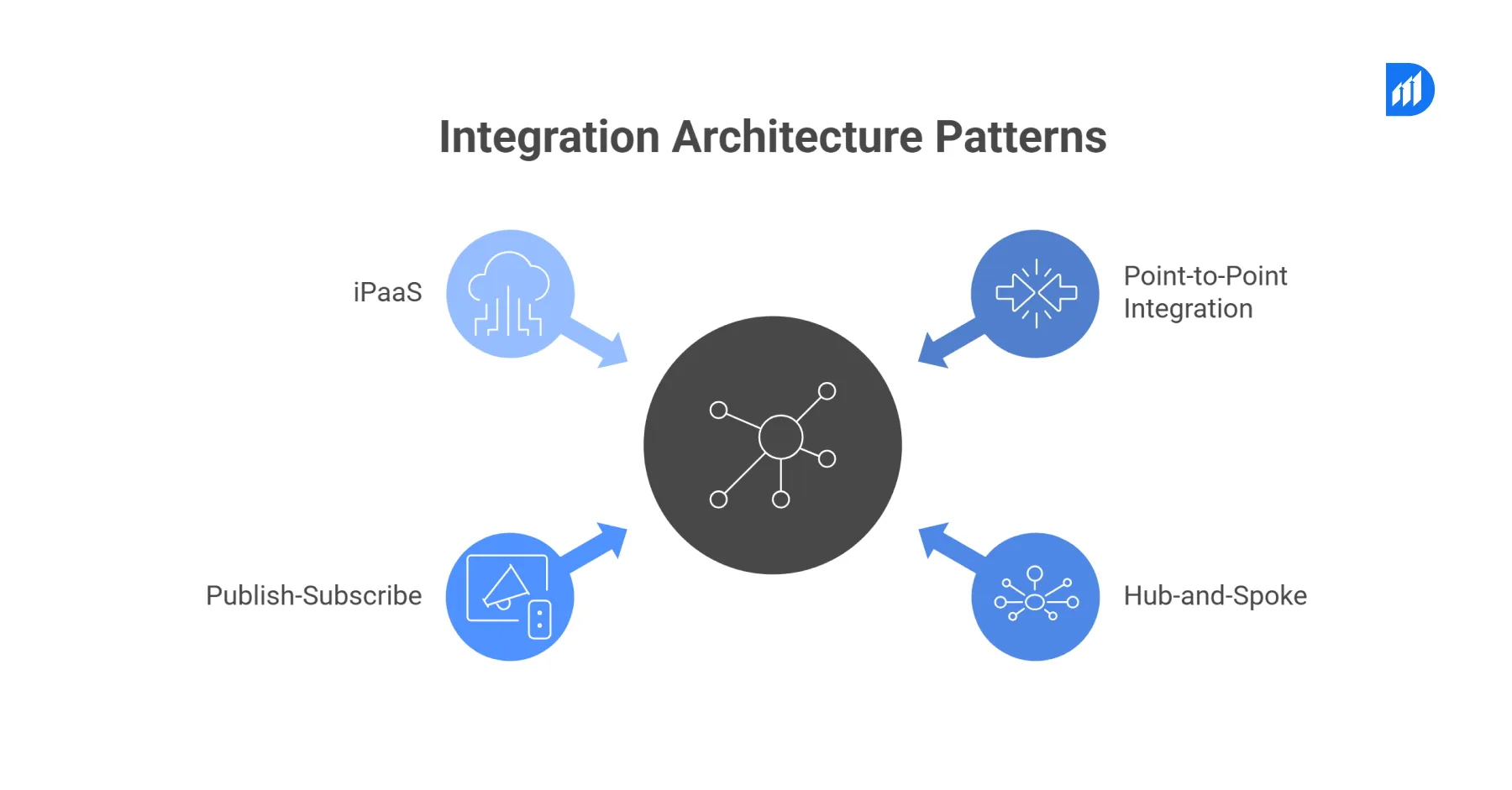
Point-to-Point Integration establishes direct API links between two systems. Fast to build, straightforward to operate. The problem it doesn’t scale. Five systems connected point-to-point require 10 links. Ten systems require 45. Each connection carries its own authentication, error handling, and maintenance burden. Fine for a two-system pilot; a liability at enterprise scale.
Hub-and-Spoke (ESB) places a central middleware hub between all systems. Applications connect to it, send messages through it, and the hub handles routing, format conversion, plus delivery tracking. This pattern suits enterprises running five or more connected systems. Microsoft Azure Service Bus and IBM App Connect are common ESB platforms in India-based enterprise deployments.
Publish-Subscribe (Event-Driven) uses message brokers like Apache Kafka or Azure Event Hubs. Source systems publish events to the broker; subscribing systems receive and process them. Built for high transaction volumes needing millisecond-level processing. The global API management market powering these architectures was valued at USD 5.42 billion in 2024, growing at 25% CAGR.
iPaaS (Integration Platform as a Service) is the cloud-native evolution of ESB. Platforms like MuleSoft, Boomi, and Informatica offer pre-built connectors, visual workflow designers, along with managed infrastructure. The iPaaS market grew more than 23% in 2024, driven by SaaS adoption and AI-powered integration tooling. For teams without a dedicated middleware engineer, it’s often the fastest path to a production-grade setup.
When Custom Integration Is Not the Right Answer
Custom integration earns its cost when workflows are complex, compliance is involved, and volume is high, especially in environments like Chain Management in Healthcare, where systems must stay tightly connected and audit-ready. Skip it when your workflow only connects three or fewer popular SaaS tools that Zapier already handles cheaply, when the need is temporary or exploratory, when your team cannot maintain it after go-live, or when data volume stays under 10,000 records per month with no compliance requirements.
Zapier vs. Custom Integration: What the Price Comparison Actually Shows

Zapier connects 7,000+ apps through pre-built connectors using simple trigger-action logic. Monthly costs range from $20 to $600 depending on usage. Setup takes hours. For an early-stage startup connecting HubSpot with Slack, it works well. The issues begin when your business grows. Zapier runs linearly: Trigger → Action. That model breaks when conditions get complex: “If deal closes AND credit limit exceeds $50k AND customer is not in ERP, THEN create invoice, notify CFO, then update three downstream systems.” There’s also a growth penalty built into the pricing. Importing 5,000 contacts burns 5,000 tasks. A ten-step sync uses ten tasks per record. At scale, monthly Zapier costs can easily exceed what you’d have paid once for a custom solution.
Custom software integration services give you full control over data movement, transformation logic, error handling, along with compliance. They also handle legacy systems, on-premise databases, proprietary APIs, and transaction volumes no-code tools can’t touch.
| Factor | Zapier | Custom Integration |
| Setup Time | Hours | 4–16 weeks |
| Initial Cost | $0–$600/month | $8,000–$80,000 one-time |
| Transaction Limits | Yes (task-based) | None |
| Complex Conditional Logic | Very limited | Unlimited |
| Legacy/On-Premise Systems | Almost none | Full support |
| HIPAA / SOC2 Compliance | Partial | Fully configurable |
| Error Handling | Basic retries | Full logging, alerting, fallback |
| Long-Term Cost at Scale | Escalates significantly | Fixed maintenance cost |
The crossover point (where custom integration becomes cheaper than Zapier) typically falls between months 8 and 18, depending on volume and workflow complexity.
Middleware Security: The Part Most Projects Budget Zero For
Your middleware moves everything: customer PII, financial records, healthcare data, payment details. It all flows through the integration layer before reaching its destination. Most projects spend weeks on functionality, then treat security as a final checkbox. That’s how breaches happen.
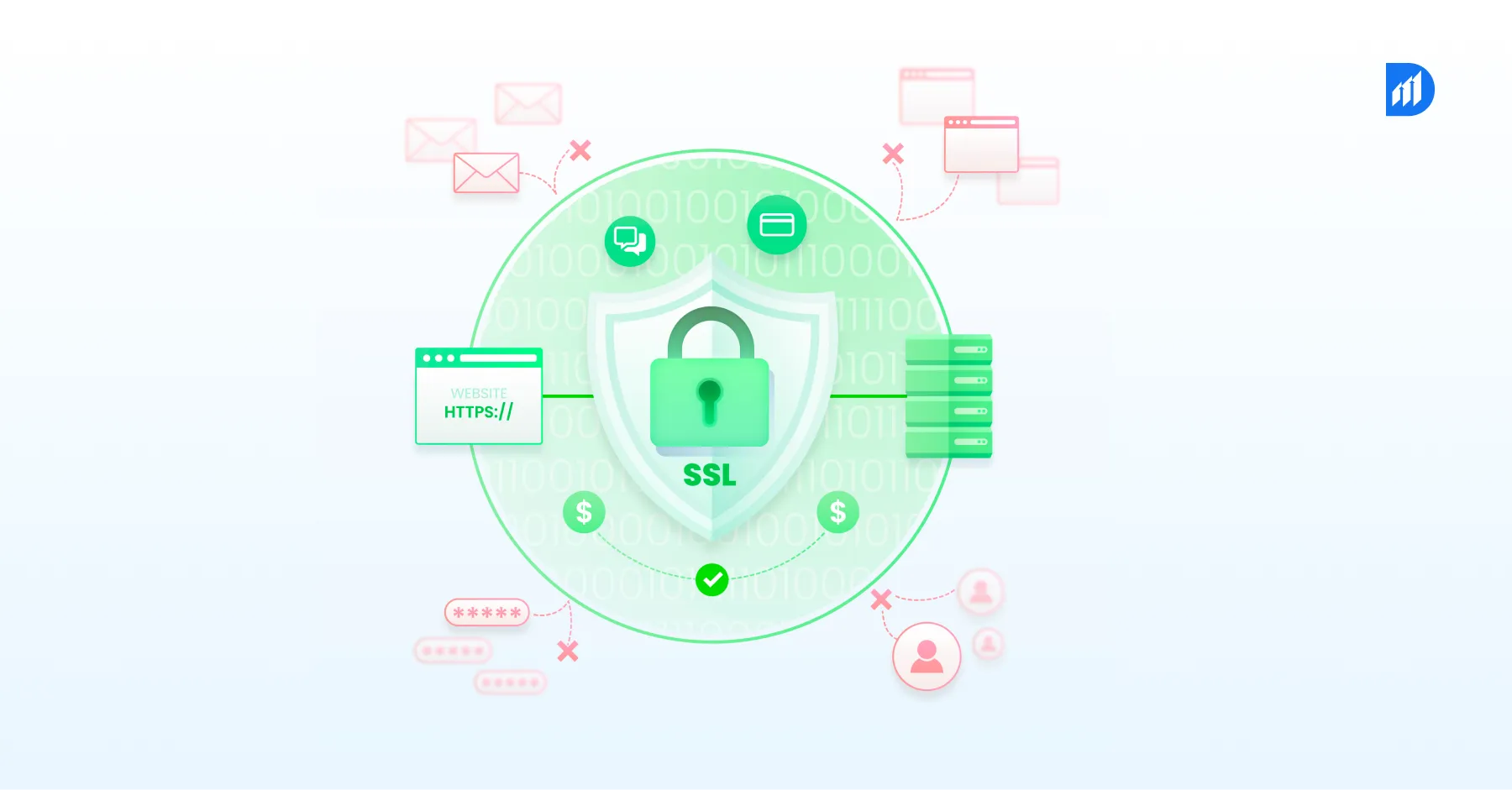
Transport Layer Security. TLS 1.2 is the floor for all API calls. TLS 1.3 is the current standard, offering faster handshakes and stronger cipher suites. Any vendor still on TLS 1.0 or 1.1 is operating with known vulnerabilities and no defensible reason for it.
Authentication Standards. OAuth 2.0 with JWT tokens is the enterprise standard for service-to-service authentication. Mutual TLS (mTLS) requires both parties to verify identity through certificates, stopping unauthorized services from posing as trusted systems. API keys alone are insufficient for any environment handling sensitive data.
Access Control. Role-based access control (RBAC) defines which services can read, write, or delete from specific endpoints. Attribute-based access control (ABAC) adds finer restrictions, like customer records accessible only from a specific IP range, only during business hours, for instance.
Audit Logging. Every data transfer needs a timestamped log: source, destination, data payload hash, user identity, transaction outcome. Without it, you cannot investigate incidents, complete compliance audits, or diagnose production failures.
Rate Limiting. Middleware without rate limits is exposed to both accidental traffic surges and deliberate denial-of-service attacks. API gateways like Kong, AWS API Gateway, and Azure API Management all implement rate limits natively. There’s no reason to skip this.
When evaluating vendors, ask for their security architecture documentation. If they can’t provide their encryption standards, authentication model, and audit logging approach in writing within 48 hours, move on.
HIPAA Compliant Software Integration: What Healthcare Businesses Must Verify Before Signing
Healthcare data integration operates under a different legal framework than everything else. The cost of getting it wrong is severe. IBM’s Cost of a Data Breach report puts the average healthcare breach at USD 9.48 million, more than double the cross-industry average. The Office for Civil Rights completed 22 HIPAA violation investigations with financial penalties in 2024, one of the most active enforcement years on record. Montefiore Medical Center paid USD 4.75 million in a single settlement for inadequate risk analysis alone.
What You Must Verify Before Signing Any Healthcare Integration Contract
Business Associate Agreements (BAAs). Every vendor handling Protected Health Information must sign a BAA: your integration platform, cloud infrastructure, monitoring tool, logging service. All of them. A vendor breach without a BAA is still your HIPAA violation.
End-to-End PHI Encryption. PHI must be encrypted in transit (TLS 1.2 minimum) and at rest (AES-256). Field-level encryption adds another layer for especially sensitive elements like diagnosis codes or social security numbers.
Minimum Necessary Standard. Integration workflows should only transfer the data fields actually needed for the function. Sending full patient records when only an appointment date is required violates this standard directly.
Audit Trail and Breach Detection. The system must maintain tamper-proof logs for six years, recording who accessed PHI, when, and from where. Integration layers should flag unusual access patterns to trigger alert workflows, which directly supports HIPAA’s 60-day breach notification requirement.
Durapid builds these controls into its healthcare integration architecture from the start. They’re not checklist items appended at the end. They’re structural requirements.
How to Sync Online and Offline Inventory in Real Time?
Most retailers are running two inventory systems in parallel. Point-of-sale updates when a customer buys in-store. E-commerce updates when someone buys online. When those systems pull from separate databases, the result is overselling, order cancellations, and customer trust you can’t easily recover. The scale of the problem is significant. According to Onramp Funds’ 2024 State of Retail Inventory report, retailers worldwide lost USD 818 billion in 2024, with 52% attributed to stockouts and 44% to overstocking. Businesses using real-time inventory data see 35% improvements in stock accuracy.
Step 1: Establish a Single Source of Truth. Pick one system as the master inventory database: dedicated inventory software like Cin7, Unicommerce, or Zoho Inventory, or a purpose-built PostgreSQL database. Everything else reads and writes through that master. No exceptions.
Step 2: Implement Webhook-Based Triggers. Configure your POS and e-commerce platform to fire webhook events on every transaction. A webhook sends an HTTP POST to your integration layer the moment a sale happens, not in batches, not on a schedule. This cuts sync time from hours to roughly five seconds.
Step 3: Build Idempotent Write Operations. Your integration layer must handle duplicate events gracefully. Network instability can cause a webhook to fire twice, which could incorrectly drop inventory twice. Idempotency keys prevent this. Build them in from the start, not after your first production incident.
Step 4: Set Buffer Stock Rules. Build a safety buffer for peak periods. If master inventory shows 50 units, display 45 on your e-commerce store. That 10% buffer absorbs the gap between a sale completing and the sync propagating across all channels.
Step 5: Monitor Continuously. Run automated reconciliation checks every hour. Compare master inventory against each channel’s displayed count. Alert your operations team when discrepancies exceed the threshold. If you’re not watching this actively, you’re finding out about problems from customers.
How to Connect Supply Chain Tools With ERP: Eliminating Procurement Delays
ERP systems like SAP S/4HANA, Oracle Fusion, and Microsoft Dynamics 365 manage core financial and operational data. Procurement platforms like Coupa, SAP Ariba, and Jaggaer handle vendor management, purchase orders, and contract compliance. When these systems don’t communicate, procurement staff enter data multiple times, finance chases incorrect reports, and approvals slow everything down. Organizations that integrate ERP with supply chain tools report 35% faster procurement cycles and 25% better supplier performance across industries. Those are real numbers with a direct line to margin.
Purchase Order Automation. When a requisition is approved in the procurement platform, a PO creates automatically in the ERP. Data mapping handles vendor master data, cost center allocation, GL coding, plus approval routing with no manual input required.
Three-Way Match on Goods Receipt. When the warehouse confirms delivery, the integration triggers a three-way match in the ERP. Matched invoices get auto-approved. Exceptions go to a review queue. Finance stops chasing paper.
Vendor Master Sync. Vendor records from the procurement platform sync to the ERP vendor master in real time. New bank details, address changes, compliance certifications push to the right places automatically with no manual vendor onboarding.
Budget Consumption Tracking. PO creation updates budget utilization in real time against approved budgets. Finance sees accurate numbers without waiting for the month-end close.
Durapid’s AI Integration Services team has delivered ERP-to-procurement integrations across manufacturing, logistics, and retail. For one logistics client running Dynamics 365, PO approval time dropped from 4.5 days to under 6 hours.
Red Flags When Hiring a Software Integration Company in India
India has more than 5,000 registered IT services companies. Many offer custom software integration services. The quality gap is wide.
They quote before doing a discovery. Accurate integration scoping requires your system documentation, API specs, data schemas, and current architecture. A vendor who gives you a fixed-price number within 24 hours of first contact is giving you a guess. That guess becomes your problem when scope collides with reality six weeks in.
They can’t describe your own systems back to you. During any technical discovery call, a capable vendor should be able to explain how your current systems work based on what you’ve shared. If they can’t, they’re selling a template, not a solution.
No post-launch support commitment. APIs get updated. Data schemas change. Endpoints disappear. This happens constantly after launch. Any vendor treating post-launch fixes as a separate billable project is one to walk away from. Look for a contractual maintenance period of at least six to twelve months.
Vague security answers. Ask directly: What encryption standard do you use for data in transit? How do you handle authentication between systems? What audit logging does your integration layer produce?” A vendor with real experience answers in technical specifics. “Industry-standard security” is deflection.
No references from your industry. Healthcare integration, fintech, manufacturing: each requires domain-specific knowledge. Ask for two references from companies in your sector, then actually call them. A vendor who hesitates at this point is telling you something.
What to Actually Compare When Evaluating Indian Integration Partners
Top-10 vendor lists are marketing, not evaluation frameworks. Four things genuinely differentiate partners worth working with.
Certifications that require proof. Microsoft Gold/Co-sell partnership, AWS Advanced/Premier tier, Databricks certification, SAP partner status. These require documented technical assessments and verified customer outcomes. They can’t be purchased. A vendor who can’t point to active, verifiable credentials is communicating something about their delivery history indirectly.
Discovery methodology. A vendor that allocates two to four weeks for technical discovery before development begins understands that most integration failures are architecture failures, not code failures. If a vendor wants to start building in week one, ask them why.
Post-launch SLA terms. Request the actual SLA document. It should include response timeframes for different severity levels, clear escalation paths, and unambiguous assignment of responsibility for defects versus change requests.
Real industry references. Not a logo on a website. An actual contact at a company in your sector, willing to take a call. This separates vendors with genuine delivery history from those with impressive decks.
Durapid Technologies holds Microsoft Co-sell Partner status, with 120+ certified cloud consultants, 150+ Microsoft-certified professionals, and 95+ Databricks-certified professionals.
India vs. US Integration Partners: The Real Cost Breakdown
The price difference between India-based and US-based partners is real and substantial. In 2025, US-based integration development runs between $100 and $200 per hour. Senior integration architects and certified platform engineers at Indian firms charge between $30 and $60 per hour.
| Factor | India-Based Partner | US-Based Partner |
| Senior Integration Architect Rate | $40–$65/hr | $130–$200/hr |
| Mid-Complexity Integration Project | $12,000–$35,000 | $55,000–$120,000 |
| Time Zone Overlap with US EST | 4–6 hours (morning IST) | Full overlap |
| Talent Pool | 5.8 million developers | Smaller, higher cost |
| Compliance Capability (HIPAA, SOC2) | Available at certified vendors | Widely available |
| Turnaround on Critical Bug Fix | May need next-day scheduling | Same-day availability |
The cost advantage compounds over multi-year engagements. A mid-complexity integration costing USD 90,000 with a US firm typically runs USD 22,000 to USD 30,000 with a strong Indian partner. That gap funds your next product sprint. On time zone overlap: the practical reality is that most integration work (architecture, build, testing) is asynchronous. The 4–6 hour morning IST window covers most urgent escalations. Where same-day availability genuinely matters, factor it into your evaluation explicitly rather than assuming it’s a dealbreaker.
Fixed-price contracts work when requirements are fully defined before development starts. Budget certainty is real, but scope creep risk falls on the vendor, which can create misaligned incentives late in a project.
Time-and-material applies to exploratory work or projects requiring frequent changes. Flexible, but needs active oversight to prevent drift.
Milestone-based contracts with phased payments are generally the most reliable structure. Define goals at each milestone, pay on delivery, hold the final payment until the system is stable post-launch. Most reputable Indian vendors accept this without hesitation. If a vendor pushes back on milestone-based payment, that’s worth understanding before you sign.
Payment Gateway Integration for US Products Selling in India
US SaaS companies processing payments from Indian customers face two core requirements. The Reserve Bank of India requires payment data stored within Indian borders. GST 18% on SaaS services must be applied and remitted correctly.
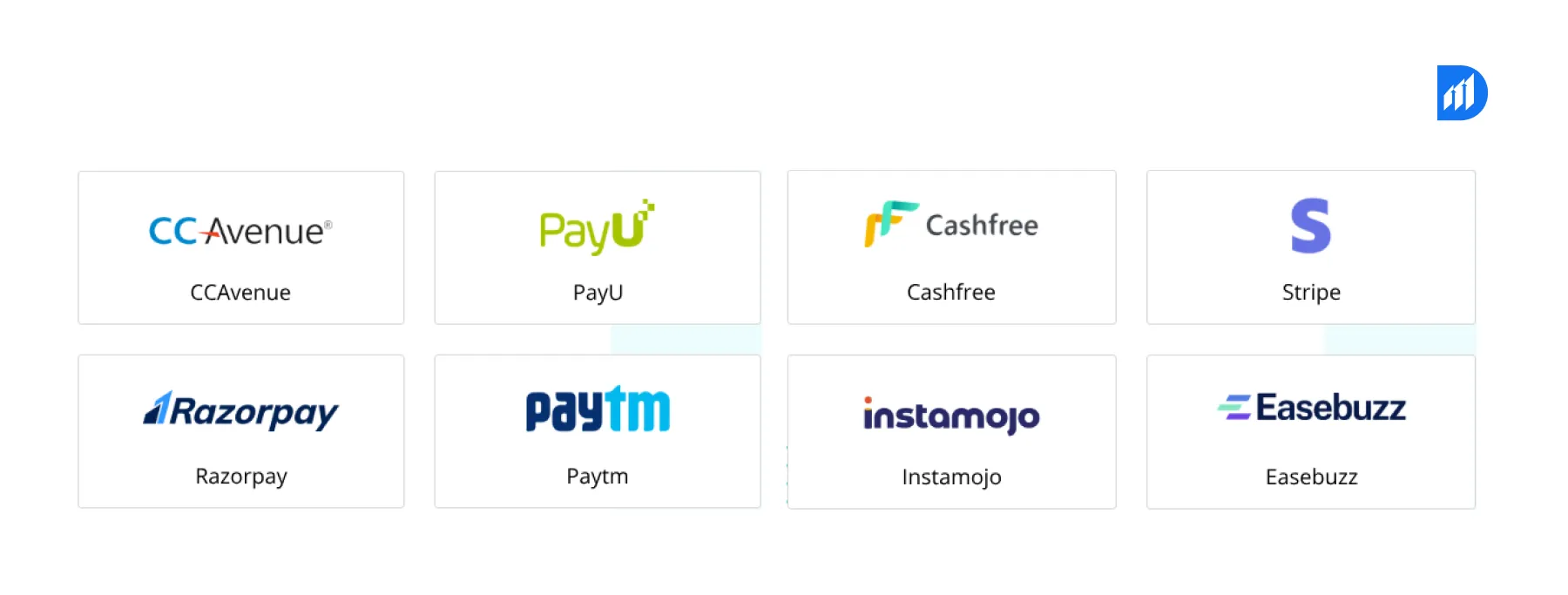
For India-first payment processing, Razorpay is the most comprehensive option, supporting UPI, Net Banking, IMPS, credit and debit cards, and EMI. PayU and Cashfree are solid alternatives. All three offer REST APIs, webhook support for payment events, and reconciliation reporting. For cross-border or global billing, Stripe handles INR billing with foreign exchange conversion and GST-compliant invoicing through its Tax product. Paddle takes on merchant-of-record responsibilities including tax compliance, which is useful if you want to avoid registering for Indian GST directly. Your product will need custom software integration services to map India-specific fields (GSTIN, PAN for high-value transactions), build RBI-compliant refund flows, and connect payment events with your accounting system for automated reconciliation.
The Most In-Demand Integration Categories in India Right Now
ERP and CRM Connectivity SAP S/4HANA to Salesforce, Dynamics 365 to Zoho CRM, Oracle to custom applications consistently in demand from enterprise sales and finance teams trying to eliminate dual data entry.
Healthcare Integrations require HL7 FHIR-compliant connections between EMR systems, insurance claim processors, and diagnostic lab platforms. HIPAA compliant integration expertise is the differentiator. Generic system integrators without healthcare-specific experience get expensive quickly.
Fintech and Banking APIs cover UPI payment integration, NACH mandate processing, CBS connectivity for lending platforms, and SEBI-compliant reporting. Regulatory requirements here are non-negotiable.
E-Commerce and Omnichannel Inventory connects Shopify to WMS, marketplace aggregators like Unicommerce and Vinculum to ERP, and D2C brand tools to accounting systems. The inventory sync architecture covered earlier in this guide applies directly here.
AI and ML Pipelines are growing fast. Enterprises need clean, connected data flowing to inference endpoints on Azure OpenAI, AWS Bedrock, and Databricks. The API connections themselves aren’t complicated, getting the data clean enough to be useful typically is.
Ready to Stop Managing Broken Data Manually?
If your systems aren’t connected, someone on your team is doing the work manually. It’s probably more than one person, and they’ve likely stopped pointing it out because it feels like just how things work.
With AI-Powered Software Development, Durapid’s team brings hands-on expertise across Azure, SAP, Databricks, and healthcare platforms helping you move from patchwork processes to intelligent, connected systems. Talk to their architects to get a clear roadmap before the next Monday morning spreadsheet reconciliation.
Frequently Asked Questions
What is the average cost of custom software integration services in India?
Most mid-complexity projects run between $12,000 and $40,000. Cost shifts based on the systems involved, data volume, compliance requirements, and whether the project uses a platform or fully custom code.
How long does a typical integration project take?
A simple two-system setup with clear APIs usually takes 4 to 8 weeks. Larger enterprise integrations with compliance requirements can run 3 to 6 months, including testing.
Can Indian companies handle HIPAA compliant software integration?
Yes, but verify everything upfront. Look specifically for BAA signing capability, documented encryption standards, and actual healthcare client references you can call.
What is the difference between point-to-point integration and middleware?
Point-to-point directly connects two systems. Simple, but it doesn’t scale. Middleware adds a central layer that handles routing, data transformation, and control across all connected systems — and lets you add new systems without rebuilding existing connections.
How do fixed-price and time-and-material contracts differ?
Fixed-price works best when scope is fully defined and budget certainty matters. Time-and-material gives flexibility but needs oversight to prevent drift. Milestone-based models balance both and are generally the most reliable structure for integration projects.

Recent Blog

How Voice AI Connects Calls With Sales Operations
October 15, 2026-
How GCCs Can Scale Engineering Teams with Staff Augmentation?
October 10, 2026 -
Asset Management Software for CFOs: From Depreciation to Capital Planning
September 29, 2026 -
Why Voice AI Is Different From Chatbots in Recruitment?
September 17, 2026