Cost to Build a Real Estate App in 2026: Features, Pricing & Insights

The cost to build a real estate app in 2026 is one of those questions that seems straightforward at first, but quickly becomes more layered the deeper you go into it. It is never just about a number or a fixed estimate. It is about what exactly you are trying to build, who your target users are, how advanced, scalable, and future-ready you want your solution to be, and the kind of Application Development Services you choose to bring that vision to life.
The use of real estate applications has progressed beyond their original purpose of showing property listings. Today, users expect real estate apps to deliver internet-based solutions that provide intelligent property searches, personalized suggestions, and dependable communication tools which help users make decisions. Development costs cannot be estimated through a single formula because multiple elements affect pricing: features needed, design complexity, personalization level, software technologies, AI-based suggestions, instant data updates, and security measures. The development process requires businesses to grasp that their work results in functional software which creates value for users who will return to the product. Ultimately, that decides both their expenses for development and the future value they will gain from their investment.
What is a Real Estate App and How Does It Work?
The digital environment of a real estate app functions to link different users, including buyers, sellers, renters, and agents, through property listings, search functionalities, virtual tours, and transaction control systems. These applications use data from MLS databases, Google Maps, and payment processing systems to develop a complete property solution.
Most real estate applications function through three interactive components: buyers or tenants who look for properties, sellers or landlords who advertise their properties, and agents or brokers who assist with transactions. Moreover, the most effective apps also provide mortgage calculators, legal document management, and CRM software to support complete transaction processes. Real estate apps today use artificial intelligence to connect users with properties that match their behavioral patterns, financial capabilities, and location needs. For instance, Zillow uses its recommendation systems to process more than one million data points every single day. That is a key reason their engagement rates are 3x higher than traditional property portals.
Key Factors That Influence Real Estate App Development Cost in 2026
The costs for real estate applications differ from one application to another. To avoid unexpected costs, you need to understand the total investment variables before development starts. Your competitor just launched a real estate app that lets buyers tour homes in 3D, get AI-powered price predictions, and close deals without visiting an office. Meanwhile, your team continues to handle inquiry emails through manual processing. According to the National Association of Realtors, 97% of home buyers now use the internet during their property search. Clearly, the shift has already happened. As a result, agencies and proptech companies need to develop real estate apps for 2026 to maintain their competitiveness. The main question is: what will it actually cost to build your project properly?
App complexity is the biggest driver. A basic listing application with search and contact features costs far less than a complete system with AI recommendations, AR tours, and payment processing.
Platform choice matters too. Native iOS and Android applications require higher expenses than cross-platform development through Flutter or React Native, though they deliver better performance for media-heavy content like virtual tours.
The location of your development team also has a significant impact on project costs. North American developers charge between $100 and $200 per hour. Eastern European teams charge between $40 and $80 per hour. Experienced Indian developers charge between $20 and $50 per hour. Furthermore, third-party integrations such as MLS feeds, Stripe, Twilio, and Google Maps API increase both project expenses and project duration. The Durapid Mobile Application Development team assists clients in choosing the right tech stack which matches their financial requirements while maintaining essential functions.
Must-Have Features of a Real Estate App in 2026
The following elements must exist as essential requirements for any real estate app that aims to succeed against competitors in the market.
Core Features Every Real Estate App Needs
- Advanced property search with filters: location, price, property type, and square footage
- High-resolution image galleries plus 360-degree virtual tours
- An interactive map displaying neighborhood information along with commuting duration details
- In-app messaging between buyers, sellers, and agents
- Push notifications about price reductions, new listings, and saved search updates
- Mortgage and EMI calculators using current interest rate information
- User profiles for storing preferred property lists
- Secure document transfers with electronic signature support for contracts
According to Matterport’s 2024 property data report, virtual tour features enable apps to achieve 40% more user engagement than apps that do not include this functionality. Therefore, for anyone building custom real estate apps for high-end clients, this feature is no longer optional.
Advanced Features for Competitive Differentiation
- AI-powered property suggestions based on search patterns
- Augmented reality for virtual room visualization with furniture placement
- Automated valuation models (AVM) for instant price estimations
- Blockchain technology for property title verification and smart contracts
- Integrated CRM software for agents to manage lead tracking and follow-ups
Types of Real Estate Apps and Their Development Costs
The type of app you build defines your feature scope, your target audience, and your budget range. Below are the most common categories and what they cost in 2026.
| App Type | Target Users | Key Features | Estimated Cost (USD) |
| Property Listing App | Buyers, Renters | Search, filters, maps, contact forms | $15,000 – $40,000 |
| Agent/Broker Platform | Real Estate Agents | CRM, lead management, document tools | $30,000 – $70,000 |
| Commercial Real Estate App | Investors, Businesses | ROI calculators, lease tools, analytics | $50,000 – $120,000 |
| Rental Management App | Landlords, Tenants | Rent payments, maintenance requests | $25,000 – $60,000 |
| Zillow-like Marketplace | All users | Full MLS, AI pricing, virtual tours | $80,000 – $200,000+ |
A commercial real estate app tends to cost more due to complex financial modeling features and enterprise-grade security requirements. Similarly, if you are building something comparable to the Zillow real estate app, budget for a phased rollout rather than trying to launch everything at once.
Cost Breakdown of Real Estate App Development (2026 Edition)
Breaking the total cost into phases helps you plan spending and prioritize features for an MVP launch. Here is what each stage typically costs.
| Development Phase | Activities Included | Cost Range (USD) |
| Discovery & Planning | Market research, wireframes, tech stack selection | $3,000 – $8,000 |
| UI/UX Design | Screen designs, prototypes, user testing | $5,000 – $15,000 |
| Frontend Development | iOS, Android, or cross-platform build | $15,000 – $45,000 |
| Backend Development | API, database, authentication, admin panel | $12,000 – $35,000 |
| Third-Party Integrations | MLS, maps, payments, messaging | $5,000 – $20,000 |
| QA & Testing | Manual and automated testing across devices | $4,000 – $10,000 |
| Deployment & Launch | App store submission, server setup | $2,000 – $5,000 |
| Post-Launch Maintenance | Bug fixes, updates, feature additions (annual) | $8,000 – $25,000 |
The standard price range for a basic real estate app starts from $15,000 and extends up to $50,000. A mid-range platform with AI capabilities and third-party connections starts from $50,000 and can reach $120,000. Enterprise-grade platforms start from $200,000 and increase based on system size and specific user needs. In addition, Durapid’s real estate app development services follow an agile delivery model. Rather than waiting until the full product is complete, you get operational features to test every two weeks.
Benefits of Investing in Real Estate App Development
A properly designed real estate app produces distinct business benefits that go well beyond its technical features. According to a 2024 NAR Technology Survey, real estate agencies that use mobile applications generate three times more leads than agencies that depend solely on their websites. In addition, agents achieve a weekly time savings of six hours through mobile app-based CRM tools and automated appointment scheduling. That time goes directly into closing more deals. For brokerages with 20 or more agents, productivity savings can reach $200,000 or more each year.
Property buyers who use apps with virtual tours are 68% more likely to make an offer without a physical site visit. This decreases the time properties spend on the market while also boosting sellers’ chances of closing successfully. Furthermore, strong real estate app development services build compliance processes that follow local property disclosure requirements, which protects your company from legal hazards.
How Advanced Technologies Impact Real Estate App Development Cost?
Adding AI, AR, and blockchain elements to your app results in higher development expenses. Even so, these technologies enhance both the value of your application and the ability of users to stay engaged with it.
AI and Machine Learning in Real Estate Apps
AI-based property recommendation systems typically add $10,000 to $30,000 in development costs. In return, apps with AI recommendations see users spending 45% more time per session, along with a 28% better conversion rate. Specifically, Durapid provides AI App Development Services that create customized machine learning models for property matching, price prediction, and lead scoring.
Augmented Reality and Virtual Tours
The AR room visualization feature increases project expenses by $15,000 to $40,000. New construction projects and luxury property markets rely on this because buyers need to review different layout designs before committing. However, the investment generates returns quickly because it reduces required site visits while speeding up deal closures.
Blockchain for Property Transactions
Implementing blockchain for title verification and smart contract functionality adds $20,000 to $60,000 in costs. These features block fraudulent activity while shortening the closing process from multiple weeks to just a few days. As a result, platforms handling sensitive compliance data should also review their Compliance Frameworks to confirm alignment with data security requirements across different regions.
Step-by-Step Process to Build a Real Estate App
Following a structured approach helps control spending while delivering a product that fulfills user requirements from day one.
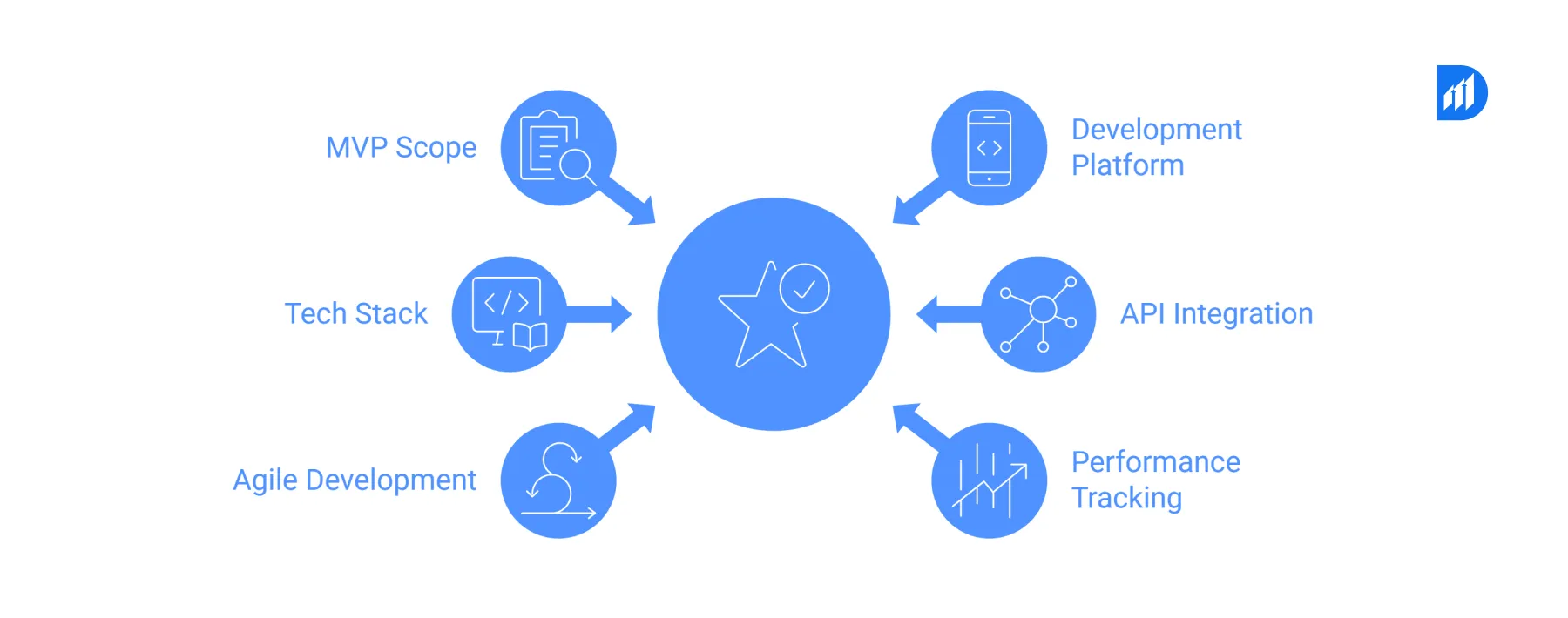
Step 1: Define your MVP scope. Select three to five essential functions for your first release. Schedule everything else for future development phases.
Step 2: Choose your development platform. Decide between native iOS and Android or cross-platform development using Flutter or React Native. Cross-platform development can reduce initial expenses by 30% to 40%.
Step 3: Finalize your tech stack. Use Node.js or Python with PostgreSQL for backend operations, since both handle property data management well. Also implement Firebase or WebSockets to support real-time functionalities.
Step 4: Connect MLS and external APIs. Use RETS or RESO Web API standards to access property data. Also integrate Google Maps for location services and Stripe for payment processing.
Step 5: Build, test, and improve. Run two-week agile sprints. Test on actual iOS and Android devices. Then gather feedback from beta users before the public launch.
Step 6: Launch and track performance. Submit to the App Store and Google Play. Finally, implement Mixpanel or Firebase Analytics for user behavior tracking from day one.
Common Challenges in Real Estate App Development
Most teams underestimate integration complexity. Your app requires custom mapping because MLS data feeds show different regional patterns. This alone can add two to four extra weeks to the project. As your user base grows, map feature costs will scale with it. For example, platforms with more than 10,000 daily active users often need to switch from Google Maps API to Mapbox because costs increase at higher volume. Planning for that transition early generates major savings later. Legal compliance is another obstacle teams often underestimate. Real estate apps need to comply with local property disclosure requirements, fair housing standards, and US data privacy laws such as GDPR and state-level equivalents. In short, building these into the application from the start costs significantly less than adding them after public release.
How Durapid Technologies Delivers Custom Real Estate Apps?
Durapid Technologies builds real estate apps that go well beyond basic listing pages. Our team, composed of more than 300 developers and 120+ certified cloud consultants, has developed property marketplace platforms, rental management solutions, and agent productivity applications operating across North America, Europe, and the Middle East.
Every project starts with a discovery sprint that produces a business model, user personas, and technical requirements. As a result, our agile teams complete software development tasks every two weeks while sharing all project details and financial information with stakeholders. Your application also benefits from our Microsoft Co-sell partnership along with our Databricks-certified experts, so your app can run on Azure infrastructure from day one. Whether you need a basic listing MVP or an advanced platform with AI pricing engines and virtual tours, Durapid develops production-ready software that matches your requirements. Ready to build your real estate app? Contact the Durapid team to schedule a free technical consultation and get a precise cost assessment tailored to your product.
Frequently Asked Questions
How much does it cost to build a real estate app in 2026?
A basic real estate app costs $15,000 to $50,000. Full-featured platforms with AI, virtual tours, and MLS integration range from $80,000 to $200,000 or more.
How long does real estate app development take?
An MVP takes 3 to 5 months. A full-featured platform with advanced integrations typically takes 8 to 14 months from discovery to launch.
What is the difference between the Zillow real estate app and a custom real estate app?
Zillow serves millions of users with massive MLS integrations and AI pricing models. In contrast, a custom real estate app is built for your specific business model, niche, and user base, giving you full control over features and data.
What technology stack is best for real estate app development?
React Native or Flutter for cross-platform mobile, Node.js or Python for the backend, PostgreSQL for data storage, and Google Maps or Mapbox for location features are the most widely used combinations in 2026.
Do I need to integrate MLS data in my real estate app?
Yes, for most buyer-facing platforms. MLS integration via RESO Web API gives your app access to current, accurate property listings. Without it, your data goes stale and users lose trust fast.

Recent Blog

How Voice AI Connects Calls With Sales Operations
October 15, 2026-
How GCCs Can Scale Engineering Teams with Staff Augmentation?
October 10, 2026 -
Asset Management Software for CFOs: From Depreciation to Capital Planning
September 29, 2026 -
Why Voice AI Is Different From Chatbots in Recruitment?
September 17, 2026