GenAI for BFSI: Architecture, Compliance and Implementation
Three years ago, GenAI was the kind of idea innovation teams loved talking about. It made for exciting demos, conference keynotes, and ambitious roadmaps, but when it came to banking, very few leaders were willing to trust it with real customer decisions. Last year, that started to change as banks launched pilots for KYC, fraud detection, compliance, and customer service. The results looked promising, but most projects never made it beyond controlled environments because they worked in the lab, not in production. This year feels different because the conversation is no longer about whether GenAI works. It is about who is already gaining an operational advantage from it.
Every month spent waiting has a measurable cost. Manual compliance reviews delay customer onboarding while fraud investigations consume thousands of analyst hours, and regulatory updates pile up faster than teams can process them. While one bank is still debating governance frameworks, another is already processing customers faster, reducing operational costs, and building institutional knowledge that compounds over time.
Consider what is happening right now. In Frankfurt, a global bank uses GenAI to support KYC decisions, reducing processing time from four hours to twenty minutes while maintaining a complete audit trail. In Brussels, another bank has deployed a compliance copilot that reviews regulatory updates across twelve jurisdictions, identifies the few policy changes that require action, and completes overnight work that previously took compliance teams weeks.
Ask yourself where your institution stands today. Most banks are still experimenting, while the winners have already crossed the gap from pilots to production. Celent research confirms that 59 percent of BFSI firms implement or test GenAI specifically for risk and compliance. However, “testing” is the operative word. Most treat GenAI as another pilot in a crowded innovation pipeline. This approach leads to missed opportunities.
What Is GenAI in BFSI and Why 2026 Is the Inflection Point?
Generative AI in banking and financial services moved from experimental to regulator-accepted status. This is not a theory. The chatbot trials of 2023-2024 stayed mostly in lab mode. Today, GenAI systems deployed in BFSI handle document analysis, compliance workflows, underwriting decisions, and customer onboarding at production scale. Banks solved two critical problems: they built regulatory confidence through Model Risk Management frameworks, and they contained hallucination using retrieval-augmented generation.
McKinsey’s survey shows 67 percent of financial services firms moved GenAI pilots into production or advanced testing. The real bottleneck today is not whether you can build it. Instead, the question becomes whether it clears model risk review while keeping audit trails that regulators can inspect. That is the inflection point.
In BFSI, effective GenAI means building systems that handle structured and unstructured data, policy documents, transaction records, customer communications. Results must survive regulatory scrutiny. For example, a fraud investigation summary must cite the data it used. A KYC decision must explain why a customer passed or failed onboarding, not just provide yes or no. Similarly, compliance reports must be reproducible and auditable, not black boxes. Traditional AI did parts of this job. GenAI accomplishes it faster, cheaper, with less reliance on labeled training data.
The architectural difference matters most. GenAI does not train a model on your historical data alone. It uses your existing knowledge base. Your policies. Your procedures. Your transaction history. Your regulatory filings. It retrieves relevant material, feeds it into an LLM, and generates grounded responses. This means faster deployment, reduced bias exposure, and regulatory pathways that avoid 18-month model validation cycles every time.
GenAI vs Traditional AI in BFSI: What Actually Changed
Traditional machine learning in BFSI relies on large labeled datasets, with data preparation alone often taking 3–6 months before training, tuning, backtesting, and regulatory approval can begin. Many banks now use AI Development Services to speed up this process while maintaining compliance and model quality.
GenAI changes the input, not the rigor. Instead of labeled training data, you provide policy documents, historical case examples, and decision logs. The model picks up patterns in that text. You ask “should this transaction be flagged?” It returns an answer grounded in your policies and historical precedents. No labeled dataset required, or at least not in the same heavy way.
The time savings are substantial. Traditional machine learning fraud detection took 6-8 months in a tier-2 bank. GenAI delivered the same capability in 10 weeks from requirements through model risk review submission. You skip data labeling and most feature engineering.
Regulatory requirements differ too. Traditional models sit inside Model Risk Management governance frameworks (SR 11-7). Regulators expect to see training data, validation outcomes, bias testing, and performance monitoring. GenAI systems need the same oversight, but validation approaches shift. You test retrieval quality, hallucination rates, and output consistency across similar prompts. Audit trail requirements change as well.
Risk profiles change over time, so traditional machine learning models often drift quietly without anyone noticing. GenAI, on the other hand, fails visibly through hallucinations, making issues easier to detect and fix with proper monitoring and fallback mechanisms, which can ultimately make it more trustworthy than a black-box model that slowly degrades.
GenAI Architecture for BFSI: The Production Stack
Production GenAI systems in banking require five layers, and you cannot skip any of them if you want real-world performance to hold up under scrutiny.
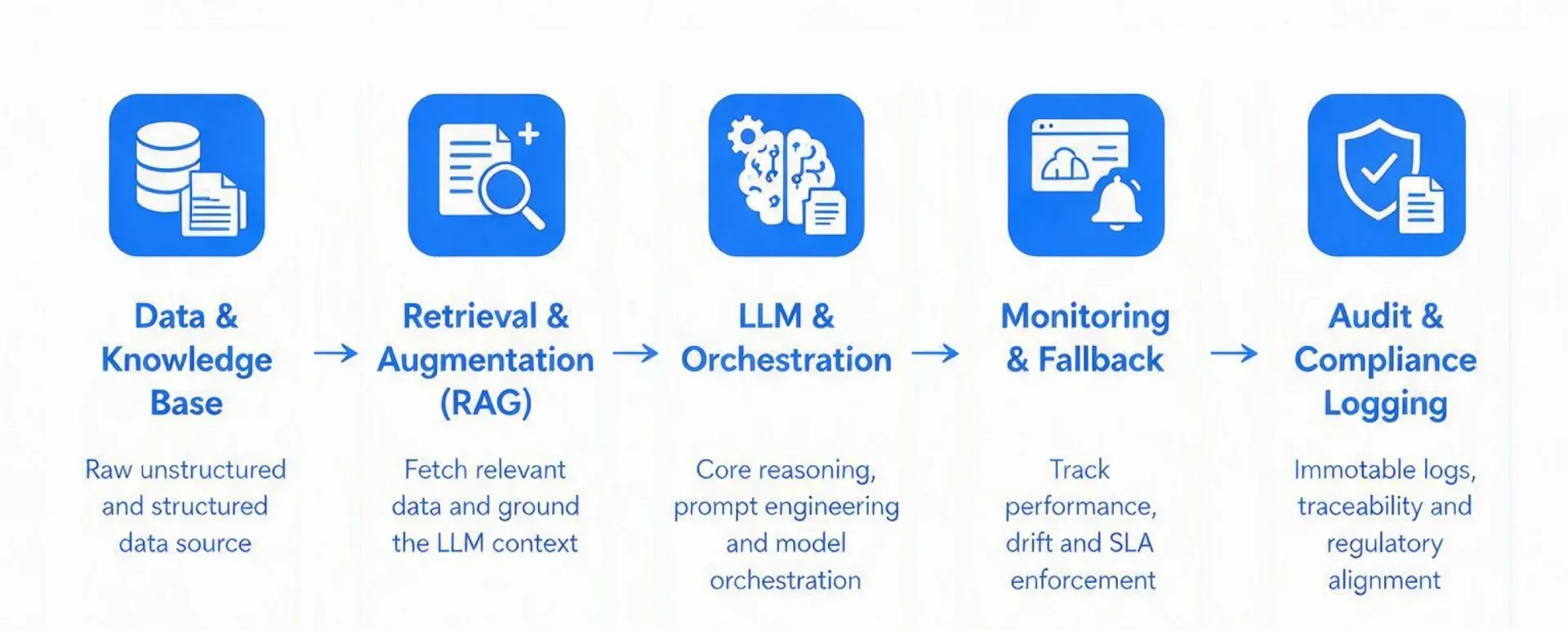
Layer 1: Data and Knowledge Base
Think of this as your retrieval source because it matters far more than most teams expect. In BFSI, it typically includes policy documents, regulatory guidance, historical case files, transaction logs, and customer records, and the quality of this layer determines everything downstream since incomplete or outdated policies can make every answer legally fragile.
One mid-market bank learned this the hard way after deploying a GenAI chatbot trained on just 18 months of transaction history, leaving out recent policy revisions and regulatory updates. Within three weeks, the chatbot began providing outdated compliance guidance, reinforcing why knowledge bases need version control, change tracking, and regular audits from day one rather than as an afterthought.
Layer 2: Retrieval and Augmentation (RAG)
Think of this as the engine that finds the right documents when questions arrive. You ask “is this customer transaction compliant?” and the retrieval layer searches your knowledge base for relevant policies, precedents, and regulations. Then it passes those materials to the LLM along with your original query.
RAG design essentially determines success or failure in most BFSI implementations. Why? Because weak retrieval surfaces irrelevant documents and confuses the LLM, even when the model itself is solid. Strong retrieval, by contrast, puts exactly the right documents in front of the LLM. We consistently see 40-point accuracy improvements in compliance systems. In virtually every case, the retrieval does the heavy lifting, not the LLM.
Layer 3: LLM and Orchestration
Tools such as Azure OpenAI, AWS Bedrock, or open-source models like Llama handle the actual text generation. Meanwhile, the orchestration layer steers the prompt, controls token context, runs streaming, and applies safety filters. In BFSI environments, prompt engineering demands precision, it is not casual or “whatever” in approach. The prompt must set compliance expectations, drive bias prevention, add safety guardrails against hallucinations, and enforce audit trail requirements.
Layer 4: Monitoring and Fallback
Production GenAI systems require continuous monitoring. If a KYC decision drops 30 percent in accuracy on Tuesdays, you need to know. When hallucination rates climb, alerts matter. Should a document type confuse the model, notification is required.
Fallback design matters just as much. What happens when the LLM cannot produce a valid answer? Does it route to a human, refuse the request, or fall back to rules? Your fallback behavior ultimately determines system trustworthiness under stress.
Layer 5: Audit and Compliance Logging
Every decision must be reproducible. In regulated environments, “the LLM decided” is not an explanation. You log the input query, retrieved documents, model version, exact prompt text, generated output, and confidence score. If a regulator audits a KYC decision from six months ago, you replay it exactly. Identical sequence.
This logging layer is not optional for BFSI. Fundamentally, it is the difference between surviving model risk review and shutdown. We build systems with audit-first principles. Therefore, yes, there is overhead, roughly 5-10 percent of latency. It is non-negotiable.
GenAI Use Cases in Banking That Are Already in Production
Banks have moved beyond AI pilots and into production, using GenAI chatbot development and other GenAI solutions to automate high-volume, document-heavy workflows while keeping humans in control of critical decisions. The result is faster turnarounds, lower costs, stronger precision, and better customer experiences across fraud detection, compliance, onboarding, lending, and wealth management.
Fraud Detection and Investigation Summaries
Banks process millions of daily transactions, and most are clean. Only 0.2 percent look suspicious and require investigation. Traditionally, analysts worked through transaction chains manually, wrote summaries, and forwarded them to compliance review. As a result, urgent cases took 2-4 hours for decision-making.
GenAI compresses this workflow significantly. You feed a transaction chain to a GenAI system trained on historical fraud patterns, regulatory guidance on suspicious activity reporting, and bank internal policies. Then ask the system: “Is this consistent with money laundering, account takeover, or commerce fraud?” It classifies the transaction, points to suspicious indicators, references relevant policies, and explains the outcome in clear language.
Consider a mid-market bank with 8 million daily payments. They deployed this approach in Q3 2025 and saw investigation summaries drop from 40 minutes to 3 minutes. On known fraud cases, accuracy improved from 78 percent (human baseline) to 91 percent (GenAI classification). Notably, the system avoids overconfidence on edge cases and escalates uncertain signals to human review rather than auto-closing.
Regulatory Compliance Reporting and Documentation
Compliance teams spend weeks preparing regulatory reports. They aggregate transaction data, write control summaries, document policy compliance, and generate full audit trails. GenAI helps with aggregation and narrative generation. The work feels less manual and more like structured support.
Feed GenAI your transaction logs, policy documents, audit logs, and current regulatory requirements. Ask it to generate a BCBS 239 compliance report. It pulls transaction summaries, checks alignment with policy expectations, flags control gaps, and produces a first draft for refinement instead of starting from scratch.
One tier-2 regional bank cut quarterly compliance reporting from 8 weeks to 4 weeks using GenAI assistance. The tool does not replace compliance expertise. It removes manual aggregation and boilerplate wording. Teams concentrate on analysis and risk assessment instead of data entry.
KYC and Customer Onboarding Automation
Know Your Customer processes are naturally document heavy. New business customers submit incorporation documents, tax IDs, beneficial ownership declarations, bank statements, and regulatory filings. Traditionally, human analysts review papers, cross-check public registries, run manual searches, and make KYC decisions.
GenAI can help speed up this workflow. You simply retrieve customer onboarding policies, FATCA guidelines, AML regulations, and submitted documents, then ask “Does this customer profile meet our onboarding standards?” The system reads documents, flags missing details, spots risk indicators, and produces a preliminary decision with reasoning. As a result, risky cases escalate while clean cases move forward.
Consider what happened at a mid-tier retail bank. They automated KYC onboarding for 85 percent of new business customers. Onboarding time dropped from 4 hours to 20 minutes. Notably, the remaining 15 percent (with missing or unclear documents) still requires manual review, adding 1-2 days. Despite these exceptions, the platform maintains 99.2 percent accuracy on successful decisions based on post-onboarding audit checks.
AI-Powered Underwriting and Credit Assessment
Underwriting is at its core a prediction task, but in BFSI it cannot be a black box. When loan officers reject credit, they must explain the reason properly. Therefore, GenAI helps by drafting those explanations. It pulls applicant credit history, proof of income, collateral estimates, and bank underwriting rules, then produces decisions with clear reasoning.
In contrast, traditional credit models output only a score and decile range. GenAI, by comparison, produces a decision plus the drivers behind it, relevant regulatory rules, and the customer message describing the outcome.
Wealth Management and Client Communication
Wealth managers typically spend hours reviewing client holdings, market movements, and regulatory changes to craft proper client communication. GenAI can streamline this process. Provide the system with client portfolio positions, current market inputs, and regulatory updates, and it generates a quarterly client note explaining portfolio positioning, market outlook, and relevant regulatory impacts.
The output serves as a first draft for wealth managers to review and refine with their own style. It is not production-ready for immediate sending. However, a 2-3 hour drafting workload becomes 20 minutes of review and refinement.
GenAI Use Cases in Insurance That Are Already in Production
Insurance underwriting looks similar to banking but relies on different data. While banking examines transaction histories, insurance evaluates claim histories, policyholder details, and actuarial tables, with many Global Capability Center teams supporting these AI-driven underwriting operations at scale.
Claims Processing at Scale
Claims processing is the primary GenAI use case in insurance. When someone submits a claim with supporting documents (medical records for health, repair estimates for property, police reports for auto), claims adjusters review everything. They verify details, check policy terms, validate coverage applicability, then approve or deny.
GenAI adds speed and consistency. You provide policy terms, coverage definitions, claim approval guidelines, and historical decisions. You give it the current claim and documents and ask: “Does this qualify for coverage under our policy terms?” The system returns a first-pass decision with a reasoning trail. Claims adjusters then review recommendations and make final decisions, especially for edge cases.
A commercial auto insurer tested this on collision claims. Claims processing dropped from 3 days to 4 hours for preliminary determinations. Ambiguous cases flag for human review, adding 1-2 days. Routine claims finish in under half a day for 70 percent of volume.
Compliance Architecture for GenAI in BFSI: What Survives Model Risk Review
Model Risk Management (Federal Reserve SR 11-7) is the regulatory framework for AI models in U.S. banking. It requires model governance (clear ownership, documentation, approval procedures), model validation (independent tests confirming the model works as intended), model monitoring (ongoing performance watchfulness and alerting), and model risk management (controls for degradation, bias, and drift).
GenAI systems in banking must satisfy all four requirements, not just one. The compliance architecture you choose determines whether your setup gets greenlit.
What Regulators Look for in GenAI Systems
Transparency on LLM limits. Regulators demand clear statements that LLMs hallucinate, retrieval fails sometimes, and confidence scores are not ground truth. Importantly, systems acting like these risks are imaginary get rejected immediately, whereas systems with engineered mitigations get approved more often.
Complete audit trails. Every decision must be logged and reproducible. No hand-waving about potential future reproduction is acceptable. If a regulator asks “why did your system decline this KYC application on March 15, 2025?” you pull the exact input, retrieved documents, used prompt, model version, and final output. This is non-negotiable. No exceptions.
Bias testing and ongoing monitoring. GenAI models trained on historical data typically pick up historical biases. Fair lending rules require unequal impact testing across protected classes, not just during development but also in production with drift alerts. Crucially, without this monitoring in place, you remain blind to performance declines.
Fallback and escalation design. What happens when the LLM fails or returns unreliable output? This matters enormously. Notably, clearly defined human escalation paths that are monitored usually pass review. In contrast, vague or undefined fallback gets rejected outright.
Performance benchmarking compared to humans. Regulators want proof that your GenAI solution performs at least as well as human decision-makers. Therefore, if your KYC workflow is 95 percent as accurate as your top analyst but 4x faster, that is defensible. However, if it is less accurate with no speed advantage, it does not get approved.
RAG Pipeline Design for BFSI: Why Retrieval Quality Is the Compliance Decision
Retrieval-Augmented Generation is not new, but what happens when you deploy it in BFSI determines success or failure. This is where most deployments live or die.
Without retrieval, an LLM is just a statistical text generator that produces convincing language based on training patterns. The problem: it has no grounded view of your policies or current internal data. So yes, it can hallucinate. In a regulated environment, that is a dealbreaker.
RAG adds a retrieval layer. When you ask “is this customer eligible for this product?” the system fetches the relevant product policy, regulatory guidance, and customer history. Then it sends retrieved material to the LLM to generate responses. The LLM still carries risk and can hallucinate. But now it hallucinates within a constrained fact set, not freestyling from the world.
RAG Quality Determines Model Accuracy
RAG quality decides model accuracy in measurable ways because we have tested it extensively. Take the same LLM with different retrieval approaches, and you will see 40-point accuracy swings. Weak retrieval (only 10 percent of top-5 results relevant) lands at 60 percent accuracy for KYC decisions. Strong retrieval (90 percent of top-5 relevant) hits 95 percent accuracy. Notably, the LLM never changed. The retrieval did all the work.
RAG quality also serves as a compliance signal. Regulators care about decision justification far more than most realize. Simply saying “The LLM decided” is insufficient. Instead, “The system retrieved policies X, Y, and Z, applied them to customer data, and concluded Z” becomes more defensible. Ultimately, this only works when your retrieval quality remains high.
Building Good RAG for BFSI
Effective RAG for BFSI needs several non-negotiable basics.
Knowledge base versioning. Track exactly which documents were active when each decision was made because policies evolve over time. A KYC decision made on March 1 may have relied on policy version 2.3, while another made on March 15 used version 2.4. That level of precision is essential for audit trails and regulatory compliance, making document versioning a core requirement rather than a nice-to-have.
Chunking and embedding strategy. How you slice documents and embed them for retrieval matters far more than most expect. A 50-page policy split into 500-word chunks retrieves differently than the same policy split into 100-word chunks. Test retrieval quality in practice (not theory) and choose the chunking approach that improves results.
Retrieval redundancy. Use multiple retrieval approaches. Vector search is good for semantic similarity. Keyword search handles exact matches. Using both and combining results usually beats either alone. In our experience, this cuts hallucinations 30-40 percent versus vector search alone. It is not just nice to have.
Retrieval monitoring. Watch whether the system actually pulls relevant documents. When retrieval quality drops, overall performance will likely slide too. Instrument retrieval with explicit quality metrics and watch continuously. Drift happens. It will not announce itself.
Implementation Roadmap: How to Deploy GenAI in BFSI Without Failing Model Risk Review?
GenAI deployment in BFSI takes 6-12 months from kickoff to production (depending on complexity). It feels slower than non-regulated rollouts because regulatory review is built in.
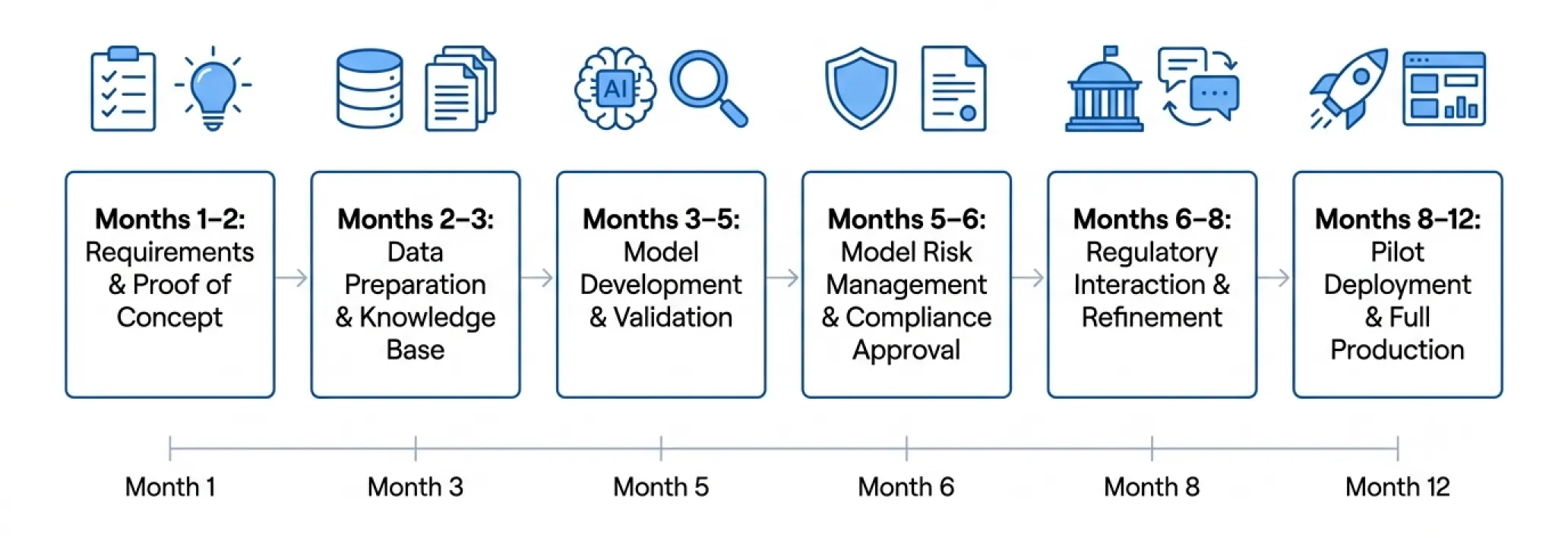
Months 1-2: Requirements, Compliance Planning, Proof of Concept
Start by defining the exact use case. What decision is GenAI actually supporting? KYC approval, fraud flagging, claims processing? Next, establish success metrics in regulatory terms. Specifically, consider accuracy compared to human baseline, audit trail completeness, and bias metrics for measurement.
Compliance involvement must happen early. This is not optional. Your compliance team lays out Model Risk Management requirements. Why does timing matter? Because if you build first and ask questions later (after the model takes shape), you will need to rebuild. That wastes time and resources.
Running a proof of concept typically takes 2-4 weeks. Importantly, confirm that retrieval accuracy is realistically achievable, verify LLM performance hits agreed baselines, and ensure the architecture supports audit logging. A successful proof of concept proves feasibility and shows you what to scale in the full build.
Months 2-3: Data Preparation and Knowledge Base Construction
First, begin by auditing your knowledge base. What documents will the system retrieve? Policies, regulations, precedent cases, customer records? Make sure everything is current, complete, and correctly versioned, not “close enough,” but correctly versioned.
Second, establish versioning and change control processes. Every document should carry metadata (version number, effective date, approval status). When policies change, track those changes. Importantly, for historical decision audits, you can then point to the exact policy version in effect at decision time, not later edits.
Finally, build your initial RAG infrastructure by deploying vector databases, embedding models, and retrieval pipelines. Start with Azure OpenAI plus Pinecone or Weaviate, or the open-source alternative Qdrant. Test retrieval quality aggressively and measure recall for the top-5 documents returned, how many are actually relevant?
Months 3-5: Model Development and Validation
Setting Up Pipeline and Monitoring
Set up the GenAI pipeline: Retrieval → prompt engineering → LLM → monitoring → logging. Standard approach, yes. But compliance requirements are baked in from day one. Do not defer this. It becomes messy if delayed.
Implement monitoring infrastructure before considering production. You need real-time monitoring on accuracy, hallucination frequency, latency, and fallback rates. Put this in the development environment. Ensure every metric is visible to compliance teams. One hundred percent transparency.
Conducting Validation and Documentation
Conduct independent model validation before deployment. A validation team that is separate from the development team should test the system against known benchmark cases to measure accuracy, evaluate fairness across different customer segments, assess how well it handles adversarial or misleading prompts, and verify that every decision can be explained in a way that satisfies auditors and regulators. This validation process typically takes 4–6 weeks, with all findings, test results, and approval decisions documented in a comprehensive Model Validation Report for regulatory review.
Months 5-6: Model Risk Management and Compliance Approval
Write Model Risk Management documentation. This formal document describes the model’s intended purpose and target use case, governance structure and approval workflows, performance metrics and benchmarks, monitoring approach and alert thresholds, identified risks and mitigation strategies.
Submit for internal compliance review. Most banks have a Model Risk Committee approving new AI systems. Get approval before regulatory submission. Otherwise you get stuck in rework loops.
Months 6-8: Regulatory Interaction and Refinement
For certain systems (credit decisions, anti-money laundering choices), you might need regulatory conversation. Hand over your Model Validation Report and Model Risk Management paperwork. Take the feedback (or main points) and iterate on design. Maybe tighten governance. Resubmit as needed.
For lower-risk cases (internal reporting, wealth management communications), you can usually document what you do and monitor it without formal regulator approval.
Months 8-12: Pilot Deployment and Full Production
Start with a pilot user group. Run the new approach parallel to legacy systems for a while. Collect performance evidence on actual living data. Real-world behavior differs from validation results.
Check fallback rates. How often does it escalate to human review? Above 50 percent means the use case is not ready for wider scaling. Below 5 percent means you may not have enough safety rails.
Keep monitoring accuracy, bias, and latency continuously. At the first sign of performance drift, pause the rollout and investigate why.
Scale to full production only when metrics land inside agreed thresholds.
What This Means If You Are Hiring for GenAI in BFSI?
Building GenAI systems that pass model risk review requires very specific skills that most people do not have. You cannot wing this with generic experience.
First, you need engineers who understand both LLM internals and regulatory compliance and can link them together without breaking things. Engineers who only built GenAI in non-regulated spaces may not grasp Model Risk Management or why audit trails matter. Similarly, compliance specialists from banking may know policies but struggle with prompt engineering, retrieval optimization, or hands-on implementation.
Second, seek people who have shipped GenAI to production in regulated environments. The distance between impressive proof of concept and production systems meeting regulatory standards is substantial. Notably, production experience matters directly, not indirectly.
Then comes retrieval engineering, a specialized skill that most engineers treat as a checkbox before moving on. Retrieval engineers, by contrast, take a different approach. They benchmark retrieval quality, tune chunking and embedding strategies, and engineer redundancy so systems survive messy data conditions. This role does not exist in many organizations yet, but in BFSI it becomes critical quickly.
You will also need compliance-aware architects. These professionals translate regulatory requirements into system architecture decisions, understand SR 11-7 deeply, and have designed systems that actually passed model risk review.
We have placed over 90 GenAI engineers across BFSI and financial services clients. Importantly, successful placements combine technical depth with documented shipping experience in regulated systems. Engineers lacking that background can learn, but expect 2-3 months of ramp-up, not 2-3 weeks.
Why Durapid Builds GenAI for BFSI Differently?
Durapid is a Microsoft Co-sell Partner and an SAP Premium Partner with 150+ Microsoft-Certified Professionals and 95+ Databricks-Certified experts. We have delivered 90+ enterprise AI projects across BFSI, healthcare, and logistics. This is not theoretical knowledge.
Our Compliance-First Approach
Our approach differs in two key ways. First, we build compliance from day one rather than bolting it in later. Many GenAI vendors create neat demonstrations then later try to force in audit trails and monitoring. We work backward from Model Risk Management requirements and build system architecture from regulatory needs. Audit logging is present from the start. Monitoring is in place. Fallback mechanisms are included. You do not retrofit these elements afterward and hope they hold.
Our Retrieval-Quality Focus
Second, we test retrieval quality in practice before touching the LLM. Most teams assume that dropping a large model onto their data will simply work. It usually does not. We run weeks of retrieval testing, benchmark different chunking approaches and embedding strategies, and measure what actually performs on your specific data before assembling the full pipeline. This practice avoids the 40-point accuracy gap that destroys most production rollouts.
The result: systems that clear model risk review on the first submission, not the third. Systems that run smoothly in production and hit the performance targets that earned initial approval.
Next Steps
GenAI is no longer optional in BFSI, and the competitive window for early movers is closing rapidly. Banks that deployed GenAI KYC automation in 2024-2025 now bring in new customers 4x faster than competitors still relying on manual review. Clearly, that advantage shows in their growth rates.
The challenge today is not capability rather, it is execution. Most organizations encounter compliance friction and architectural complexity rather than limitations with the LLM technology itself. If you are building GenAI for BFSI, consider starting with these key steps. First, define your specific use case and success metrics in regulatory terms. Second, audit your knowledge base and set up versioning infrastructure. Third, test retrieval quality thoroughly before optimizing the LLM. Fourth, engage compliance early to understand Model Risk Management requirements. Finally, plan for 6-12 month deployment timelines and budget accordingly.
Durapid specializes in AI and ML Solutions for regulated environments. We support architecture, compliance planning, team staffing, and GenAI chatbot development or custom AI systems. We run a Global Capability Center with 300+ developers and specialists, including experts who shipped GenAI systems in BFSI and passed model risk reviews.
Get started: Contact us for a 30-minute consultation on your GenAI deployment strategy. We assess your use case, review compliance needs, and map out a realistic timeline and resource plan.
Frequently Asked Questions
What is GenAI in BFSI?
Generative AI in banking and financial services uses large language models to automate document reviews, decision explanations, and workflow execution while keeping audit trail details and regulatory compliance intact. In essence, it is AI that talks through its reasoning, not AI that only outputs results without explanation.
How is GenAI different from traditional AI in banking?
The differences are substantial. Traditional AI depends on labeled training data and typically takes 6-8 months to deploy. GenAI, by contrast, leans on your existing documents and policies as retrieval sources and deploys in 6-12 weeks. Moreover, traditional AI stops at predictions, whereas GenAI provides predictions with clear explanations.
What are the compliance requirements for GenAI in banking?
Federal Reserve SR 11-7 (Model Risk Management) covers all AI systems in banking, including GenAI. Therefore, you need governance, validation, ongoing monitoring, and documented risk controls—not just a model and a dashboard. Additionally, you need audit trails showing what data was used and how the system reached each decision.
What is RAG, and why does it matter for BFSI GenAI?
RAG stands for Retrieval-Augmented Generation and anchors LLM answers to your own knowledge base instead of broad internet patterns. As a result, this approach reduces hallucination risk and makes outcomes more defensible. In regulated environments specifically, retrieval layer quality often determines whether compliance is actually achievable.
What GenAI use cases are already in production in BFSI in 2026?
Several use cases have moved into production. Fraud investigation summaries, KYC automation, compliance reporting, underwriting support, and claims processing are already deployed at scale across multiple tier-1 and tier-2 financial institutions. These solutions have evolved from pilot mode into production operations.
How long does it usually take to deploy GenAI in BFSI?
Typically, deployment takes 6-12 months from requirements to production. The actual timeline depends on how complex your use case is and how much regulatory interaction you need. Generally, it covers the standard steps: proof of concept, knowledge base preparation, model development, validation, and compliance approval.
Can Durapid build GenAI systems that pass model risk review?
Yes, we can. Our approach bakes regulatory requirements into architecture from day one rather than as an afterthought. We have delivered 90+ enterprise AI projects and specialize in AI Development Services aligned with Model Risk Management standards. We staff teams with engineers who have shipped regulated GenAI systems and managed compliance approval cycles.

Recent Blog

How Voice AI Connects Calls With Sales Operations
October 15, 2026-
How GCCs Can Scale Engineering Teams with Staff Augmentation?
October 10, 2026 -
Asset Management Software for CFOs: From Depreciation to Capital Planning
September 29, 2026 -
Why Voice AI Is Different From Chatbots in Recruitment?
September 17, 2026