What Is Outlier AI? Understanding the Future of AI Training
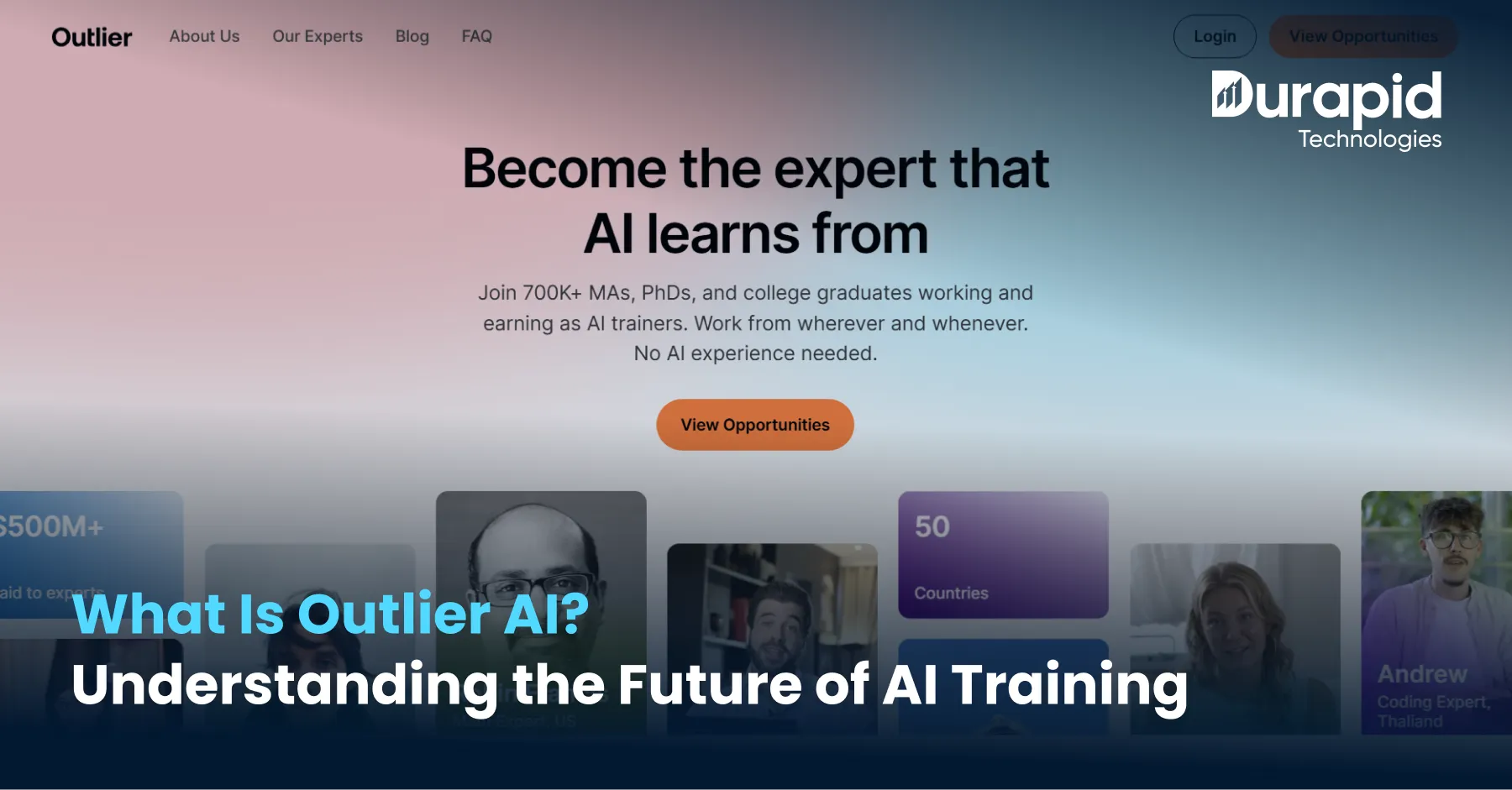
AI research now extends beyond the development of advanced intelligent systems. The focus now centers on making model training more efficient. Outlier AI provides a direct solution to this problem. The demand for precise human-guided training has grown because businesses use AI across multiple functions including AI Inventory Management, AI Marketing Agents, and AI Manufacturing applications. The effectiveness of AI systems depends on how well they process incoming data alongside human evaluations, which is exactly what Outlier AI addresses.
The Scale AI platform called Outlier AI lets organizations hire subject matter experts who work remotely to develop and assess AI systems. Instead of relying only on automated data pipelines, the system uses real human expertise from STEM professionals, coders, and writers to improve AI accuracy. In short, it operates as a marketplace where human intelligence shapes artificial intelligence. This blog explains Outlier AI, how it works, why it matters for AI training, and how it connects to applications like AI in Manufacturing and genai chatbot development services.
What Is Outlier AI and Who Owns It?
Outlier AI exists as an AI training marketplace platform which Scale AI operates. The platform enables subject matter experts from STEM fields, coding, writing, law, and medicine to connect with AI companies which require structured human feedback for their model development. The parent company Scale AI provides services to OpenAI, Meta, Microsoft, and Google. Meta made a $14 billion investment to obtain a 49% ownership stake in Scale AI during June 2025, which demonstrates the massive importance of AI training facilities. Outlier operates as the main access point for Scale AI users who need to create data annotations through its network of certified data professionals.
The platform has paid more than $100 million to over 40,000 contributors worldwide while operating in 61 different countries. So far, it has completed more than 34 million tasks. These numbers show that Outlier AI functions as an essential platform supporting businesses in the generative AI sector. In fact, its system works as core infrastructure for the entire generative AI industry.
How Does Outlier AI Work? The Core Process
Outlier AI operates in the background to support advanced AI systems which remain unknown to most people. You use ChatGPT, Meta AI, or Microsoft Copilot every day. Yet the model responds effectively only because human experts taught it what “good” looks like. That is exactly what Outlier AI does. As a result, AI companies can access expert professionals who deliver the human evaluation services needed for training their LLMs.
AI usage has increased by 270 percent during the past four years because training data quality determines the effectiveness of AI systems. Outlier AI sits at the center of that quality gap.
Specifically, Outlier AI operates through a feedback system which uses Reinforcement Learning with Human Feedback (RLHF) as its core method. This process helps LLMs create precise, well-structured outputs which meet safety requirements.
Step-by-Step: How the Workflow Runs
The workflow system functions through these specific steps:
- Sign up and verify identity – Contributors create an account, upload a resume, and complete identity verification.
- Take skill assessments – The platform assigns tasks to contributors according to their knowledge in different areas. The system creates math and coding challenges for a STEM professional. A writer receives tasks to assess language and content quality.
- Browse and accept tasks – Contributors log in to a dashboard and pick available tasks. These include writing prompts for AI, ranking AI-generated responses, editing outputs for accuracy, and flagging hallucinations.
- Submit and get reviewed – Submissions undergo quality assessment procedures before they enter the AI training pipeline.
- Earn weekly – Payments process weekly via PayPal or AirTM with a minimum payout threshold of $10.
Generally, pay rates start at $15 per hour and reach a maximum of $50 per hour based on the domain and task difficulty. Specialist roles in coding, mathematics, or legal reasoning typically command higher rates.
Key Task Types on the Outlier AI Platform
Outlier AI tasks are not generic data entry. They require domain knowledge, critical thinking, and communication skills. The platform runs four primary task categories:
| Task Type | What It Involves | Skills Required |
| Prompt Writing | Craft challenging questions for AI to answer | Subject expertise, creativity |
| Response Ranking | Compare two AI responses and rate quality | Analytical judgment, domain knowledge |
| Fact-Checking | Verify AI-generated claims against sources | Research, accuracy |
| Code Review | Evaluate AI-written code for correctness | Programming expertise |
Overall, each task type feeds into a different layer of the AI training stack. Model performance improves through prompt writing activities. Response ranking, in turn, establishes how users prefer to receive their answers. Hallucinations decrease through fact-checking. Code review then improves the accuracy of technical work. Together, these tasks enable AI systems to achieve higher intelligence levels while becoming more dependable.
Enterprises can use this model to assess AI marketing agents and implement intelligent automation solutions. Your AI tools’ performance hinges completely on the quality of the training data which powers them.
Why Outlier AI Matters for Enterprise AI Development?
Most organizations underestimate how much human feedback shapes AI quality. A model trained without curated human input produces outputs that are technically fluent but contextually wrong. That gap costs real money.
For enterprises using AI in supply chain management, customer support, or operational activities, poor model quality translates into financial loss. That is exactly why platforms like Outlier AI exist to bridge the space between technical models and operational solutions.
Consider what this looks like in practice. An AI inventory management system requires working AI predictions because an undertrained model produces incorrect predictions. These errors lead to stockouts or overstock situations that cost thousands of dollars per week. As a result, the human feedback layer becomes crucial for maintaining correct system functioning.
Outlier AI contributors teach models to:
- Recognize nuance in language and intent
- Apply domain-specific logic (legal, medical, financial)
- Avoid producing harmful, biased, or factually incorrect outputs
- Create responses which meet human requirements throughout different cultures
This is not a small concern. For example, McKinsey research shows that organizations with developed AI training processes achieve 30 percent better production model accuracy than those which depend on automatic training data alone.
When to Use Outlier AI and When Not To?
The Outlier AI system demonstrates effective performance for particular use cases. Understanding where it fits and where it does not helps organizations make smarter decisions about AI investment.
Outlier AI is the right fit when:
- You need to fine-tune a general LLM for a specific domain (legal, medical, financial)
- Your AI outputs are inconsistent and require human calibration
- Your organization needs a formal network of contributors to build RLHF pipelines
- You want various human viewpoints to reduce model bias
Outlier AI is not the right fit when:
- You need visual data for computer vision systems or autonomous vehicle research (that stays in the Remotasks domain)
- Real-time or synchronous collaboration with contributors is required
- On-premise data processing is needed due to compliance regulations
- Your project volume is too small to make the onboarding procedure worthwhile
For enterprises developing AI manufacturing solutions or implementing custom AI agents, the better approach is partnering with dedicated AI solutions providers. These partners create training pipelines that fit your specific data, domain, and compliance needs.
Outlier AI vs Traditional Data Annotation Platforms
The AI training market has several players. Below is how Outlier AI compares on core dimensions:
| Platform | Focus Area | Contributor Profile | Pay Range |
| Outlier AI | LLM training, RLHF | Domain experts, professionals | $15 to $50/hour |
| Remotasks | Computer vision, autonomous vehicles | General contributors | $5 to $15/hour |
| Appen | Multilingual data, NLP | Freelancers globally | $8 to $20/hour |
| Scale AI SEAL | AI evaluation, red-teaming | Researchers, engineers | Project-based |
What sets Outlier AI apart is the depth of its contributor base. It targets professionals with advanced degrees and domain expertise rather than general crowd workers. This quality difference is why its client list includes the world’s top AI labs.
The Role of Human Feedback in GenAI Development
AI models which generate content base their decisions on patterns found within available data. The system optimizes its output to create fluent content, but it often fails to produce accurate, ethical, or practically useful results. However, RLHF changes that by placing human judgment directly into the training loop.
Outlier AI gives businesses a practical way to run their RLHF processes at larger scales. Rather than relying on a handful of internal researchers, AI companies tap into thousands of vetted professionals who bring real-world context to model evaluation. This is how models move from technically impressive to genuinely useful.
For businesses exploring GenAI chatbot development services, this distinction matters significantly. A chatbot trained with quality human feedback performs better on domain-specific tasks and stays aligned with your brand voice and compliance requirements.
Building Better AI Starts with Better Training
Outlier AI demonstrates that every capable AI system requires a layer of human intelligence underneath it. As enterprises scale their AI adoption, understanding this layer becomes critical. Ultimately, the difference between a model that helps and one that costs you money often comes down to the quality of human feedback built into its training.
At Durapid Technologies, we help organizations design AI systems built right from the ground up with proper data strategies, structured training pipelines, and domain-specific customization. Our team of 120+ certified cloud consultants and 95+ Databricks-certified professionals brings the technical depth your project demands, whether you are deploying GenAI agents, building intelligent automation, or modernizing legacy systems with AI.
Ready to build AI that actually works in your business context? Contact Durapid Technologies to explore what a well-trained, enterprise-grade AI system looks like for your industry.
FAQs
What is Outlier AI used for?
Outlier AI is used to train and improve large language models through human feedback tasks such as writing prompts, ranking AI responses, and fact-checking outputs.
Is Outlier AI legitimate?
Yes. Outlier AI is owned by Scale AI, a company valued at over $14 billion with clients including OpenAI, Meta, and Microsoft. It holds a TrustScore of 4 out of 5 on Trustpilot based on over 2,000 reviews.
How much does Outlier AI pay?
Hourly rates range from $15 to $50 depending on the task type and domain expertise. Specialized tasks in coding, mathematics, and law tend to pay at the higher end.
What skills do you need for Outlier AI?
Contributors need expertise in a specific domain such as STEM, writing, programming, or law. Applicants must pass skill assessments before accessing tasks.
How does Outlier AI improve AI model quality?
Outlier AI contributors provide structured human feedback that feeds into reinforcement learning pipelines. This process helps models produce more accurate, relevant, and contextually appropriate outputs.

Recent Blog

Why Voice AI Is Different From Chatbots in Recruitment?
September 17, 2026-
LlamaIndex vs LangChain: Which One to Choose in 2026?
July 29, 2026