The Hidden AI Skills Gap in 2026: Why 72% of Employers Still Can’t Fill AI Roles
Hidden AI skills are becoming the biggest bottleneck in AI adoption, somehow. Companies aren’t so much fighting to buy AI. They’re more stuck on finding people who can actually use it, in a real way. By 2026, AI is everywhere, literally.
Every boardroom wants an AI strategy, and every founder wants AI features in their product. Every enterprise wants to automate workflows, upgrade decisions, and move faster. But there’s this one issue nobody really talks about enough. The tech keeps advancing faster than humans can keep up. According to some recent industry reports, nearly 72% of employers say they struggle to fill AI related positions. That’s even with record investments in artificial intelligence. And yeah the irony is hard to ignore. Companies spend millions on AI tools, cloud infrastructure, and GenAI initiatives. But many efforts just stall because the right talent never shows up. And the shortage isn’t just about machine learning engineers anymore.
Companies need people who can build AI systems, plug them into existing workflows, and evaluate outputs. They also need people who can keep AI in check responsibly, and yeah, translate actual business problems into AI opportunities. These abilities are way rarer than “just” knowing how to write a handful of prompts, or finishing some online certification.
Where the Real Hidden AI Skills Gap Shows Up
We’ve seen this up close during enterprise AI rollouts. The biggest trouble is, usually not choosing between Azure OpenAI, AWS SageMaker, or Databricks. The hard part is finding professionals who really grasp how AI behaves once it’s in production. They also need to understand how business processes have to shift around it. Then it’s about taking experimentation and turning it into measurable results. So this is where the real AI skills gap begins.
And for a lot of organizations, the priciest AI problem in 2026 won’t be the tech they don’t have. It’ll be the talent they don’t have.
What Is the AI Skills Gap?
The hidden AI skills gap sort of means that employers go after AI titles. In the real world, production know-how stays scarce. Nearly 70% of organizations say they are struggling to fill open roles in 2026. AI positions are sitting right at the center of that shortage (SHRM, 2026). IDC is projecting that more than 90% of global enterprises will run into serious skills shortages this year. That could put $5.5 trillion in productivity at risk. Durapid Technologies has already placed 300+ developers into enterprise AI work through its AI consuling services. Honestly, the pattern is pretty consistent. This AI skills gap is not about “more or less” headcount, it’s about job ready capability.
In short, the AI skills gap is the mismatch between the AI capabilities organizations actually need. It’s also about the practical production-level skills that exist in the workforce. This isn’t that people can’t identify what AI is. The issue is a lack of people who can build, deploy, and govern AI systems in day to day conditions. These come with real constraints like latency, cost, and compliance.
By the Numbers: How Big Is the AI Skills Gap in 2026?
Right now global AI talent demand seems to run ahead of supply, by about a 3.2:1 ratio. That works out to roughly 1.6 million open AI roles against something like 518,000 qualified candidates worldwide (Second Talent, 2026). In a bit of a mismatch, only 35% of leaders say they’ve readied employees effectively for these AI positions. Meanwhile 94% of CEOs and CHROs name AI as their top most urgent skill. Then again, AI job tracks tend to pay more too, showing a 67% salary premium compared with standard software roles. There’s also 38% year over year wage growth, so it’s not just a hiring puzzle, it’s a comp problem too.
What AI Skills Are Employers Actually Looking For in 2026?
Employers aren’t really hiring for AI familiarity anymore. They’re hiring for the ability to ship and keep production AI systems running. Honestly, that difference is where most candidates sort of fall apart. It’s like people can talk about AI, but can’t operationalize it in the real world, you know, end to end.
Technical AI Skills in Highest Demand
LLM development, MLOps, and AI governance are showing the sharpest gaps. The demand numbers land above 85 out of 100 while supply sits below 35. From our work building enterprise AI and ML solutions, the hardest roles to staff usually are not data scientists. Instead it’s engineers who can operationalize models: orchestration using LangChain, deployment on Azure OpenAI or AWS SageMaker. That also means ongoing monitoring for drift once a model is live.
Soft Skills and Business AI Literacy
Technical know-how alone does not close the gap. Employers are increasingly looking for AI governance literacy,meaning the ability to evaluate model outputs critically. They also want cross functional fluency between engineering and business teams. That’s one reason AI exposed roles have been evolving 66% faster than other job categories (PwC AI Jobs Barometer, 2025).
Why Are Companies Still Struggling to Hire AI Talent in 2026?
Average time to fill for AI roles has climbed to 68 days, from 42 days in 2023. Honestly, it feels like a clear signal that the demand is moving faster than the available talent pool. There are four structural issues that explain most of the slowdown, kind of like they all stack up at once.
The Salary Premium Is Pushing Past Most Budgets
AI roles come with salary levels that are 67% higher and North American averages sit near $285,000. For lots of mid-market firms that means they cannot compete for in-house, senior AI engineers, not in a straightforward way. So they pivot toward partner-led delivery models instead, even if it’s less direct.
Job Descriptions Are Written For Unicorns
We’ve seen this repeated pattern across BFSI and logistics clients. The job posting asks for five years of LLM experience, plus deep MLOps ability, plus domain knowledge in one person. In practice, the candidate pond isn’t really big enough to meet that bar, so the requisition stays open for months. The hiring team starts to feel stuck too.
The Gap Between Classroom Training and Production AI
Most university AI programs focus on model theory. They usually do not cover token limits or the cold-start latency you hit in serverless inference. They also skip how schema drift shows up inside streaming pipelines. Those are the exact issues that show up once a model leaves the demo stage. Suddenly the timeline expectations don’t match reality.
Internal upskilling programs are lagging too. Only around a third of employees say they got any kind of formal AI training within the last year. That’s even though about half of employers are reporting trouble filling AI-related roles (IDC, 2026). There are training budgets, sure, but a lot of what’s offered isn’t really mapped to day to day job tasks. So it feels a bit… academic, i guess.
Which Industries Are Hit Hardest by the AI Skills Gap?
Financial services and healthcare are dealing with the toughest shortage situation. For specialized AI roles, average time-to-fill can stretch out to something like 6 to 7 months. In regulated sectors, hiring cycles run 73% longer, because of compliance processes and clearance steps (McKinsey AI Skills Survey). Manufacturing is not far off either: estimates suggest about 2 million workers will need AI reskilling by 2026. This shows up as production lines roll into predictive maintenance and computer vision type systems.
What Does the AI Skills Gap Actually Cost Businesses?
An average 68-day time-to-fill doesn’t just slow down one hire. It can push back every AI initiative linked to that same position, sometimes by a full fiscal quarter. Organizations that have formal AI training programs, what BCG refers to as AI Leaders, end with 2.3x faster AI adoption. They also see 67% higher AI ROI compared with companies still battling talent gaps. The opposite basically holds too. When roles stay open, the effects stack up: missed deployment windows and pilots that stall. AI budgets often don’t show a measurable return either.
The 3 Types of AI Skills Gap (And Which One Your Business Has)
Not every AI skills gap looks the same, and the fix depends on what kind you are dealing with.
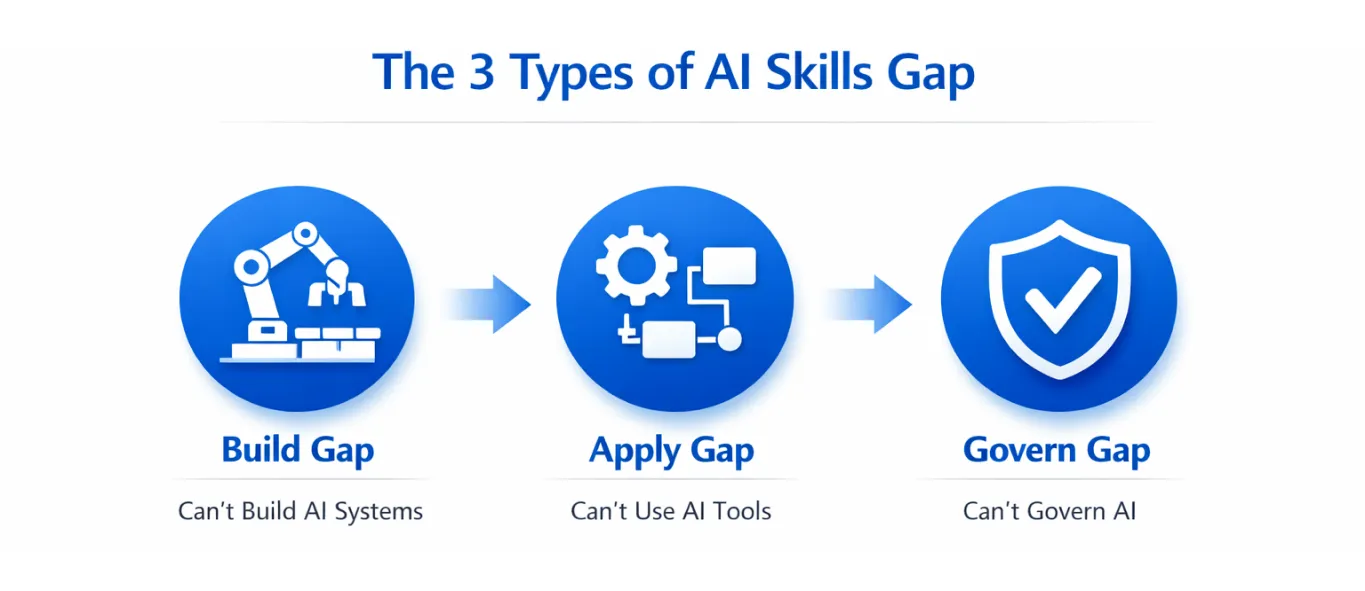
Type 1: The Build Gap
You cannot find engineers who can architect and deploy AI systems. This kinda shows up as stalled pilots that just never make it to production.
Type 2: The Apply Gap
You actually have the technology, but employees do not know how to apply it inside real workflows. You end up seeing low adoption even with high spend on tools.
Type 3: The Govern Gap
You are missing the AI governance and oversight know how to roll things out responsibly. This tends to show up as compliance risk, especially in BFSI and healthcare environments.
How Are Forward-Looking Companies Closing the AI Skills Gap?
Companies that are closing the gap fastest usually blend structured internal upskilling with external delivery partners for the build-heavy stuff. On average, the training investment lands around $12,500 per technical employee. These more structured programs can return roughly 340% ROI in about 18 months. Plus, 78% of the trained employees are still proficient a year later. Hire AI developers for the architecture-heavy work, while keeping internal teams for domain specific applications.
Should Your Business Build AI Skills In-House or Partner with an AI Company?
In-house hiring makes sense when you want long-term ownership of a very narrow AI capability. Partnering tends to win when you need production-grade delivery, faster than the 68-day hiring cycle, actually allows. Durapid’s AI consulting services are designed for this exact mismatch: 150+ Microsoft-Certified Professionals and 95+ Databricks-Certified Professionals. That team delivers without the months-long requisition cycle that most internal groups run into.
What AI Roles Are Hardest to Fill in 2026?
MLOps engineers, AI governance specialists, and full stack AI developers come out on top. That’s largely because those roles demand breadth across infrastructure, model behavior, and compliance all at once. Full stack AI developers are especially hard to source. They have to hop between React frontends, FastAPI backends, and LLM orchestration, without creating handoffs that slow everything down. That React work lines up closely with Durapid’s React.js development services.
What Will the AI Skills Landscape Look Like by 2028?
The World Economic Forum estimates around 59% of the global workforce will need retooling or upgrading by 2030. That’s roughly 120 million workers. So AI roles will likely keep fragmenting into hybrid setups that mix domain knowhow with hands-on AI capability. These won’t really show up as separate “AI engineer” titles. In other words, firms that grow internal AI literacy today will end up spending less effort later. That hard, scarce search for senior talent gets easier over time.
Closing the Gap Starts with the Right Delivery Partner
Waiting 68 days per hire really isn’t a plan. Durapid’s AI and ML solutions help enterprise teams reach production AI faster. So do our full stack AI developers, without needing that “unicorn” job posting. Reach out to Durapid for a delivery plan built around the skills you actually need.
Frequently Asked Questions
What is the AI skills gap?
It’s the misalignment between what businesses truly need from AI and what production-ready skills are actually available in today’s workforce. That gap spans build, application, and governance.
Why can’t companies fill AI roles in 2026?
Because the average time-to-fill has climbed to 68 days, job requirements are often unrealistic. Compensation also tends to run about 67% higher than standard tech roles. Also, academic training usually doesn’t touch the kinds of production AI problems you see in the real world.
What AI skills are most in demand right now?
Right now the biggest pinch points are LLM development, MLOps, and AI governance. You can see it clearly: demand scores sit above 85 out of 100 while supply is below 35.
How long does it take to hire a qualified AI developer?
For specialized AI roles in regulated industries, you’re looking at 6 to 7 months to get a hire in place. If you partner with an established delivery team like Durapid, that schedule can shorten a lot.
Is it better to upskill existing staff or hire new AI talent?
Structured upskilling tends to deliver around 340% ROI within 18 months for application level skills. But when it comes to build-heavy work, like model architecture and deployment, most teams end up needing specialized hires. A delivery partner can also do it end to end.
How much does it cost to hire an AI developer in India?
Costs shift based on seniority and the exact stack. Still, partnering with a certified delivery team is often quicker and more predictable than a solo hire. That’s especially true given the 68-day average time-to-fill. Check our guide on how to hire AI developers for the full cost breakdown.

Recent Blog

Asset Management Software for CFOs: From Depreciation to Capital Planning
September 29, 2026-
Why Voice AI Is Different From Chatbots in Recruitment?
September 17, 2026 -
LlamaIndex vs LangChain: Which One to Choose in 2026?
July 29, 2026