How Much Does It Cost to Build a Conversational AI Chatbot in 2026?
Your sales team closes their operations at 8 PM. Meanwhile, customers continue their purchasing activities without interruption. A Fortune 500 retailer lost $1.4 million through abandoned carts during a three-month period because their support team had no coverage for six hours. After the company implemented a conversational AI chatbot system within three months, cart recovery jumped 38%. Moreover, support tickets decreased by 52%. The cost of creating the project reached $85,000. Still, the first year brought a return on investment exceeding $4 million.
Every organization today needs an AI chatbot that can conduct natural conversations. But most people still don’t fully understand the real costs behind it. That’s where Chatbot Case Studies start to matter, because they show what actually goes into building, scaling, and maintaining these systems. On the surface, it all looks simple. The interface feels basic. The responses seem instant. But the moment you go deeper, things get complex, fast. Which is why before you even think about budgeting, you need to ask the right question.
Are you creating a fundamental artificial intelligence chat bot which will respond to frequently asked questions? Or does your project involve creating an advanced AI chatbot which will conduct actual dialogues, acquire knowledge from users, while enhancing its capabilities over time? The two options require your project work to proceed in different pathways. Furthermore, the cost difference between the two options will create a substantial gap between them. Most people misunderstand this part. This blog will explain the process of creating a conversational AI chatbot system including operational costs and pathways to intelligent investment choices.
What Is a Conversational AI Chatbot and What Does It Do?
A conversational AI chatbot functions as a software application which processes human language through natural language processing and machine learning and sometimes uses large language models to produce real-time human responses. Specifically, it needs to understand user intent, context, and the emotional tone of their speech. Because of this capability, the chatbot can manage multiple dialogue sessions, handle open questions, while determining appropriate times to send users to human operators.
The most advanced versions operate on platforms which include Azure OpenAI Service, Google Dialogflow CX, and Amazon Lex. According to Gartner, by 2027, chatbots will be the primary customer service channel for 25% of organizations globally. Furthermore, the difference between an artificial intelligence chat bot and a traditional chatbot is measurable. AI-powered variants resolve 65–80% of queries without human intervention, compared to just 20–30% for scripted bots. Now that you understand what a conversational AI chatbot actually does, the next step is understanding what drives its cost.
Key Factors That Affect Conversational AI Chatbot Development Cost
The price of developing a chatbot includes more than just the development phase. In fact, the price depends on your desired functionality for the system. The requirements for describing your website usage, your ai chatbot website optimization conversion goals benefits, and your AI chatbot will define your objectives. As a result, your project has progressed from developing a chatbot to creating an entire system. This system will affect how users engage with your product, how much support costs your business, along with how much revenue your business earns.
Online chat news platforms currently expect smarter conversations, which has increased the need for better tools like ca gpt and Afreechat. People no longer prefer automatic responses which robots provide. Instead, they want dialogues that create genuine human connections. Today, therefore, it is important to learn the basic differences between simple bots and advanced AI systems which function as chatbots. Cost estimation without context is guesswork. Several technical and business variables move the number significantly, so it helps to understand each one before you plan a budget.
Complexity of Conversation Flows
This is the biggest driver. A chatbot handling 10 intents costs far less than one managing 150+ intent categories with contextual memory across sessions. Each added intent requires training data, testing, plus tuning. Businesses that maintain a proper ai chatbot conversations archive can significantly reduce intent-mapping time during this phase.
Integration Requirements
Connecting your ai powered chatbot to a CRM like Salesforce, an ERP like SAP, or a ticketing system like ServiceNow adds development hours. A basic FAQ bot needs no integrations. However, an enterprise support agent might need six.
NLP Model Training
Organizations must spend between $15,000 and $40,000 for custom natural language processing model training based on their chosen dataset size. The use of OpenAI and Google off-the-shelf models decreases this expense. Nevertheless, organizations must still dedicate resources to fine-tune domain-specific language for their healthcare and finance needs.
Deployment Channels
Finally, the cost of deployment channels also plays a role in the overall cost. The web widget requires simple implementation. In contrast, the system needs to handle development and testing work for WhatsApp, Slack, Teams, SMS, and voice support which will multiply the required effort.
Once you understand these cost drivers, the next logical step is identifying which type of conversational AI chatbot your business actually needs.
Type of Conversational AI Chatbots
Different businesses require different solutions according to their needs. The market for conversational AI chatbots contains four separate levels of development, and each one comes with its own price range and performance ceiling.
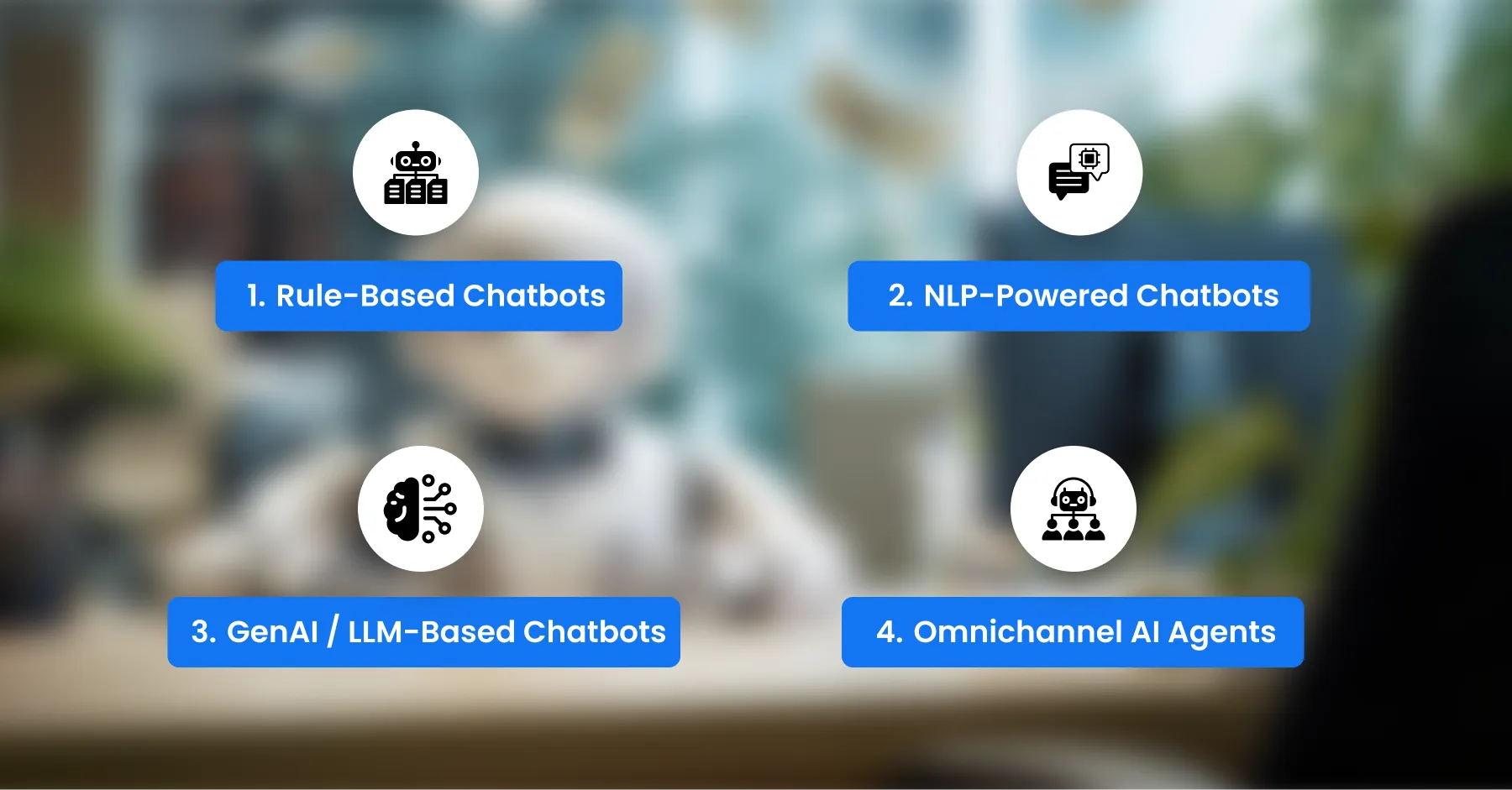
1. Rule-Based Chatbots
These follow predefined scripts. The system handles basic FAQ questions which require a development cost between $5,000 and $20,000. Because the system allows no mistakes, it demands full accuracy in all operations without allowing any deviation from its intended path.
2. NLP-Powered Chatbots
These use intent classification and entity recognition. The second layer of the system operates with tools that use Dialogflow and Rasa, and the system costs between $20,000 and $60,000. It effectively manages most support needs which mid-sized businesses use for lead qualification and scheduling.
3. GenAI / LLM-Based Chatbots
These use models like GPT-4 via Azure OpenAI or Anthropic Claude to generate responses dynamically. As a result, the system resolves unclear questions while supporting complex reasoning and expert knowledge tasks. Development costs begin at $60,000 and increase to more than $150,000 for large business implementations. Teams building AI for Fraud Detection in Finance at this tier see the most measurable ROI.
4. Omnichannel AI Agents
These function across web, mobile, voice, and messaging platforms while maintaining continuous user information. These agents represent the highest level of performance, which therefore requires the largest financial investment because their costs start at $100,000 and exceed $300,000. Banks, healthcare organizations, and major retail companies operate these systems throughout their businesses.
Choosing the right type is only one piece of the puzzle. After that, the depth of your NLP investment will determine how well your chatbot actually performs.
Natural Language Processing (NLP) Capabilities
The depth of NLP you build directly affects both performance and price.
Basic NLP handles keyword matching and simple intent detection. In contrast, advanced NLP includes entity extraction, coreference resolution, sentiment analysis, and language detection. The jump from basic to advanced adds 25–40% to development cost.
For a ca gpt-style conversational experience where users interact freely, you need transformer-based models. These require more infrastructure, more compute, as well as more ongoing model monitoring.
NLP Capability Tiers and Costs
Here’s what NLP capability tiers typically cost to implement:
| NLP Capability | Added Cost | Performance Gain |
| Intent classification only | $0 (included) | Handles 30–40% of queries |
| Entity extraction + slots | +$8,000–$15,000 | Handles 55–65% of queries |
| Sentiment analysis | +$5,000–$10,000 | Improves escalation accuracy by 40% |
| Multilingual support | +$12,000–$25,000 | Expands addressable market 2–4x |
| LLM-based generation | +$20,000–$50,000 | Handles 75–90% of queries |
Investing in multilingual NLP makes sense if more than 15% of your user base communicates in a non-primary language. Below that threshold, the ROI rarely justifies the cost. Beyond capabilities, though, there is another layer of cost that many teams underestimate: security and scalability.
Security, Compliance, and Scalability
Security is not optional when deploying a conversational AI chatbot at enterprise scale. It is also not cheap to skip and retrofit later. For regulated industries like financial services and healthcare, compliance with HIPAA, SOC 2, GDPR, or PCI DSS adds $15,000–$30,000 in development and audit costs. Specifically, this covers data encryption at rest and in transit, role-based access controls, conversation logging policies, as well as PII redaction pipelines.
Why Scalability Planning Saves Money Long-Term
Scalability planning prevents expensive rewrites. A chatbot handling 1,000 sessions per day on a monolithic architecture will break at 50,000. Consequently, Kubernetes-based auto-scaling with cloud-native deployment on Azure or AWS handles traffic spikes without manual intervention.
Teams building for global scale use Azure Bot Framework with geo-distributed deployments. This adds $10,000–$20,000 upfront but prevents $200,000+ in emergency re-architecture costs when traffic surges. With all these factors in mind, let us now look at what the actual numbers look like across different project sizes.
How Much Does a Conversational AI Chatbot Cost to Build?
The actual expenses for developing conversational AI chatbots depend on their specific engagement types according to actual project data.
Starter Package – $10,000 to $35,000
This includes FAQ support and basic NLP capabilities. The solution works best for small businesses that need internal HR chatbots and basic website support. Additionally, the project requires a duration of 4 to 8 weeks to complete.
Mid-Market Package – $40,000 to $90,000
This includes NLP capabilities and system integrations. The system enables CRM integration along with lead capture and deployment across multiple channels. As a result, the project needs between 8 to 16 weeks to complete.
Enterprise GenAI Chatbot – $90,000 to $200,000
The package provides LLM fine-tuning and compliance layers, custom dashboards, and multi-department workflows. Furthermore, the project requires a duration of 16 to 32 weeks to complete.
Ongoing Maintenance Costs
The typical annual expenses for maintenance and model retraining reach 15 to 20 percent of the total build expenses. The annual operational expenses for a $100,000 chatbot range from $15,000 to $20,000 which organizations need to spend for maintaining system accuracy and security. According to Forrester data, organizations that neglect maintenance procedures experience a 30 percent reduction in resolution accuracy within 18 months. Knowing the cost is useful. However, knowing how to reduce it without cutting corners is even more valuable.
Tips to Reduce Your Conversational AI Chatbot Development Cost
You do not need to choose between quality and budget. Instead, specific decisions consistently reduce cost without sacrificing performance.
Start With a Focused Scope
Build for your top 20 use cases first. Companies that launch a focused ai chatbot conversations archive of real customer queries as training data cut NLP tuning time by 35%. Consequently, this is one of the most underused cost-saving moves in chatbot projects.
Use Pre-Built Platforms Before Custom Builds
Azure Bot Service, Google CCAI, or Amazon Lex cover 70% of enterprise use cases out of the box. Therefore, custom NLP is only justified when off-the-shelf accuracy drops below 85%.
Leverage Cloud-Native Services
Using managed services for speech, translation, and analytics on Azure or AWS eliminates 40–60 hours of custom development per feature.
Reuse Components Across Channels
A well-architected core dialogue engine deploys to web, WhatsApp, and Teams without rebuilding logic. As a result, this alone reduces multi-channel deployment cost by 30–45%.
Run Phased Rollouts
Launching to 10% of users first catches integration failures before they affect everyone. According to internal deployment benchmarks, teams using phased rollouts spend 22% less on post-launch bug fixes. These steps will help you build smarter. However, your results will ultimately depend on the team you choose to build with.
How Durapid Technologies Helps You Build a Conversational AI Chatbot?
Durapid Technologies delivers conversational AI chatbot solutions built for enterprise-grade performance. With 120+ certified cloud consultants and 95+ Databricks-certified professionals, Durapid’s teams design, build, and deploy chatbots that connect to your existing systems from day one.
Durapid provides complete enterprise solutions which range from Gen AI Chatbot Development Services to tailored AI products for banking, healthcare, retail, and logistics industries. Moreover, our Chatbot Case Studies show measurable outcomes: 60% reduction in support costs, 3x faster query resolution, and 90%+ customer satisfaction scores across enterprise deployments. The project begins with a discovery sprint which establishes your actual AI chatbot conversations archive together with their integration points and success metrics. This prevents scope creep, the number one cause of chatbot projects exceeding budget by 40% or more.
So if your organization needs a conversational AI chatbot and requires a complete estimate with a defined ROI model, our team will evaluate your use case and create a deployment plan that matches your budget. Before you move forward, here are some of the most common questions teams ask at this stage.
Frequently Asked Questions
Q: How long does it take to build a conversational AI chatbot?
Simple bots take about 4 to 8 weeks, while enterprise GenAI chatbots with integrations usually need 16 to 32 weeks from discovery to full launch.
Q: What is the difference between an AI agent vs chatbot?
A chatbot follows predefined conversation flows, while an AI agent can take actions, call APIs, and complete multi-step tasks on its own.
Q: Can a conversational AI chatbot work for AI chatbot website optimization conversion goals benefits?
Yes, chatbots on high-intent pages can convert 3 to 5 times better than static forms by qualifying and routing leads instantly.
Q: What ongoing costs should I plan for after launch?
Plan around 15 to 20 percent of your initial build cost annually for retraining, updates, and security to keep accuracy above 85 percent.
Q: Is it better to build or buy a conversational AI chatbot platform?
Buy and configure if you have simple needs, but for complex workflows or regulated industries, a custom build on platforms like Azure or AWS works better long term.

Recent Blog

How GCCs Can Scale Engineering Teams with Staff Augmentation?
October 10, 2026-
Asset Management Software for CFOs: From Depreciation to Capital Planning
September 29, 2026 -
Why Voice AI Is Different From Chatbots in Recruitment?
September 17, 2026