How to Hire Pre-Vetted AI Developers Without the Big Agency Price Tag
Hire pre-vetted AI developers without spending months searching for the right talent. Most companies don’t really struggle to find AI talent. It’s not the “can we get someone?” part. It’s the “can we afford them” part.
When you hire a single AI developer through a big agency, you can end up paying 30% to 70% more than the developer’s real billing rate. It’s not because the person is magically better. You’re mostly funding extra layers: account managers, a sales team or two, recruitment overhead, plus agency margins. So what’s the actual problem, in plain terms? You still need serious builders who understand LLMs, AI agents, machine learning pipelines, vector databases, and production deployment. Saving money shouldn’t mean lowering the bar.
That’s why more orgs are moving toward pre-vetted AI developers via AI staff augmentation and dedicated hiring approaches. You get access to verified talent, quicker AI developer onboarding, and costs that don’t swing wildly without the heavy, enterprise-style agency fees. In this blog, we’ll unpack what “pre-vetted” means in practice, how AI developer hiring costs usually get structured, and the smarter ways to hire AI developers without agency markups eating into your budget.
What Does It Mean to Hire a Pre-Vetted AI Developer?
When companies decide to hire pre-vetted AI developers, the expectation is a structured screening process, not just a filtered resume list. Hiring through a big agency typically costs 40 to 60% more than it should. You’re mostly paying for a whole stack of extra people and processes: account management layers, recruiter commissions, and brand overhead. Most of that doesn’t translate into better work delivered. Meanwhile the AI developer talent pool is global, pretty skilled, and now more reachable outside the traditional agency model, if you know where to look and what to verify first.
A pre-vetted AI developer has already gone through structured technical screening before they ever show up to a client. This isn’t a friendly job interview. It’s a multi-layer check that tries to confirm both hard skills and actual production readiness.
In real pre-vetting you usually see four layers of evaluation: technical depth covering ML frameworks, LLM integration, and cloud platforms. Then system design, meaning can they actually architect a solution rather than just crank out code. Code quality gets checked against standards you’d expect in real production. Communication is the fourth layer, specifically whether they can operate inside a distributed team without someone hovering every day.
When a hiring partner skips even one of those layers, what they call “pre-vetted” starts looking closer to a filtered CV pile. That distinction matters a lot when you’re trying to hire pre-vetted AI developers for production work. A developer who clears a coding quiz but can’t reason through a RAG pipeline architecture will cost you time and rework across the first three sprints.
Why Big Agencies Charge So Much (And What You’re Actually Paying For)
According to Korn Ferry’s Global Talent Crunch research, the global tech talent shortfall is projected to hit 85 million workers by 2030. Big agencies lean on scarcity narratives to prop up their high margins, even when that scarcity doesn’t really apply to the Indian and Eastern European talent pools they’re pulling from anyway.
A typical large agency might bill you $120 to $180 per hour for an AI developer, while paying that developer only $25 to $45 per hour. The remaining spread covers things like a dedicated account manager who schedules syncs you didn’t ask for. There’s a bench management team whose whole job is keeping developer availability on a spreadsheet. A legal and compliance layer adds more contract complexity than you needed. Marketing and brand overhead gets subsidized through every invoice you send.
None of that improves your product. It’s mostly organizational infrastructure that exists so the agency can operate, not so it can serve your specific project.
The Hidden Cost Breakdown of Agency AI Hiring
Understanding where the money actually goes reframes the conversation, especially when you’re trying to hire pre-vetted AI developers at a cost that makes business sense. The table below compares what a typical enterprise client pays versus what reaches the developer.
| Cost Layer | Agency Model (per hour) | Staff Augmentation / Direct (per hour) |
| Developer compensation | $25–$45 | $30–$50 |
| Vetting and QA overhead | $5–$10 | $5–$8 |
| Account management | $15–$25 | $2–$4 |
| Brand and sales markup | $30–$50 | $5–$10 |
| Total billed to client | $120–$180 | $45–$75 |
The AI staff augmentation model shifts more of the budget toward the developer, with less going toward the agency’s fixed overhead. For a 3-developer AI team working together for 6 months, the spread between the two approaches usually lands between $150,000 to $250,000. That’s not a rounding error. It’s closer to a second wave of development, and you really do feel it in practice.
What Big Agencies Actually Provide vs What You Need
The agency value proposition hinges on three things: talent access, risk reduction, and speed. Each one warrants a second look, even if the pitch sounds smooth.
Talent access seems real but it’s a bit stretched. Most agencies draw from the same pools you can reach yourself: India, Eastern Europe, and Southeast Asia. The talent isn’t as exclusive as they imply.
Risk reduction is partially legit. Bigger agencies carry liability insurance, enforce NDAs, and manage local employment compliance. That stuff matters, but it’s not unique to large firms. Smaller, specialized partners often offer similar cover at a lower rate.
Speed is where the story often collapses. A well-structured AI staff augmentation partner can place a vetted AI developer in 5 to 10 business days. Many large agencies drag it to 3 to 6 weeks because of internal approvals, scheduling friction, and bench rotation delays.
What you actually need is a partner with a pre-screened developer pool, a consistent AI developer vetting process, a straightforward NDA and IP ownership setup, and the option to swap a developer quickly if the fit is wrong. None of that has to come with a $180 hourly price tag attached.
What “Pre-Vetted” Actually Means: And What to Look For
Hiring managers often just take the vendor’s word when they say “pre-vetted,” without really asking what that process involves in practice. This is the gap where bad hires slip in.
A solid AI developer vetting process has five concrete checkpoints. First, a hands-on technical skills test that checks what the person actually claims: PyTorch, TensorFlow, LangChain, Hugging Face, or cloud-native ML services depending on the role. Second, a live system design session where the candidate has to build a workable approach while time is ticking. Third, a review of code from a past project or a submitted take-home assignment. Fourth, an evaluation focused on communication and async workflow style, because shipping AI work is rarely synchronous. Fifth, a background and reference check tied to real delivery outcomes rather than vague promises.
If you’re talking to any staffing partner about how to hire pre-vetted AI developers for your team, ask them to walk through their vetting checklist step by step. If they can’t name each stage clearly, it isn’t genuine pre-vetting. It’s mostly resume filtering with a fancier label.
The 3 Hiring Models: Which One Cuts Costs Without Cutting Quality
The offshore AI developer hiring landscape breaks down into three main models. Each one carries a different cost profile, risk profile, and use case fit.
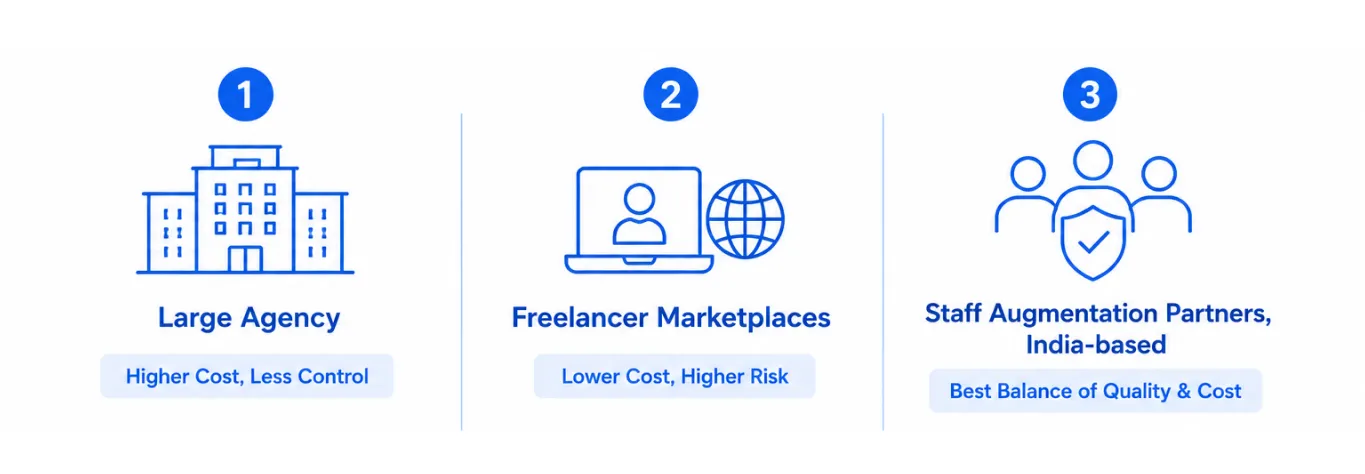
Model 1: Large Agency (Higher Cost, Less Control) Works best for regulated industries that need full contractual coverage and a liability handoff. Typical cost: $120 to $180/hour. Time to hire: 3 to 6 weeks. The risk here is that you end up paying for broader infrastructure rather than actual talent quality.
Model 2: Freelancer Marketplaces (Lower Cost, Higher Risk) Good for small, clearly bounded tasks with no production dependency. Cost: $25 to $65/hour. Time to hire: 2 to 5 days. There’s often weak accountability, inconsistent vetting, and high turnover on complex projects. More on this in the Freelancers vs. Dedicated AI Developers section below.
Model 3: Staff Augmentation Partners, India-based Best for mid-to-large AI development projects that need steady delivery, team integration, and cost efficiency that doesn’t drift. Cost: $45 to $75/hour. Time to hire: 5 to 10 business days. Risk tends to be lowest when the partner has a structured vetting process with a replacement guarantee that actually holds.
For most enterprises running a 3 to 12 month AI project, Model 3 usually delivers the best blend of quality and cost. It’s also the most practical path when you want access to pre-vetted AI talent at a rate that doesn’t blow your quarterly budget.
Staff Augmentation Partners (India-based): What Makes One Worth Hiring
India produces more than 1.5 million engineering graduates every year. The number of certified AI and cloud professionals has jumped considerably since 2022. The real question isn’t whether good talent exists in India. It’s whether the partner actually brings that talent forward in a way that’s ready for enterprise delivery.
What makes a credible India-based dedicated AI developer partner feel different from a resume farm usually comes down to three things: how deep their certifications go, how often clients stay, and how smooth the AI developer onboarding process is for new engagements. The bench size relative to active clients matters too.
Durapid Technologies has 120+ Certified Cloud Consultants, 150+ Microsoft-Certified Professionals, and 95+ Databricks-Certified Professionals. In our work on AI Agent Development Services and enterprise ML deployments across BFSI, logistics, and e-commerce, we consistently see that developers with platform certifications answer architecture questions roughly 30 to 40% faster than their non-certified peers. The reason is they’ve internalized the platform’s failure patterns rather than just knowing the shiny features.
Durapid’s positioning as a Microsoft Co-sell Partner and SAP Premium Partner also helps clients in regulated sectors get contractual compliance coverage without the extra agency overhead, which is where a lot of teams usually get stuck.
Key Skills to Look for in an AI Developer
One thing to keep in mind when you hire pre-vetted AI developers is that “vetted” means different things at different shops. Hiring without a skills framework is how companies end up with a Python engineer who builds a neat demo but cannot productionize a model. The checklist below reflects what actually splits a demo-capable developer from a production-ready one.
Core ML and AI Skills: Proficiency in PyTorch or TensorFlow. Familiarity with transformer architectures and fine-tuning workflows. Experience using LangChain or LlamaIndex for LLM orchestration. Solid understanding of RAG pipelines, vector database tooling like Pinecone or Weaviate, and embedding strategies in practice rather than just theory.
Production and Infrastructure Skills: Docker and Kubernetes for containerized deployment. Most people say they know it; fewer can get it stable. CI/CD integration using GitHub Actions or Azure DevOps. Model serving with FastAPI or Triton Inference Server. Monitoring via MLflow or Weights and Biases, so you catch failures early rather than after the fact.
Cloud Platform Skills: Azure OpenAI or AWS SageMaker for managed ML services. Databricks for large-scale feature engineering and model training. Terraform or Bicep for infrastructure as code, so environments don’t drift and break over time.
When you hire dedicated developers through a structured partner, the expectation should be that each candidate shows coverage across all three of these groups, not just one or two.
Freelancers vs. Dedicated AI Developers: Which Is Better?
Freelancers can work for a certain slice of AI labor: discrete, well-defined tasks with a clear finish line and no downstream dependency. A one-off data labeling pipeline, a proof-of-concept notebook, or a fine-tuning experiment with zero production intent and no long-term running plan.
For everything else, the dedicated AI developer model is quantifiably better. If you want to hire pre-vetted AI developers affordably without sacrificing reliability, a dedicated model via staff augmentation is the more sensible path. In our experience building AI projects for enterprise clients, freelancer-based teams hit three repeatable failure modes. Availability gaps come first: people juggling multiple clients can’t drop everything to handle your escalation at 9 PM on a Thursday launch. Context loss is the second one: when a freelancer disappears between milestones, they take institutional knowledge with them, which isn’t just annoying but costly. Accountability gaps round it out: no SLA, no replacement promise, no clean liability chain.
When you hire Generative AI Developers on a dedicated basis, the SLA structure shifts entirely. The developer is embedded in your sprint rhythm, shows up for your standups, and keeps context moving across the engagement. Replacement timing is contractually defined, so you’re not stuck playing phone tag when something breaks.
We saw this play out with a logistics client we supported. They started with a freelancer-first approach for a real-time route optimization AI feature. After two missed sprints and a developer exiting mid-engagement, they switched to a dedicated AI developer through Durapid. The same scope got delivered in 11 weeks with a steady team of two throughout. The feature processed 8 million events per day with sub-500ms inference latency on Azure OpenAI.
That result isn’t realistically on the table using a freelancer model for a production system at that scale.
When NOT to Hire Pre-Vetted AI Developers Through Any External Model
This matters more than most hiring guides will tell you. When you hire pre-vetted AI developers through offshore AI developer hiring or staff augmentation, it works extremely well in the right context. But it’s not automatically the right fit for every situation.
Don’t use this model when your AI work touches regulated data that cannot move outside your internal environment, regardless of how it’s wrapped in contracts. Don’t use it when the AI system itself is a core competitive edge that must stay inside your internal IP perimeter. Don’t use it when your internal engineering culture can’t handle async, distributed teams, because the collaboration overhead will quietly eat the cost savings like a slow leak.
In those cases, the sensible move is internal hiring, even if it looks more expensive upfront. AI staff augmentation is a delivery instrument, not a stand-in for internal capability. If internal capability is the real requirement, that’s what you need.
Frequently Asked Questions About Hiring Pre-Vetted AI Developers
How long does it take to hire a pre-vetted AI developer? With a structured staff augmentation partner, placement usually lands in 5 to 10 business days. Larger agencies tend to stretch it to 3 to 6 weeks because of internal approvals and extra process layers. The AI developer onboarding timeline is also notably faster with dedicated partners.
What is the average AI developer hiring cost in India? India-based AI staff augmentation partners commonly bill around $45 to $75 per hour for dedicated AI developers. Big US or UK agencies often run $120 to $180 per hour depending on how they structure their fees.
What’s the difference between a pre-vetted AI developer and a regular hire? When you hire pre-vetted AI developers, the candidate has already passed structured technical screening covering ML frameworks, system design, code review, and communication fit before being shown to the client. A regular hire only goes through employer-side screening.
Can a freelance AI developer handle enterprise-grade production work? Rarely. Freelancers generally don’t carry an SLA or a replacement guarantee, and project context can get shaky between engagements. For production AI systems processing millions of events, a dedicated developer approach is noticeably more reliable.
What AI developer skills matter most for LLM-based projects? LangChain or LlamaIndex for orchestration is a big one. Solid RAG pipeline design with vector databases, FastAPI for serving, and Azure OpenAI or AWS SageMaker for managed inference round out the core stack. Platform certifications on Azure or Databricks often correlate with faster delivery and fewer back-and-forth cycles.
Build Your AI Team Without the Agency Markup
The talent is out there. The question is whether you reach it through a model that serves your project or one that serves the intermediary’s margin.
Durapid Technologies helps companies hire pre-vetted AI developers without agency fees slowing things down. We place full stack AI developers into enterprise AI, GenAI, and cloud engineering projects with a structured 5-stage vetting process and a replacement guarantee. Microsoft Co-sell and SAP Premium Partner backing also covers regulated industry compliance.
If you’re planning an AI project and want to review pre-vetted AI talent profiles within 48 hours, reach out to Durapid for a no-obligation team match.

Recent Blog

Why Voice AI Is Different From Chatbots in Recruitment?
September 17, 2026-
LlamaIndex vs LangChain: Which One to Choose in 2026?
July 29, 2026