AI Staffing vs Traditional IT Staffing: What’s Changed in 2026
IT staffing has not vanished. It just isn’t enough for AI products anymore. Two years ago, companies were grabbing Java developers, QA engineers, and cloud architects. Now? They’re hunting for AI engineers who can build RAG pipelines, fine-tune LLMs, deploy agents, and ship production-ready AI products. Same hiring dance, sure, but completely different talent. So that’s where classic IT staffing starts to feel kind of outdated, like, suddenly the playbook doesn’t fit.
Most staffing firms were built around predictable software projects. With AI, things don’t behave like that. An AI product needs people who understand models, prompts, vector databases, cloud infrastructure, and how to actually roll out to production without breaking everything. Finding one of those specialists is already a pain. Finding an entire AI team through a traditional staffing model is even more difficult, almost annoyingly so.
That’s why AI staffing has become one of the biggest hiring shifts of 2026. Companies that hire full stack AI developers want more than resumes. They want verified AI expertise, faster onboarding, and engineers who can contribute from day one. No long runway. No slow ramp-up.
What Is AI Staffing and How Is It Different from Traditional IT Staffing?
IT staffing has kind of split into two separate disciplines now. One is built for AI. The other is not really. The gap feels way wider since 2024. Gartner points out that AI talent scarcity is now the top barrier to enterprise AI adoption. It beats both budget constraints and infrastructure gaps, which is kind of wild. Still, most companies send their AI hiring requests through the same traditional IT staffing agencies built for software engineers. Not for ML engineers or LLM deployment specialists. This mismatch keeps costing teams months of lost time, along with a chunk of hiring budget too.
AI staffing is really the specialized recruitment and placement of professionals who build, deploy, and maintain artificial intelligence and machine learning systems. That typically includes ML engineers, data scientists, LLM fine-tuning specialists, MLOps engineers, and AI product managers. Full-stack AI developers who can move across the whole model-to-production pipeline also fall under this category.
Traditional IT staffing, on the other hand, was originally designed for placing software developers, network engineers, QA analysts, and IT support professionals. The skill assessment systems, the recruiter knowledge bases, and the talent pipelines at many IT staffing agencies are still built around those roles. Not around someone who can tune a transformer model on Azure OpenAI, then deploy it through a FastAPI backend with LangChain orchestration.
The distinction matters because AI roles need a different evaluation standard, like entirely. A senior ML engineer who cannot explain the trade-offs between fine-tuning and RAG-based retrieval in a real production setting isn’t ready for enterprise AI work. That’s true even if their resume sounds impressive. Traditional recruiters usually don’t have a framework for that kind of conversation. So the process stalls somewhere in the middle, and nobody notices until later.
What Has Actually Changed Between 2024 and 2026 in IT Staffing?
Two years ago, most enterprises were still stuck in the AI pilot phase. Talent demand was kind of concentrated in that narrow strip of research-oriented roles. The hiring cycle felt slower. Projects were smaller. Honestly, traditional IT staffing agencies could still get away with slotting general data engineers or Python developers into AI-adjacent positions.
From Pilots to Production at Scale
That whole thing changed quite a lot in 2025, then really accelerated into 2026. Enterprise AI moved from experimentation to production at scale. McKinsey’s 2025 State of AI report noted that 78% of organizations now deploy AI in at least one business function. That’s up from 55% in 2023. With that shift, the need became for a different kind of practitioner. Not just someone who handles model deployment or inference optimization. Someone comfortable across vector databases, production-grade MLOps pipelines, and the full stack, not just data analysis or API integration.
At the same time, the talent supply tightened up. Universities haven’t fully closed the gap yet between ML research graduates and production AI practitioners. So you end up with a market where the strongest AI talent has multiple offers within days. Meanwhile, traditional IT staffing agency timelines of 6 to 12 weeks for placement are structurally incompatible with that speed, and it shows fast.
AI Staffing vs Traditional IT Staffing: A Full Side-by-Side Comparison
The table below compares how these two models perform across the criteria that matter most to engineering and technology leaders in 2026. Before you review, just note one context point: these differences aren’t about effort or quality of service. It’s more like a structural mismatch between what traditional IT staffing firms were built for and what AI hiring actually needs.
| Criteria | AI Staffing | Traditional IT Staffing |
| Skill assessment | Technical vetters with ML/LLM production experience | Resume screening, general coding tests |
| Time to placement | 1 to 3 weeks | 6 to 12 weeks |
| Talent pipeline | Pre-vetted offshore + nearshore AI specialists | General software engineering pool |
| Role coverage | ML engineers, MLOps, LLM specialists, AI product managers | Developers, QA, network, support |
| Contract flexibility | Project-based, staff aug, dedicated team | Typically permanent or long-term contract |
| Offshore AI capability | Structured pipelines in India, Eastern Europe | Limited or nonexistent for AI roles |
| Agency fee model | Often team-based or monthly retainer | 20 to 30% of annual salary per placement |
The Cost Gap That Adds Up Fast
The cost and speed gaps are where most enterprise teams feel the first kind of pain. A 25% agency fee on a $180,000 AI engineer salary ends up being $45,000 per placement. If three hires don’t work out within 90 days, you’re looking at $135,000 in fees with no usable product afterward.
Why Traditional IT Staffing Is Struggling with AI Roles Specifically
Traditional Recruiters Can’t Assess AI/ML Skills
Technical screening for AI roles means looking for someone who actually gets the difference between a model that looks good on a benchmark and one that holds up under real production inference load. In our experience doing AI staffing for enterprise customers across BFSI, logistics, and healthcare, one gap keeps showing up. Candidates can get a notebook demo working but have never run token budget optimization, cold-start latency tuning, or hallucination mitigation in a live setting.
Traditional agency recruiters aren’t set up to catch that gap. They tend to lean on keyword matching and generic coding assessments that don’t surface whether someone is production-ready for AI.
The 20 to 30% Agency Fee Doesn’t Work for AI Role Budgets
Senior ML engineers and LLM deployment specialists earn somewhere in the $150,000 to $220,000 range in the US market by 2026. Run that with a 25% placement fee and one hire ends up costing about $37,500 to $55,000 just in agency fees. For companies trying to build AI teams of 5 to 10 people, this approach quickly becomes unsustainable. AI staff augmentation models built around team structures or dedicated developer pools cut down the per-head acquisition cost quite a lot.
Traditional IT Staffing Services Have No Offshore AI Talent Pipeline
Offshore staffing for traditional software roles is already pretty mature. IT staffing services have set up long-running pipelines in India, Eastern Europe, and Latin America for Java devs, QA engineers, front-end developers, and similar roles. Offshore AI talent pipelines are a completely different kind of infrastructure. You need relationships with institutions that actually produce ML practitioners. Plus a vetting process tuned to real AI role requirements, and delivery management experience that fits distributed AI teams.
Most traditional agencies simply do not have that setup. Durapid’s network of 300+ skilled developers includes dedicated AI and ML practitioners across offshore and nearshore locations. We source vetted candidates at a fraction of the timeline traditional agencies quote. If you’re also looking to hire dedicated developers for longer-term AI builds, having that offshore pipeline already in place makes a real difference.
Speed Mismatch: AI Projects Can’t Wait 6 to 12 Weeks
Enterprise AI initiatives run on tight schedules. A real production rollout for a fraud detection model or a document intelligence pipeline isn’t some neat 6-month waterfall project. If the team is stuck with no MLOps engineer in place, or they can’t get a fine-tuning specialist fast enough, the impact goes well beyond the hiring delay. It’s every single week that deployment slips, times the business value the model should have started producing by now.
That’s also why top IT staffing agencies operating under the traditional model don’t quite fit the tempo. Their candidate sourcing, vetting, and compliance processes suit slower, longer-horizon placements, not this kind of urgency.
How AI Staffing Actually Works?
AI staffing starts with a technical intake that most traditional agencies wave over. Before any sourcing begins, the staffing partner needs to understand your target stack. That means Azure OpenAI vs AWS SageMaker vs open-source tooling, and where the system actually has to run. The deployment environment matters too. Are we talking containerized setups on Kubernetes, serverless, or something at the edge? Then there’s model type, like fine-tuned LLM work, a RAG pipeline, or classical ML. What gaps the team already has, skills-wise and process-wise, matters just as much.
Vetting That Actually Fits AI Roles
After that, sourcing comes from pre-vetted talent pools where candidates have already passed technical assessments tuned to those exact requirements. The checks are not generic. The vetting for an LLM deployment role tends to probe prompt engineering and LangChain or similar orchestration frameworks. It also covers vector database integration using Pinecone, Weaviate, or FAISS, and inference optimization patterns that a normal coding screen usually won’t touch.
Choosing the Right Engagement Model
Placement then lands in one of three paths. There’s direct hire for permanent roles, staff augmentation for short-term project needs, or a dedicated developer team model. That last option is a fully managed group of AI practitioners that plugs into the client’s existing engineering org. Choosing between them comes down to timing and budget. It also depends on whether the AI capability needs to stay in-house long-term or get delivered as a project outcome.
Understanding the AI development cost 2026 picture early helps teams pick the right engagement model before committing to a staffing approach.
The 5 Biggest IT Staffing Trends Reshaping 2026
The IT staffing market isn’t really going in just one direction. A few competing forces are quietly, but also pretty rapidly, changing how companies source AI talent this year.
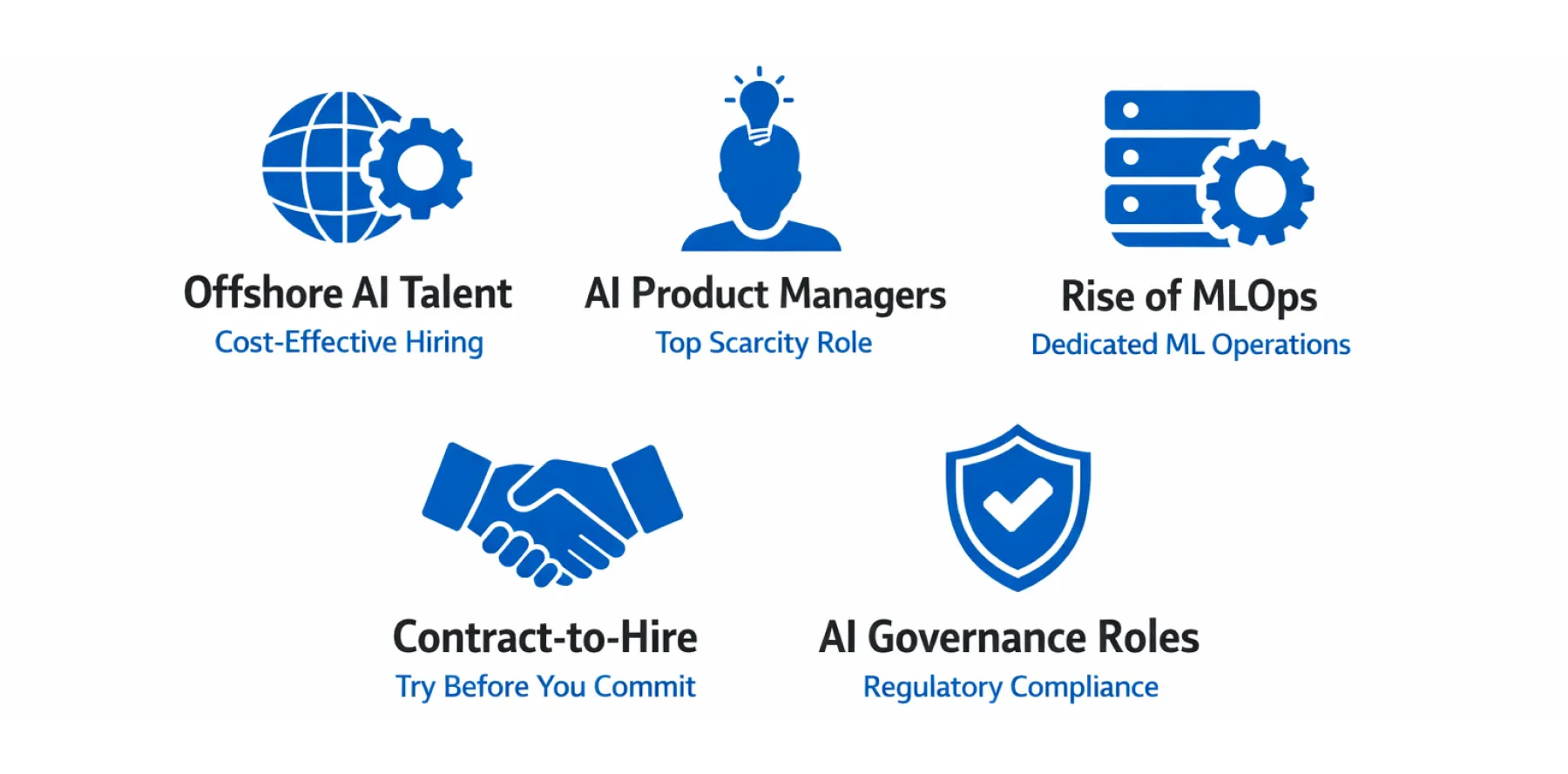
Offshore AI staffing is turning into the main cost model for mid-market firms. Hiring a senior ML engineer in India with Databricks certification and two years of production LLM experience can run roughly 40 to 55% less than a comparable US-based hire. The quality gap in technically rigorous roles is smaller than most people expect.
AI product managers are becoming the hardest role to land across basically all IT staffing services. It’s difficult to find someone who can wrap their head around model evaluation, prompt engineering trade-offs, and product delivery all at once. A real scarcity issue.
MLOps is getting treated as its own separate discipline now. It’s starting to show up as a dedicated staffing category inside top IT staffing agencies in the USA. Companies that bundled MLOps duties into general DevOps roles are reworking those jobs into more focused functions.
Contract-to-hire is moving past permanent placement and becoming the preferred route for AI roles. Companies want around 90 days of production evidence before they commit to long-term compensation packages. That’s why contract IT staffing services are seeing a surge in demand for AI-specific engagements.
AI governance roles are now showing up as a staffing category. As regulatory frameworks keep tightening across the EU and US, demand for AI ethics, compliance, and auditability expertise is accelerating noticeably.
How Much Does AI Staffing Cost vs Traditional IT Staffing in 2026?
The cost comparison depends on role seniority, engagement model, and whether offshore talent is in the mix.
For a US-based senior ML engineer, the traditional agency placement runs about $37,500 to $55,000 in fees. Add 6 to 12 weeks of lost productivity while searching. An AI staffing approach with offshore capabilities can get an equivalent-level candidate onboard in 2 to 3 weeks. The team-based retainer typically runs 40 to 60% less per placement.
For a five-person AI team, the total cost gap between conventional IT staffing and a structured AI staffing arrangement can go beyond $150,000 in year one. That’s once you factor in placement fees, time-to-productivity breakpoints, and failed replacement cycles. This is why the AI development cost 2026 context matters. Staffing is a major part of total spend on AI initiatives. The staffing model you pick has a compounding effect on the overall project economics.
How Durapid Goes About AI Staffing a Bit Differently
Durapid’s AI staff augmentation model is built using the same technical foundation we run for our own AI and ML solutions projects. Our 95+ Databricks Certified professionals and 150+ Microsoft Certified professionals aren’t just badges on a page. They are the vetting benchmark we apply when matching practitioners to clients.
In a recent engagement, a mid-sized financial services firm needed three ML engineers and an MLOps lead. The goal was to stand up a real-time credit risk pipeline on Azure Databricks. Traditional IT staffing agencies were quoting 10 to 14 weeks for sourcing. Durapid put in a four-person team in 18 days, all with verified Databricks and Azure ML experience. The pipeline went live in week 11 of the project, about three weeks ahead of the original timeline.
This is possible because our AI and ML solutions delivery work gives us continuous access to practitioners. People who have already solved these issues in production. We are not rummaging through a generic talent database. We are working inside a community we have built and vetted over years through enterprise AI delivery work.
Not sure whether to hire full-stack AI developers or build smaller specialist squads? Our AI consulting services team helps map the right structure before sourcing even starts.
When NOT to Use AI Staffing
AI staffing isn’t the right model in every case, honestly.
If your project leans toward general software engineering, cloud infrastructure, or front-end development with no AI-specific pieces, traditional IT staffing or freelance platforms will usually get you moving faster. At lower cost too. AI staffing specialists target a very particular talent profile. Using them for regular roles creates a lot of extra, and frankly pointless, overhead.
If your organization still doesn’t have the internal backbone to support an AI practitioner, bringing in a specialist too early creates friction for everyone. That means no ML platform, no real data pipeline, no clear deployment target. In those situations, an AI development services engagement to build the infrastructure first tends to make more sense than staffing.
And if your timeline is truly flexible and your internal recruiter has real technical AI screening capability, building the team in-house over 6 to 9 months is a workable option. AI staffing earns its premium mainly when you need speed, a solid technical fit, and offshore cost optimization all at the same time.
Frequently Asked Questions
What is the difference between AI staffing and traditional IT staffing?
AI staffing is a niche recruitment lane for ML engineers, LLM specialists, and MLOps roles, using technical vetting tuned to what production AI actually needs. Traditional IT staffing usually covers broader hiring for software engineering and IT support, using keyword checks with standard coding screens.
How long does AI staffing take compared to traditional IT staffing?
When you use an AI staffing partner that handles offshore delivery, candidates often get placed in about 1 to 3 weeks. Traditional IT staffing agencies average closer to 6 to 12 weeks, especially for senior technical roles.
What does AI staffing cost in 2026?
Most team-based AI staffing retainers tend to land around 40 to 60% less than traditional placement fees. Traditional placement fees typically run 20 to 30% of annual salary for the same kind of role, especially where the process includes offshore talent pipelines.
More Questions About AI Staffing
Which IT staffing model works better for healthcare AI projects?
For healthcare IT work, AI staffing is typically the better fit, particularly when you need ML, NLP, or clinical data pipeline know-how. Traditional IT staffing agencies sometimes cover the general IT side, but they rarely provide people who combine healthcare domain depth with real production AI experience.
Can offshore AI talent match onshore quality for enterprise projects?
In very technical roles like MLOps, LLM fine-tuning, and Databricks engineering, offshore practitioners from established AI talent markets often hold the same certifications as onshore people. Production experience tends to match too. It comes in at about 40 to 55% lower cost, so quality can stay close even when the budget is different.
What are the top IT staffing agencies in the USA for AI roles?
The top IT staffing agencies in the USA for AI have built dedicated ML and LLM talent pipelines. They use production-level technical vetting and can source offshore AI practitioners at speed. Generic software staffing firms, even well-known ones, rarely meet those criteria for specialized AI hiring.
The IT staffing market has permanently bifurcated. Enterprises that route AI hiring through traditional IT staffing agencies in 2026 are accepting slower timelines and higher costs. Lower technical fit comes with that too, as a kind of default condition. That is a choice, not an inevitability.
If you’re building an AI team or scaling what you already have, Durapid’s staffing team can place vetted AI practitioners in days, not months. Reach out to talk about your current hiring requirements.

Recent Blog

Why Voice AI Is Different From Chatbots in Recruitment?
September 17, 2026-
LlamaIndex vs LangChain: Which One to Choose in 2026?
July 29, 2026