AI/ML Developer vs Gen AI Developer: Key Differences Explained
AI used to feel like one giant bucket where every developer building “AI stuff” somehow did the same thing, or at least it seemed that way. Then generative AI happened, and suddenly businesses started hearing five new job titles every week. AI engineer vs ML engineer, Generative AI developer. LLM engineer, Machine learning developer. AI architect. Everybody sounds important, and honestly, everybody kind of is. But the real difference between an AI/ML developer and a generative AI developer is way bigger than most people expect, maybe even larger.
One side is usually focused on prediction systems, recommendation engines, fraud detection models, forecasting pipelines, and structured machine learning workflows. The other is building AI products that generate content, reason over documents, power copilots, automate conversations, and live inside large language model workflows in production. Different tools. Different architectures. The developer instincts required are pretty different too.
That’s exactly why companies trying to hire generative AI developers in 2026 are approaching hiring a little differently now. Businesses aren’t just searching for “someone who knows AI” anymore. They want developers who understand the precise layer of AI their product actually depends on, whether that’s traditional ML infrastructure, LLM application development, or full generative AI systems. This shift is happening fast, really fast. This guide sorts it all out, pretty clearly, without making it feel too chaotic.
What is an AI/ML Developer?
Job postings asking for generative AI engineer skills grew nearly 7x between 2022 and 2024, according to Lightcast workforce data. Yet companies still use terms like “AI/ML developer” and “Gen AI developer” interchangeably, even though the roles are built for completely different outcomes. One may build predictive systems while another handles LLM-powered generation workflows. That confusion quietly delays projects, stretches budgets, plus pushes teams into painful rebuilds later. Which is exactly why future-ready engineering teams are becoming far more intentional about who they hire for modern AI products.
A machine learning developer designs, trains, then deploys ML models that pull patterns from structured data so they can make predictions or decisions. Their day to day covers the full lifecycle you’d expect: data preprocessing, feature engineering, model selection, training, evaluation, then production deployment.
These folks usually live inside classical ML frameworks. They take on tasks such as demand forecasting, fraud detection, recommendation engines, predictive maintenance, and customer churn prediction. The “end product” is typically a statistical model that classifies, regresses, clusters, or flags anomalies from datasets that already exist.
What is a Generative AI Developer?
A generative AI developer builds systems that produce new content, text, code, images, audio, or structured data, by leaning on foundation models like GPT-4, Claude, Gemini, Llama, or Stable Diffusion. In practice, their day to day work covers prompt crafting, fine tuning, retrieval augmented generation (RAG), and setting up agentic pipeline architecture, sort of orchestrating how everything flows together.
The role sits nearer to application engineering than pure research. This developer takes already-trained large language models (LLMs) or multimodal models, then tunes them for particular enterprise needs and workflows. Analytics Vidhya research cited by Kore1 puts generative AI specialists at an average annual salary of $174,727 in the US. Top performers go past $300,000. That gap shows, in a real way, how quickly demand has outrun supply.
AI/ML Developer vs Gen AI Developer: A Side-by-Side Comparison
Both roles need strong Python skills along with a solid grasp of statistical basics. The ai engineer vs ml engineer split is clearest at the model layer, and it compounds through every next decision, whether it’s obvious or not.
| Dimension | AI/ML Developer | Gen AI Developer |
| Primary output | Predictive/classification model | Content generation system or AI agent |
| Core model types | Decision trees, XGBoost, CNNs, LSTMs | LLMs, diffusion models, multimodal models |
| Training approach | Train from scratch on domain data | Fine-tune or prompt-engineer foundation models |
| Evaluation metrics | AUC-ROC, RMSE, F1-score | BLEU, ROUGE, human eval, hallucination rate |
| Primary frameworks | Scikit-learn, TensorFlow, PyTorch | LangChain, LlamaIndex, Hugging Face, FastAPI |
| Deployment target | REST API, batch inference, edge device | RAG pipeline, agent orchestrator, chat interface |
| Data requirement | Large labeled dataset required | Pre-trained model; domain data for fine-tuning |
The table above reflects the main differences in daily workflow. An ML developer can spend about three weeks on feature engineering before touching a model. A gen AI developer might spend three weeks doing prompt iteration, RAG indexing, then latency optimization. The order shifts, the tools shift, and so does the whole mental model.
Key Skills Required for Each Role
The overlapping foundation is Python, statistics, and basic cloud infrastructure. Beyond that, the gen ai developer skills and ML developer skills diverge sharply.
AI/ML Developer Core Skills
- Feature engineering and data transformation pipelines
- Model training with scikit-learn, TensorFlow, or PyTorch
- MLOps: model versioning, CI/CD for ML, drift detection with tools like MLflow or Azure ML
- SQL and big data processing with Apache Spark or Databricks
- Statistical modeling: regression, classification, clustering, time-series analysis
Generative AI Developer Core Skills (Gen AI Developer Skills That Matter Most)
- Prompt engineering and chain-of-thought design
- RAG architecture: vector databases (Pinecone, Weaviate), embedding models, retrieval pipelines
- LLM fine-tuning: LoRA, QLoRA, RLHF, instruction tuning on Hugging Face
- Agentic frameworks: LangChain, LangGraph, AutoGen, CrewAI
- Output evaluation: hallucination scoring, factual grounding, latency benchmarking
According to Burtch Works’ AI and Data Science Compensation Report, NLP and LLM prompt engineering pay runs 10 to 20% higher than median machine learning roles. That premium reflects the shortage of engineers who truly understand how foundation models behave once they’re under production load.
Tools & Technologies: What Each Developer Actually Works With
The toolchain difference is where role confusion gets most visible inside real job postings.
The AI/ML Developer Stack
For an AI/ML developer, the usual stack is Python, scikit-learn, PyTorch or TensorFlow, Apache Spark, Databricks, MLflow, Docker, Kubernetes, Azure ML or AWS SageMaker, Apache Airflow, with SQL sitting on something like Snowflake or BigQuery.
The Gen AI Developer Stack
For a Gen AI developer, the stack centers on LangChain or LlamaIndex, the OpenAI or Azure OpenAI API, Hugging Face Transformers, vector databases such as Pinecone or Qdrant, FastAPI for serving, Weights & Biases for experiment tracking, with CrewAI or AutoGen handling multi-agent orchestration.
The gen ai developer skills around RAG, orchestration, and LLM evaluation have no real equivalent on the ML side. Both approaches overlap on cloud setup and containerization, so at first glance they don’t look totally different. After that, the ML developer is mostly tuning a training pipeline while the gen AI developer is managing context windows, retrieval precision, and token costs. Durapid’s AI and ML solutions teams work across both stacks, with 95+ Databricks-certified specialists handling ML infrastructure alongside dedicated Gen AI engineers managing LLM deployment on Azure OpenAI.
Job Roles & Day-to-Day Responsibilities
What does each developer actually do on a Tuesday afternoon, like real life, not some glossy job post?
A Day in the Life: AI/ML Developer
An AI/ML developer spends their day pulling features out of a feature store, then retraining a churn model after concept drift alerts fire in MLflow. Later they check precision-recall curves, squinting at thresholds, then push a validated model artifact into Azure ML so it can run A/B testing against the current production version.
A Day in the Life: Generative AI Developer
The Gen AI developer on the other team is usually stuck debugging a RAG pipeline that keeps pulling weirdly irrelevant document chunks, and it’s not always obvious why. They tweak chunk overlap, adjust embedding model parameters, then run evaluation sets to get faithfulness scores, trying to make sure answers are actually grounded. The end goal is often speed, so they optimize inference latency from 4.2 seconds down to under 1.8 seconds for a customer-facing chatbot.
These are not interchangeable days. The ai engineer vs ml engineer distinction plays out differently in practice than it reads in a job description. Treating them like they are the same is the whole reason so many AI hiring efforts go off track.
Salary & Market Demand for AI/ML vs Gen AI Developers in 2026
The AI developer salary 2026 gap between these roles has widened considerably since 2023. Understanding AI developer salary 2026 benchmarks helps when you hire AI developer talent at the right budget level.
| Role | US Average Salary (2026) | India Average Salary (2026) |
| AI/ML Engineer (mid-level) | $147,524 | ₹18–32 LPA |
| Generative AI Engineer (mid-level) | $174,727 | ₹25–45 LPA |
| Senior Gen AI Engineer | $250,000–$310,000 | ₹50–80 LPA |
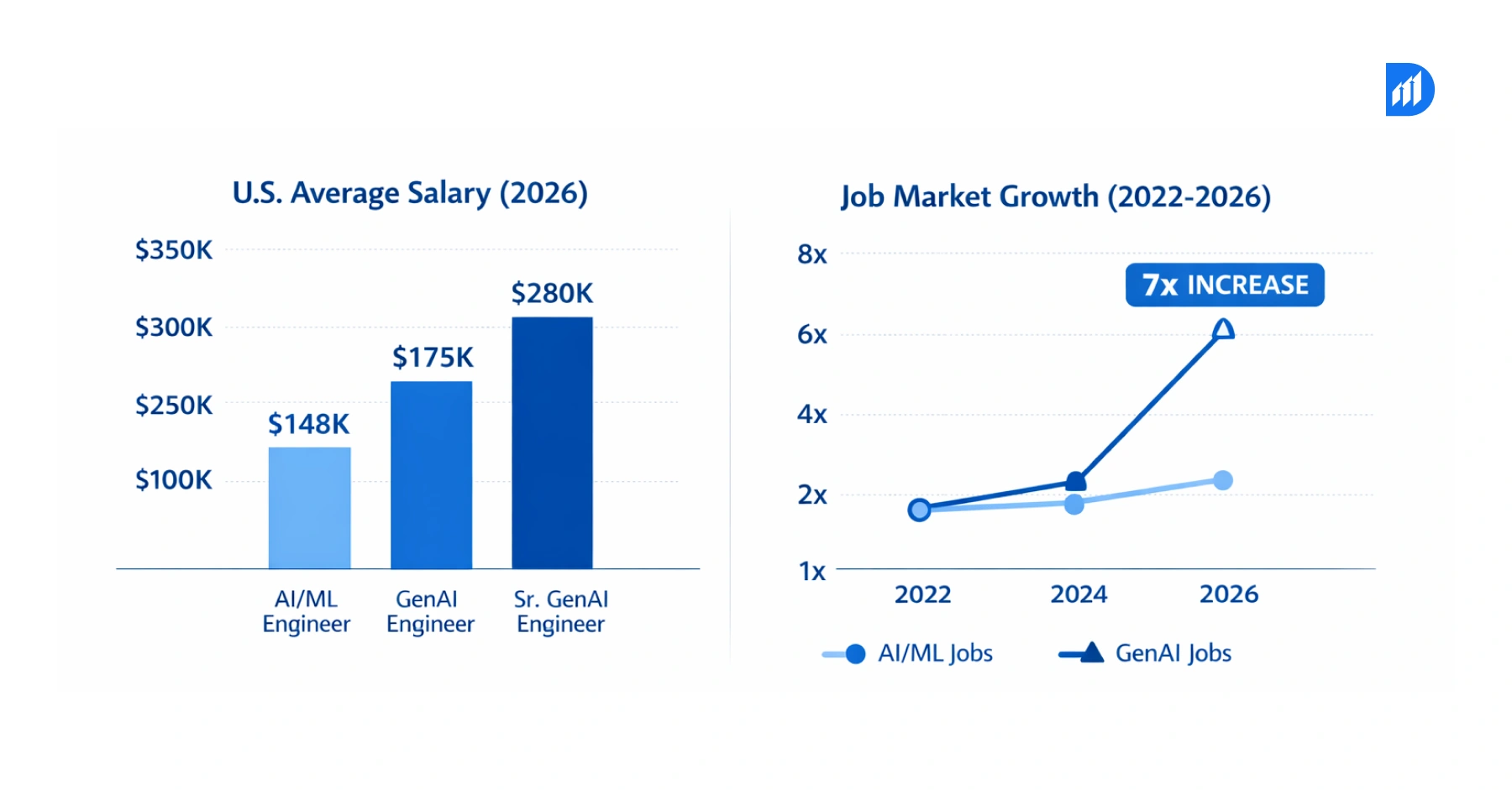
The demand signal is unambiguous. Generative AI engineer job postings went up 7x between 2022 and 2024, while general ML engineer demand stays pretty steady, only it isn’t ramping at the same rate. LinkedIn picked AI engineer as the top role on its 2026 “Jobs on the Rise” list, with AI literacy now the most requested capability worldwide. The 7% year over year US salary bump for AI roles from 2025 to 2026 shows up across both categories. Generative AI specialists still get a noticeable premium because the know-how needed to handle foundation model deployments reliably in production is still hard to find.
When Should You Hire an AI/ML Developer vs a Gen AI Developer?
Hire an AI/ML Developer When:
- Your problem requires a predictive outcome from structured historical data
- You need fraud detection, demand forecasting, anomaly detection, or recommendation logic
- Your team owns labeled training data and needs a model trained on it
- Your deployment involves edge devices, embedded systems, or real-time scoring APIs
Hire a Generative AI Developer When:
- You need to build a document Q&A system, AI assistant, or code generation tool
- Your workflow requires summarization, classification of unstructured text, or content generation
- You are integrating an LLM into an existing product or business process
- Your team wants to use Azure OpenAI, GPT-4, or Llama without training a model from scratch
If you are unsure which profile fits your project, Durapid’s AI consulting services team runs structured scoping sessions to map your business problem to the right technical profile before you decide to hire an AI developer. This matters whether you plan to hire an AI developer in-house or bring in a specialist team. The decision to hire AI developer talent should follow the problem, not the market trend.
When NOT to Use Either Role
Not every business problem needs a full time AI developer. If your main need is nicer dashboards, a data engineer or BI developer will give you roughly 80% of the value at about 30% of the cost. Automating a rule-based workflow with zero real pattern recognition? Go with an RPA engineer, not an ML or Gen AI developer.
One common failure mode at enterprises is painful to watch: hiring a generative AI developer to build a chatbot while the actual bottleneck is a broken internal search index. That’s a $180,000 engineer spending six months routing around an Elasticsearch misconfiguration.
Also, if your labeled dataset has under 10,000 examples and the situation involves tricky language understanding, a traditional ML model will pretty consistently fall short compared to a fine-tuned foundation model. Don’t force the wrong tool onto the right situation. Check the AI development cost implications before you lock in a hiring profile.
Can One Developer Do Both? The Rise of Hybrid AI Roles
Some engineers genuinely bridge both sides. They get how MLOps pipelines work, can train a custom model when it’s needed, and they also know how to put together a RAG workflow using LangChain and evaluate it the right way. These hybrid profiles are showing up more and more as organizations move from pilot mode into real production.
When a Hybrid Hire Actually Makes Sense
A few conditions make a hybrid hire actually workable:
- Your team is small (under 5 engineers) and you need wider coverage rather than deep specialization
- Your work involves both structured prediction and unstructured text generation inside the same product
- You’re building an AI platform that ties together classic ML models with LLM-based components
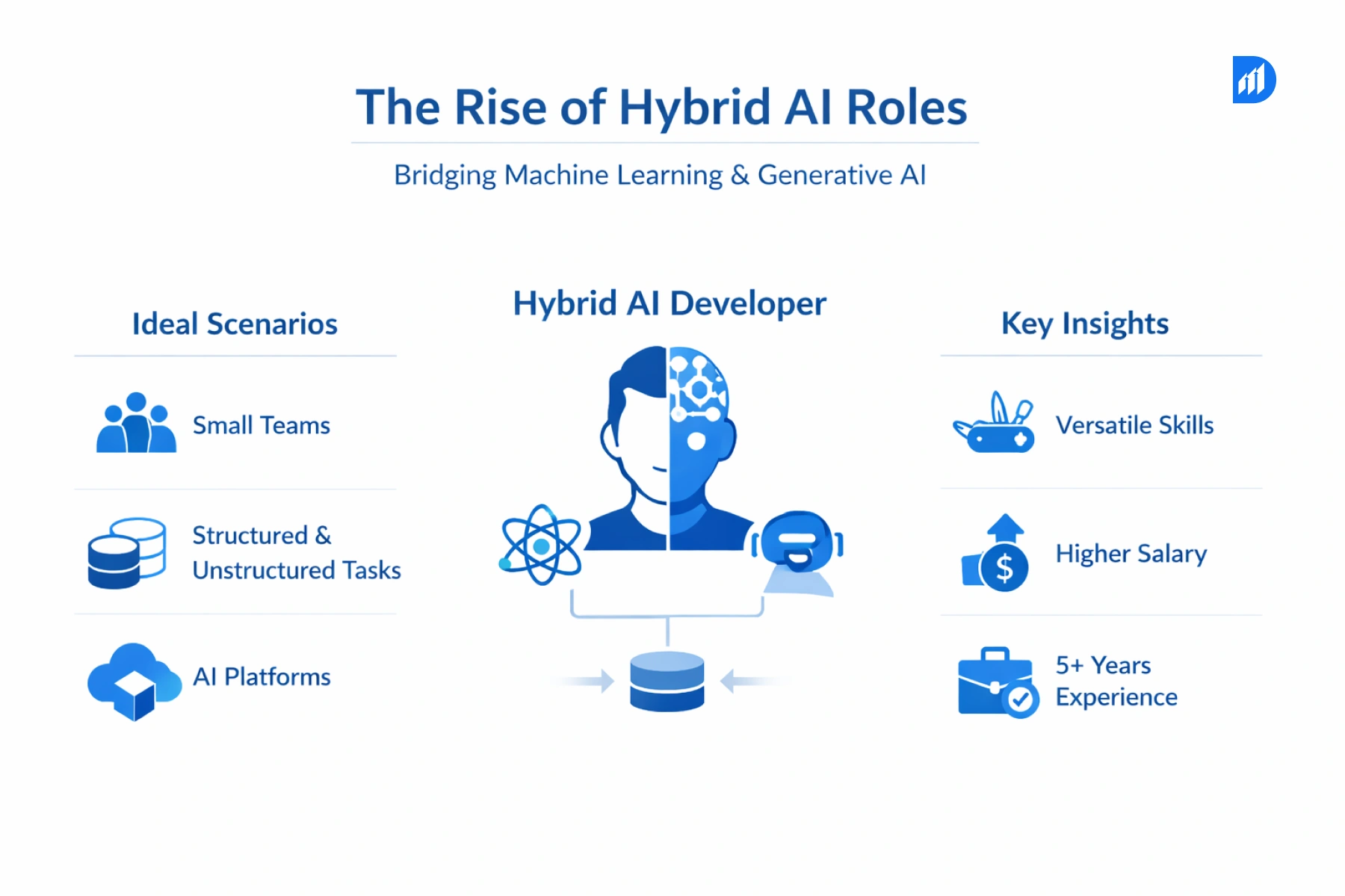
Hybrid profiles usually come with a premium. Plan on paying around 15 to 25% above the regular generative AI developer rates. They’re also harder to assess because the interview loop needs to span two different technical domains. Durapid’s teams building future-ready engineering groups suggest treating hybrid roles as a senior-level appointment, with a minimum of five years of combined experience across both ML and Gen AI work.
How to Choose the Right AI Developer for Your Business?
The problem comes first, not the job title. Write down the business outcome you need: reduce fraud by X%, generate product descriptions at scale, predict equipment failure 48 hours in advance, or build a document assistant for your legal team. Each of those maps pretty cleanly to a developer profile, and that’s what should guide the decision to hire AI developer talent.
Setting the Right Starting Point Based on Your Data
Then take a look at what data you already have. If you’ve got structured, labeled historical data, a machine learning developer is usually the right starting point. If your assets are mostly documents, emails, tickets, or free-text logs, a gen AI developer tends to get you results faster.
After that, check your production needs. ML models running in real-time scoring pipelines generally require mature MLOps. Gen AI systems deployed inside customer-facing products need reliability engineering focused on hallucination rates, latency SLAs, and content safety guardrails. Different operational skills, not just different tools.
When you’re ready to hire generative AI developers, hire an AI developer for ML work, or staff a full team, Durapid’s 300+ skilled developers along with 120+ certified cloud consultants across Azure and AWS help enterprises move from problem statement to production deployment. Explore Durapid’s AI and ML solutions to see how these roles slot into a broader delivery model.
Frequently Asked Questions
What is the difference between an AI/ML developer and a Gen AI developer?
An AI/ML developer mainly works on prediction systems trained using structured data, things like recommendation engines or forecasting models. A generative AI developer works more with LLMs, AI assistants, RAG systems, and content generation workflows.
Which role is more in demand in 2026, AI/ML developer or Gen AI developer?
Both roles are growing fast, though generative AI hiring is accelerating much faster right now because of enterprise LLM adoption. AI/ML engineers still stay heavily relevant across core enterprise infrastructure and predictive systems.
What programming languages do Gen AI developers use?
Python is still the main language across most Gen AI stacks, especially with tools like LangChain, Hugging Face, and FastAPI. TypeScript is also becoming common for AI apps running on Node.js environments.
Can an AI/ML developer transition into generative AI?
Yes, and many developers are already making that move. The shift usually involves learning prompt engineering, RAG architecture, orchestration frameworks, and how production-grade LLM systems actually behave under load.
What does a Generative AI developer actually build?
A generative AI developer builds AI assistants, document Q&A tools, enterprise search systems, automated reporting workflows, and content generation platforms. Most of the role revolves around connecting LLMs to real business use cases.
How much does it cost to hire a Gen AI developer vs an AI/ML developer?
Gen AI developers generally cost more right now because production-ready talent is still limited. Salary ranges vary by region, though this role usually commands a premium over traditional ML roles. Check Durapid’s AI development cost guide for a full breakdown. AI developer salary 2026 data shows Gen AI consistently costs more, so budget accordingly before you hire an AI developer in either category.
Do I need both an AI/ML developer and a Gen AI developer for my project?
Not always. If your product mainly depends on prediction systems, an AI/ML developer is usually enough. If it relies on LLMs, AI assistants, or generation workflows, a generative AI developer makes more sense.
What is the role of LLMs in Gen AI development?
LLMs act as the reasoning engine behind most Gen AI applications. This developer configures, fine-tunes, prompts, and connects these models to production workflows using APIs, RAG pipelines, and orchestration systems. Read more in Durapid’s LLM vs Generative AI breakdown.
Ready to staff the right AI team for your project? Durapid’s certified AI and cloud engineering teams help enterprises scope, hire, then deploy AI solutions across ML with Gen AI. Contact Durapid to start with a structured scoping session.

Recent Blog

How Voice AI Connects Calls With Sales Operations
October 15, 2026-
How GCCs Can Scale Engineering Teams with Staff Augmentation?
October 10, 2026 -
Asset Management Software for CFOs: From Depreciation to Capital Planning
September 29, 2026 -
Why Voice AI Is Different From Chatbots in Recruitment?
September 17, 2026