What Is Enterprise AI and How Are Businesses Using It in 2026?
Enterprise AI isn’t coming. It’s already kind of decided who goes first and who gets left behind, like without asking. A few years ago, AI was more like something companies did on the side, you know try it here, a chatbot there, a recommendation engine over here. Now though it’s starting to act like the operating system of modern enterprises, not just an “extra feature”.
And per McKinsey, almost 8 in 10 organizations are now using AI in at least one business function. So the whole talk has shifted from “Should we invest in AI?” to more like “How fast can we expand this?” But, here’s the part many businesses still mess up a bit. Getting an AI tool isn’t the same thing as building an AI-powered enterprise. The organizations that actually see measurable returns aren’t merely dropping a ChatGPT style assistant into their daily work. They’re linking AI with their ERP systems, CRMs, supply chains, data lakes, customer support platforms, along with the real decision-making routines. That connection is what separates just using AI from doing enterprise AI.
From spotting equipment problems before they happen, to catching fraud in milliseconds, to routing thousands of support tickets automatically, enterprise artificial intelligence is quietly reshaping how businesses run at scale. Giving executives faster choices through real-time insights is part of that too. In this guide, we’ll sort out what enterprise AI really means, how it differs from consumer AI, and which technologies are making it possible. We also cover enterprise data services, use cases, implementation, the usual challenges, and the trends likely to shape enterprise AI in 2026.
What Is Enterprise AI?
Enterprise AI turns raw data into competitive decisions at machine speed. In 2026, it is no longer optional or a “nice to have” kind of thing. Global spending on enterprise artificial intelligence hit $301 billion in 2026, up from $223 billion the year before (IDC’s Worldwide AI Spending Guide). Still, only 6% of organizations manage to become true AI high performers, as McKinsey points out. So the gap is not just ambition. It is mostly the architecture, data readiness, plus execution decisions that turn a demo into a production system.
Enterprise AI is basically the weaving together of machine learning, natural language processing, and computer vision into large scale business operations. The goal is to automate processes, raise decision quality, and pull usable value from messy or complicated data. And unlike consumer AI tools, enterprise artificial intelligence is built for scale. It has to deal with millions of transactions, plug into older legacy systems, and stay aligned with data governance frameworks. Producing consistent outputs across distributed teams is part of that baseline too. A chatbot answering customer questions at 11 PM is more consumer AI. A fraud detection system that scans 40 million daily payment events in under 200 milliseconds is enterprise AI.
From our work on enterprise AI deployments across BFSI, logistics, and manufacturing clients, a pattern keeps showing up. Most implementations that underdeliver were basically designed like consumer tools, then pushed into enterprise environments without the right supporting data infrastructure.
What Are the Benefits of Enterprise AI?
The business case for enterprise AI is getting increasingly real, like really concrete. McKinsey’s 2025 State of AI survey says organizations deploying AI into operations are seeing around a 23% average cost reduction. Meanwhile companies that put AI to work in marketing report a 39% revenue lift, plus a 37% cut in campaign expenses.
The most obvious advantage we notice across enterprise software development engagements is decision latency compression. That basically means shrinking the time between “we know” and “we act.” For example a retail client had weekly demand forecasting cycles, but after a Databricks based ML pipeline it became hourly refresh. They then brought overstock write-offs down by 31% within two quarters.
Two other measurable outcomes also show up pretty consistently. IT teams using AI report 31% fewer critical incidents and 28% faster mean time to resolution. Machine learning models trained on three to five years of operational data tend to outperform older statistical forecasting by about 15 to 40%. That holds across most industry verticals.
Tools and Technologies Used in Enterprise AI
Enterprise AI software stacks vary by use case, but the core architecture is consistent across mature deployments. Choosing the right enterprise AI software starts with understanding these technology layers and their primary functions. The table below maps them out.
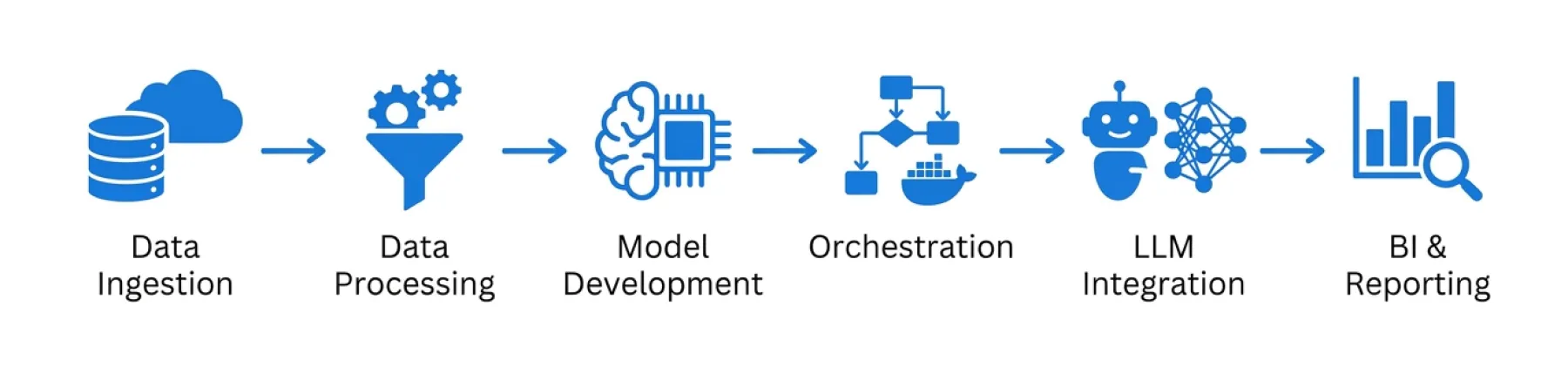
| Layer | Technologies | Primary Function |
| Data Ingestion | Apache Kafka, Azure Event Hubs | Real-time and batch data collection |
| Data Processing | Databricks, Apache Spark, Snowflake | Transformation, enrichment, feature engineering |
| Model Development | Azure ML, AWS SageMaker, PyTorch | Training, versioning, evaluation |
| Orchestration | Apache Airflow, Kubernetes, Docker | Pipeline scheduling and containerized deployment |
| LLM Integration | LangChain, FastAPI, Azure OpenAI | Agentic workflows and GenAI application layers |
| BI and Reporting | Power BI, Tableau | Business-layer visibility and decision support |
Platform selection usually gets nudged by what cloud infrastructure is already in place and how much data is coming in. The exact AI capability we’re trying to ship plays a role too. For a financial services company already on Azure, the move to rebuild machine learning infrastructure on AWS SageMaker rarely pays off unless there is a clear performance reason. In practice, most of our enterprise AI work starts with a platform audit before any single model is trained.
Gartner also expects that 40% of enterprise applications will have integrated task-focused AI agents by the end of 2026. That’s a jump from fewer than 5% in 2025. Nvidia AI Enterprise is among the more commonly deployed platforms helping make this shift easier, especially for GPU-accelerated model inference at scale. For organizations evaluating enterprise AI solutions that need to run GPU workloads at volume, Nvidia AI Enterprise is worth looking at seriously.
Key Components of Implementing Enterprise AI
Most enterprise AI failures are not model failures. More like, they are infrastructure and process failures that show up before a model is even trained. People tend to miss that part. In our AI consulting services practice, organizations keep throwing a lot of money at model selection, while kind of underfunding the foundations that make a model actually production-ready.
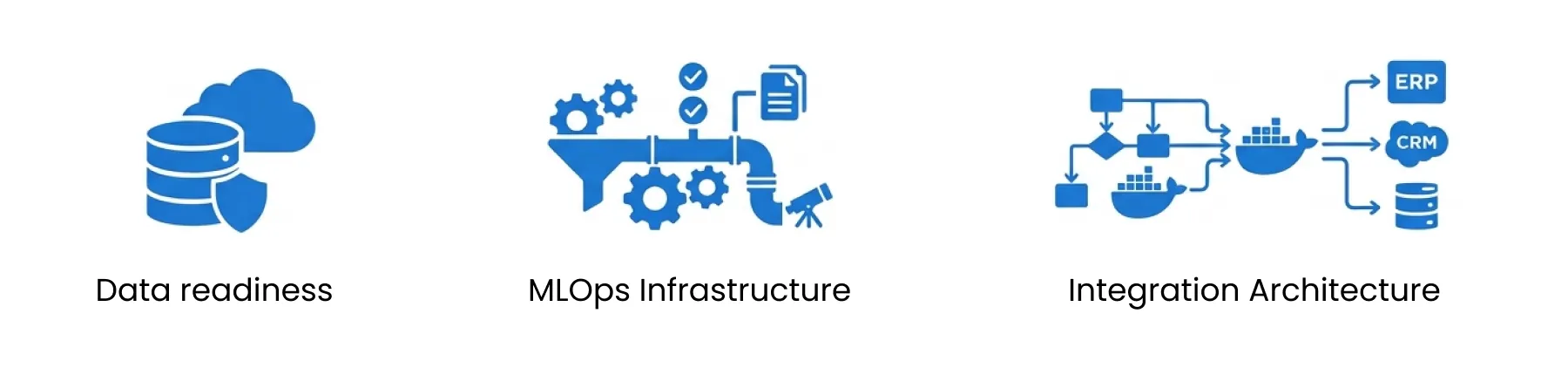
Data readiness. AI systems are only as accurate as the data they consume. When data is incomplete, inconsistent, or stuck in silos, it creates systematic model errors that compound at scale. A data governance framework before model development is the real prerequisite, not some later add-on.
MLOps infrastructure. Training a model is not the same as deploying one. MLOps pipelines manage automated testing, versioning, deployment, and drift monitoring. Organizations with mature MLOps practices typically deploy models 5 times faster, with 90% fewer post-deployment issues.
Integration architecture. Enterprise AI has to connect with existing ERP, CRM, and operational systems. If Enterprise Application Integration is weak, you get data lag, manual handoffs, and security gaps. Those gaps quietly undermine basically every downstream AI output, even if the model itself looks fine.
Governance, Compliance, and Delivery
Governance and compliance. The EU AI Act took effect in 2025. 42% of global enterprises have adjusted their AI practices to comply. Meanwhile $2.1 billion in regulatory fines tied to AI misuse were issued worldwide in 2025, a seven-fold jump from 2023.
Durapid’s enterprise AI implementations are delivered by 150+ Microsoft-Certified Professionals and 95+ Databricks-Certified Professionals, backed by Microsoft Co-sell Partner status. Across 90+ enterprise AI projects, data infrastructure maturity is the most consistent indicator of success, not model cleverness or sophistication.
Enterprise AI Use Cases by Industry
Enterprise artificial intelligence is not just one thing. It is more like a set of tools that get used in slightly different ways depending on the data environment and what decision is being automated. How much risk the domain can actually tolerate matters a lot too.
Financial services. Fraud detection models catch anomalies in under 200 milliseconds on real time transaction streams. Mastercard’s AI powered system raised detection accuracy by an average of 20%, reaching up to 300% improvement in high-risk segments. AI driven loan processing has also compressed approval timelines from days to something like under 60 seconds.
Healthcare. Diagnostic imaging AI cuts per scan review time by about 40 to 60% once running in real hospital settings. Predictive readmission models spot patients at risk roughly 72 hours before discharge so clinicians can act earlier, instead of reacting late.
Manufacturing. Predictive maintenance approaches estimate equipment failure odds 10 to 14 days before a breakdown. One automotive client we supported saw unplanned downtime decline by 34% within six months after deployment.
Logistics. Route optimisation combined with shipment prediction boosts on-time delivery rates by around 15 to 22% for big fleet operators. Power BI services then translate those model outputs into operational dashboards for logistics teams and executive leadership.
What Are the Challenges Associated with Enterprise AI?
The enterprise AI failure rate is pretty well-documented, sure. You’ll see numbers like 70 to 85% of AI projects not making it all the way to full production. The why behind it is honestly more useful than just repeating the count. Most enterprise AI solutions that stall out share the same underlying causes.
Most times, data quality is the culprit. No clever model architecture can really “save” a wrecked data foundation, the kind where the inputs are incomplete or inconsistent. When an AI agent works with siloed or partial data, it basically borrows all those flaws right along with the context. Then there’s talent scarcity, which makes execution risk kind of snowball. In 2025, IT consulting engagements centered on AI strategy grew 89% year over year. Still, most enterprises can’t staff ML engineering and data architecture teams fast enough, at least not at the pace the business wants.
After that, model drift is the sneaky part, it goes unnoticed without MLOps. Models degrade when the real-world data distribution changes, which happens constantly. Without automated drift monitoring, a model that starts out at 94% accuracy at launch can slide down to 71% six months later. Nobody catches it in time. Finally, security exposure keeps climbing. 76% of enterprises say data privacy and security are their top AI risk, per Gartner. 34% have already had an AI related security incident, including data leakage through LLM prompts and similar interactions.
When NOT to Use Enterprise AI?
Enterprise AI is not really the right fit for every operational challenge, and honestly some setups just don’t work well. Avoid deploying enterprise AI solutions when your data volume is too small, like fewer than 10,000 labeled samples for a classification task. You can’t train a model with much confidence on that. Don’t use it when the decision you want to automate includes unreviewed regulatory or ethical risk, say credit scoring, hiring, or medical diagnosis. Also skip it when what’s actually broken is a process problem rather than a data problem, because automating a dysfunctional workflow produces that faster dysfunction. Avoid it when the ROI window goes past three years without intermediate milestones. Investments without visible checkpoints at 6 and 12 months tend to get sidelined during budget cycles.
What’s Ahead in 2026 for Enterprise AI?
The shift from AI as a mere productivity helper to AI as an autonomous business operator is already kinda underway. 61% of CEOs worldwide are actively getting ready to roll out AI agents at scale. McKinsey estimates that AI-powered agents could bring in around $2.9 trillion in US economic value each year by 2030. The enterprise AI failure rate for agentic projects is still elevated, with Gartner expecting over 40% of them to be canceled by 2027, so execution discipline matters more than ever.
Agentic AI is probably the biggest architectural change happening right now. These systems plan, then execute multi-step workflows, pulling in humans only when truly needed. In early deployments, especially in logistics and financial operations, teams are already seeing process cycle times drop by about 60 to 70%. That’s compared to workflows that rely on humans alone.
Still, only 1% of organizations say their AI strategy is “mature,” according to McKinsey. The companies that close that gap through data infrastructure upgrades, improved MLOps maturity, and solid governance frameworks will be pretty structurally hard to outcompete. That window is roughly the next 18 months. The question in 2026 is not really “should we invest in enterprise artificial intelligence.” It’s more like whether the infrastructure underneath that investment is actually prepared to handle it.
Frequently Asked Questions
What is enterprise AI?
It’s the use of machine learning, NLP, and computer vision at production scale within large organizations, to automate tasks and improve decisions. It differs from consumer AI mostly in integration complexity, stricter governance rules, and operating scale.
What are enterprise AI tools?
The core enterprise AI software stack usually includes Azure OpenAI and AWS SageMaker for model building, Apache Kafka for streaming ingestion, Databricks and Snowflake for processing, LangChain for LLM orchestration, and Power BI for the business reporting layer. Nvidia AI Enterprise is commonly used where GPU-accelerated inference is a priority.
How is Enterprise AI different from traditional AI solutions?
Enterprise AI runs continuously at production speed, connects to live data systems, and operates under compliance and audit frameworks. Traditional AI solutions are often standalone, with less built-in governance and less system integration.
What are the main benefits of Enterprise AI?
Many organizations report about 23% average cost reduction in operations, around 39% revenue increases in AI driven marketing, and figures up to 5.8x ROI within 14 months after production deployment, according to McKinsey and Deloitte benchmarks.
What should companies consider before adopting Enterprise AI?
Data quality and governance readiness come first. Evaluate existing data infrastructure, clarify the integration needs, put an MLOps framework in place, and make sure regulatory compliance obligations are mapped out before model development starts.
Build Enterprise AI That Actually Reaches Production
Most enterprise AI efforts stop at the demo, kind of mid way, and then everyone scrambles. Durapid builds the data infrastructure, ML pipelines, and integration architecture that helps enterprise AI move from pilot to full production, not just a slick proof of concept.
With 95+ Databricks-Certified Professionals and 150+ Microsoft-Certified Professionals, our teams have shipped 90+ enterprise AI projects across BFSI, logistics, healthcare, and manufacturing. Reach out to our AI team so you can see what production-ready implementation should look like for your environment.

Recent Blog

Asset Management Software for CFOs: From Depreciation to Capital Planning
September 29, 2026-
Why Voice AI Is Different From Chatbots in Recruitment?
September 17, 2026 -
LlamaIndex vs LangChain: Which One to Choose in 2026?
July 29, 2026