What Is DeepFleet AI? The Complete Guide to Next-Gen Fleet Automation
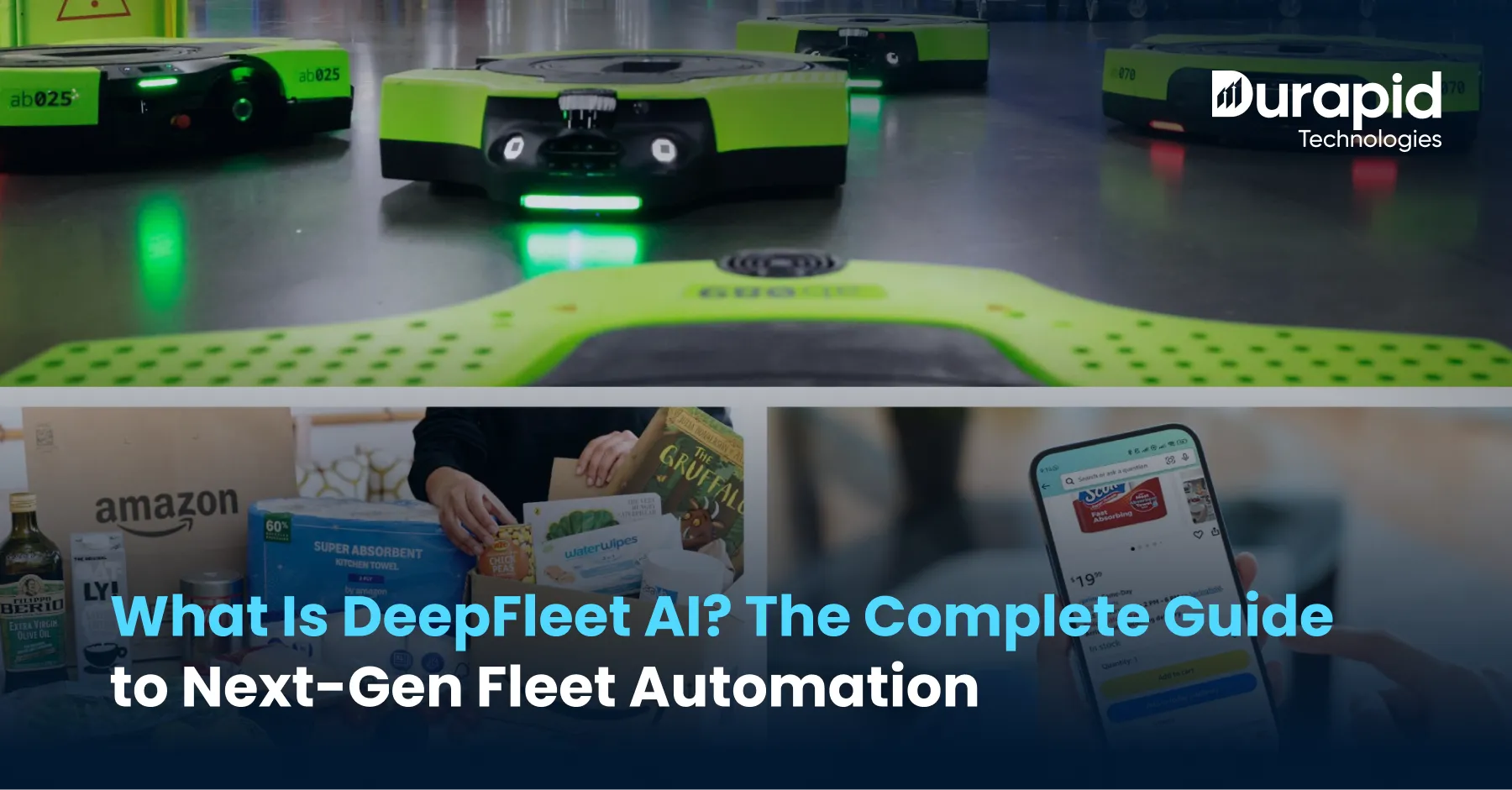
DeepFleet AI delivers 10% fleet travel efficiency gains across one million robots. This is what AI management systems look like at scale.
Amazon proved this in July 2025 when it deployed DeepFleet AI across 300+ global fulfillment facilities. The result was not incremental. It was a measurable, enterprise-scale shift in how autonomous fleets coordinate movement in real time. For organizations investing in Enterprise Fixed Asset Management, that outcome highlights a broader transformation in how physical assets, equipment, and autonomous systems are managed across large-scale operations. For logistics leaders still running rule-based fleet software, that outcome signals one thing: the coordination gap between traditional systems and AI-driven fleet automation is widening fast.
What Is DeepFleet AI and Why Does It Matter Now?
DeepFleet AI is a suite of generative AI foundation models designed to manage the synchronized movement of large-scale mobile robot fleets in real time.
Unlike traditional fleet management software that follows fixed routing rules, DeepFleet predicts upcoming robot positions and detects congestion before it fully forms. It then dynamically assigns tasks so conflicts never materialize in the first place. Amazon built and trained these models on billions of hours of operational data from hundreds of thousands of warehouse robots worldwide, running entirely on AWS infrastructure with Amazon SageMaker handling the training pipeline.
This matters now because the global fleet management market stood at $27 billion in 2025 and, per Global Market Insights, is projected to reach $122.3 billion by 2035. Enterprises that deploy AI management systems early are already separating from competitors on the cost metrics that show up in CFO reviews.
How DeepFleet AI Works: Four Model Architectures Explained
DeepFleet uses four distinct transformer-based architectures. Each addresses multi-robot coordination from a different angle. Together they cover nearly the full design space for multi-agent foundation models at warehouse scale.
Robot-Centric (RC) Model The RC model focuses on one robot at a time. It ingests the states of the 30 nearest robots, 100 nearest grid cells, and 100 nearest objects, then predicts that robot’s next actions sequentially. With 97 million parameters, the RC model produces the lowest position and state prediction errors among all four architectures.
Robot-Floor (RF) Model The RF model uses cross-attention between individual robots and the global warehouse floor map. It learns how a single robot’s movement choices relate to the broader floor layout, something the RC model’s local view cannot fully capture.
Image-Floor (IF) Model The IF model applies convolutional encoding to a multi-channel image of the entire active fleet. It treats fleet-wide spatial patterns the way a computer vision model processes a photograph, capturing density distributions and movement paths across the whole facility simultaneously.
Graph-Floor (GF) Model The GF model combines time-based attention with graph neural networks. It encodes how robots relate to each other as graph edges, then learns how movement propagates through the fleet network across time, not just within a single moment. In our experience working on high-density logistics deployments, this model adds the most value in zones where robot paths overlap frequently.
Each model runs inside a shared training framework that processes fleet movement data, including robot positions, goals, and interaction histories, at scale. At deployment, the models handle task assignment and route planning simultaneously, steering robots away from potential congestion zones before those zones can form.
Key Features: What Makes DeepFleet AI Different From Traditional Systems
Traditional fleet management platforms operate on deterministic rules. If Robot A occupies Zone 3, send Robot B to Zone 7. DeepFleet replaces that rigid path with pattern-based prediction, asking instead: given the current fleet state, what will happen over the next N steps, and how should each robot act to prevent inefficiency?
This distinction becomes critical at scale. A rule-based system managing 1,000 robots produces 1,000 separate decision threads. DeepFleet treats the fleet as one dynamic system, where every robot’s movement influences every other robot’s optimal route. This system-wide intelligence reflects the next evolution of AI in Asset Management, where assets are no longer managed as isolated units but as interconnected components of a continuously optimizing operational network. Three capabilities set DeepFleet apart from conventional AI management platforms:
Predictive Congestion Avoidance: The model forecasts traffic bottlenecks multiple steps ahead, then reroutes robots before congestion forms. Traditional systems react after the bottleneck already exists. The difference in throughput impact compounds over thousands of daily cycles.
Foundation Model Adaptability: Because DeepFleet is built on a foundation model architecture, it generalizes across different warehouse floor layouts and handles varied robot types, including Amazon’s Hercules, Pegasus, and Proteus units, without requiring separate rule sets for each configuration.
Asynchronous State Processing: The RC model processes robots as they update their own states, rather than waiting for one synchronized global snapshot. This approach cuts latency and scales cleanly to fleets of one million units or beyond.
The Financial ROI: How DeepFleet AI Cuts Operational Costs
A 10% travel efficiency lift is not a vague performance metric. At enterprise scale, it translates directly into financial outcomes.
Consider a facility processing 500,000 units per day. A 10% reduction in robot travel time tightens cycle durations, reduces energy consumption per unit, and increases throughput without additional hardware investment. Amazon directly attributes swifter delivery timelines and lower fulfillment costs to DeepFleet’s deployment.
The broader AI fleet adoption data reinforces this. Early AI fleet adopters report approximately 45% fewer equipment breakdowns and roughly 25% lower maintenance costs compared to non-AI peers (FleetRabbit, 2026). Fleets deploying full AI safety solutions have reported crash rate reductions of 73% over 30 months (Samsara, 2025). Each prevented accident saves an average of $148,000 when accounting for injury impact, legal exposure, and operational downtime, based on FMCSA data.
The 2025 Penske Transportation Leaders Survey found that 40% of AI-adopting fleet operators reported at least 50% improvements in fuel savings and route efficiency. Route optimization reduces fuel burn. Lower fuel burn reduces cost per delivery. Lower cost per delivery expands margin on every shipment. The gains compound once they start moving.
For organizations running large warehouse or logistics operations, the question is no longer whether AI management systems deliver ROI. It is whether deployment can happen before competitors close the efficiency gap.
DeepFleet AI vs. Traditional Fleet Management Systems
The comparison below covers the dimensions that matter most in enterprise operations. Traditional systems perform reliably for small, predictable fleets. DeepFleet is built for environments where those systems break down.
| Capability | Traditional Fleet Systems | DeepFleet AI |
| Routing logic | Fixed rules, static maps | Predictive, dynamic per fleet state |
| Congestion handling | Reactive (after bottleneck forms) | Proactive (prevents formation) |
| Scalability | Degrades above approximately 500 units | Tested across 1M+ robots |
| Adaptability | Requires manual rule updates | Foundation model generalizes across layouts |
| Training data | Rule definitions by engineers | Billions of hours of real operational data |
| Latency model | Synchronized global snapshots | Asynchronous per-robot updates |
| Position prediction accuracy | Rule-bound, no uncertainty model | 97M-parameter RC model, lowest measured error |
Traditional systems remain effective for fleets under 100 units with predictable, fixed workflows. As fleet size grows and operational complexity increases, rule-based logic requires escalating engineering effort just to maintain performance. DeepFleet replaces that maintenance burden with a model that learns from data and improves over time.
This scalability ceiling is not unique to warehouse robotics. A consultant management system or campus management system built on static logic hits the same constraint that warehouse operators faced before DeepFleet. The architectural problem is identical even if the context differs.
When NOT to Use DeepFleet AI
DeepFleet is not the right fit for every operation. Deploying it without assessing these constraints can create costly misalignment.
Small, Static Fleets: Operations running fewer than 50 autonomous units in predictable environments will see the overhead of training and deploying a foundation model outweigh the benefit. A well-configured conventional setup delivers better ROI at that scale.
Facilities Without Sufficient Historical Data: DeepFleet’s accuracy depends on training data quality and volume. New facilities with less than six months of operational history may not generate enough signal to fine-tune the model for their specific floor geometry.
Unstructured Outdoor Environments: DeepFleet was designed for structured warehouse and fulfillment center settings with defined robot paths, grid markers, and known object positions. Outdoor environments with variable terrain and shifting conditions significantly reduce predictive performance.
Organizations Without MLOps Infrastructure: Maintaining a foundation model suite requires ML pipelines, model monitoring, and recurring retraining workflows. Without a solid MLOps capability in place, model performance degrades as the operational environment evolves. We have seen this failure mode repeatedly across enterprises that underestimate the infrastructure commitment before deployment.
How to Implement DeepFleet AI in Your Current Logistics Workflow?
Integrating DeepFleet AI into an existing logistics environment requires a phased approach. Skipping phases is the primary reason enterprise AI deployments stall before reaching production.
Phase 1: Data Infrastructure Audit (Weeks 1 to 3) Verify that your fleet sensor and telematics feed captures robot position, heading, laden or unladen state, goal, and interaction history at sufficient granularity. Missing data elements require instrumentation before model training begins.
Phase 2: Historical Data Pipeline (Weeks 4 to 8) Build an ingestion pipeline using Apache Kafka for real-time event streaming and Apache Airflow DAGs for historical batch ingestion. Store raw fleet state data in a cloud data lake on Azure or AWS, partitioned by facility and time window for efficient retrieval during training.
Phase 3: Model Training and Evaluation (Weeks 9 to 16) Run training using Amazon SageMaker or Azure ML against your historical fleet data. Evaluate all four model architectures against your specific floor geometry. The RC model typically delivers the best position accuracy. The GF model adds measurable value in dense zones where spatial relationships between robots are complex.
Phase 4: Simulation and Shadow Mode (Weeks 17 to 20) Deploy the trained model in shadow mode alongside your existing system. It observes live operations without overriding them. Compare predicted robot behavior against actual outcomes. Track position error rates and congestion prediction accuracy against ground truth before touching production traffic.
Phase 5: Phased Production Rollout (Weeks 21 to 26) Activate DeepFleet routing in a single facility zone. Track cycle time, throughput, and energy consumption against the pre-deployment baseline. Expand zone by zone once measured outcomes meet the target thresholds, maintaining consistent metrics throughout.
A Real Deployment Example
A mid-sized e-commerce fulfillment operator running 800 autonomous units across two facilities was managing peak-hour congestion manually, with supervisors reassigning robots in real time. After deploying Apache Kafka for state streaming, building a historical training dataset covering 14 months of operations, and running the RC and GF models through a 20-week implementation cycle, peak-hour throughput increased by 18% and manual supervisor interventions dropped by 64% within the first 90 days of full production.
Durapid’s AI/ML development services team has built ML orchestration pipelines across logistics and enterprise asset management environments. With 95+ Databricks-certified professionals and 120+ certified cloud consultants, the team covers data pipeline architecture through model monitoring in production. For organizations also managing distributed physical assets, Durapid’s AI in asset management practice and the Enterprise Fixed Asset Management application offer capabilities that integrate directly alongside fleet AI deployments.
Frequently Asked Questions
What kind of AI does DeepFleet use?
DeepFleet uses generative AI foundation models built on transformer architectures, trained on billions of hours of real fleet movement data from Amazon warehouse operations globally.
How long does it take to deploy an AI fleet management system like DeepFleet?
Enterprise deployments typically run 20 to 26 weeks across five phases. Shadow mode validation alone requires approximately 4 weeks to establish reliable accuracy baselines before production rollout.
Can DeepFleet work with existing fleet management platforms?
Yes, but integration requires a real-time data pipeline that surfaces robot state data in a format the model can ingest. AWS SageMaker and compatible MLOps frameworks handle the orchestration layer.
What is the minimum fleet size where DeepFleet delivers measurable ROI?
Amazon’s published results apply to fleets above one million robots, but measurable efficiency gains appear with several hundred autonomous units operating inside a structured facility.
How does DeepFleet compare to a consultant management system for enterprise AI management?
A consultant management system handles human resource allocation and project workflows. DeepFleet coordinates physical robot movement in real time. The underlying AI management systems concepts, including predictive allocation, dynamic routing, and load balancing, overlap conceptually, though the operational contexts are distinct.
Ready to Build AI-Powered Fleet Intelligence?
DeepFleet AI demonstrates what becomes possible when foundation model architecture meets real physical operations at scale. The 10% fleet efficiency gain Amazon achieved is a starting point, not a ceiling, for organizations that instrument their data correctly and deploy with discipline.
Durapid brings 300+ skilled developers and 150+ Microsoft-certified professionals to enterprise AI and logistics transformation projects. If your operation manages large-scale assets, distributed logistics, or autonomous workflows, contact Durapid to schedule a technical consultation on how an AI management systems architecture fits your environment.

Recent Blog