How AI/ML Developers Are Transforming Healthcare Operations
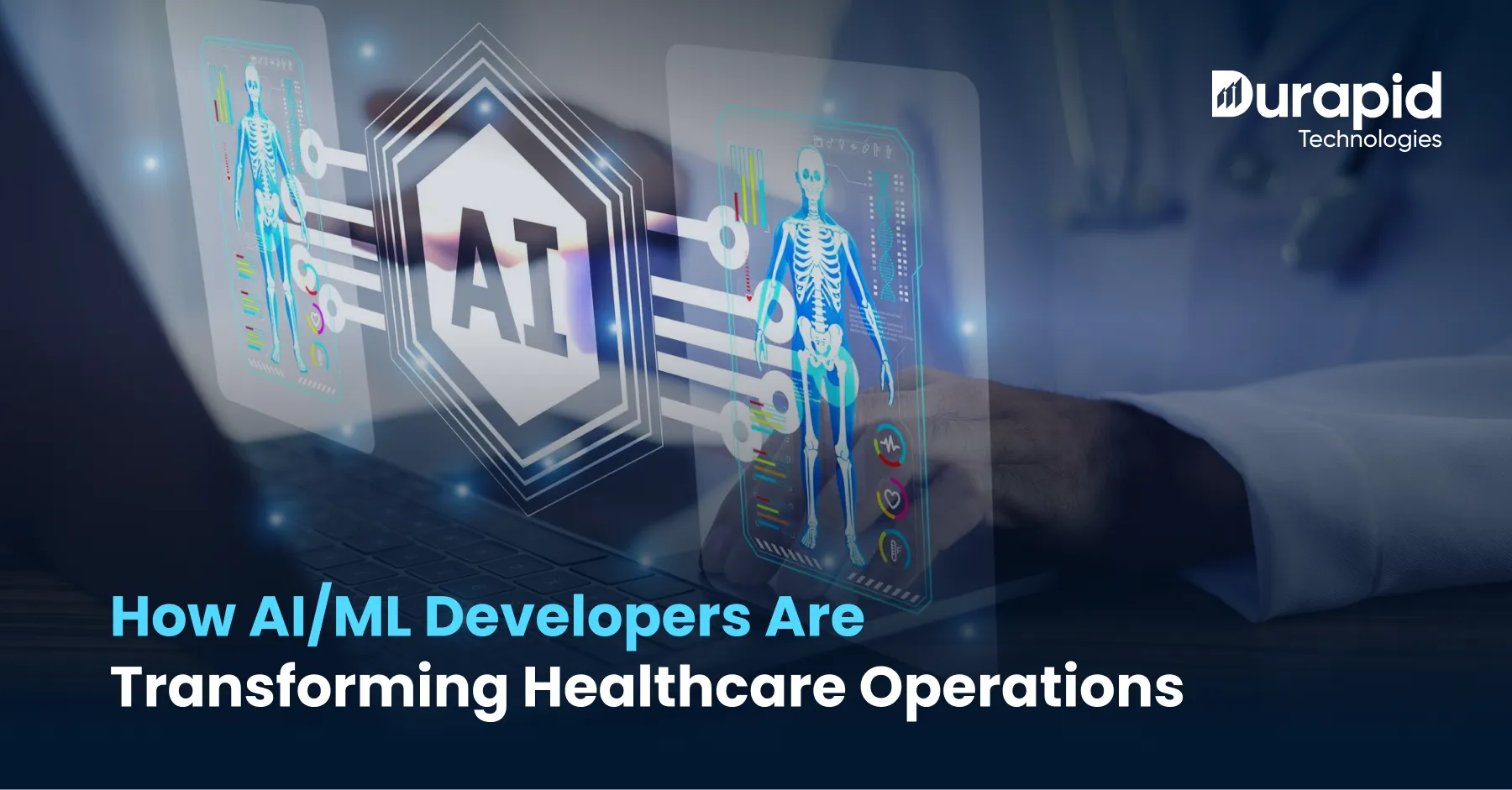
AI/ML Developers are fixing some of healthcare’s most expensive problems. You know the scene: a nurse spends hours updating records. A radiologist reviews hundreds of scans every day. Meanwhile a billing team is still chasing claims that really should have been approved weeks ago. The issue isn’t that there’s zero expertise. It’s that people are still doing work machines can handle faster, and somehow everyone keeps acting surprised.
Healthcare orgs are starting to notice that better patient outcomes don’t really show up just by hiring more people. The change is more about helping the teams they already have work smarter, with less friction. Per McKinsey, AI can generate as much as $100 billion every year in value for the healthcare industry. Most of that comes via improved decision making, automation, plus operational efficiency. That’s where AI/ML developers come into the story.
They aren’t only building models. They’re putting together systems that help forecast patient risks before complications begin, automate repetitive administrative chores, and trim diagnostic delays. They also support hospitals in making faster calls using the data they already have on hand. In our experience with enterprise AI initiatives, the biggest healthcare challenge usually isn’t a shortage of data. It’s the messy part: turning data into action. Organizations solving that step right now are delivering stronger care and cutting costs, while boosting operational efficiency all at once.
This shift is moving healthcare operations from reactive mode into predictive mode. And yes, AI/ML developers are making that possible through advanced machine learning systems, intelligent automation, and AI Agent Development Services that help healthcare teams make faster, data-driven decisions at scale.
Why Healthcare Organizations Are Adopting AI/ML Technologies
AI/ML developers in healthcare now drive about 70% of AI adoption across the industry, compared with 63% last year. Kinda seems like it’s accelerating. Healthcare and life sciences orgs have moved past the whole pilot phase. In a 2026 industry survey, 70% of organizations say they are actively using AI. That’s up from 63% in 2025. Meanwhile 69% say they use generative AI and large language models, climbing from 54% before. You can see this shift being engineered by AI/ML developers. They’re building the pipelines, the models, as well as the integrations that turn raw clinical data into operational results, outcomes, whatever you want to call it.
Administrative overload is the main reason people are pushing this hard. A 2025 clinician survey found 57% of clinicians lose more than 44 hours per month just to documentation. Yes, that’s more than a full work week, every single month. That burden then feeds into clinician attrition along with higher operating costs. So hospital systems are reaching for custom healthcare AI solutions rather than generic software “patches.”
The money story is pretty plain too. Healthcare AI spending is forecast to hit $45 billion in 2026. For diagnostic imaging AI, accuracy is reported at 94.5%, which matches or even beats radiologist performance for specific tasks. In our work with enterprise AI projects across regulated environments, we keep seeing the same pattern. The organizations that get AI/ML developers involved early, before the data architecture becomes a bottleneck, are the ones that capture the fastest ROI.
The Growing Role of AI/ML Developers in Healthcare Transformation
AI/ML developers are no longer some sort of back office technical staff. They actually sit alongside clinical and compliance teams to help design systems that touch diagnosis, scheduling, billing, plus patient communication all at once. In practice this means you need fluency in HIPAA-compliant architecture, not only model accuracy.
A healthcare AI development company often sets up its team in a way that feels almost modular. Three roles tend to stay in the room: data engineers who build HIPAA-compliant pipelines, ML engineers who train and validate clinical models, and MLOps specialists who handle deployment, monitoring, and drift detection once things are in production. If you plan to Hire Generative AI Developers, they usually work alongside these teams to build clinical copilots, medical documentation assistants, and patient-facing AI applications that rely on secure, compliant healthcare data. If you skip even one of these roles, it’s a common reason healthcare AI projects stall after the pilot phase. Then everyone wonders why the momentum disappears.
Key Ways AI/ML Developers Are Transforming Healthcare Operations
Automating Administrative Workflows
AI/ML developers build NLP based systems that auto generate clinical notes, schedule visits and route prior authorizations, kind of all at once. At one health system, burnout rates dropped from 52.6% to 30.7% across an 84-day stretch after ambient documentation tools showed up. Under the hood the work is not just “plug in an off the shelf” transcription API. It’s fine tuning speech-to-text models, then embedding them straight into EHR workflows while tightening the feedback loops.
Enhancing Medical Diagnosis and Imaging
Computer vision models trained on radiology datasets can now flag abnormal findings at accuracy levels that track specialist review when the task is narrow. The people building these systems tend to work with DICOM image pipelines, validation against FDA clearance requirements, plus ongoing monitoring for dataset drift across different patient cohorts. That whole process is more than simple detection. It’s like keeping the system calibrated, even when the inputs quietly change.
Improving Patient Care and Engagement
Conversational AI can do appointment scheduling, send medication reminders, and manage triage routing. But these systems really need thoughtful guardrails. If an AI invents a clinical suggestion that is not correct there is real harm. So in production teams usually favor retrieval-augmented generation over open ended LLM output, or it tends to drift.
Predictive Analytics for Better Clinical Outcomes
Predictive models can flag sepsis risk, estimate readmission likelihood, and notice early deterioration patterns well before symptoms become clinically obvious. Getting those results to work consistently means strong feature engineering built around time series vitals data, plus careful class imbalance handling. Adverse events are uncommon compared to the total number of patient encounters.
Optimizing Hospital Resource Management
ML forecasting models project bed demand, staffing requirements, plus equipment utilization. A mid-sized hospital network that still relies on legacy batch reporting sometimes figures out ICU capacity problems about a full shift late. Meanwhile, streaming based forecasting narrows the window to near real time, which is often what administrators actually need.
Streamlining Revenue Cycle and Claims Processing
Streamlining revenue cycle and claims processing, uh. In short AI/ML developers build claims scrubbing models that catch coding problems before submission. It really helps cut the denial rates. Then insurers started flagging “aggressive” AI assisted coding as a thing that can drive higher medical expenditures. So now some teams use downcoding strategies. That means the developers have to design the whole system with payer side scrutiny in mind, not only submission accuracy.
Technologies Used by AI/ML Developers in Healthcare
| Technology | Primary Use Case |
| Machine learning models | Risk scoring, readmission prediction |
| NLP | Clinical documentation, coding |
| Computer vision | Radiology, pathology imaging |
| Generative AI | Clinical summarization, patient communication |
| Cloud platforms (Azure, AWS) | HIPAA-compliant hosting and scaling |
And yeah, each of these technologies relies on the cloud infrastructure underneath it. Platforms such as Azure OpenAI and AWS SageMaker have become common deployment environments for healthcare AI workloads. Through specialized Azure Cloud Development Services, healthcare organizations can build, deploy, and scale AI applications while maintaining security, compliance, and performance requirements. Both Azure and AWS offer HIPAA-eligible service tiers with built-in audit logging, making them suitable choices for healthcare AI software development services.
Benefits of AI/ML Development for Healthcare Organizations
Quantified outcomes are the thing that split a working pilot from an enterprise deployment. In general, organizations say they see less integration failures, incident resolution goes faster, with costs coming down in a way that is actually measurable once the models sit in stable production, not just a demo. This is usually where healthcare machine learning services start to prove their worth beyond the pilot stage.
When NOT to Use AI/ML in Healthcare Operations?
AI/ML is usually a poor match if data quality is too inconsistent to support reliable training, if the clinical liability questions are still open for that specific use case, or when the case volume is too small to confirm model performance in a statistical sense. For instance, deploying a predictive model with fewer than a few thousand labeled cases often yields risk scores that feel shaky. That tends to chip away at clinician trust quicker than it builds any confidence.
Case Study: Claims Processing at Scale
A regional hospital network that processed about 18,000 claims every week was manually reviewing each submission prior to filing. This created an average lag of around four days between the service date and the claim being submitted. After rolling out an ML-based claims-scrubbing pipeline using Azure Machine Learning, plus adding rule-based pre-checks on top, the submission lag fell to under 18 hours. In the first quarter of production use, first-pass claim acceptance rose by 22%.
Key Skills That Healthcare AI/ML Developers Should Really Have
In this space, developers need a working knowledge of healthcare data standards like HL7, and also FHIR, along with HIPAA-compliant architecture patterns plus good model validation habits that work inside regulated environments. Pure machine learning modeling skill, without the domain context, is one of the most frequent causes that healthcare AI hires end up underperforming later. This is exactly the gap that a strong AI development partner is supposed to close.
How to Pick the Correct AI/ML Development Partner
Try to find an AI consulting for a healthcare partner with specific healthcare delivery experience, not just broad AI promises. Ask directly, like how they manage HIPAA compliance in their cloud architecture, how they validate models before anything hits a clinical deployment, plus if they can share a case study with actual numbers, rather than generic, “great results” type outcomes. A real healthcare AI consulting engagement should be able to walk you through all three without hesitation.
If your organization is exploring enterprise healthcare AI solutions or healthcare app development, the same questions apply. The right partner treats AI/ML developers healthcare operations work as a long-term build, not a one-off project.
Frequently Asked Questions
How is AI used in healthcare operations?
AI automates note writing, helps review diagnostic imaging, with predictive models for staffing decisions plus patient risk, usually using Azure or AWS hosted ML pipelines.
What do AI/ML developers do in healthcare projects?
They build and keep data pipelines running, train and sanity check clinical models, then handle HIPAA compliant deployment, with ongoing monitoring once it is in production.
What are the benefits of AI and machine learning in healthcare?
There is less administrative drag, quicker claims processing, plus earlier detection of clinical risk. Those are the measurable gains organizations report most often.
Is AI replacing healthcare professionals?
No. The current evidence shows AI supports documentation and triage, but clinical decision making and liability still belong to licensed professionals.
How can healthcare organizations implement AI solutions?
Usually they start with a small but high volume use case like documentation or claims scrubbing, validate outcomes over 8 to 12 weeks, then expand into wider clinical workflows.
If you are ready to bring AI/ML developers into your healthcare operations, check out Durapid’s AI Consulting Services, or hire dedicated AI/ML developers to get moving.

Recent Blog

Why Voice AI Is Different From Chatbots in Recruitment?
September 17, 2026-
LlamaIndex vs LangChain: Which One to Choose in 2026?
July 29, 2026