TurboLearn AI: A Comprehensive Guide to Intelligent Learning and Education Automation
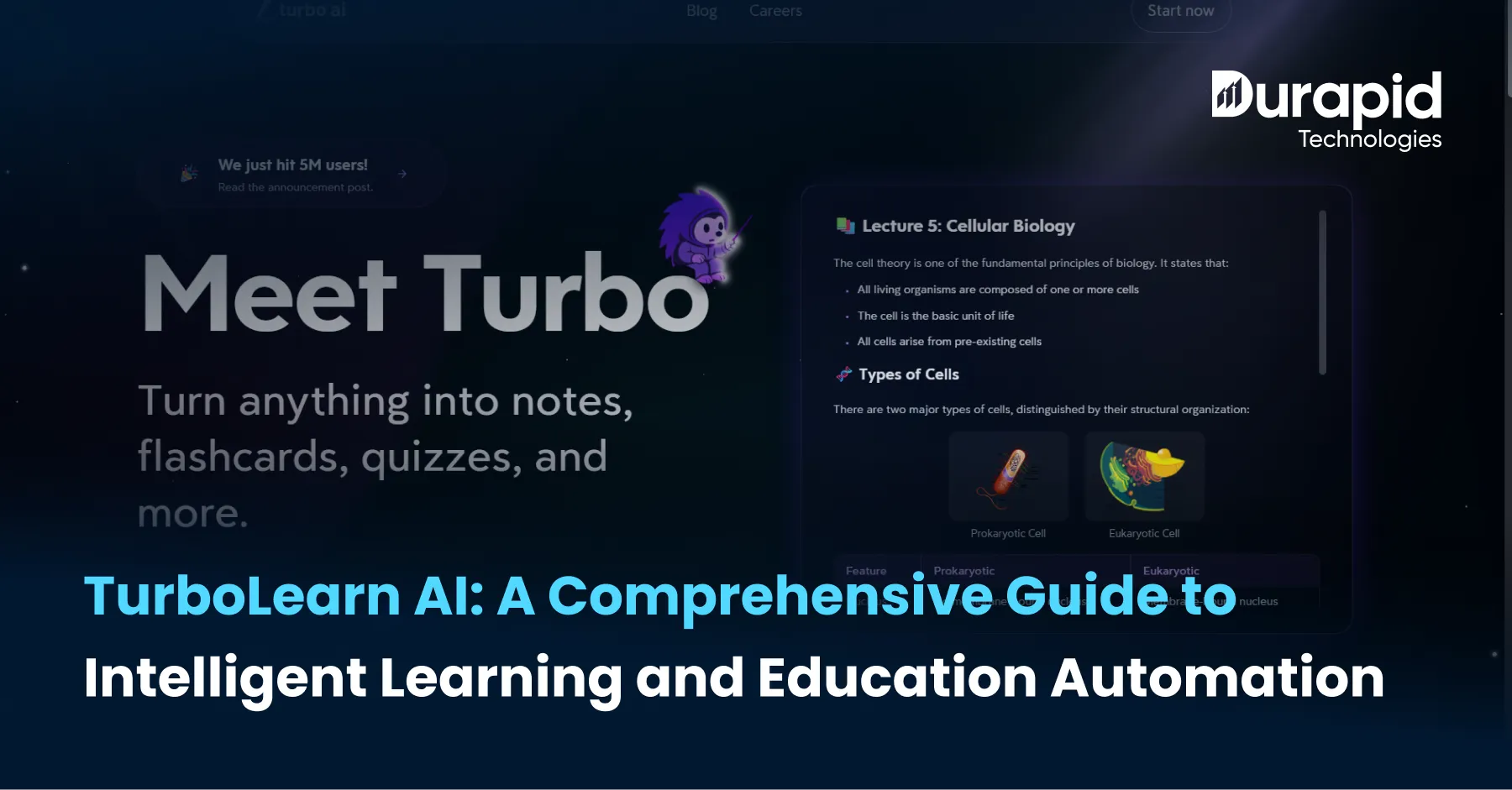
Your group just examined a huge volume of training content amounting to 10,000 hours. Now it’s the time to make it suitable for 500 employees scattered in 12 departments. Each has varying skill levels and learning speeds. The traditional LMS platforms would take months to get configured. TurboLearn AI does it in a few hours. It automatically generates personalized learning paths, quizzes, and monitoring for every individual using the system. Organizations that adopted AI-enhanced learning platforms assert that results include 42% faster skill acquisition. Furthermore, they also see 67% higher course completion rates compared with traditional systems of training.
The introduction of TurboLearn AI marks a significant change for both businesses and learning institutions in their ways of automating learning. Instead of the labor-intensive method of manually creating courses, quizzes, and study materials, this platform leverages the generative AI to turn the raw content into structured, personalized experiences of learning. In the case of businesses using a yearly employee training budget of $1,200, AI-based tools such as TurboLearn AI would help them save 73% of the time needed for making the content. What is more, a 34% rise in knowledge retention would be their additional benefit.
What Exactly Is TurboLearn AI and How Does It Operate?
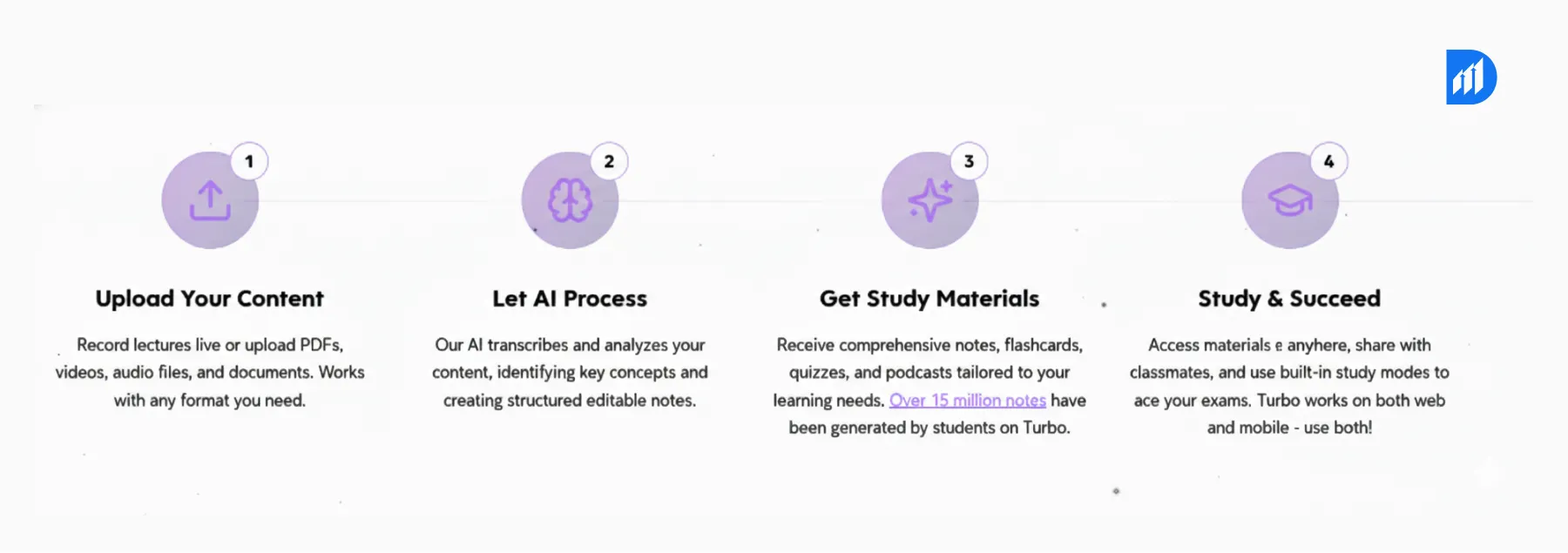
TurboLearn AI is a smart learning platform. It takes advantage of generative AI and natural language processing to change documents, videos, lectures, and websites into study materials that are interactive. The system performs analysis on the content that is input. Subsequently, it proceeds to extract the most important concepts, create summaries, develop quizzes, and build learning paths tailored to each person based on their performance data.
Three main components form the platform’s foundation. Its first component, the content ingestion engine, handles and processes different formats. These include PDFs, PowerPoint presentations, video transcripts, and web articles.
Next, the AI processing layer applies gigantic language models to recognize learning goals. It pinpoints important information and organizes knowledge into hierarchies. The following step is the personalization engine that monitors learner’s performance. It alters the content in terms of difficulty, speed, and mode according to comprehension indicators.
Companies working with TurboLearn AI claim to have experienced a huge increase in productivity. In the case of traditional course development, it takes anywhere between 40 to 100 hours for one module. TurboLearn AI cuts that down to 2 to 5 hours through the automation of content structuring, quiz generation, and assessment creation. The platform connects with the current learning management systems via REST APIs. It offers SCORM compliance for large-scale deployments in corporations.
Main Characteristics of TurboLearn AI for Smart Learning
TurboLearn AI provides an automatic content transformation. Specifically, it turns extensive documents into tiny and easier to consume learning modules. The system generates chapter summaries, key concept lists, and practice questions in a few minutes. Users upload the source materials first. This function helps to relieve a significant bottleneck. 63% of corporate trainers declare that content creation is their biggest time-thief (Training Industry, 2024).
The quiz generation power of the platform produces multiple-choice, true/false, and short-answer questions straight from the source content. It evaluates the text’s complexity and specifies learning objectives to derive tests that are at Bloom’s Taxonomy levels. Educational institutions use the automated quiz generation. They report a 56% drop in instructor workload and no change in the loosening of the quality standards for the assessment.
Additionally, TurboLearn AI includes spaced repetition algorithms. These organize review times in accordance with the forgetting rates. The system keeps track of the concepts that the learners have difficulties with. Through its control, the remedial materials are offered at the best time intervals.
Research indicates that spaced repetition enhances long-term retention by as much as 200%. In comparison, this compares to the continuous practice method (Cognitive Science Society, 2023). The StreamEast App builds on this principle by offering voice note transcription that allows students to save recordings of their lectures or spontaneous ideas. The platform then transforms these into text that is not only searchable but also accompanied with study guides. This functionality is particularly helpful for those students who attend lectures for more than 15 hours a week. Typically, they are not able to allocate time for organizing their notes manually. The transcription technology performs with 94% accuracy regardless of the language or the accent used.
How TurboLearn AI Uses Generative AI in Education
Generative AI is the driving force behind the content transformation of TurboLearn AI. Essentially, it utilizes customized language models trained on educational data. The platform not only takes out the text but also comprehends the context. It recognizes the connections between the concepts and produces explanatory material. This material is in accordance with the learning stage of the user.
To ensure the content produced is accurate and has educational value, the system utilizes prompt engineering techniques. TurboLearn AI, for instance, when dealing with technical documents preserves the exactness of the terminology. At the same time it offers easy-to-understand explanations for the difficult parts. For example, the case here is for a cybersecurity training program. The system took 200 pages of tech specs and turned them into 15 micro-learning modules. Each lasted 8-12 minutes.
The creative power of TurboLearn AI is similar in nature to that of the case of generating practice scenarios and case studies. In the context of corporate training, this means transforming the policy documents into real-life scenarios of the workplace. Learners utilize the knowledge they have acquired in order to find solutions to the problems. Scenario-based learning has been associated with a 45% superior transfer of knowledge to job performance. This compares it to lecture-based training (American Society for Training & Development, 2024).
The platform is capable of incorporating various generative AI frameworks such as GPT-4, Claude, and even customized models. These are for unique content production in specific areas like medical training or certification tests. With this range of options, firms can select the AI backend that conforms to their compliance standards. It corresponds to the intricacy of the content they are dealing with.
TurboLearn AI: Your Partner in Advanced AI Learning
The AI-powered learning assistant TurboLearn AI is very much like a personal tutor who is always there for you, day or night. The system uses retrieval-augmented generation to answer questions about course materials. This is a combination of the uploaded content knowledge base and large language model reasoning. This method guarantees that the given answers are not only based on course materials. They also do not come up with false information.
The user-friendly layout allows different interaction modes. Students can clarify concepts, ask for examples, or point out relationships between topics. The AI learning assistant keeps track of the dialogue history. This helps provide responses that are most relevant to the given context. The use of AI learning assistants at universities leads to students spending 28% less time getting basic concept questions answered by the instructor (Education Technology Research, 2024).
Moreover, TurboLearn AI has the ability to support many languages. This means that it can translate learning resources and offer help in more than 50 languages. This feature is essential for international companies that have training materials in English. They have non-English-speaking employees who need support. Technical content translation may achieve up to 92% accuracy. This is measured against that of professional human translators.
The system provides analytics on progress. Therefore, these highlight the learners’ areas of strength and weakness. They also show predicted performance in assessments. The aforementioned insights are derived from the data gathered. This includes analyzing answer patterns, the time spent on concepts, and the historical performance dataset. The models predict 87% accuracy in finding out the learners who are at risk of failing the assessments. Thus intervention can be done early on.
Advantages of TurboLearn AI for Students, Educators, and Enterprises
Students are the most fortunate ones to have their time of study hollowed out. This is due to the use of automatic paraphrasing and smartly done highlighting. The leaners won’t have to re-read the entire textbook. Rather the core concepts will be captured and the length will be only 20% of the original text length. The AI generates 85% of core concepts in 20% of the original text length. A medical student who used TurboLearn AI lost 19 hours per week for the preparation of the exam. However, he still got the same score as before (Journal of Medical Education Technology, 2024).
Educators see the content creation workload lessened. At the same time, learner engagement is raised. A teacher using TurboLearn AI can create quizzes and practice materials in 65% less time. The platform creates formative assessments on its own. With this, teachers can focus on the activities that only they can do and that provide the most value, such as individual mentoring and developing the curriculum.
As a result, the companies are enjoying a faster employee integration process. They also see higher compliance training completion rates. The companies that brought in TurboLearn AI for onboarding got the productivity of their employees increased by an average of 23 days. The automated quiz generation of the platform ensures that there are the same assessment standards across departments. This is in line with the 41% of companies that reported uneven training quality (Deloitte Learning Survey, 2024).
The financial impact is tangible. The companies that invest in training of $1,200 a year for each employee can save $420 per person through the automation. At the same time, they are going to have better results. For a 1,000-employee company, this is $420,000 a year in savings. Additionally, the increase in productivity due to faster up-skilling.
TurboLearn AI Pricing: Plans, Features and Value Analysis
TurboLearn AI pricing is based on a tiered system. This depends on the volume of usage and the feature access. The free tier allows individual learners to process up to 10 documents a month with the basic quiz generation. This plan is for students who are preparing for exams. They need quick creation of study materials without enterprise features.
The Pro plan is priced in the range of $15 to $20 a month. It does away with document limits and comes with many advanced features. These include spaced repetition, voice transcription, and also priority processing done by AI. This tier is for serious students and independent professionals. Therefore, they will be able to access unlimited content transformation. Pro users are averaging 50-75 documents a month. Hence the per-document cost is $0.20-0.40 based on the usage pattern.
Enterprise pricing starts with annual contracts of $8,000 for 100-500 users. This works out to be the lowest. This tier comes equipped with API access, SSO integration, SCORM compliance, custom AI model training, and assigned support. Enterprise customers are also given the advantage of having usage analytics dashboards. They get administrative control over content management.
The value proposition is clearly visible when compared to the alternatives. The cost of hiring professional instructional designers to create training content ranges from $85 to $150 per hour. Thus, if a training module is to be developed taking 40 hours, it will cost from $3,400 to $6,000. Meanwhile, TurboLearn AI will create comparable modules for just $50-$200 in platform fees. Add 2-3 hours subject matter expert reviewing time.
TurboLearn AI Alternatives: Comparing the Best AI Learning Platforms
The AI-based learning sector is attracting a variety of platforms offering different functionalities. Document-based learning is one of the features of Notion AI. It is integrated into a workspace tool. Nevertheless, it does not have educational algorithms specific for teaching. For instance, spaced repetition. Notion organizations find the AI features to be of value. Yet they lament the absence of TurboLearn AI’s analytical learning tools.
Quizlet’s AI supports the generating of flashcards and the recommending of study materials. Its strength lies in memorization-oriented forms of learning. However, it does not offer much help with document transformation and content structuring of complex nature. Quizlet is often the choice of students whose exams are heavy on vocabulary. In contrast, those dealing with technical documents prefer the full processing of TurboLearn AI.
ChatGPT with custom instructions can produce quizzes and summarizations. But each scenario needs a different manual prompt getting done. The approach works well for the users who are tech-savvy and willing to devote time to change the prompts. However, it does not have the features of automated workflow and monitoring that TurboLearn AI offers from the start.
Coursera and LinkedIn Learning are typical structured course platforms getting better. This is because of the AI features they are integrating. These services provide professionally created content with a little personalization. TurboLearn AI is in the opposite niche. It is creating learning experiences from organizations’ specific internal content. Companies with exclusive knowledge that cannot be taught through regular courses get the biggest benefit from TurboLearn AI’s method.
Performance comparisons indicate that TurboLearn AI is 3 times quicker than the manual process in generating quizzes. It is also 40% quicker than ChatGPT with repeated prompts. Its advanced educational AI models yield more pedagogically valuable assessments than usual language models.
Role of AI and ML Solutions in TurboLearn AI’s Architecture
The technical architecture of TurboLearn AI depends on a range of AI and ML solutions that interoperate seamlessly. The natural language processing models are responsible for the text analysis, concept extraction, and summary generation. Through the processing of the input documents, these models are able to identify the main ideas, supporting details, and the relationships between the concepts. They achieve 89% accuracy that is based on the human expert annotations.
The personalization engine modifies content difficulty and pacing. Machine learning algorithms drive it. The system employs collaborative filtering and content-based recommendations to propose materials that are relevant. Learner modeling techniques monitor knowledge states using Bayesian knowledge tracing. The accuracy of predicting whether a learner has mastered specific concepts is 82%.
Meanwhile, the platform makes use of computer vision for the processing of slides, diagrams, and handwritten notes. When making learning materials searchable, OCR accuracy is 96% for printed text. It is 84% for handwriting. This is a facility that allows TurboLearn AI to go beyond just text documents to multimedia educational content.
The process of speech recognition and NLP provides structured notes from the recorded lectures. Moreover, the system has the ability to detect speaker changes, the borders of topics, and the main points in the audio file. Universities report that the feature has reduced the students’ time on manual note-taking by 78%. This has given them more time to concentrate on active learning taking place during lectures.
Azure and AWS form the foundation of the cloud infrastructure. Consequently, it permits the large-scale processing of the documents’ volumes. The enterprise deployment can manage more than 10,000 users at the same time with 99.9% uptime. To scale-up reliably during the peak period of usage, the architecture employs containerized microservices. These are deployed through Kubernetes. The peak period is the exam season.
Use Cases of TurboLearn AI in Education and Corporate Training
Flipped classroom models are the ones that higher education institutions apply TurboLearn AI to support. The professors submit the recordings of their lectures along with the readings. The platform turns them into pre-class study materials with quizzes embedded. Students do the preliminary learning at their own pace. Then, the time of the class is allocated for discussions and problem-solving. The universities that have adopted this approach are seeing an increase in final exam scores by 31% (Educational Research Review, 2024).
Corporate compliance training gets an upgrade through TurboLearn AI’s talent. It breaks the regulatory documents into small pieces. The financial industry has firms that take the SEC rules, the GDPR directions, and their internal documents. They turn all these into training with automated evaluation programs. This method makes it possible for the whole staff to participate in compliance training. Simultaneously, it cuts the training cost by 58%.
The medical education sector also takes advantage of the TurboLearn AI to the full extent. This is in the case of preparing for board exams. Learners send the system the textbooks, research papers, and lecture notes. It gives them practice questions in the USMLE and COMLEX style. Medical students using AI-generated practice materials perform 12% better in board exams. This compares to those relying on traditional study methods (Medical Education Journal, 2024).
Sales enablement departments are taking up AI-generated learning materials. They create product training from technical specifications and competitive analysis documents. The new salespeople get their product certification done 40% quicker. This is if they are using AI-generated learning materials. The use of the platform’s quiz features guarantees that the reps exhibit the product knowledge before interacting with the clients.
Language Learning Applications
The language learning applications are making use of the TurboLearn AI’s features. This is through its vocabulary extraction and giving examples of contextual usage. The students who learn foreign languages upload authentic materials like news articles and academic papers. The system produces vocabulary lists, translation exercises, and comprehension questions. These are specifically aimed at the learner’s current proficiency level.
Is TurboLearn AI Worth It for Personalized Learning?
The value proposition of TurboLearn AI depends on three factors. These are the volume of content, the objectives of the user, and the learning of the user. Individual students who process about 5-10 documents weekly can save time significantly. They may reach similar results with the use of free tools like ChatGPT. The breakeven point for the subscription happens with around 20+ documents monthly. The automation and continual progress tracking features of TurboLearn AI are worth the cost of the subscription at this point.
Firms with huge libraries of training see immediate ROI. Organizations that store over 100 training documents are using about 2,000 hours a year for updating and reformatting the content. TurboLearn AI takes off 70% of this time spent on content maintenance. Hence it is $140,000 savings from labor a year for the organizations paying $70 for an hour of instructional design work.
Content Type and Security Considerations
The degree of personalization success is greatly influenced by the type of content. Highly structured technical content is the one that is most benefited from TurboLearn AI’s processing. The result is 91% satisfaction of the learners with the content. The marketing strategy category, for instance, gets the lowest customer satisfaction rating of 73%. This is because AI-generated questions may miss some of the subtlety involved in the interpretation.
Data security considerations are the main factors hindering the spread of turbo-learn AI in the regulated industries. The enterprise version of turbo-learn AI has the features of data residency controls and encryption at rest. Organizations in healthcare and finance need to comply with HIPAA or SOC 2. They can use private instances, but this will increase their total cost of ownership by 40-60%.
The effectiveness of the platform is directly proportional to the quality of content. Organizations that provide well-structured source materials with clear learning objectives get better outcomes. This compares to those that just upload unorganized content. TurboLearn AI is most effective when implemented as a part of the instructional design process. It should not totally replace the human expertise.
Frequently Asked Questions About TurboLearn AI
What is TurboLearn AI used for?
TurboLearn AI uses generative AI technology to transform documents, videos, and lecturing into engaging study materials with interactive quizzes, summarizations, and personalized learning paths.
How much does TurboLearn AI cost?
TurboLearn AI has a free tier for standard use. A Pro plan priced between $15 and $20 monthly for individuals. Enterprise pricing beginning from $8,000 annually for organizations.
Is TurboLearn AI superior to ChatGPT in terms of learning?
By offering a variety of educational features such as spaced repetition, progress tracking, and automated assessments that ChatGPT does not possess, TurboLearn AI is more effective for structured learning.
Will TurboLearn AI be able to integrate into my current LMS? Definitely, TurboLearn AI is compliant with SCORM. It also supports REST API integration which helps it to interface with the major learning management systems such as Moodle, Canvas, and Blackboard.
What are the different file formats that can be used with TurboLearn AI? TurboLearn AI accepts and processes the following file formats: PDFs, Word documents, PowerPoint presentations, video files, audio recordings, and web URLs. It converts them into structured learning materials.
Recent Blog

What Is Agentic Commerce? Strategy, Technology, and Implementation Guide
February 22, 2026