Private Blockchain vs Public Blockchain: Pros, Cons, and Business Impact

Every time someone says blockchain, the conversation quietly splits into two rooms. People in one room discuss open networks and transparency and decentralization and permissionless participation. The other group explores control and compliance and governance and enterprise-grade performance. The actual battle between private and public blockchain technology.
A Private Blockchain gives organizations structured control: defined participants, permissioned access, predictable performance, and clear governance. The system functions effectively within industries that require them to follow regulations while handling sensitive information and maintaining operational flow. A Public Blockchain, on the other hand, thrives on decentralization. The system establishes trust through its operation which eliminates the need for intermediaries while providing worldwide visibility that uses decentralized methods to authenticate transactions on public networks.
The two systems possess equal strength and drive significant change. However, they produce distinct outcomes because they follow different development paths.
The blockchain technology requires this distinction because it needs to merge with new technology. Your data ownership and model security and partnership systems and trust elements will all be affected by the blockchain framework which you choose to implement for any of these AI applications in Product Development, AI in Manufacturing and AI Marketing Agents and AI Manufacturing Process Optimization and Generative Adversarial Network-powered intelligent systems development.
What Is a Private Blockchain? Architecture, Control, and Governance Model
A private blockchain is a permissioned network. The network permits only invited members to join and validate transactions and access data. The consortium or central authority determines who receives access and what abilities they possess.
The system functions as a secured network that businesses use for their internal operations. Most business organizations utilize Hyperledger Fabric and R3 Corda systems to establish their private blockchain networks. The platforms enable organizations to establish specific access rights for each node through their role-based access control system.
In a Private Blockchain, consensus doesn’t need drama. Most private networks use mechanisms like Practical Byzantine Fault Tolerance (PBFT) or Raft. Now that sounds technical, but the idea is simple: the system doesn’t have to convince thousands of strangers that a transaction is valid. It only needs agreement from a small group of known, trusted participants.
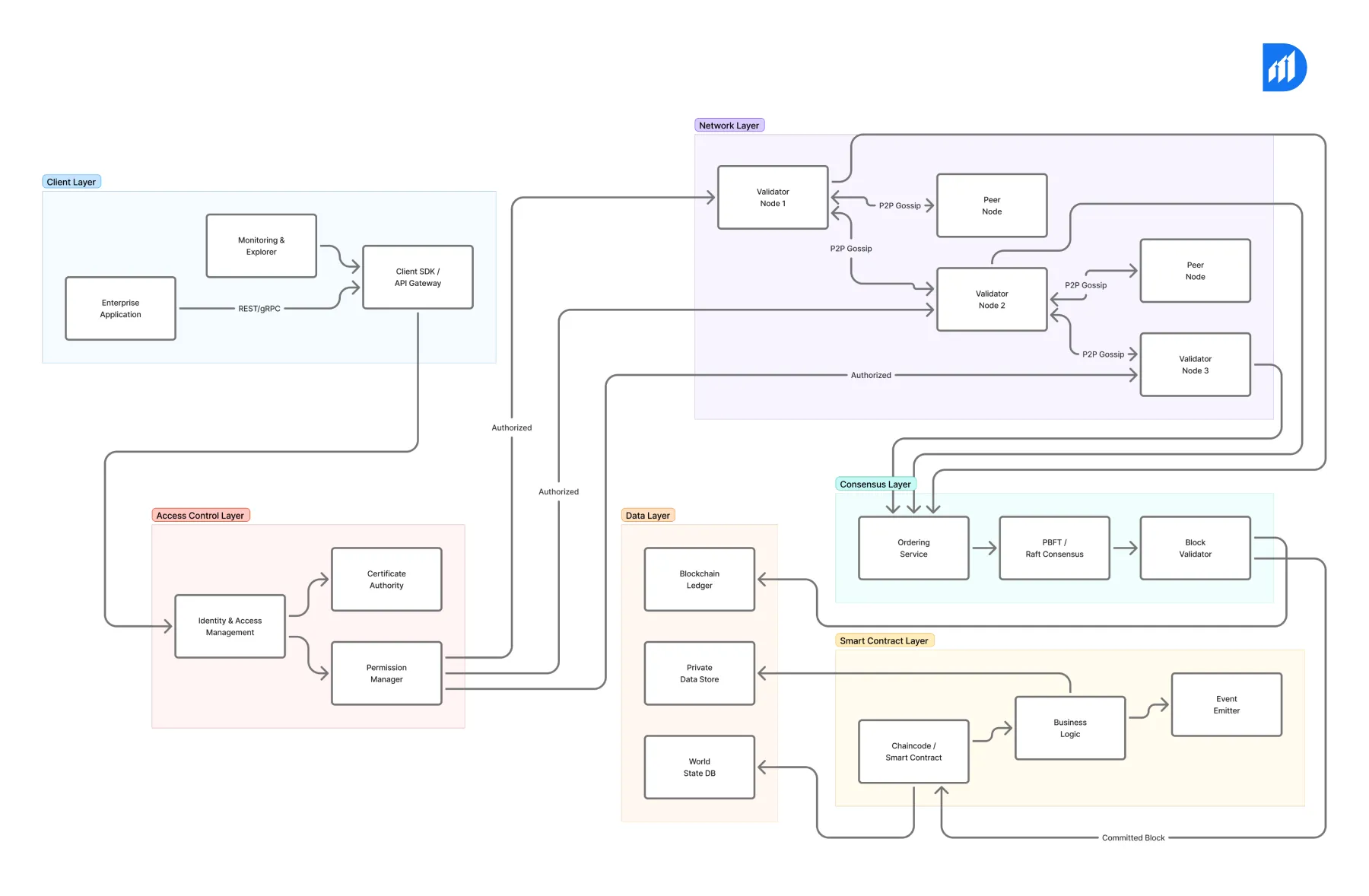
And that changes everything. If you have 20 verified nodes: all permissioned, all accountable, they can reach agreement much faster than a Public Blockchain trying to coordinate 10,000 anonymous nodes scattered across the world. There’s less noise. Fewer unknowns. Faster validation. This is exactly why enterprises lean toward a Private Blockchain when performance and predictability matter. The network isn’t built to be open to everyone. It’s built to be efficient, controlled, and aligned with business governance.
In simple terms? When trust is predefined, speed follows. And that’s one of the quiet but powerful advantages in the private vs public blockchain conversation.
How Governance Works in Private Blockchain
A single organization maintains all governance responsibilities or a specific group of organizations administers them. The organization implements internal procedures to obtain approval for policy changes and system upgrades and member eligibility criteria. Therefore, the system functions as an ideal solution for private blockchains that need to comply with regulations while maintaining data security and audit capabilities.
What Is a Public Blockchain? Decentralization, Transparency, and Consensus Mechanisms
A public blockchain allows anyone to access its resources without requiring permission. Users can establish connections to the network to verify and observe all transaction activities. Bitcoin and Ethereum represent the most popular blockchain networks which operate through thousands of nodes distributed throughout the world.
The organization functions according to its fundamental principle which determines its operational methods. The system maintains a complete record of all transactions which all users can access through a shared network. Ethereum handles more than 1 million transactions every day and no single entity is in control of it. That’s what makes a Public Blockchain fascinating. The system operates at maximum capacity while handling extensive data processing yet it remains unowned by any party.
Public networks depend on consensus mechanisms which include Proof-of-Work (PoW) and Proof-of-Stake (PoS) to achieve their operational requirements. The systems operate with high resource requirements because their design protects open systems in which users lack direct confidence toward each other. Public blockchains undergo continuous development throughout their existence.
Ethereum completed its transition from Proof-of-Work (PoW) to Proof-of-Stake (PoS) in 2022 which resulted in a 99.95% decrease of its energy usage. Not a small tweak. A structural transformation. It’s a reminder that decentralized systems aren’t static. They adapt, optimize, and grow, even without centralized control.
How Decentralization Shapes Public Networks
Public blockchains operate without any central governing body. As a result, the system prevents both security failures and censorship interruptions. However, the system enables decision-making through multiple governing organizations. Community members need to reach a consensus before they can implement protocol upgrades which need several months to complete.
Private Blockchain vs Public Blockchain: Core Differences Explained
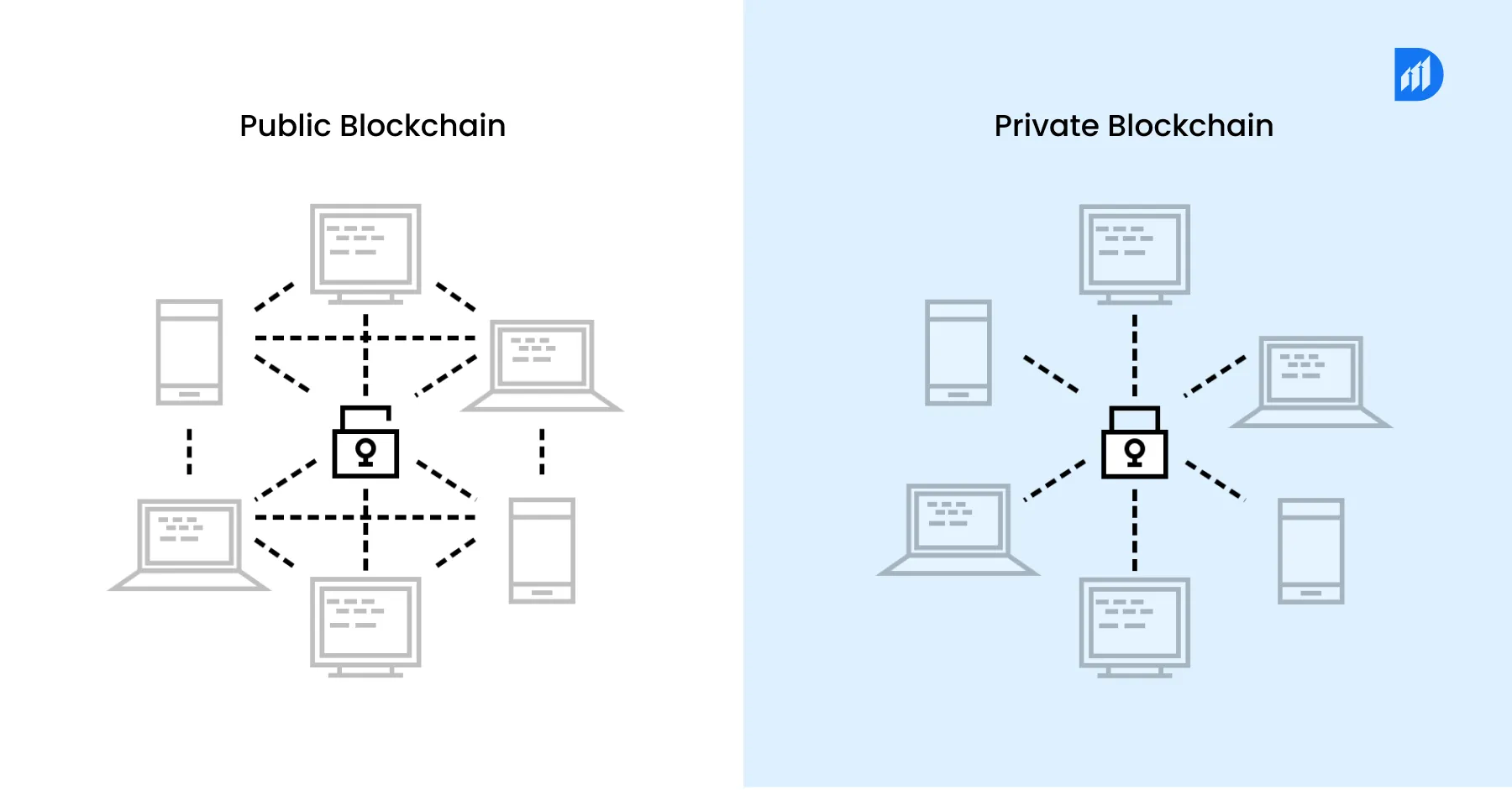
When we talk about private vs public blockchain, the differences aren’t subtle. They show up in architecture, governance, performance, cost, almost every structural layer of the system. Here’s a clear side-by-side comparison across six critical dimensions:
| Dimension | Private Blockchain | Public Blockchain |
| Access | Permissioned (invite-only) | Permissionless (open to all) |
| Consensus | PBFT, Raft, Paxos | PoW, PoS, DPoS |
| Speed | 1,000+ TPS | 7–30 TPS (Bitcoin/Ethereum) |
| Privacy | High (data restricted) | Low (data public) |
| Cost | Lower (fewer validators) | Higher (gas fees, mining) |
| Governance | Centralized or consortium | Community-driven |
This comparison makes one thing clear. Private blockchains are built for speed, efficiency, and operational control. Public blockchains are built for openness, decentralization, and trust at scale.
Neither model is “better” in absolute terms. They simply exist to solve different problems and that distinction is what truly defines the private vs public blockchain conversation.
Key Advantages of Private Blockchain for Enterprises
Private blockchains don’t just sound efficient, they prove it in numbers.
Hyperledger Fabric, for instance, can process more than 10,000 transactions per second. Compare that to Bitcoin, which averages around 7 TPS. The performance gap isn’t small. It’s structural. And speed is only one part of the story.
In a Private Blockchain, data stays within a controlled environment. Access is restricted. Participation is defined. That level of privacy matters deeply in sectors like healthcare and finance, where the pros and cons of blockchain often come down to one critical question: who gets to see the data? Enterprises also retain full authority over their ecosystem. They control smart contracts, determine consensus rules, and define node access. The global community vote process is unnecessary because changes can be implemented immediately.Organizations that require security protection, performance optimization, and clear governance structures, as well as restricted partner access, should use private blockchains.
Why Cost Reduction Matters in Private Networks
The private network implementation provides another advantage through cost reduction. The private networks of the system remove both gas costs and mining expenses. For example, the IBM Food Trust system, which operates on Hyperledger Fabric, transformed food traceability by reducing the time needed from seven days to 2.2 seconds while achieving a 30% decrease in operational expenses.
Key Advantages of Public Blockchain for Open Networks
Public blockchains operate on a very different promise, trust without intermediaries. They enable what’s called trustless verification. That means transactions are validated by the network itself, not by a central authority or private operator. No middle layer. No gatekeeper.
On Ethereum, smart contracts execute automatically the moment predefined conditions are met. No manual approval. No human intervention. Just code performing exactly as designed. This infrastructure powers large-scale ecosystems from DeFi platforms and NFT marketplaces to international payment systems. In many ways, public networks form the backbone for open financial innovation across different types of blockchains.
And the scale is real. Ethereum alone currently secures more than 50 billion dollars in DeFi assets within its ecosystem, a clear signal of how deeply public blockchain networks are embedded in decentralized finance.
Censorship Resistance as a Business Advantage
The system provides another beneficial feature through its ability to resist censorship. The system allows users to complete transactions without any single entity possessing power to block activities or shut down the network. The global payment system requires this feature to operate effectively. Stellar enables users to complete international payments within 3 to 5 seconds at a cost below 0.01 dollars per transaction.
Security Comparison: Private Blockchain vs Public Blockchain
The two security models both present different security systems. Public blockchains gain security from their increased network size which serves as their primary defense mechanism. To attack the Bitcoin network attackers must secure 51 percent of the hash rate which requires them to spend over 5 billion dollars on hardware. Public blockchains achieve high resistance against outside attacks because their network size reaches such extensive dimensions.
Internal Threats in Private Networks
Private blockchains protect themselves from different security threats. A 51 percent attack becomes easier to execute because the network has fewer nodes which create more accessible internal entry points. The organization faces its main threat because all members who possess access rights to internal systems can work together to deceive others. Multi-party approval processes together with audit trails and regulatory supervision enable enterprises to achieve risk reduction.
The blockchain private key QR code serves as an essential security component for both systems. Users in public blockchains hold responsibility for managing their private keys. Meanwhile, enterprises in private blockchains establish central key custody systems which decrease user mistakes but elevate institutional security threats.
Scalability and Performance: Private vs Public Blockchain Networks
The performance differences between private vs public blockchain become most apparent through their scalability functions. Hyperledger Fabric benchmarks show 20,000 TPS under optimized conditions. Ethereum natively supports 15 to 30 TPS but Layer 2 solutions such as Polygon enable it to exceed 7000 TPS.
Predictability vs. Community-Driven Scaling
Private networks scale more predictably. The system lets you manage both the number of nodes and the hardware specifications and the parameters used for reaching consensus. In contrast, public networks require protocol updates together with community adoption to achieve their scaling goals which creates uncertainty about their future progress.
Private blockchains offer superior performance capabilities for enterprise workloads that need to handle millions of daily transactions. Public blockchains that use Layer 2 scaling solutions provide an effective solution for applications which need worldwide trustless operation at moderate processing speeds.
Cost Structure and Implementation Considerations
Private blockchain implementation typically costs $50,000–$500,000 upfront, covering infrastructure, development, and integration. The ongoing expenses of the project increase based on the number of nodes and their hosting requirements. AWS, Azure, and Google Cloud all provide managed blockchain services that help customers decrease their operational expenses.
Public blockchain costs work differently. There are no infrastructure fees, but transaction costs fluctuate. Ethereum gas fees reached their highest point of $70 per transaction during the 2021 bull run. As a result, developers working on public blockchains must create their projects to handle the unpredictable nature of transaction costs.
The AI field uses tools such as Generative Adversarial Networks to shape how smart contracts acquire knowledge and improve their performance, which now plays a vital role in the AI in Product Development processes that utilize blockchain technology.
Use Cases of Private Blockchain in Enterprise Environments
Private blockchains power some of the most impactful enterprise deployments today. Walmart employs Hyperledger Fabric to monitor food origins across 25 product categories within its supply chain network. Additionally, HSBC handled more than $250 billion worth of transactions through its private blockchain system in the trade finance sector.
Healthcare organizations use private blockchains for hospital network patient record sharing between multiple facilities. The healthcare sector uses different blockchain systems which protect data privacy through private blockchain systems that meet HIPAA regulations. Artificial intelligence systems now used in manufacturing require private blockchain technology to produce unchangeable records of their manufacturing activities which link sensor measurements with permanent audit records used for quality control purposes.
Use Cases of Public Blockchain Across Industries
Public blockchains create innovative business models that did not exist before. Decentralized finance eliminates the need for banks. Non-fungible tokens establish digital ownership through verifiable proof. Furthermore, Ripple enables cross-border remittance operations at a cost that is 60 percent lower than traditional wire transfer methods.
Public blockchain networks enable supply chain provenance tracking which allows end customers to confirm product authenticity without needing to depend on specific vendors. Private chains lack the transparency which public chains provide.
AI Marketing Agents use public blockchain information to study consumer behavior on blockchain networks while creating transparent measurement systems which show how digital advertisements reach their audience.
Challenges and Limitations of Private and Public Blockchain Models
Private blockchains deliver actual operational limits. The system creates trust dependencies through its centralization. The governing entity can present dishonest actions which leave participants without any methods to defend themselves. In addition, custom middleware solutions are necessary because different private chains suffer from interoperability issues which prevent direct connection.
Scalability and Regulatory Hurdles in Public Blockchains
Public blockchains encounter two major obstacles which include their high operational costs and their difficulties in handling large amounts of data. The situation has improved but energy consumption still represents a major problem. Public crypto assets face regulatory ambiguity which leads to compliance challenges for businesses. The industry has lost billions through smart contract vulnerabilities, with the 2016 DAO hack resulting in $60 million ETH theft.
Both models require strong key management. A public network blockchain private key QR code loss leads to total asset disappearance. Private networks use institutional protocols as the only method for recovering lost access keys.
How to Choose Between Private Blockchain and Public Blockchain for Your Business
Before choosing between a Private Blockchain and a Public Blockchain, identify your primary requirement, not the trend, not the hype, but the actual operational need.
If your project demands strict data privacy, regulatory compliance, and the ability to process high transaction volumes efficiently, a Private Blockchain is the logical choice. It offers controlled access, predictable performance, and governance that aligns with enterprise standards.
On the other hand, if your goal is global accessibility, trustless verification, and token-based incentive models, then a Public Blockchain makes more sense. It enables open participation, decentralized validation, and economic mechanisms built into the network itself.
The right choice isn’t ideological. It’s strategic and it starts with understanding what your system truly needs to achieve.
Questions to Ask Before Deciding
Make your decision only after answering these questions:
- Who controls the network membership process, do you or someone else?
- Do you require your data to remain private?
- How many transactions per second does your use case require?
- Does your business model need decentralized trust to operate effectively?
Multiple hybrid models also exist. The enterprise solutions of Polygon enable businesses to establish private chains which connect at regular intervals to the public Ethereum mainnet, thereby achieving both privacy protection and public verification. The pros and cons of blockchain technology always return to one fundamental decision between two options: organizations should choose centralized control or decentralized trust. The correct decision process depends on understanding which aspect of your workload needs greater importance.
FAQs
What is the basic distinction between private and public blockchain systems?
Private blockchains restrict access to invited participants, offering speed and privacy. Public blockchains are open to anyone, prioritizing decentralization and transparency.
Which blockchain system provides better value for businesses?
Enterprises prefer private blockchains because they deliver superior operational speeds and safeguard data and comply with regulatory requirements.
Can a business use both private and public blockchain?
Yes. Hybrid architectures let businesses run permissioned private chains while anchoring critical data to a public blockchain for auditability.
What advantages and disadvantages does blockchain technology bring to businesses?
The advantages include immutable records and transparent operations and automated processes through smart contracts. The disadvantages include limited scalability and high implementation costs and difficult key management processes.
What industries benefit most from private blockchain?
Financial services, healthcare, supply chain, and manufacturing gain the most, where data privacy and auditability drive compliance requirements.

Deepesh Jain
Recent Blog

Private Blockchain vs Public Blockchain: Pros, Cons, and Business Impact
February 28, 2026-
What Is Agentic Commerce? Strategy, Technology, and Implementation Guide
February 22, 2026