How to Hire Dedicated Machine Learning Engineers: The Blueprint for Scalable AI Performance
On the same day, three different companies decided to go for AI projects. Company A took the most advanced route by bringing on board a machine learning engineer having a solid GCP background and domain knowledge. Meanwhile, Company B went for a development team consisting of generalists to do the outsourcing. Company C only entailed bringing in Python beginners contractors. After 6 months, Company A’s recommendation engine contributed to a 41% rise in sales. In contrast, Company B’s model sits in the development stage. It has already cost $180,000. Company C has the worst scenario since their algorithm predicts with 62% accuracy, less than random guessing. Why the discrepancies? All of them were in need of AI. However, only one recognized the right machine learning engineers who could actually accomplish the task.
Worldwide, the machine learning market is expected to touch $209.91 billion by the year 2029 with a whopping 38.8% year-on-year growth (Fortune Business Insights, 2024). However, 87% of data science projects fail to make it to production. This happens mainly due to the lack of trained personnel and wrong hiring decisions. If you hire machine learning engineer without a proper setup, your project will likely fail. At the same time, you will be losing millions in opportunity costs while your competitors scale their AI and Machine Learning capabilities.
What differentiates Machine Learning Engineering from Traditional Development
Machine Learning Engineering is the point where software development, data science, and systems architecture meet. Machine learning engineers as opposed to conventional developers who write deterministic codes create systems that learn from data and become better with time. Thus, this core variance alters every aspect of the recruiting process.
A typical software engineer writes pretty straightforward instructions: “If the user presses button A, then show the result B.” On the other hand, a machine learning engineer designs systems to discover patterns: “Evaluate 10 million user interactions and then predict the next best thing for each user to see.” Such a task demands a mix of skills. Specifically, it requires statistical modeling, data pipeline architecture, and designing production-scale systems. Unfortunately, 73% of conventional development teams do not possess these skills (Gartner, 2024).
When you bring on board machine learning engineers, it is not merely a developer position that you are filling. Instead, you are hiring persons with specialized knowledge. They can turn raw data into predicting systems, tune machine learning algorithms for operable conditions, and connect the gap between research prototypes and business-critical apps.
Why Companies Fail to Hire Machine Learning Engineers Successfully
The AI talent deficit is not merely a question of numbers but also one of knowing what exactly to look for. Companies that have a hard time getting AI and ML developers, especially in generative AI , usually make three big errors. First, they mix up data scientists with machine learning engineers. Second, they give more weight to academic qualifications than production experience. Third, they expect one person to manage the whole ML lifecycle.
Clear Role Definition Matters
MIT Sloan’s research reveals something important. Companies which clearly delineate ML engineering roles enjoy 3.2x faster time-to-production compared to those with unclear job descriptions. Furthermore, the problem becomes more complicated because machine learning konsult and implementation require expert skills. These skills can differ enormously from one case to another. For instance, an engineer specializing in computer vision might find it difficult to work with natural language processing. Similarly, another one who is excellent in reinforcement learning might feel lost in time-series forecasting.
Seven Essential Components of Machine Learning Systems
The distinct phases of machine learning systems require different technical skills and are consequently the reason for the diversity of technical skills among the different phases. Learning the components helps you to point out the most needed skills when you are hiring machine learning engineers for your specific case.
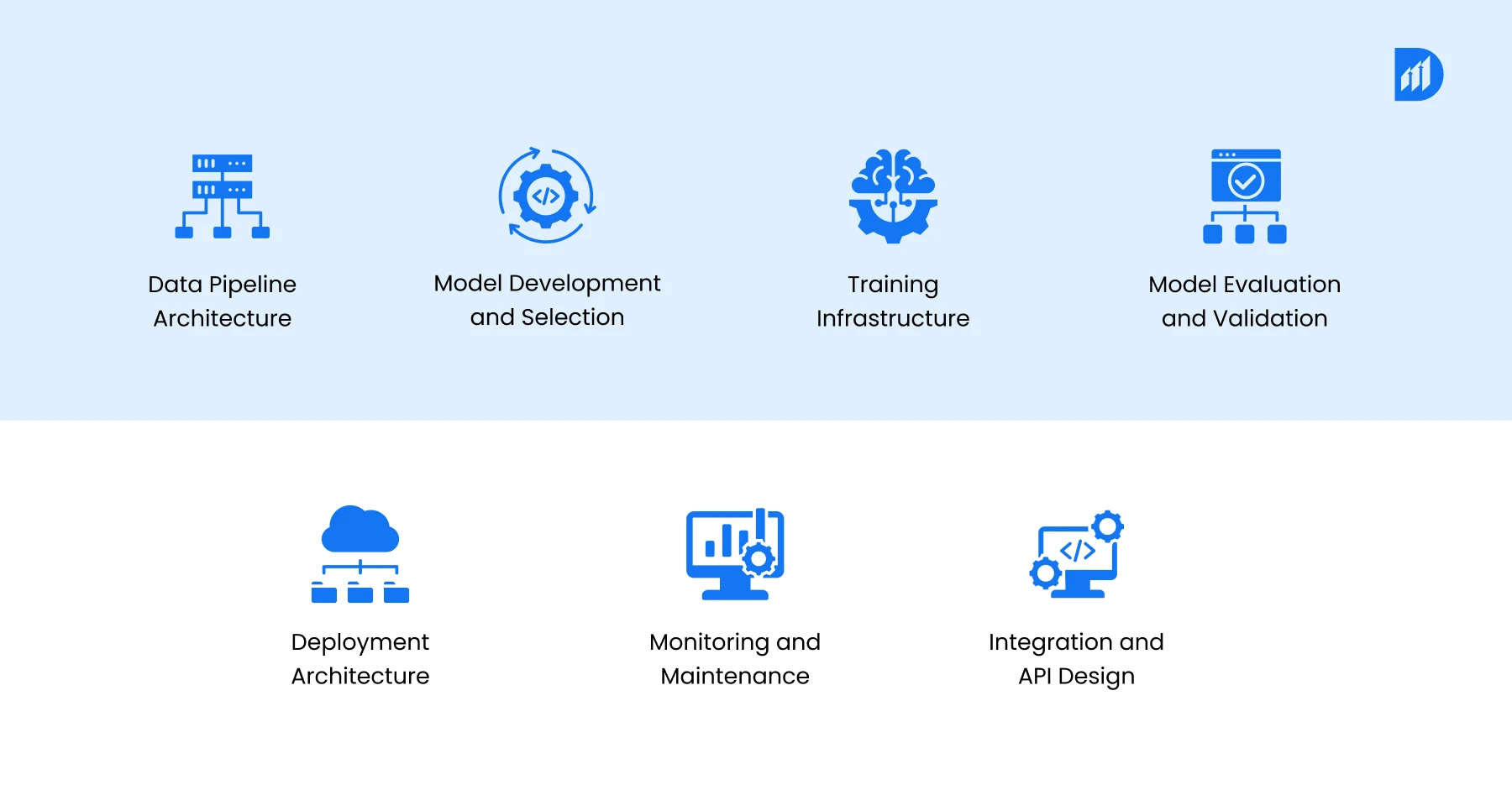
Data Pipeline Architecture
Data Pipeline Architecture is the starting point. Engineers start designing the different systems for collecting, cleaning, and converting raw data into usable formats before model training begins. Additionally, companies that handle real-time data streams need engineers with extensive GCP knowledge or equivalent cloud experience. These engineers can create pipelines processing millions of events per second. Bad pipeline design results in losses. Enterprises lose up to $15 million a year due to delayed insights and inefficiencies in operations (IDC, 2023).
Model Development and Selection
Model Development and Selection demands a wide-ranging knowledge of machine learning algorithms. This ranges from classical methods like random forests to modern neural architectures. Moreover, engineers have to assess a myriad of approaches. They look at accuracy, time for training, and speed of inference. For example, a recommendation system could apply collaborative filtering, matrix factorization, and transformers-based models before choosing the best approach.
Training Infrastructure
Training Infrastructure applies computational resources in an effective manner with respect to the scale. The cost of training large language models can range from $500,000 to $2 million per run. Production-experienced engineers manage GPU usage, introduce distributed training, and cut costs by 60-80% compared to naive implementations.
Model Evaluation and Validation
Model Evaluation and Validation eliminates the catastrophe scenario. This is where models succeed during tests but fail in production. To prevent this, engineers create A/B testing frameworks, monitor implementations, and set up feedback loops. These ensure the model never reaches an unfit stage for customer use. As a result, companies equipped with solid validation frameworks declare a huge reduction of 91% in production incidents associated with AI systems.
Deployment Architecture
Deployment architecture defines whether an ML system can make predictions at scale. An engineer may build a model with 99% accuracy, but if it takes 30 seconds to return an output, it won’t work for real-time applications. In discussions around Data Science vs. Artificial Intelligence, the difference between model performance and their being ready for production is especially highlighted. Production-ready ML engineers create inference pipelines that take care of all three factors – accuracy, low latency, and cost efficiency – thus guaranteeing the models to perform well in the real-world environments.
Monitoring and Maintenance
Monitoring and Maintenance deal with the expiring of concepts, low-quality data, and poor performance. Machine learning systems need constant monitoring since changes in data distributions take place. For example, financial companies using fraud detection models have to retrain their systems every two or three weeks. This maintains their effectiveness as fraud patterns change.
Integration and API Design
Integration and API Design links the ML capabilities with the already-existing business applications. The top model in the world will not create any value at all if product teams cannot integrate it into customer-facing systems. Therefore, engineers have to create clean APIs and handle error situations with care. Additionally, they must make sure that reliability standards align with the requirements of the most important business processes.
How Machine Learning Algorithms Influence Hiring Qualifications
Different types of machine learning algorithms require completely different types of engineers. For instance, a company that makes recommendation engines will need engineers who know about collaborative filtering and matrix factorization techniques. On the other hand, one that works on fraud detection will require experts in catching anomalies and doing class-imbalance handling. When you hire machine learning engineer for specific algorithm needs, matching their expertise to your project type becomes critical.
Supervised vs Unsupervised Learning Requirements
Tasks that involve supervised learning (where you have labeled data) require engineers capable of building feature engineering pipelines. They must tune model hyperparameters to desired levels. However, professionals dealing with unsupervised learning need different skills. Specifically, they should be experts in clustering algorithms and have a good grasp of dimensionality reduction. Additionally, they must assess results without ground truth labels.
Deep Learning Complexity
Using deep learning makes the situation quite a bit more complicated. Deep learning methods have created a demand for engineers who have a full knowledge of neural networks, gradient descent, and GPU programming. A study performed by the Stanford AI Lab (2023) on 500 AI projects revealed that, among others, the teams with deep learning experts worked 2.4 times faster than the teams of generalists learning on the job.
What Programming Language to Use When Hiring Machine Learning Engineers
The main language used in ML engineering is Python. According to (Stack Overflow, 2024) 83% of ML systems in production support it. When you aim to employ machine learning engineers you must consider a person who is proficient in Python. The ecosystem of the language provides a variety of tools that engineers require for both quick prototyping and production deployment. The tools include scikit-learn for classical ML, TensorFlow and PyTorch for deep learning, and Pandas for data manipulation.
Python by itself is not enough though. Production ML systems often need diverse programming languages. Knowledge of Java or Scala allows engineers to use Apache Spark for massive data processing. C++ is a must for systems which are very efficient and responsive to users where every millisecond matters. R is the tool for statisticians to work on and come up with good models and run experiments.
Cloud Platform Knowledge
Knowledge of cloud platforms is just as important as programming languages. Deep GCP experts can leverage Vertex AI for model training and deployment. AWS specialists take advantage of SageMaker for complete ML workflows. Azure experts use the partnerships with OpenAI and security features suitable for businesses. Forrester (2023) found something interesting. Organizations that hire ai ml developers with cloud certifications reduce infrastructure costs by 34% compared to those relying on generic cloud knowledge. Engineers with deep GCP experience specifically understand how to optimize costs while maintaining performance at scale.
AI vs ML: Why the Distinction Matters for Hiring
Confusion between artificial intelligence and machine learning leads to hiring disasters. AI is the umbrella term that refers to any system displaying intelligent behavior, rule-based expert systems included, and present-day neural networks as well. Whereas machine learning is one particular area of AI that allows systems to learn through data rather than being programmed explicitly. The distinction between ai and ml is vital as it leads to better recruitment decisions.
When the question is asked, “what is the difference between ai and ml?” The answer will determine the recruitment approach. In that case, a rule-based chatbot uses AI but not machine learning. A predictive recommendation engine relying on user preferences applies machine learning. Meanwhile, self-driving cars consist of two: rule-based safety systems and ML models for perception and decision-making.
This distinction matters because companies try to hire “AI developers” for the reason that they really need machine learning engineers. The ai vs ml division determines the technical skill sets that are required. Specifically, rule-based AI systems need logic-oriented programmers. Machine learning systems need engineers skilled in statistical modeling and probabilistic reasoning. When you hire machine learning engineer who understands these distinctions, project success rates improve dramatically.
Deep Learning in the AI vs ML Debate
Deep learning adds new depth to the artificial intelligence vs machine learning debate. This approach uses neural networks with many layers to automatically learn hierarchical representations. As a specialized type of machine learning, deep learning requires expertise in network topologies, optimization strategies, and high-performance computing infrastructure.
| Capability | Traditional AI | Machine Learning | Deep Learning |
| Programming Approach | Rule-based logic | Statistical pattern learning | Neural network architectures |
| Data Requirements | Low (explicit rules) | Moderate (structured datasets) | High (millions of examples) |
| Computational Needs | Minimal | Moderate | Intensive (GPU required) |
| Interpretability | High (clear rules) | Medium (feature importance) | Low (black box models) |
| Use Cases | Expert systems, chatbots | Fraud detection, recommendations | Computer vision, NLP |
Companies structuring their investments in computer vision need engineers who are specialists in convolutional neural networks. Organizations focused on building language models will require expertise in transformers’ architectures. Firms are allocating machine learning engineers who concentrate on ensemble methods and feature engineering to predictive analytics. Aligning the technical specs to exact AI and ML solutions prevents costly mismatches between talent and project requirements.
The Machine Learning Konsult Approach: Technical Evaluation Framework
A series of good technical evaluations reveals the separation of engineers who merely discuss machine learning algorithms from those who deal with them at scale. The interview should assess three major attributes: theoretical knowledge, the skill of writing code, and experience in production. When you hire machine learning engineers, this evaluation framework ensures you get production-ready talent.
Testing Theoretical Knowledge
Theoretical assessments confirm that candidates grasp fundamental concepts. Could they give a clear statement about bias-variance tradeoff? Are they aware of when to use precision over recall? Could they distinguish applicable machine learning algorithms depending on different problem types? Engineers should communicate these concepts without using technical jargon.
Evaluating Coding Skills
Coding evaluations test the candidate’s ability to implement solutions practically. Offer candidates a dataset along with a relevant business problem and a 2-3 hour time limit to create a working solution. A very competent engineer produces code that is clean, improves productivity, and handles errors properly. Such an engineer would also document assumptions, validate results, and explain trade-offs among different approaches.
Assessing Production Experience
Production scenarios show real-world problem-solving capabilities. A simple question to ask candidates could be: “Your model’s accuracy in production dropped from 92% to 78%. Can you walk me through your debugging process?” Good answers touch on aspects like data drift monitoring, A/B testing, and feature distribution analysis together with methodical hypothesis testing. Engineers who have worked on production systems at least once can tell such scenarios straight away. Professionals with deep GCP experience will also mention cloud-specific monitoring tools and auto-scaling strategies.
Soft Skills Matter Too
In addition to assessing machine learning engineers’ hard skills, companies that are hiring should also look at soft skills that have a big impact on successful project delivery. Can the candidates make non-technical stakeholders understand technical concepts? Do they ask clarification questions concerning business objectives? Can they get along with data engineers, product managers, and business analysts? Machine learning projects often suffer from bad communication rather than technical constraints.
Building ML Engineering Teams: Specialists vs. Generalists
The specialist versus generalist debate decides the fate of team structures. Machine learning konsult sessions usually indicate that winning groups are those who strike a balance by adopting different archetypes. Specialists enhance depth in critical areas. Meanwhile, generalists contribute width and system-level thinking.
When to Use Generalist Engineers
Early AI projects are handled by generalist ML engineers who can manage the whole stack from data pipelines to model deployment. These engineers are fast and skilled enough to build prototypes and validate ideas without needing big support infrastructure. For instance, even a small team of 2-3 generalists can turn out a recommendation engine or a fraud detection system at the very beginning.
Scaling with Specialist Engineers
The next level is where specialists are needed. ML systems become more complicated. As a result, engineers on the team work in specific areas: MLOps specialists tune deployment pipelines. Data engineers set up foolproof collection systems. Research engineers expand model performance thresholds. Infrastructure engineers make sure systems run reliably even at large scales.
In organizations having a mature AI program, teams form according to product areas instead of technical functions. As one example, a personalization team consists of ML engineers, data scientists, backend developers, and product managers who all collaborate on recommendation systems. Companies like Netflix and Spotify have embraced this arrangement. As a result, it speeds up the iteration process and enhances cross-functional collaboration.
How We Help Companies Hire Machine Learning Engineers Successfully
Durapid Technologies uses a tried-and-true process of ML engineering talent placement to close the gap between AI aspirations and execution reality. We keep a pool of more than 300 adept developers. This includes over 95 Databricks-certified pros and 120 certified cloud consultants who are all exclusively trained in AI and ML Solutions.
Our Evaluation and Matching Process
Our framework for evaluation explores the seven key components that have been outlined previously. This way engineers prove their theoretical mastery as well as hands-on experience. Furthermore, we align client needs to the capabilities of specialists. You might require machine vision experts for quality control in manufacturing, NLP developers for service automation of customers, or time-series wizards for predicting financial matters.
When you engage Durapid in your search for machine learning engineers, you get access to skilled workforce already acquainted with enterprise-grade tools and platforms. Our engineers possess extensive GCP knowledge and AWS skills. Moreover, they hold Azure certifications. This reduces the training period from several months to just a few weeks. They have delivered production systems capable of processing billions of data points, not just worked on academic projects with toy datasets.
Flexible Engagement Models
We provide several different flexible engagement models to meet specific needs of organizations. Staff augmentation incorporates skilled ML staff for the short term with no long-term obligations to the teams already in place. Alternatively, a dedicated development team gives full project ownership throughout the whole life cycle from requirement gathering to production deployment. Consulting partners assist firms in selecting an ML strategy before deciding not to go for full-scale implementation.
AI ML development services do not stop at hiring engineers only. Additionally, we help in assessing and deciding ML readiness, designing scalable architecture, executing MLOps best practices, and setting up monitoring frameworks that detect problem areas before they affect customers. Overall, this approach ensures that hiring machine learning engineers translates to measurable business outcomes, not just increased headcount. When you hire ai ml developers through our services, you get complete support from evaluation to deployment.
FAQs
What is the cost of hiring machine learning engineers?he salaries differ from $120,000 for entry-level engineers to $300,000+ for highly skilled senior specialists who are primarily focused on specific disciplines such as computer vision or NLP.
AI and ML engineers are not the same?
AI engineers can work on various kinds of intelligent systems, including those based on rule-based logic, while ML engineers are concerned only with the systems that use statistical techniques to learn from data. Knowing what is the difference between ai and ml helps companies hire machine learning engineer profiles that match their exact project requirements.
What is the time frame for training the best ML engineers?
With good evaluation standards, the process will take you 4-6 weeks. Companies without clear criteria usually look for 6-12 months, during which they either reject qualified candidates or hire poor fits.
You will still need ML engineers even if you have data scientists on your team?
Absolutely, Data scientists are tasked with creating models and interpreting outputs, while ML engineers take care of model deployment, data ingestion, and system reliability at scale. AI ML development services typically include both roles for comprehensive project execution.
Which cloud platform will be helpful for the ML engineers to have knowledge about?
It all comes to what your setup is. Engineers with strong GCP skills are ideal for those companies that use Google Cloud. If you are already using AWS or Azure then it would be best to hire ai ml developers who are specialists from that respective cloud.
Recent Blog

What Is Agentic Commerce? Strategy, Technology, and Implementation Guide
February 22, 2026