AI Voice Agent in Healthcare: What They Are, Key Use Cases, and Implementation Guide
A nurse walks 4 miles per shift just to update patient records. A front desk team handles 300 calls every day which consists of appointment requests. A hospital loses $1.2M every year because of lost equipment and equipment that lacks proper tracking. The first statement does not describe special situations because it shows how healthcare systems function every day while an AI voice agent in healthcare already solves three problems. AI voice agents in healthcare already solve three problems which these hospitals experience every day. The demand for a reliable AI voice agent in healthcare has never been this high.
According to a 2025 McKinsey report healthcare organizations that use AI-driven communication tools achieve administrative cost reductions of up to 30 percent. Staff productivity also increases by 25 percent. The shift is happening now and it occurs at a speed which exceeds the expectations of most hospitals.
What Are AI Voice Agents in Healthcare?
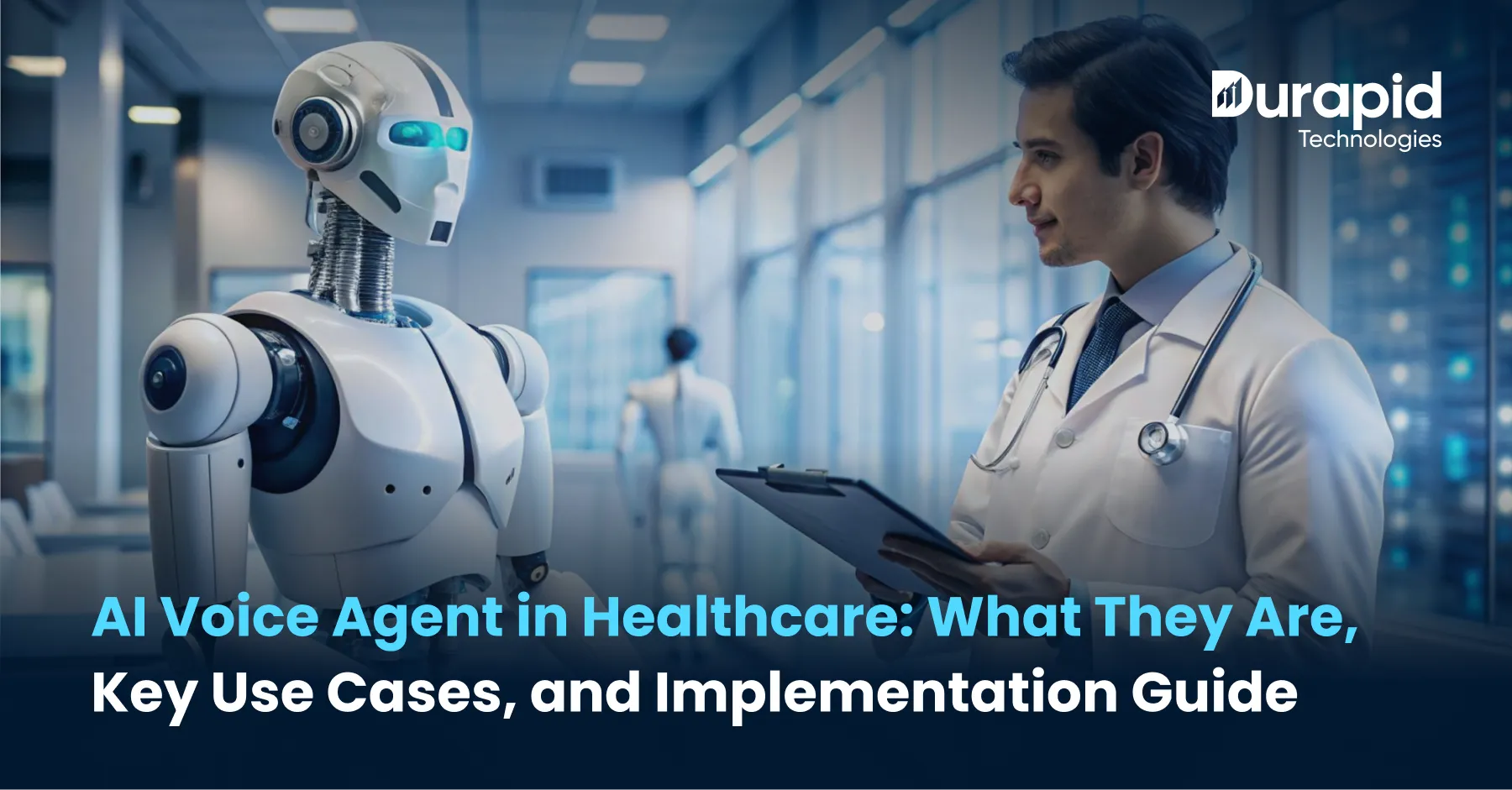
An AI voice agent in healthcare is a software system that uses speech recognition and natural language processing to interact with patients, staff, and clinical systems using spoken language. The system listens to audio input and comprehends situational information before executing commands without needing human assistance.
These systems go far beyond simple IVR phone trees. The contemporary AI voice agent in healthcare enables users to schedule appointments and complete EHR updates while answering clinical questions and sending alerts. It also helps nurses with their rounds. The system operates continuously throughout the week and grows its capacity without requiring extra staff members. Voice AI agents, unlike traditional chatbots, can process audio in real-time and determine goals and conduct dialogues that involve multiple exchanges. Think of it as a medical assistant who maintains complete performance during sick days.
How Do AI Voice Agents Operate?
Voice AI agents use four fundamental components which include audio capture, speech-to-text conversion, natural language understanding, and response generation. First, the system obtains spoken input through microphones which capture sound from phone lines and smart devices. Automatic speech recognition then processes the audio material using ASR engines which include Azure Cognitive Services Speech and Google Cloud Speech-to-Text. Next, the NLP model processes the transcribed text to identify user intentions while extracting essential information and selecting proper responses.
The system uses text-to-speech (TTS) technology to create spoken responses. At the same time, it fetches information from connected systems which include EHR, HIS, and scheduling platforms. The complete process finishes within 500 milliseconds. That speed helps medical personnel who need immediate results during urgent situations.
Most enterprise-grade deployments use Azure OpenAI or AWS Transcribe Medical as their base system. FHIR-compliant APIs then provide connections to downstream hospital systems.
Voice AI and Hospital Asset Tracking
Asset tracking in hospitals represents an essential but frequently ignored area of waste reduction within healthcare operations. Research demonstrates that nurses need between 20 to 30 minutes during their shifts to find lost medical devices which include IV pumps, wheelchairs, and ventilators. Across a 500-bed hospital, this results in thousands of lost working hours every year. An AI voice agent in healthcare directly addresses this problem.
Hospital asset tracking software and RTLS (Real-Time Location Systems) now support air AI voice agent deployments which provide users with immediate hands-free results. A nurse can simply say, “Where is the nearest available infusion pump on floor 3?” and receive a response in real time.
The table below compares traditional asset tracking methods with voice-integrated tracking systems through real-time location systems. It covers four factors which compare traditional tracking systems with voice AI systems that use real-time location systems. The data represents results which healthcare organizations obtained through operational research and live testing at mid-sized American hospitals.
How Telematics Supports Asset Health Monitoring
Additionally, monitoring asset health via telematics is now a core part of how hospitals manage their equipment. The monitoring system uses telematics to track asset condition through its extended capability. Moreover, hospital equipment tracking devices use IoT sensors to transmit real-time status updates which include battery levels, usage counts, and maintenance alerts to the voice agent response system. Together, these tools support broader health care asset management goals across departments. Monitoring asset health via telematics also helps flag maintenance needs before equipment fails. When paired with an AI voice agent in healthcare, health care asset management becomes faster and more proactive.
Integration with EHR and Hospital Information Systems
The use of an AI voice agent in healthcare requires integration with both hospital information systems and electronic health record systems. The success of voice AI systems depends on their ability to connect with other platforms. A voice AI agent must connect seamlessly with EHR platforms like Epic, Cerner, or Oracle Health. Furthermore, the system requires access to scheduling systems, billing platforms, and pharmacy databases.
The standard integration layer uses HL7 FHIR (Fast Healthcare Interoperability Resources) APIs. The current benchmark for exchange of structured data between clinical systems uses FHIR R4. Through FHIR endpoints a voice agent gains access to patient records which enable him to read documents, write clinical notes, update medication lists, and trigger care alerts.
The middleware tools MuleSoft and Azure API Management function as the interconnecting component for HIS integration. Specifically, the system performs three main functions which include verifying user identity, controlling access limits, and converting data between the voice agent and traditional hospital systems. Durapid adopts an AI development method which requires current infrastructure to connect with voice agents by using the integration-first approach.
Natural Language Processing (NLP) and Speech Recognition in Healthcare Environments
For any AI voice agent in healthcare, NLP implementation faces distinct obstacles. Clinical language contains numerous abbreviations along with drug names, procedure codes, and specializations. A standard NLP model will interpret “PE” incorrectly because it treats the term as an exercise class instead of a pulmonary embolism. Healthcare-specific NLP models such as those developed on Amazon Comprehend Medical and Microsoft Azure Health Bot use clinical corpora which includes SNOMED CT, ICD-10, and RxNorm. As a result, the voice AI agent in healthcare can identify clinical entities which exist in unstructured speech.
The accuracy of speech recognition in clinical environments relies on two essential factors: proper acoustic environment adjustment and environmental sound management. The hospital environment contains multiple sources of sound pollution. Background sounds include alarms, ventilators, and people talking at the same time, all of which decrease ASR performance. Enterprise deployments solve this problem by using noise-canceling microphones, speaker diarization technology, and domain-specific acoustic models. Durapid develops Generative Adversarial Networks through its AI research which enables scientific researchers to perform model fine-tuning for clinical NLP at scale.
Security, HIPAA Compliance, and Data Governance for AI Voice Systems
All AI voice agent services for businesses operating in healthcare must follow HIPAA regulations when handling patient information. The system needs to protect voice data which contains Protected Health Information (PHI) through encryption. This covers data during transmission and storage, as well as authorization controls and tracking systems which create comprehensive records of system activities.
Voice AI systems that meet HIPAA standards use TLS 1.2 or 1.3 for data transmission while implementing AES-256 to secure stored information. Organizations must either delete voice recordings which contain PHI after processing or keep them in a secure HIPAA-compliant cloud environment which includes Azure Government and AWS GovCloud.
Organizations must also establish Business Associate Agreements (BAAs) with all external voice AI vendors. This includes ASR providers, NLP platforms, and cloud hosting services. Data governance frameworks need to establish retention policies, de-identification procedures, and breach notification methods. Organizations that fail these requirements face penalties up to $1.9M per violation category annually under the HIPAA Enforcement Rule. Durapid’s Healthcare Data Mining services operate within this compliance framework which ensures all data pipelines meet federal healthcare standards.
How Durapid Technologies Enables AI Voice Agent and Hospital Asset Tracking Integration
Durapid Technologies creates complete AI voice agent in healthcare systems for providers. The work covers architecture design, NLP model fine-tuning, EHR integration, RTLS connectivity, and HIPAA compliance review. Every AI voice agent in healthcare deployment they build is tailored to the clinical environment it serves.
Durapid uses AI voice agent services for businesses to provide hospitals with equipment tracking capabilities. These capabilities enable hospitals to monitor equipment usage and receive maintenance notifications while using existing RTLS systems. In addition, the system creates one unified interface which enables clinical personnel to retrieve instant solutions without needing to use different software platforms.
Durapid uses its approach in the healthcare sector because it applies intelligent automation to decrease administrative work. This enables staff members to concentrate on providing patient assistance. The company has 150 Microsoft-certified professionals and 95 Databricks-certified experts who enable Durapid to create technically proficient deployments which meet production standards.
Case Studies: Real-World Results with AI Voice Agents in Healthcare
The Regional Hospital Network in the Midwest United States achieved a 42% reduction in call center volume after introducing its voice AI agent in healthcare which handles appointment scheduling and triage intake functions. The average handle time decreased from 8 minutes to 90 seconds. Patient satisfaction scores increased by 18 points during the six-month period.
The Large Academic Medical Center achieved a 35% decrease in clinical documentation time after integrating an AI voice agent in healthcare with its Epic EHR system. Physicians reported spending 45 fewer minutes per day on note entry. The process which took 12 months resulted in 1800 lost physician hours being recovered every quarter.
The Multi-Site Hospital Group achieved a 67% reduction in equipment search time after implementing voice-integrated hospital asset tracking software. The annual equipment loss decreased from $2.3 million to $850,000. The voice AI agent provided real-time location information through hospital equipment tracking devices which connected to IoT systems across six campuses. Together, this demonstrates the value of health care asset management and asset tracking in hospitals done right.
Overall, these results demonstrate that businesses achieve better results through AI voice agent services for businesses which have been developed for medical work than through standard consumer software. For any organization evaluating AI voice agent services for businesses, these case studies make the case clearly.
Frequently Asked Questions
What is an AI voice agent in healthcare?
The system functions as more than a talking robot. It uses speech recognition technology to understand user input and provide answers to patient inquiries while creating clinical documentation and operating hospital functions in real time. Spoken language links to real-time data which enables natural-sounding interactions to produce results that matter.
How does voice AI help with asset tracking in hospitals?
Staff members can request equipment through voice commands instead of spending 20 minutes searching hospital corridors for wheelchairs and infusion pumps. The air AI voice agent connects with RTLS and hospital asset tracking software which enables users to locate equipment hands-free within 60 seconds. Search time drops, which allows caregivers to spend more time with patients. The air AI voice agent shows its highest value in multi-floor hospital buildings where asset tracking systems become difficult to manage.
Is a voice AI agent HIPAA compliant?
The system achieves compliance through proper construction and configuration. It uses AES-256 encryption together with secure TLS transmission, strict access controls, detailed audit logs, and signed business associate agreements with vendors. Security does not function as an additional feature here, it serves as the core system for protection.
What systems does an AI voice agent in healthcare integrate with?
The system operates without problems with EHR systems from Epic and Cerner together with HIS solutions, scheduling applications, and RTLS technology. Integration uses HL7 FHIR APIs together with Azure API Management middleware which allows the system to operate within existing hospital ecosystems.
How accurate is speech recognition in noisy hospital environments?
Modern healthcare-grade ASR systems achieve up to 95% accuracy, even in high-noise clinical settings. That’s made possible through domain-trained acoustic models and advanced noise-canceling hardware designed specifically for the realities of a hospital floor.
This isn’t just about automation. It’s about giving time back to healthcare professionals and bringing clarity into systems that save lives every single day.

Rahul Jain
Recent Blog

Private Blockchain vs Public Blockchain: Pros, Cons, and Business Impact
February 28, 2026