AI Trends in Healthcare: Latest Insights Transforming Patient Care in 2026
The real shift in healthcare did not arrive with noise. It happened quietly. Somewhere between a doctor finishing medical rounds and a patient opening an app to see updated test results. That space right there? That is where AI Trends in Healthcare began turning from experiments into everyday reality.
Hospitals, insurance desks, diagnostic centers, and even living rooms, AI Trends in Healthcare are no longer pilot projects sitting in innovation labs. They are live systems delivering speed, clarity, and confidence. In 2026, the conversation is not about “Will AI work?” It is about how fast AI in healthcare trends are creating measurable impact.
What Is Driving This Shift in 2026?
The healthcare industry executive group which includes organization leaders currently focuses on discovering healthcare business insights which help achieve better financial results. AI implementation requires organizations to establish their needs through controlled implementations. The deeper AI technology work for healthcare needs to advance clinical knowledge. That is what helps organizations achieve financial success while maintaining quality treatment.
Why 2026 Is a Turning Point for AI Trends in Healthcare ?
The healthcare sector has achieved significant advantages through its initial implementation of AI technologies. The Accenture report predicts that AI applications in healthcare will create $150 billion in savings for the United States healthcare system by 2026. The AI in healthcare market reached a value of $52.28 billion in 2023. The market will expand to $928 billion by 2035 through its 37.66% compound annual growth rate according to Towards Health Care. The market operates through a complete transformation. It extends beyond any specific technology.
Medical professionals require improved decision-making resources which they need to fulfill their actual work objectives. Hospital AI system adoption has increased from 18% in 2018 to 54% in 2025 according to specific data. The organizations that understand this distinction are the ones pulling ahead.
What Are the Core AI Trends in Healthcare Right Now?
The AI in healthcare trends worth tracking in 2026 fall into five major categories. Each solution path exists to solve actual operational difficulties, which can therefore produce measurable financial benefits when executed properly.
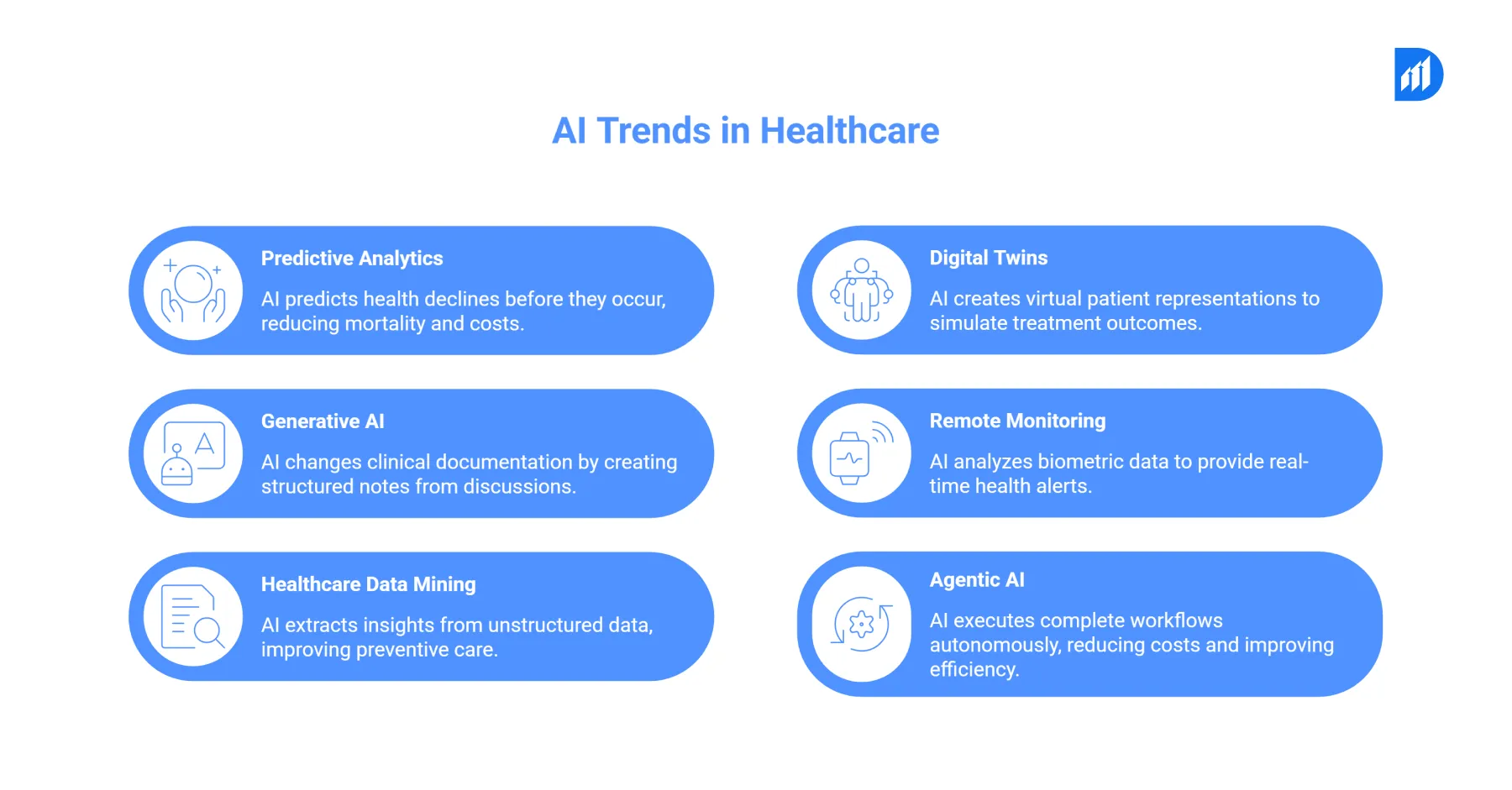
1. Predictive Analytics Is Replacing Reactive Care Models
Most hospital systems use their services to respond to emergency situations. The medical team takes action once the patient’s condition starts to decline. However, predictive AI creates an entirely new way of operating. The platforms which use Azure Machine Learning and AWS SageMaker tools now study over 1000 different factors. They predict when patients will experience dangerous health declines before an actual medical crisis occurs.
Johns Hopkins University used a predictive sepsis model which achieved a 10% reduction in sepsis mortality during its first year. As a result, the 500 bed hospital saves multiple lives and reduces ICU expenses by millions every year. This clearly reflects how AI adoption patterns in healthcare have evolved through 2026, shifting from passive data access to active clinical intervention.
2. Generative AI Is Changing Clinical Documentation Forever
The medical field faces a serious problem because doctors experience burnout at high rates. In fact, doctors spend almost half of their work hours on documentation according to a Stanford Medicine survey. Therefore, the healthcare industry uses generative AI through ambient clinical documentation tools. These tools use large language models to create structured EHR notes from patient-physician discussions.
Early adopters report saving 90 minutes per physician per day. In addition, the system recovers thousands of clinical work hours every month without needing extra staff. Health systems use Nuance DAX platforms which function with Microsoft Azure OpenAI Service for their operations.
3. Healthcare Data Mining Unlocks Insights Hidden in Unstructured Data
Healthcare institutions possess more than 80 percent of their data as unstructured information. This data exists within physician notes and radiology reports and discharge summaries and patient messages. Traditional analytics tools cannot match it. However, healthcare data mining techniques use natural language processing and transformer-based models. They enable researchers to extract structured data from unstructured records at large scale.
An insurer organization studied 4 million patient records using NLP-based data mining. Consequently, they discovered 23 percent additional patients who qualified for preventive care programs. The infrastructure of enterprise systems operates through technologies such as Databricks and Snowflake and Apache Spark which create this operational capability.
4. Digital Twins in Healthcare Are Moving from Research to Operations
A digital twin creates a virtual representation that duplicates a patient, an organ, or an entire hospital system. Digital twins in healthcare let clinicians simulate treatment outcomes before administering them. For instance, the oncology team can create tumor response models which predict treatment results based on chemotherapy combinations and actual patient genetic information.
Siemens Healthineers and Philips are both shipping digital twin capabilities for cardiac care. Furthermore, digital twin simulations have shown a decreased rate of adverse drug reactions by 30 percent in clinical research. The concept has progressed beyond laboratory testing. Standard clinical procedures now implement it.
5. AI-Powered Remote Monitoring System
The AI-Powered Remote Monitoring System establishes continuous patient observation. It reaches beyond what is possible through scheduled appointments alone. A patient only interacts with their doctor for less than 1 percent of their life. In other words, most health mishaps occur at home. The AI-driven remote patient monitoring platforms analyze biometric data from wearables continuously. They provide real-time alerts about health condition changes to medical teams. During clinical trials for heart failure and COPD, the technology is proven effective by showing a decreased 30-day hospital readmission rate. This directly impacts one of the most expensive factors in hospital reimbursement.
6. Agentic AI: The Trend Every Healthcare Leader Is Watching Right Now
The AI Trends in Healthcare for 2026 will experience its largest transformation through this development. Agentic AI generates content and provides operational insights at its core. Moreover, these systems operate autonomously to execute complete workflows without human intervention throughout the entire process.
According to Deloitte’s 2026 US Health Care Outlook Survey, more than 80 percent of healthcare executives anticipate that agentic AI will bring substantial advantages this year. The research indicates that 98 percent of executives anticipate at least 10 percent cost reductions through agentic systems within the upcoming years.
Real-World Agentic AI Applications Already in Use
The real-world applications of the technology have already begun. For example, the Mayo Clinic uses AI agents to verify eligibility, manage prior authorization, and support prescription needs. An agentic AI framework enabled a Snowflake client to reduce clinician chart review time by 98 percent. It maintained 99 percent accuracy in infection control reporting. That transformed a 7-10 day process into near real-time results. In fact, the system needs an agent that completes data processing tasks from start to finish.
The research from Microsoft and Health Management Academy in the New England Journal of Medicine shows that 43% of health systems currently test agentic AI systems. Meanwhile, 60% expect these systems to enhance patient-provider interactions. However, only 3% of organizations have implemented agents throughout their operational systems. The organizations which develop agentic infrastructure will therefore determine their operational speed for the upcoming five years.
Why Prior Authorization Is the Best Use Case
The prior authorization problem alone illustrates the value. The typical process requires providers to collect clinical documentation, confirm payer requirements, and complete form submission and tracking. As a result, agentic systems operate all of this without human intervention. AI agents identify authorization needs, extract EHR data, fill payer forms, and track submissions. Revenue cycle teams handle thousands of requests monthly. Ultimately, the entire process has been transformed through a new workflow design.
When AI Trends in Healthcare Deliver Strong ROI and When They Do Not
Not every AI deployment produces value. Understanding where the solution fits the problem matters more than the technology itself. This applies across all AI Trends in Healthcare, not just agentic systems. According to a Guidehouse survey, 50% of healthcare executives face three main obstacles: cybersecurity issues, data privacy concerns, and financial limitations. Furthermore, over 40% consider data quality and governance the main restricting factor. Identifying specific use cases helps organizations prevent costly project failures.
| Use Case | Strong ROI Signal | Caution Flag |
| Predictive deterioration alerts | High patient volume, ICU infrastructure | Small facilities with limited EHR data |
| Generative AI documentation | High documentation burden, EHR integration | Specialty areas with highly variable language |
| Healthcare data mining | Large unstructured data stores | Siloed or low-quality historical data |
| Digital twins | Complex chronic or oncology cases | Early-stage facilities lacking imaging data |
| Remote monitoring | Chronic disease populations | Patients without device access or digital literacy |
| Agentic AI workflows | High-volume, rules-driven admin tasks | Organizations without clean, interoperable EHR data |
AI reaches its highest performance when data systems are clean, use cases are well defined, and staff act on generated results. The absence of these three criteria creates difficulties for even advanced solutions. In short, this table shows the healthcare business insights which organizations collected through actual implementation patterns of their enterprise health systems.
The Infrastructure That Makes AI Trends in Healthcare Scalable
The infrastructure serves as the main factor that separates proof of concept from actual AI system implementation. Understanding how AI Trends in Healthcare connect to infrastructure choices is something more organizations are starting to take seriously. Specifically, future trends in healthcare informatics point clearly toward cloud-native, interoperable architectures built on FHIR standards.
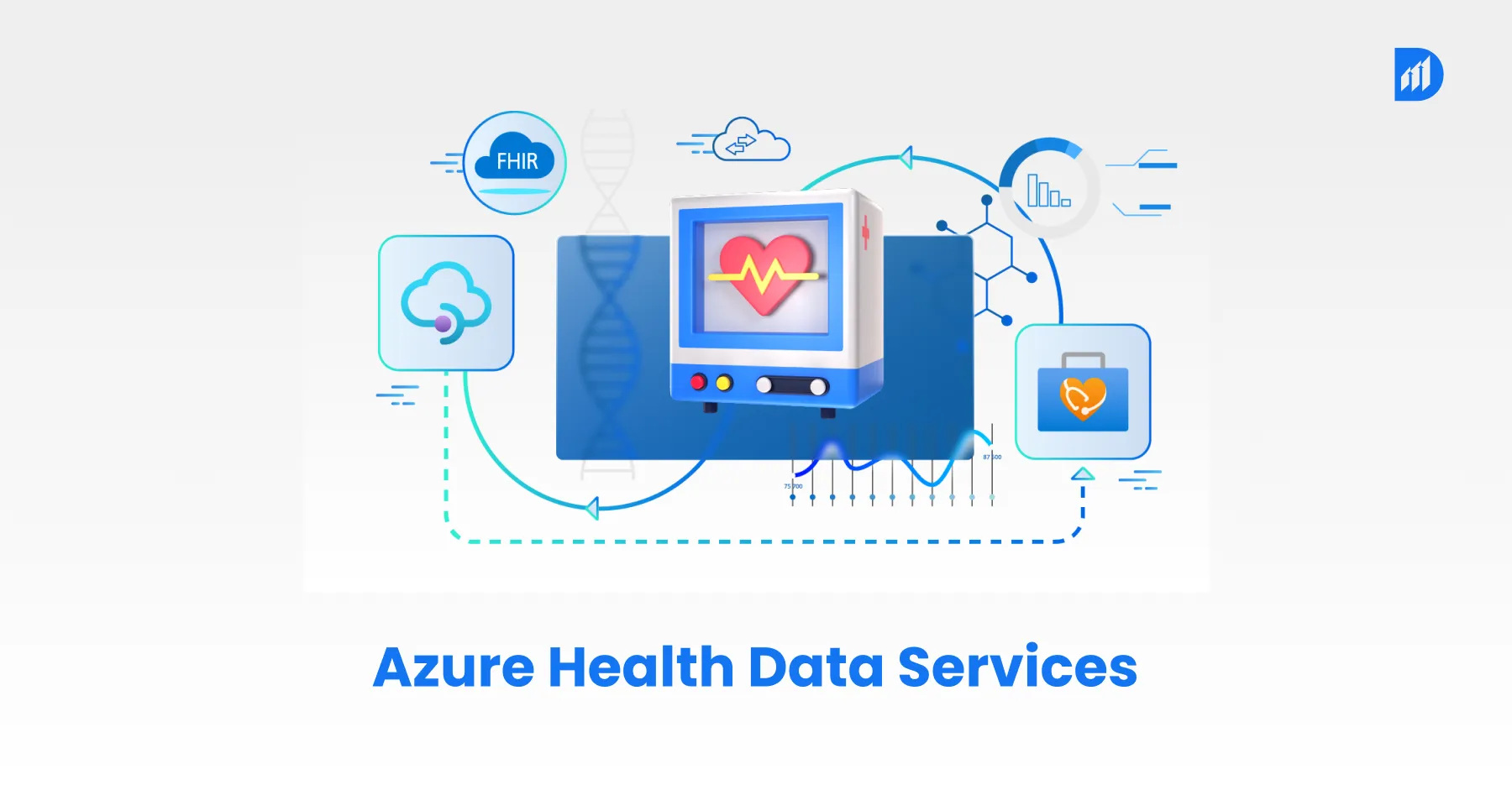
The three platforms: Azure Health Data Services, AWS HealthLake, and Google Cloud Healthcare API establish a data normalization system. This enables AI models to learn from multiple data sources. Without that component, models train on inconsistent information and generate inaccurate results. According to NVIDIA’s 2026 State of AI in Healthcare survey, 82% of healthcare institutions consider open-source AI models as moderate to extremely essential for their AI development.
Medical imaging serves as a prime example of how infrastructure investments lead to financial returns. The FDA has now authorized 1,357 AI-enabled medical devices. Additionally, 61% of medical technology companies use AI for imaging while 57% report measurable ROI from these technologies. The AI-assisted scan analysis process helps radiology teams work more efficiently. AI detects anomalies first, then physicians confirm results to expedite case handling.
Healthcare IT consulting teams play a critical role here. They assist organizations in evaluating data readiness while developing governance frameworks and selecting appropriate platforms. In fact, omitting this step is the primary reason AI projects stall after initial tests. The Healthcare IT Consulting work at Durapid begins with data readiness assessment because of this requirement.
What the Data Says About AI in Healthcare Trends and Outcomes ?
The healthcare community has reached a common agreement that embedded AI workflows provide better results than standalone analytics dashboards. The findings of this study align with the AI Trends in Healthcare domain which has developed over the past two years. According to a 2024 HIMSS survey, health systems that used embedded AI workflows achieved 41% better clinician satisfaction and 27% fewer diagnostic errors than systems that relied on standalone AI tools.
Health system executives now have different perspectives on return on investment. AI represents more than a financial measure for organizations. Instead, organizations use it to enhance quality while retaining employees. The National Center for Health Workforce Analysis anticipates a 10% national nursing shortage by 2027. So organizations must adopt AI to maintain adequate staffing levels. Tracking insight healthcare metrics alongside workforce data is becoming a standard part of strategic planning.
The Governance Gap: The Barrier Most Organizations Are Not Ready For
Most health systems have been unable to establish governance methods which can match their current rate of technology adoption. This is one of the most underreported AI Trends in Healthcare right now. The FDA has authorized more than 1357 AI-based medical devices. Yet only a small number receive active insurance reimbursement codes. As a result, health systems must handle operational tools that work normally while financial payment systems remain incomplete. Internal research shows that healthcare leaders in 67% of organizations consider burnout their primary staffing issue.
Meanwhile, 95% report that existing staffing gaps have already started to reduce care standards. Therefore, AI governance frameworks require organizations to establish direct control over both medical safety and workforce operations.
Organizations that achieve success establish governance as their primary operational design element. They create audit trails for all automated decisions, perform bias testing on training data, and set protocols for human review of clinical AI outputs. Ultimately, the future trends in healthcare informatics depend on trust. Trust requires organizations to establish system accountability from the foundational level.
Frequently Asked Questions
What are the biggest AI Trends in Healthcare for 2026?
Agentic AI, generative AI documentation, predictive analytics, healthcare data mining, and digital twins are driving the strongest near-term ROI. These AI Trends in Healthcare are moving from pilots to real operational impact in 2026.
What is agentic AI in healthcare and why does it matter now?
Agentic AI refers to systems that autonomously plan and execute multi-step workflows like prior authorization or scheduling without constant human input. With most executives expecting strong value in 2026, it matters because efficiency and speed are now strategic priorities.
How does AI improve patient outcomes specifically?
AI flags health deterioration earlier, reduces documentation errors, and personalizes treatment using clinical and genomic data. It also enables continuous monitoring between visits, shifting care from reactive to proactive.
Is healthcare data mining safe for patient privacy?
Yes, when implemented with proper de-identification protocols and HIPAA-compliant infrastructure. Modern platforms include built-in governance, encryption, and audit controls to protect patient data.
How should healthcare organizations start if they have no AI infrastructure?
Begin with a data readiness assessment and one high-impact use case like predictive readmission alerts. Establish governance first, then scale strategically with support from a Healthcare IT Consulting partner. Understanding the core AI in healthcare trends before committing to a platform helps avoid costly course corrections. For healthcare business insights on where to start, organizations should assess both their data maturity and their top operational pain points. AI consumer behavior trends healthcare 2026 data shows that patient expectations around digital access are rising fast, making this the right moment to act on insight healthcare leaders have been gathering for years.

Rahul Jain
Recent Blog

Private Blockchain vs Public Blockchain: Pros, Cons, and Business Impact
February 28, 2026