AI in Manufacturing: Key Use Cases, Benefits, and ROI Insights
Imagine a scenario where an unnoticeable breakdown in a semiconductor plant led to a financial loss of no less than $2.3 million during one quarter only. AI in manufacturing is no longer a futuristic concept, it’s already changing outcomes on the factory floor. The maintenance staff performed their duties per the standard procedure, doing a monthly inspection, then a complete overhaul every quarter, but the big malfunction occurred right in between the inspections. Meanwhile, an AI-powered rival in the same industry was able to foresee those defects 2 days ahead, enjoyed a 99.2% operational time, and had an annual cost saving of $1.8 million. What was the reason for the difference? The use of predictive algorithms analyzing sensor data in real-time as opposed to hoping nothing will break until the next inspection.
Each day, over 1,800 terabytes of data to be worked on comes directly from the manufacturing process. Nevertheless, 73% of this data is still being stored in legacy systems, and that is why it is not being utilized. AI in manufacturing converts this inactive data into intelligence you can act on. Companies embracing artificial intelligence in manufacturing witness a 20% reduction in production cycle time, a 30% decrease in quality defects, and 25% cut in operational costs compared to traditional ways. This isn’t about future automation, it’s about present-day production issues being tackled with high accuracy.
What Is the Role of AI in Manufacturing Operations?
AI in the industry works like the brain of the operation. It links up the machines, the processes, and the decision-making systems. Manufacturers have moved on from just troubleshooting reactions. Now they predict equipment failures, optimize production schedules, and automatically adjust quality parameters, all without direct human intervention.
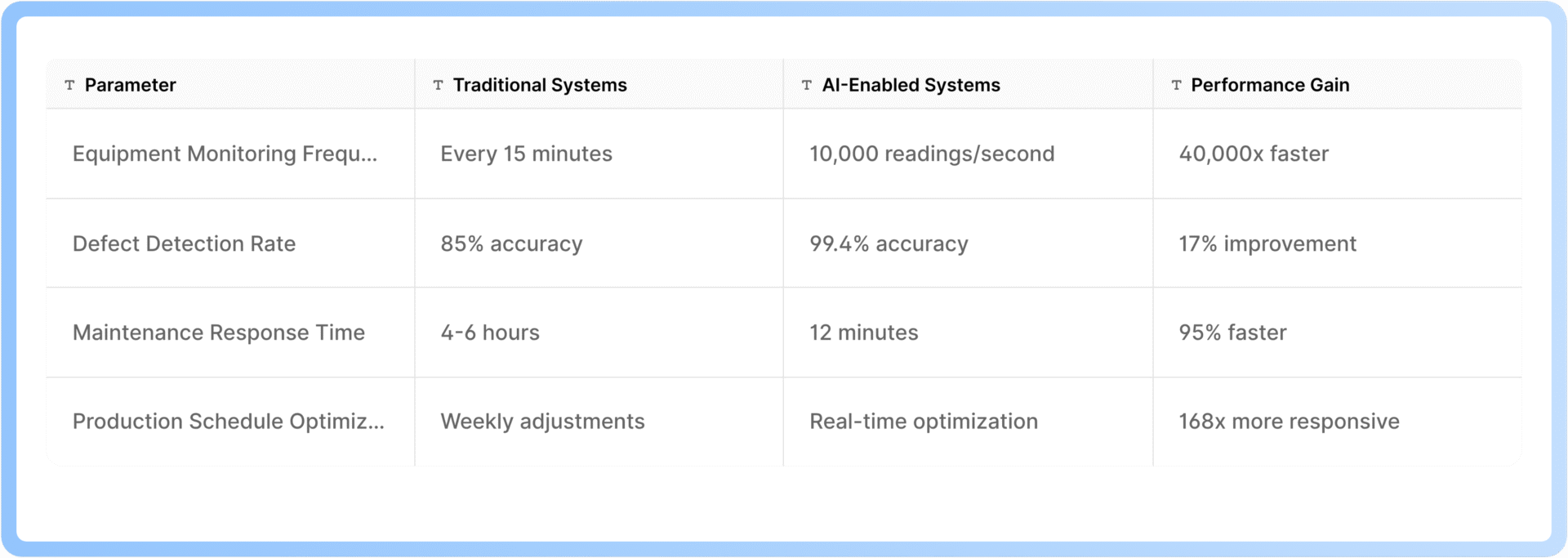
This technology mixes machine learning algorithms with industrial IoT sensors that look at production patterns. If a CNC machine gets detected with vibration anomalies 0.3 milliseconds beyond normal, AI alerts it long before human technicians see performance degradation. Conventional monitoring systems check machine condition every 15 minutes. AI-powered ones check 10,000 data points in a second, capturing issues that manual inspection might miss entirely.
Essential Parts of AI-Driven Manufacturing Systems
Modern AI in industrial automation bases itself on three closely related parts. First, edge computing devices capture real-time data from production machines. They process information locally to cut down latency. Second, machine learning models study historical patterns. They find the best places to optimize. Third, automated control systems make changes with no human involvement.
Specification Comparison: Traditional vs. AI Manufacturing Systems
A German car maker put AI vision systems in place on their assembly lines. They spotted paint flaws 28% quicker than human inspectors. The machine takes 300 pictures of cars per minute. It identifies micro-scratches that aren’t even visible to the naked eye. Such accuracy was out of reach for manual quality control that checked only 15 vehicles a day.
Benefits, Use Cases, and Applications of AI in Manufacturing Industry
Factory workers accepting AI app development solutions report significant progress. They see improvements in production efficiency, quality control, and supply chain optimization. It’s not an incremental change, companies report a 35-50% decrease in unplanned downtime and a 40% increase in resource utilization.
Predictive Maintenance and Equipment Optimization
Machine learning in manufacturing predicts and prevents failures. Sensors continuously monitor different parameters. These include temperature variations, vibration patterns, and power usage of production machines. As soon as algorithms learn of anomalies indicating bearing wear or motor degradation, maintenance teams get notified 2-3 days before breakdown day.
By resorting to predictive maintenance based on machine learning, a steel manufacturing plant brought down its unplanned downtime. It went from 18 hours a month to 3 hours. The AI application scrutinized data collected from 240 sensors. It foresaw the failure of specific components with 94% accuracy. As for financial impact? $4.2 million in production losses avoided every year. This compared to a $680,000 investment for implementation, a 6:1 return on investment in the first year.
Quality Control and Defect Detection
Computer vision technologies detect faulty products where human inspectors cannot. Among AI manufacturing applications, electronics manufacturers employ high-speed cameras. They monitor printed circuit boards for solder defects, component misalignment, and micro-cracks. These systems process 450 boards per hour with 99.6% accuracy. Manual inspection handles only 120 boards per hour with 91% accuracy.
Automation in manufacturing went beyond just defect detection. Whenever AI spots quality issues that occur over and over, it automatically adjusts machine parameters. A pharmaceutical company producing tablet medicine cut down weight variation in tablets. It went from ±8% to ±1.2% following the introduction of AI-controlled dosing systems. Such accuracy led to 340,000 fewer substandard units disposed of every year. The company saved $1.7 million on materials alone.
Supply Chain and Inventory Intelligence
AI actively optimizes inventory levels by analyzing demand patterns, supplier reliability, and production capacity. Instead of maintaining 60-day safety stock, manufacturers using AI Agent Development platforms reduce inventory to 22 days, one of the most practical AI in manufacturing examples seen in mid-sized operations. They maintain 99.1% order fulfillment rates. This inventory reduction freed $8.3 million in working capital for a mid-sized electronics manufacturer.
Companies that traded neural nets for statistical models realized a 43% improvement in demand forecasting accuracy. These systems incorporate variables traditional forecasting ignores. Weather patterns affect logistics. Geopolitical events disrupt supply chains. Competitor pricing strategies influence demand. A consumer products supplier contained their forecast wrongness from 18% to 9.4%. They saved $2.6 million in inventory costs every three months.
Latest Trends in AI and Manufacturing in 2026
Generative AI entered factory floors in 2025. Reliance on it surged 230% in the first quarter of 2026. Manufacturers now use Gen AI Chatbot Development to keep technicians continuously updated. They get instant guidance in case of problems with their devices. Operators narrate the situation using natural language. AI agents provide detailed repair instructions based on maintenance databases and manufacturer documentation.
Digital twins – virtual representations of physical production systems turned out to be standard practice. These simulations operate all the time. They test process changes before implementing them on real machines. A beverage bottling company applied digital twin technology to their line changeover procedures. They optimized them, reducing setup time from 47 minutes to 18 minutes. The 340 changeovers annually produced a saving of 164 production hours, worth $420,000 in increased output.
Edge AI and Real-Time Processing
Edge AI deployment witnessed a 175% increase. Manufacturers moved processing power nearer to devices. Rather than transmitting sensor data to cloud servers for analysis, edge devices make local decisions in 8-12 milliseconds. This quickness is critical for processes needing instant corrections. Injection molding systems adjust cavity pressure in real-time. Robotic welders modify arc length every 0.03 seconds.
What Are Concerns About AI in Manufacturing?
The very high implementation costs usually associated with AI are the main reason companies delay planning implementation. Small manufacturers think ai in industrial automation will cost them at least $2 million to $5 million upfront. However, reality is quite different. Modular AI solutions start at $85,000 for single production line optimization. A textile manufacturer installed quality inspection AI for $120,000. After 8 months of cost reduction and labor reallocation, it recovered the investment.
The workforce issue is job displacement. Research indicates AI in manufacturing reduces repetitive manual work by 23%. At the same time it creates demand for 31% more technical workers. Companies introducing AI successfully retrain workers. Operators become system supervisors, data analysts, and maintenance specialists. For instance, a packaging company reallocated 18 quality inspectors as monitors of AI systems after automation. They kept inspectors employed while increasing inspection capacity by 380%.
Security and Integration Challenges
The growth of connected devices increased areas that attackers can target. This resulted in higher data security risk. Ransomware incidents in manufacturing increased 140% between 2023-2025. Attackers mainly focus on production control systems. Manufacturers using AI systems connected to company networks apply security measures. They use network segmentation, encrypted communication, and zero-trust architecture.
Integration with older equipment in factories is complicated from a technical standpoint. Companies applying AI in manufacturing face difficulties if they still use machines 15-20 years old. These machines don’t come with built-in connectivity for AI systems. Retrofitting solutions like external sensors and protocol converters cost between $12,000 and $35,000 per machine. They allow AI use without replacing operational equipment. One automotive parts maker spent $890,000 to link 43 old CNC machines to an AI monitoring system. They realized predictive maintenance across the entire plant.
How to Use AI in Manufacturing: Examples and Use Cases
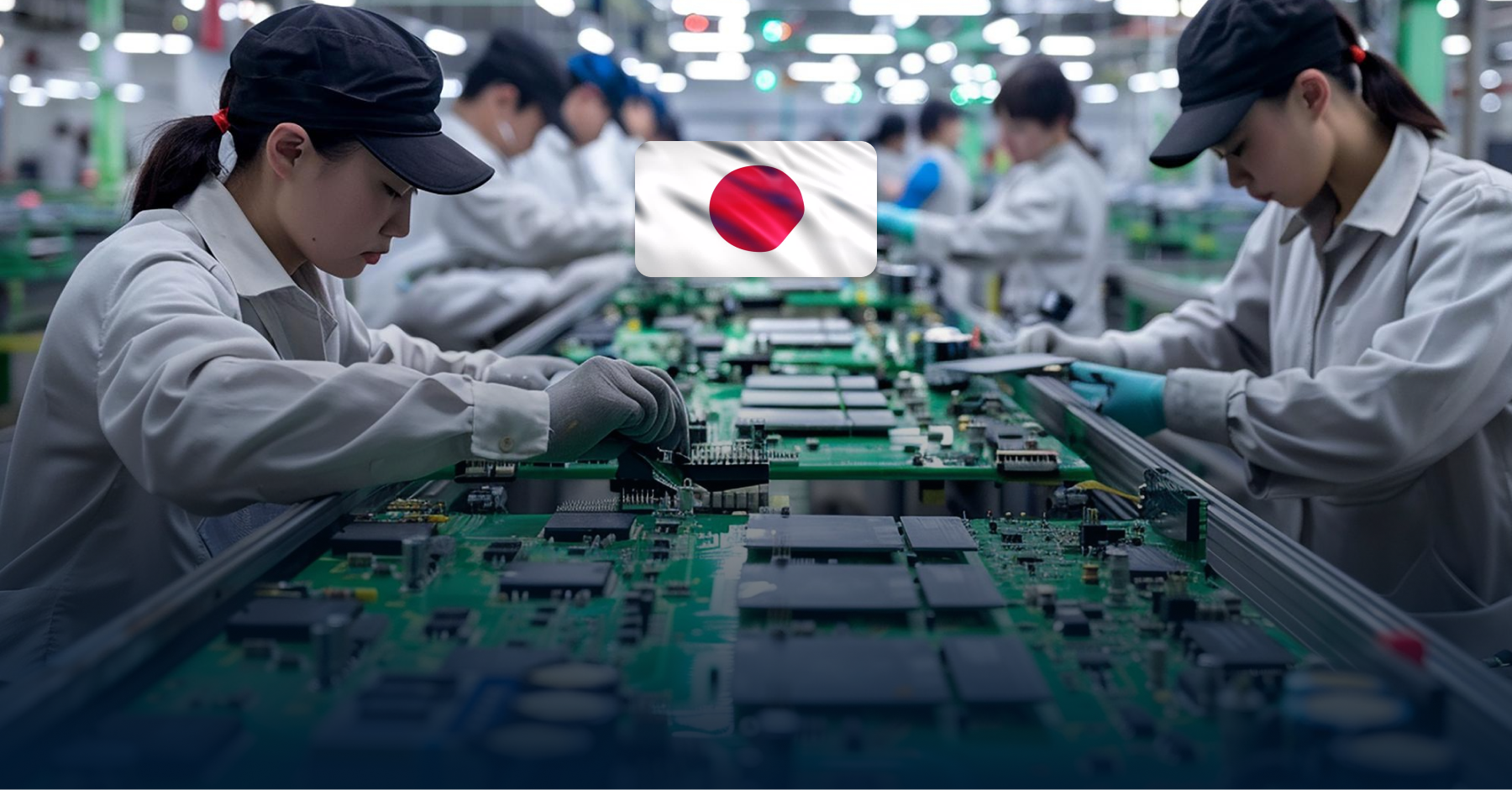
A Japanese electronics manufacturer suffered a 12% return rate on their products. Microscopic solder defects couldn’t be detected during production. They decided to use computer vision AI on six SMT assembly lines. They put in place high-resolution cameras taking 8K pictures of each circuit board. The system looks at 2,400 solder joints per board in 0.4 seconds. It spots cold joints, bridging, and insufficient solder coverage.
Implementation went through stages lasting 9 weeks from pilot testing to full deployment. Engineers utilized a training dataset of 50,000 images. These contained both defective and non-defective solder joints to train the neural network. The system successfully acquired the ability to differentiate among 17 defect types. It achieved 99.3% accuracy, surpassing experienced inspectors at 94% accuracy. After six months, returned products decreased from 12% to 1.8%. This resulted in a saving of $6.4 million in warranty costs and customer replacements per year.
The technical architecture combined edge computing with cloud-based learning. Edge devices processed images at the site making real-time pass/fail decisions. Cloud systems constantly collected data and refined the model. In case production changed by adding new components or solder types, AI adapted through transfer learning. This required only 500-800 new training images versus total retraining.
This manufacturer didn’t stop at detecting defects. They extended AI capabilities further. The decision-making system got equipped to set reflow oven temperature profiles with precision. It considered board complexity, component density, and solder paste characteristics. Production yield increased 8.4% as AI kept thermal stress on sensitive components minimal. Meanwhile it made sure solder melting went on correctly.
Adoption of AI in Manufacturing: Key Challenges and Concerns
Lack of skills restricts the speed of AI adoption. Employers in the manufacturing sector indicate it’s hard to find candidates. They need both IT knowledge and data science skills – 68% report this difficulty. Companies take on such issues by collaborating with technical colleges. They provide apprenticeship programs mixing traditional manufacturing with AI system training. For instance, a machinery manufacturer invented a program lasting 16 months. It allowed skilled machinists to acquire knowledge of AI system specialists. 34 professionals graduated across three cohorts in this process.
Decision makers get confounded by difficulties in measuring ROI. Purchases of traditional capital equipment have clear payback periods. Buy a $400,000 machine, produce 12,000 more units annually, calculate exact ROI. AI in manufacturing generates value through defect prevention, avoiding downtimes, and improving efficiency. Existing financial models struggle to quantify this. However, progressive manufacturers adopted ‘value engineering’ frameworks. They assign monetary values to prevent quality escapes ($8,500 per incident) and avoid downtime hours ($3,200 per hour).
Resistance to change management is one reason for delayed implementation. Production supervisors with 25 years of experience prefer their own instinct to algorithms. The introduction of new technology works by taking operators along the way to the end. Don’t impose systems on them. Collaborate on defining the problem and solution design. The more workers feel AI is part of their expertise rather than a replacement of judgment, the faster adoption goes. Employee satisfaction surveys at AI-implementing manufacturers show positive reception is 76% when workers participate in deployment. It’s only 41% when systems get imposed from the top down.
FAQs
How much does AI implementation cost in manufacturing?
Entry-level AI systems start at $85,000 for single-line applications, with enterprise deployments ranging $800,000-$2.5 million depending on facility size and complexity.
What ROI timeframe should manufacturers expect from AI?
Most implementations achieve payback within 12-18 months through reduced downtime, improved quality, and lower operational costs, with some quality inspection systems recovering costs in 6-8 months.
Can AI work with existing manufacturing equipment?
Yes, retrofit sensors and edge computing devices enable AI capabilities on legacy machinery, typically adding $12,000-$35,000 per machine versus full equipment replacement.
What skills do workers need for AI manufacturing systems?
Technical roles require data literacy and basic programming, while operators need system monitoring skills and process knowledge, with most companies providing 8-16 weeks of training.
How does AI handle custom or low-volume production?
Transfer learning allows AI models to adapt to new products using 500-2,000 examples rather than tens of thousands, making systems viable for job shops and custom manufacturers.
Recent Blog

Private Blockchain vs Public Blockchain: Pros, Cons, and Business Impact
February 28, 2026-
What Is Agentic Commerce? Strategy, Technology, and Implementation Guide
February 22, 2026