
About the Client
Picture a firm with 10,000+ employees spread across Asia, the Middle East, and Europe, each region governed by its own rules on leave, benefits, and contracts. Now picture trying to answer one simple employee question correctly for every single one of them.
That was the daily reality for this global professional services firm. It operates in highly regulated industries, where compliance requirements differ by country, role, and employment type. For a firm this size, an HR question is never just an HR question. It is a compliance question wearing a friendlier face.
The Goal
The brief was easy to say and hard to deliver. Build a single, governed source of HR policy truth inside Microsoft Teams, where employees already work. Cut query resolution time. Eliminate jurisdiction-mismatched answers. Free HR from repetitive tickets so the team could finally spend its time on work that actually needed a human.
Four lines on a page. Months of unwinding fragmented, untrustworthy data behind them.
The Challenge, and What Was Tried Before
Ask an employee at this firm where to find the real HR policy, and you would get three different answers, all wrong in their own way. Policy documents lived in three places: 188 untagged files sitting in a SharePoint folder untouched since 2021, a PDF emailed at onboarding and never updated since, and an inbox attachment that had quietly become the unofficial source of truth, simply because it was the easiest thing to find. No version control. No metadata. No way to tell if a document was even current.
So people did what people always do when a system stops working for them. They stopped trusting it and started asking a colleague instead, and that answer was often wrong in ways nobody could trace back to anything. HR absorbed the cost of that broken trust directly. 60% of its time went into repetitive queries like leave balances and reimbursement rules, each one manually logged as a ticket, each one taking 2 to 3 hours to resolve. Two officers could give two different answers to the same question on the same day. Every inconsistency chipped away a little more at how much employees believed HR actually knew.
The firm had already tried to fix this, twice.
Keyword search across SharePoint sounded like a reasonable patch, until it returned every document containing the word “maternity” with no way to tell a UAE policy from a UK one. Email broadcasts meant to standardize distribution backfired just as badly. Employees ignored them, and outdated versions kept circulating in inboxes for months afterward, still being treated as gospel. Neither attempt solved the real problem, because the real problem was never search. It was fragmented, ungoverned content with no single version anyone could point to and trust.
Left alone, this was never just an efficiency problem. Every outdated policy an employee acted on in a regulated market was a compliance exposure quietly waiting to surface, and the risk only grew as headcount and ticket volume climbed.
Discovery & Research
Before Durapid touched a single line of architecture, the team went looking for the truth of the situation, not the version of it in the project brief.
The audit covered the SharePoint structure top to bottom, paired with stakeholder interviews across HR, IT security, and regional operations, because a compliance officer in Dubai and an HR generalist in London need very different things from the same policy library. The sprawl turned out to be worse than anyone had flagged going in: 188 files, no metadata, no expiry tags, no mapping to jurisdiction or role whatsoever.
There was good news buried in the mess, though. The Microsoft stack the firm actually needed was already sitting there: Teams for daily communication, SharePoint for documents, Azure AD, now Entra ID, for identity. None of it was missing. It was just badly governed. And the client was clear on one point from day one: no new platform. Whatever got built had to work inside what they already had.
Why This Approach
Two alternatives came up early, and both got ruled out fast, for reasons that mattered.
A third-party HR knowledge base would have meant pulling sensitive employee data outside Microsoft entirely, triggering a fresh round of vendor compliance review, and still ending up with no native Teams integration. A SharePoint governance overhaul with smarter search sounded like the safer middle ground, but it still could not interpret intent. Ask it “what’s my notice period,” and it would hand back every document containing that phrase, not the one policy that actually applied to that employee’s contract and country.
The only approach that solved retrieval quality and governance at the same time, without making the firm leave its own ecosystem, was a Retrieval-Augmented Generation system built on Azure OpenAI, with Azure Cognitive Search handling semantic retrieval and SharePoint Online staying the governed source of truth. As a Microsoft Solutions Partner for Data and AI, Durapid already had the certified architecture and partner access to build this without adding another vendor to an already complicated compliance picture.
Tech Stack
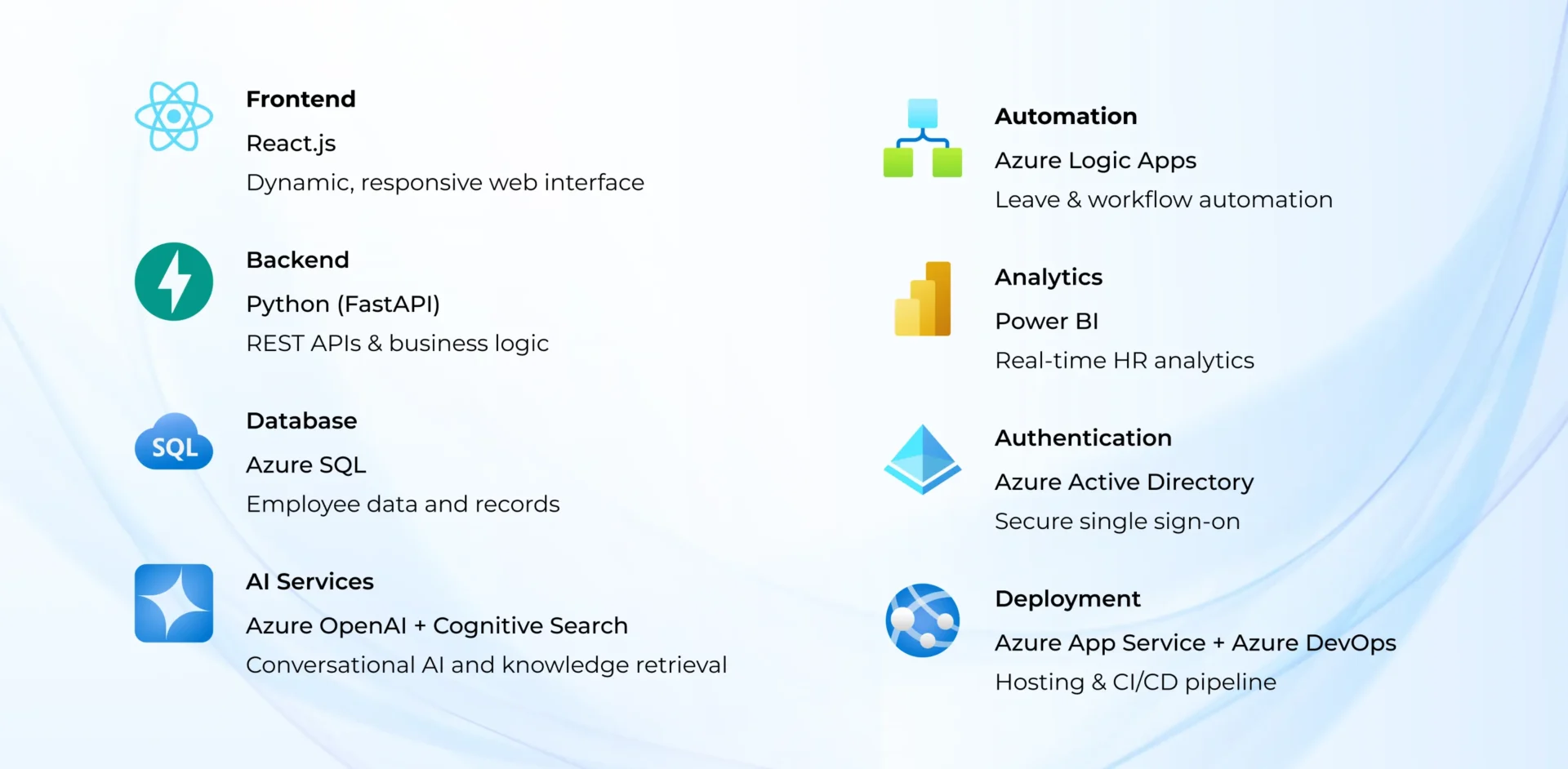
Generation: Azure OpenAI
Retrieval: Azure Cognitive Search, matching queries by meaning rather than keyword
Document repository: SharePoint Online, with documents tagged for jurisdiction, role, version, and effective date, plus automated version control to retire outdated copies
Deployment: Azure Bot Service inside Microsoft Teams
Indexing: Graph API for indexing and retrieval
Identity & access: Entra ID for SSO and role-based access
Security policy: Conditional Access for geo-fencing and MFA
Monitoring: Azure Monitor for audit logging
Accuracy: a validation pipeline between retrieval and generation to prevent hallucination, with every response carrying a citation and a direct SharePoint link
Every layer earned its place for a reason: speed for the employee asking the question, and governance for the compliance team that has to answer for it later.
Compliance & Security
In a firm operating across this many jurisdictions, compliance was never a checkbox to tick after the fact. It was the foundation everything else got built on.
All data stayed inside the client’s own Azure tenancy. Nothing went to external services. Entra ID enforced role-aware and geo-aware responses, so a UK employee could never be shown a UAE-specific policy as though it applied to them. Azure Monitor logged every query, every response, every document access, a hard requirement from the client’s legal team before sign-off, and the kind of detail that turns “we believe it’s compliant” into “we can prove it, on demand, for any query, on any day.”
Implementation
Migration & Governance: Audited and migrated all 188 files into governed SharePoint, defined metadata schemas covering jurisdiction, role, version, and effective and expiry dates, and automated the archiving of every superseded document so an old version could never resurface by accident.
Architecture: Built the RAG pipeline, with SharePoint as the source, Cognitive Search as the index, Azure OpenAI as the generation layer, and a validation pipeline sitting between retrieval and generation for citation accuracy. Designed the Teams bot flow, including country and category routing, so the right answer reached the right employee without them having to specify anything.
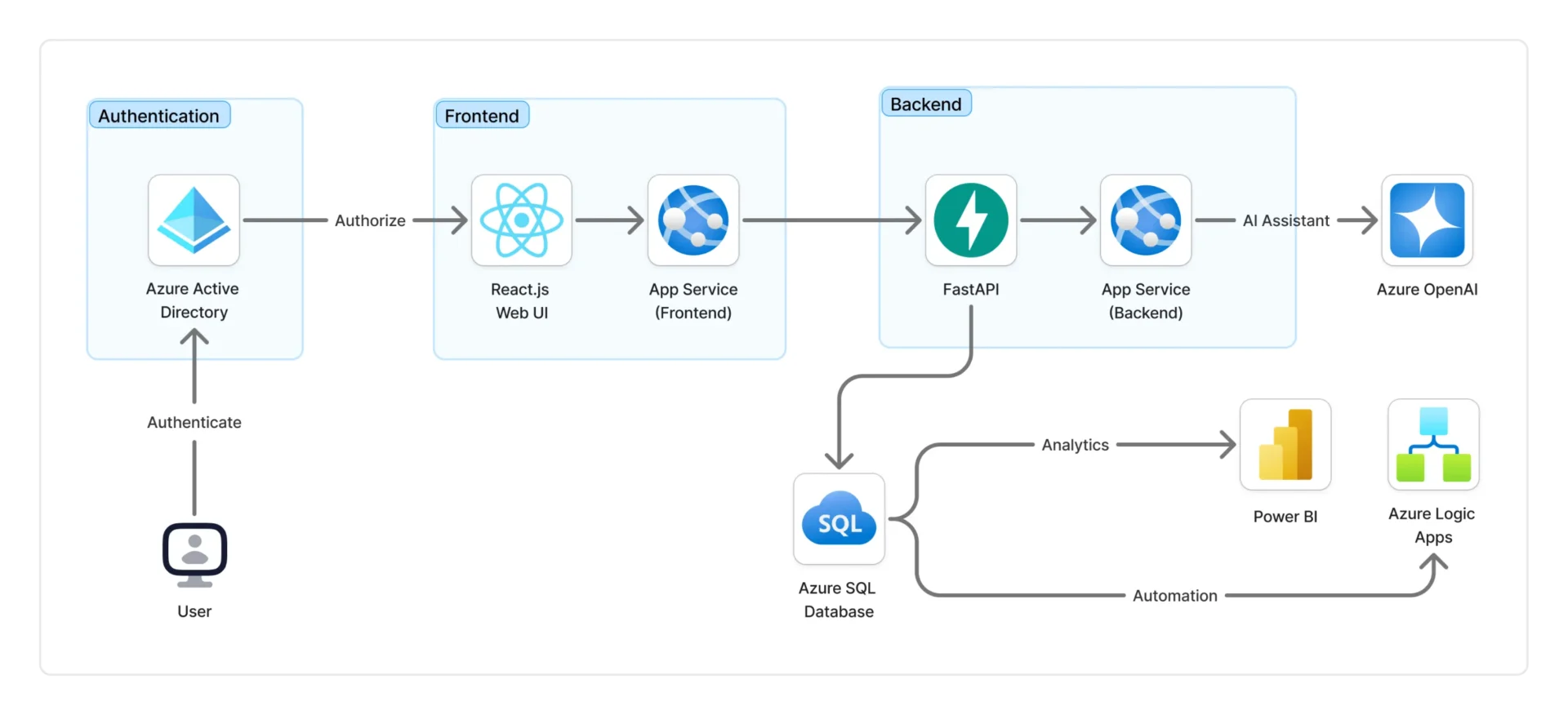
Build: Connected Azure Bot Service to Teams via the Bot Framework, wired the Graph API for real-time indexing of new documents, and built one-click ticket escalation into the existing HR helpdesk, for the cases that genuinely needed a human and not a database.
Testing & Optimization: Tested over 40 query scenarios across six jurisdictions, tuned the validation pipeline to cut false-positive citations, and set up Azure Monitor dashboards to track query volume and adoption from week one.
Execution Challenge
Migration surfaced a problem nobody had fully reckoned with going in.
Several policies existed in conflicting versions at once: one on SharePoint, one as a shared-drive PDF, one as a forwarded email attachment, and in two cases the actual content materially differed between them. No clever query logic could decide which version was correct. That call needed people, specifically regional HR stakeholders who had not originally been part of the project scope, to formally sign off on the authoritative version before a single document got ingested.
It added two weeks to the timeline. It also confirmed something worth remembering for anyone attempting this kind of project: document governance problems that look technical on the surface are almost always people and process problems underneath, and no AI system can quietly paper over that gap. It can only be as honest as the documents it is allowed to trust.
Results & Business Impact
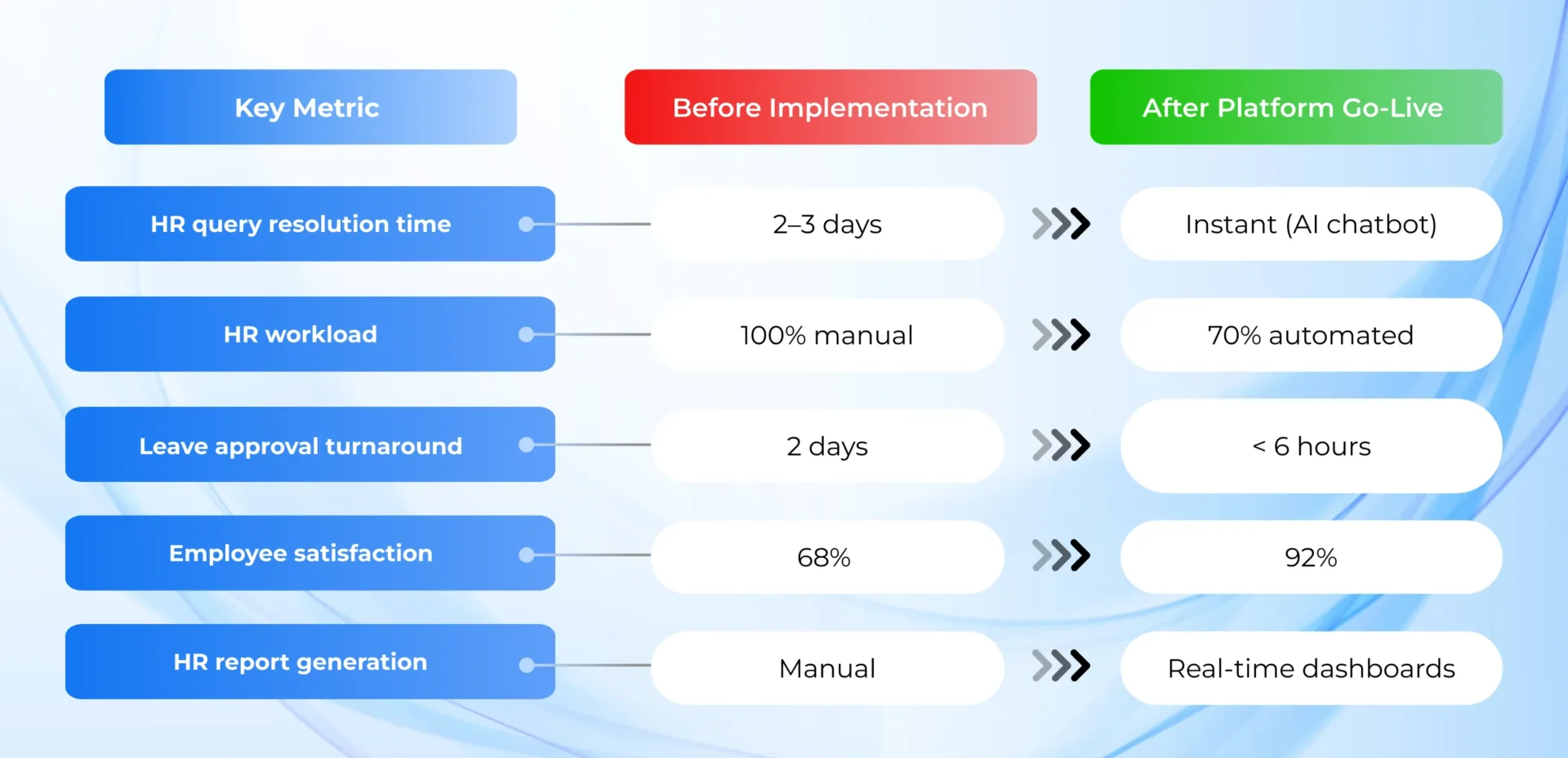
Query resolution dropped from 2 to 3 hours to under 30 seconds. Read that again: hours to seconds. HR officers who once spent most of their day answering leave-balance questions now spend it on the conversations and judgment calls a chatbot was never going to handle anyway.
Repetitive policy tickets fell 65%, and HR reclaimed 30% of its weekly capacity, time that manual answering had been quietly swallowing for years.
Employee satisfaction with HR communication rose 40%. An employee in Mumbai and one in Dubai can now ask the exact same question and get the answer that is actually correct for their own contract and country, not a generic answer that happens to be wrong for one of them.
Compliance risk from version confusion was eliminated through fully traceable, version-controlled retrieval. Every response carries a citation showing the exact document, version, and effective date, doing something no internal memo ever managed: resetting the trust dynamic between employees and HR.
The Real Win: A Reset in How Employees Experience HR
Here is what the numbers do not fully capture.
Before this project, asking HR a question came with a quiet undercurrent of doubt. Would the answer be right? Would it apply to your specific situation, your specific country? Would you have to ask twice just to be sure? That hesitation never showed up in any report, but it showed up everywhere else: in slower onboarding, in employees defaulting to a colleague instead of the system of record, in a low-grade wariness toward HR as a function that no engagement survey ever quite names.
That hesitation is largely gone now.
New hires get consistent, jurisdiction-correct answers from day one, instead of being handed a PDF and a list of people to chase if anything is unclear. Onboarding now runs on accurate information from the very first question, rather than slowly correcting itself over someone’s first confusing weeks on the job. HR officers, freed from the most repetitive 60% of their workload, have moved toward the parts of the role that actually build trust: complex cases, sensitive conversations, the judgment calls no system should ever be making on its own. And because every answer traces back to a governed, auditable document, the firm’s compliance exposure has gone from an open, growing risk to something it can demonstrate control over, which matters enormously when a regulator’s real question is never “was the answer right,” it is “can you prove it was right.”
So no, this was never really a ticket-deflection project, even though the ticket numbers are the easiest thing to put in a slide. It was a trust-rebuilding project that happened to use AI to get there. The productivity gains, the faster onboarding, the lower compliance exposure: all of it is downstream of the same fix. Employees finally have one place to go, and for the first time, they can actually believe what it tells them.
Key Learnings
Most large enterprises on Microsoft 365 already have the infrastructure they need: Teams, SharePoint, Entra ID. What is usually missing is not a platform. It is the governance and retrieval layer that should sit on top of it.
Document sprawl has to be fixed before the AI problem can be solved. A retrieval system is only ever as good as what it retrieves from, and cleaning the source data is not a preliminary step to rush past. It is the core of the project, often the part that quietly decides whether anything built on top of it can be trusted at all.
This architecture extends well beyond HR. Legal, Finance, Procurement, and IT policy management all face the exact same fragmented-document problem. HR was simply the first place this firm chose to fix it, not the last.
