What Is Agentic Commerce? Strategy, Technology, and Implementation Guide
Agentic commerce is quietly shifting online shopping from “click and compare” to “delegate and done.” Instead of users manually browsing ten tabs, AI commerce agents now understand intent, evaluate options, negotiate prices, and complete purchases almost like a digital representative working in the background. What once felt like futuristic agentic AI commerce is now turning into real market movement, and the rising wave of agentic commerce news is proof that this is not a trend, it is a structural shift in how transactions happen.
The concept of agentic commerce has transformed into a market force that impacts consumer purchasing methods and business selling techniques and automatic transaction processing. The global market opportunity will reach between three trillion and five trillion dollars three years from now according to McKinsey research. Your organization needs to prepare for AI agents who will choose which customers receive sales opportunities. The question is not whether your business will encounter agentic commerce.
This document explains agentic commerce as a concept and its system architecture and provides business organizations with guidance on implementing the technology.
What Is Agentic Commerce and How Does It Differ from Traditional E-Commerce?
Agentic commerce operates through e-commerce AI agents who execute product discovery and option comparison and price negotiation and purchase completion tasks on behalf of users across various platforms and systems. Traditional e-commerce requires customers to use a web browser for site navigation and product selection through various pages and to finalize their orders through the payment confirmation process. Agentic commerce operates through a different method. The user states an intent, and the AI agent executes everything that follows. The agent completes a transaction after it reads product catalogs and understands pricing rules and verifies stock availability and makes the sale.
The two systems create measurable distance between them. A human shopper typically takes 15 to 30 minutes to research and complete a product purchase. In contrast, the right APIs and protocols enable an AI agent to complete the same task in just a few seconds. As a result, enterprises experience better conversion rates while spending less to acquire new customers because they need to build connections with machines that now represent human consumers.
From User Intent to Autonomous Execution: The Agentic Commerce Transaction Flow
All agentic commerce transactions progress through an established series of stages. Product teams and engineers need to grasp this operational process because it enables them to create systems that function with agent e-commerce technology.
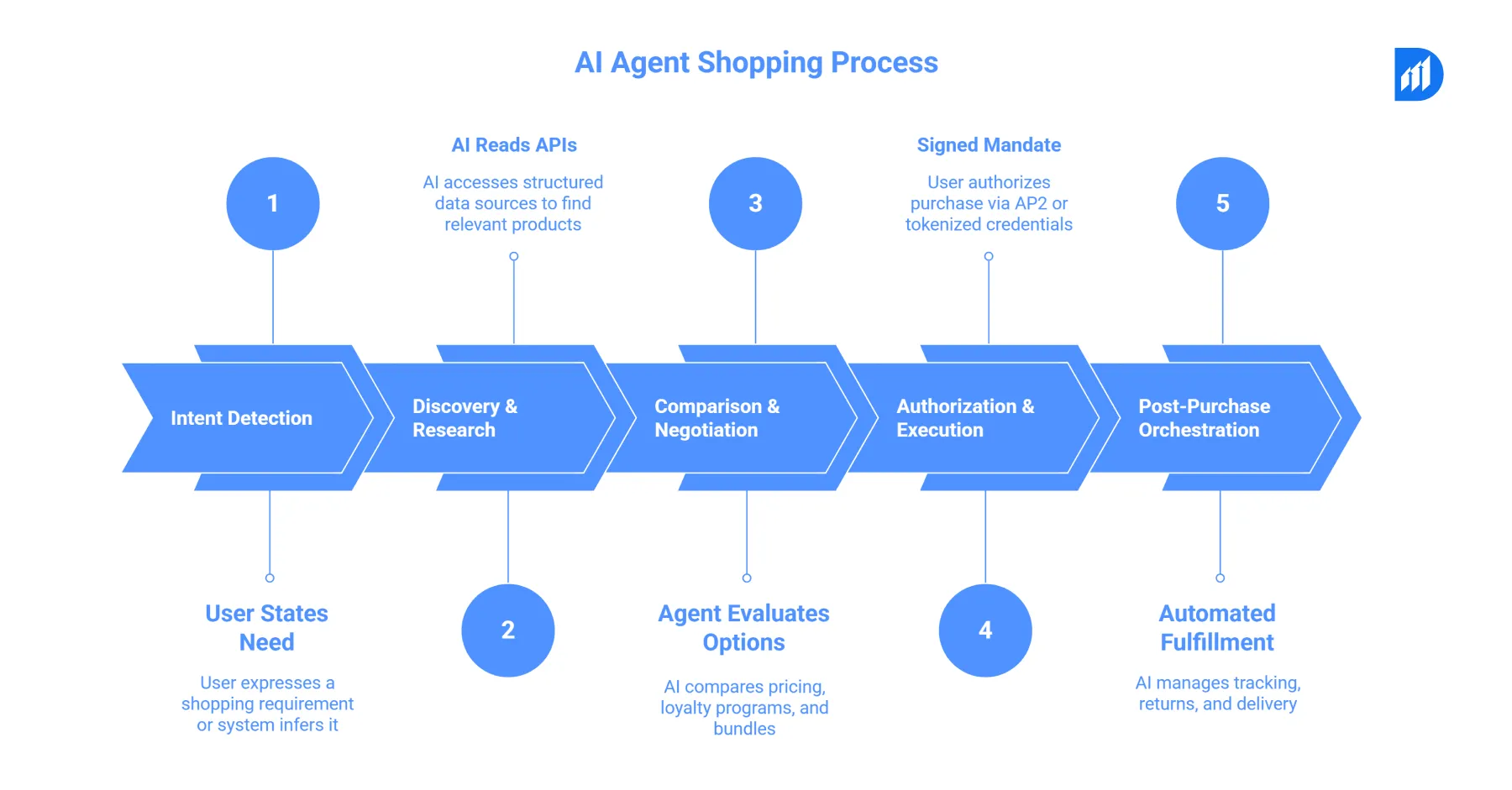
- Intent Detection: The user expresses a need, either directly or through contextual signals. For example, calendar invites for home moves can activate the purchase-planning system without any user input.
- Discovery and Research: The AI agent examines product catalogs while it reads product metadata to assess available options through structured data feeds and APIs. Traditional keyword-based search methods are no longer needed.
- Comparison and Negotiation: The agent assesses pricing information and competitor products while applying loyalty-based rules to execute direct bundle negotiations with merchant AI systems.
- Authorization and Execution: The transaction process uses Google Agent Payments Protocol (AP2) and Visa tokenized agent credentials to execute transactions with a cryptographically signed mandate that generates an authenticable audit trail.
- Post-Purchase Orchestration: The system manages delivery tracking and return processing and fulfillment status updates through automated API calls without requiring human intervention.
The flow operates successfully when merchants establish systems that can process and act upon requests which machines initiate. Businesses that continue using human-readable HTML content together with session-based checkout procedures will not be detected by AI agents.
The Role of Model Context Protocol (MCP) in Standardizing Agentic Transactions
The Model Context Protocol enables agents to conduct commerce because it represents Anthropic’s most important infrastructure discovery. MCP functions as an open standard for system interoperability which enables AI agents and systems to exchange context information about their current state and intended actions and stored knowledge and previous activities among various models and tools.
Less than two years ago, AI systems required standalone operation because engineering teams had not created methods to transfer information between different system environments. Knowledge could not be retained from earlier interactions, so users had to initiate a new session each time. Essentially, every interaction started from zero. MCP solves this by establishing continuous communication pathways which LLM applications use to connect with external systems through APIs and function calls.
In agentic commerce, therefore, MCP permits the agent to keep track of important user details like preferred shipping carriers, pending returns, and budget caps. This makes the experience genuinely personalized across all store visits.
Developers building agent-ready commerce platforms should treat MCP integration as a baseline requirement, not an advanced feature.
Agentic Commerce Architecture: Interaction, Orchestration, Translation, and Execution Layers
A robust agentic commerce system has four distinct architectural layers. Each layer handles a specific function, and failures at any layer break the entire transaction chain.
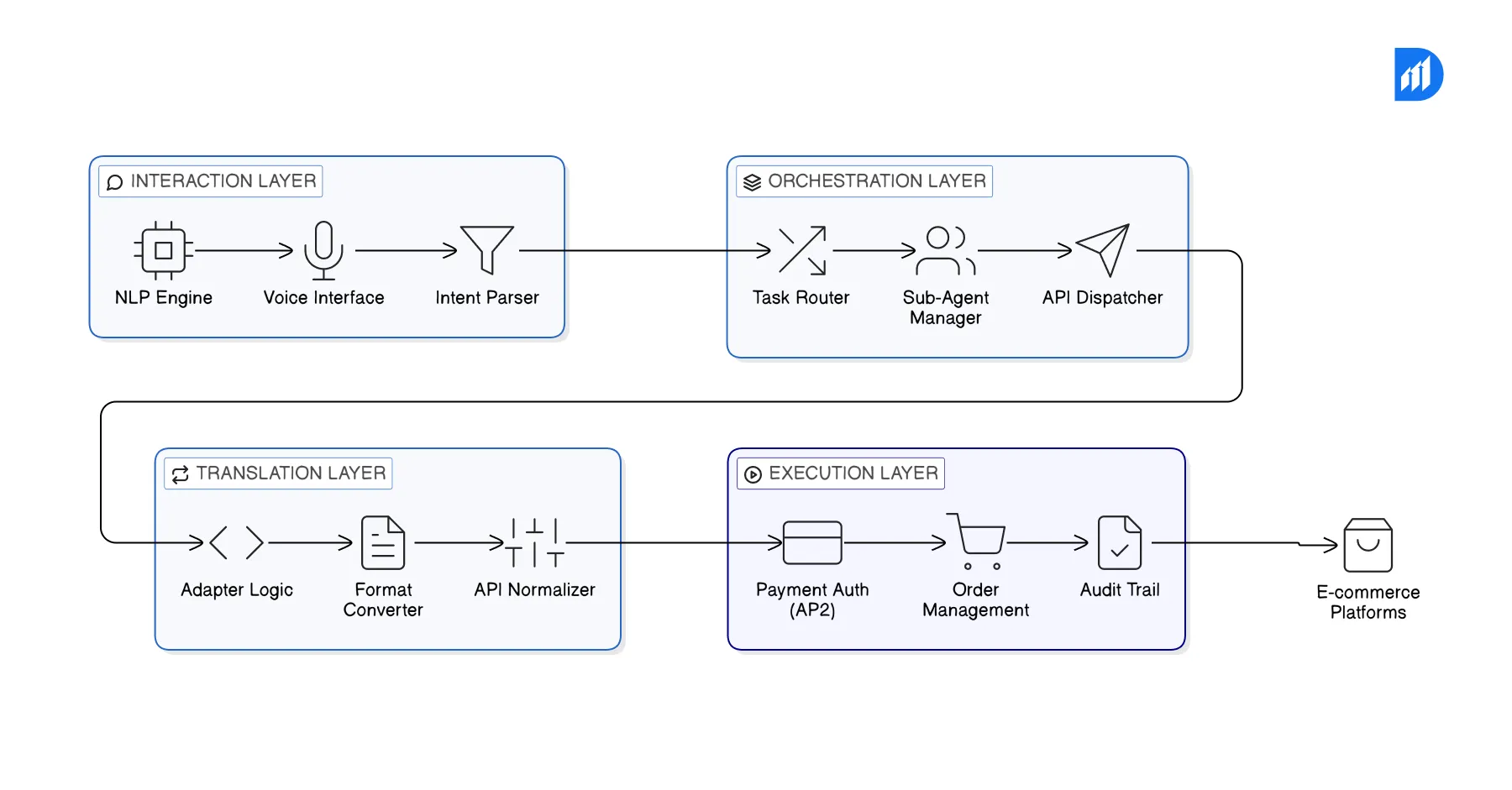
The Interaction Layer is where agents receive user intention through natural language processing which converts it into organized task requirements. The interface also functions as a system for AI voice agents for e-commerce platforms that use AI-based voice assistance.
The Orchestration Layer routes tasks to the right sub-agents or APIs. It operates as a task manager which assigns work to the product search agent, pricing agent, or fulfillment agent based on requirements.
The Translation Layer converts agent requests into formats that each merchant API can understand. The adapter logic exists here because it is the most complex point of the system which expands its capacity at scale.
The Execution Layer completes the transaction. It manages payment authorization through AP2 and related protocols while initiating order management systems and maintaining the audit trail necessary for compliance and dispute resolution.
All four operational layers require stable independent scalability when enterprises construct their agentic commerce infrastructure. Monolithic architectures that combine all functions will fail under high-volume, multi-agent workloads.
Core Infrastructure Layer: Building the Foundation for Autonomous Commerce
Agentic AI e-commerce requires advanced infrastructure which exceeds basic web stack requirements. These are the essential components every enterprise must implement.
Structured data formats such as JSON-LD and schema.org provide machine-readable product catalogs which enable automatic data parsing without needing to understand HTML content. Agents cannot extract product information because human-oriented visual layouts prevent them from accessing essential data.
Enterprises require OAuth 2.0 delegation patterns with signed agent credentials and scope-limited access tokens that specify an agent’s authorized activities. Additionally, agents require access to real-time inventory systems so they can execute purchasing decisions based on current stock information. Delays of more than two seconds will cause agents to make purchasing mistakes and result in more chargebacks.
Event-Driven Fulfillment Systems need to be fully machine-readable. Webhook notifications, structured shipment tracking APIs, and automated return initiation allow agents to operate without human follow-up. Furthermore, every agent action must be recorded with timestamps, intent context, and authorization metadata for compliance purposes.
Ecosystem Enablers: Platforms and Systems Adapting to Agent-Driven Transactions
The entire ecosystem around agentic commerce is shifting fast. Many leading platforms have already made significant moves, and agentic commerce news from the last few months reflects this acceleration.
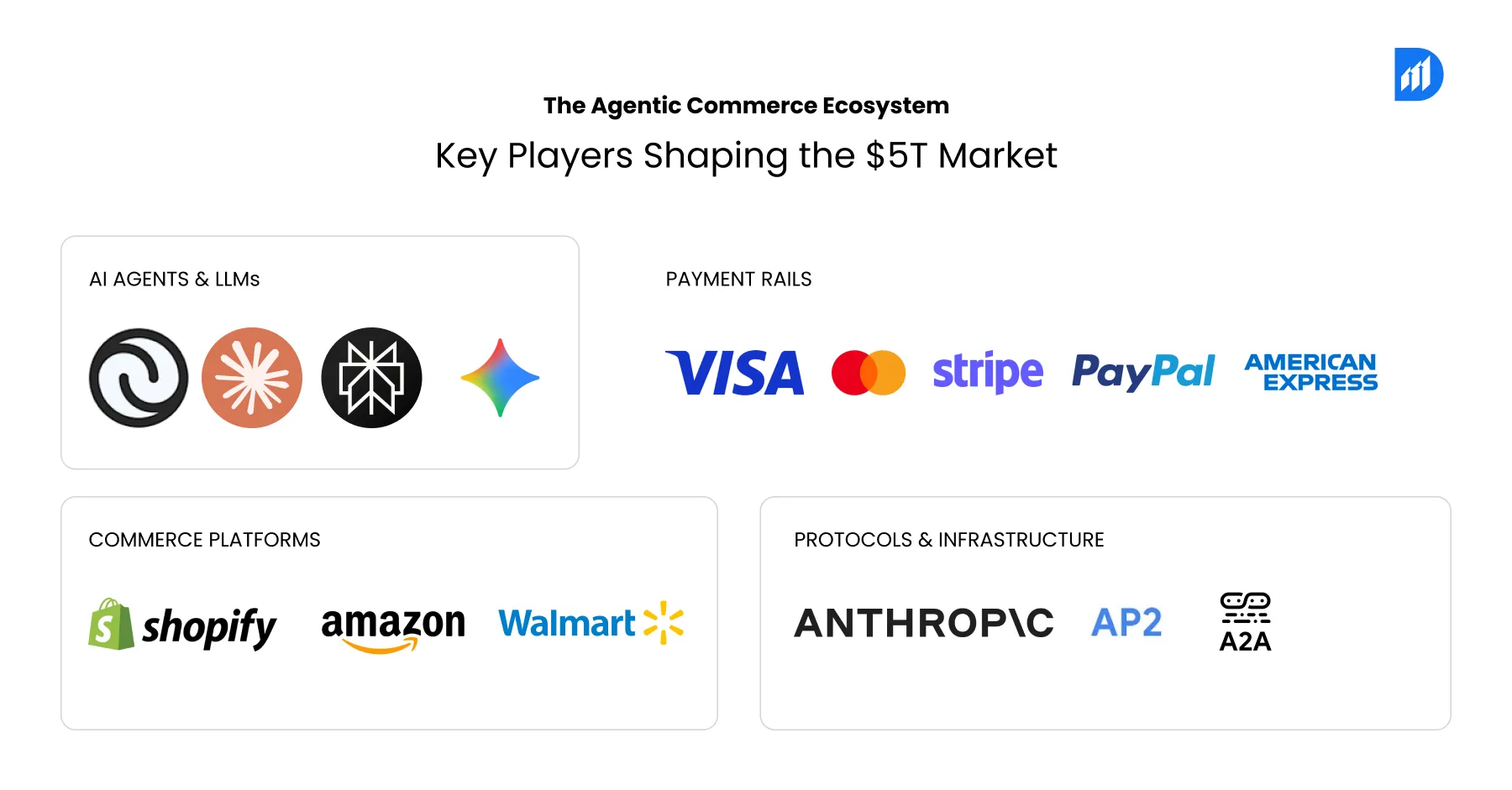
Shopify agentic commerce is one clear example: Shopify is constructing an agentic shopping system which enables agents to create shopping carts across its merchant network. OpenAI’s Operator, which launched in January 2025, uses agents to perform automated tasks inside ChatGPT. Meanwhile, Perplexity introduced its “Buy with Pro” agentic shopping tool in late 2024.
On the payments side, Mastercard is developing Agent Pay. Visa is testing tokenized AI-ready cards through partnerships with Anthropic and Stripe. Similarly, Google’s AP2 protocol receives support from PayPal, American Express, and Adobe. These are production-grade infrastructure moves that establish the payment rails for agentic commerce right now.
As a result, enterprises developing on platforms like Shopify will see agentic commerce integrations become standard practice, not a competitive differentiator.
How AI Agents Orchestrate Multi-System Commerce Workflows
Modern commerce depends on multiple systems including ERP, OMS, WMS, PIM, CRM, and payment gateways. AI agents need to coordinate across all of them in a single transaction flow. This is where multi-agent orchestration patterns become essential.
The Agent-to-Agent (A2A) Protocol enables AI agents from different vendors and architectures to communicate, delegate tasks, and share results. For instance, a personal shopping agent can negotiate directly with a retailer’s in-house commerce agent to secure bulk pricing, apply loyalty credits, and confirm inventory availability. The same multi-agent architecture also supports personalization at scale, similar to how AI Marketing Agents operate across channels to deliver targeted offers. Agents can analyze browsing behavior, study seasonal demand variations, and apply dynamic pricing methods to create specific offers for individual users.
The operational efficiency gains here are substantial. Companies using automated multi-system orchestration report up to 40% fewer integration failures and 65% faster resolution of transaction errors than they experience with manual monitoring methods.
Technology Stack Required to Implement Agentic Commerce
Building an agent-ready commerce stack requires deliberate technology choices at every layer.
| Layer | Recommended Technology |
| LLM / Reasoning Engine | Claude 3.7+ via Anthropic API, GPT-4o via Azure OpenAI |
| Agent Orchestration | LangGraph, AutoGen, CrewAI |
| Context Management | Anthropic MCP, custom memory stores on Redis |
| API Gateway | Kong, AWS API Gateway, Azure API Management |
| Product Catalog | Structured JSON-LD, Algolia for semantic search |
| Payments | Stripe + AP2 integration, Visa Delegated Authorization |
| Event Streaming | Apache Kafka, AWS EventBridge |
| Observability | Datadog, OpenTelemetry, custom agent audit logs |
This stack supports enterprise-level agentic AI commerce workflows. The system must allow for the separate deployment and replacement of each individual component. Vendor lock-in at any single layer creates vulnerability across the entire pipeline. The architecture also enables manufacturing and logistics enterprises to implement AI in Manufacturing and supply-chain automation workflows.
Strategic Implications for Enterprises Adopting Agentic Commerce
The agentic commerce news from the last six months shows a single clear trend: the companies that establish their operations first will create the industry standards. Those that delay will face operational limitations established by others.
Three strategic options exist for enterprises right now. First, build product experiences that agents can discover. Agents do not read meta descriptions, they query structured APIs. If your catalog is not machine-readable, agents will direct buyers to competitors whose catalogs are.
Second, decide where to own the agent layer and where to partner. Building an in-house AI agent system requires both high costs and lengthy development times. Established platforms enable faster launches, however businesses must sacrifice differentiation. In most cases, a hybrid approach works best: control your orchestration logic while partnering on the underlying LLM and payment infrastructure.
Third, invest in trust architecture before scaling. Agents making autonomous purchases without visible human approval create reputational risk if anything goes wrong. Explainability, spend controls, and user override mechanisms are therefore risk management infrastructure, not UX niceties. Organizations that already apply practices like Generative Adversarial Networks in their AI governance will respond to changes at a faster pace.
Implementation Roadmap: Designing for API-First, Machine-Readable Commerce
A phased implementation roadmap helps enterprises move from static e-commerce to full agentic ai e-commerce readiness without disrupting existing operations.
Phase 1 (Months 1–3) : Catalog Structuring: Use product data to create JSON-LD structured data and apply schema.org markup. Develop product APIs that feature machine-readable pricing and inventory data. This single step makes your catalog available to AI agents browsing the web today.
Phase 2 (Months 3–6) : API Gateway and Authentication: Deploy a specialized API gateway for all agent traffic. Implement OAuth 2.0 delegated authorization patterns. Each agent interaction type needs specific access tokens that limit their access to designated resources.
Phase 3 (Months 6–9) : Orchestration and Payments: Integrate MCP software to maintain contextual information across systems. Connect to AP2 or an equivalent system for agent-initiated payment flows. In addition, implement webhook-based fulfillment notifications. Teams working on AI in Product Development will find many of these orchestration patterns already familiar.
Phase 4 (Months 9–12) : Observability and Governance: Build audit logging for all agent activities. Set up spending controls and user override features. Establish regular review processes to monitor agent performance.
Companies already using AI-powered workflows in product development will encounter familiar patterns during Phase 3 integration. Agent orchestration patterns maintain consistency across different operational domains. Consequently, enterprises that finish this roadmap will gain the ability to earn agentic commerce revenue before the market consolidates around a handful of agent-ready platforms. Companies that treat this as a future-state problem will end up making compliance changes instead of developing customer acquisition strategies.
FAQs
What is agentic commerce in simple terms?
It is a model where AI agents handle all shopping activities for users from product search to payment without requiring active user interaction at each step.
How does agentic commerce differ from traditional e-commerce AI?
Traditional e-commerce AI recommends products to human users. Agentic commerce replaces the full navigation process by enabling AI agents to execute transactions across systems without human involvement.
What is the Model Context Protocol and why does it matter?
MCP enables AI systems to maintain stored information and context across various platforms, which creates an uninterrupted and customized shopping process for users.
Which businesses are at highest risk from agentic commerce disruption?
Businesses that depend on advertising-based discovery, traditional SEO, and manual checkout processes will experience the greatest impact as AI agents bypass these channels.
What is the projected market size for agentic commerce?
McKinsey projects the US B2C market alone could see up to $1 trillion in orchestrated revenue by 2030, with global projections reaching $3 trillion to $5 trillion.

Deepesh Jain
Recent Blog

Top AI Development Companies in India 2026
March 31, 2026