Top 10 Software Development Trends in 2026: What CTOs and Tech Leaders Must Prepare For

Every single year someone announces that this is the year everything changes in tech. Cloud was the revolution, then mobile-first was the revolution, then AI entered the chat and decided it owns the word “revolution” entirely. But 2026 feels different because this time it’s not one shift, it’s ten happening together.
If you’re a CTO or tech leader, tracking software development trends is no longer a “stay updated” exercise, it’s a survival strategy. Budgets depend on it, hiring depends on it, product velocity depends on it, and honestly, your competitive edge depends on how early you see what’s coming. The conversation around the latest trends in software development has moved from curiosity to accountability.
Why This Moment Is Different for Tech Leaders
We’re no longer asking whether AI should be used in development. We’re asking how deeply it is embedded into the software development life cycle. From generative AI writing production-level code to enterprise-grade AI and ML Solutions driving predictive decisions, from intelligent testing pipelines to self-optimizing infrastructure, the pace is no longer gradual. It’s compounding.
Customer experience improvements emerge from advanced AI Powered Chatbot systems which create more natural conversations than their scripted responses. The healthcare industry uses Generative AI innovations to transform its operations, demonstrating that even the most compliance-heavy sectors are accelerating their advancements. Most companies today also need to establish real-time visibility systems, which enable them to monitor their supply chain operations and achieve operational resilience, because emerging supply chain software trends require these capabilities to operate their businesses effectively.
The 2026 software development trends show what will become the primary focus of the industry. They’re about what’s inevitable and the leaders who prepare early won’t just adapt to change. They’ll define it.
Here’s what every CTO, VP of Engineering, and tech decision-maker needs to know before Q3 planning begins.
AI-Assisted Development Is No Longer Optional
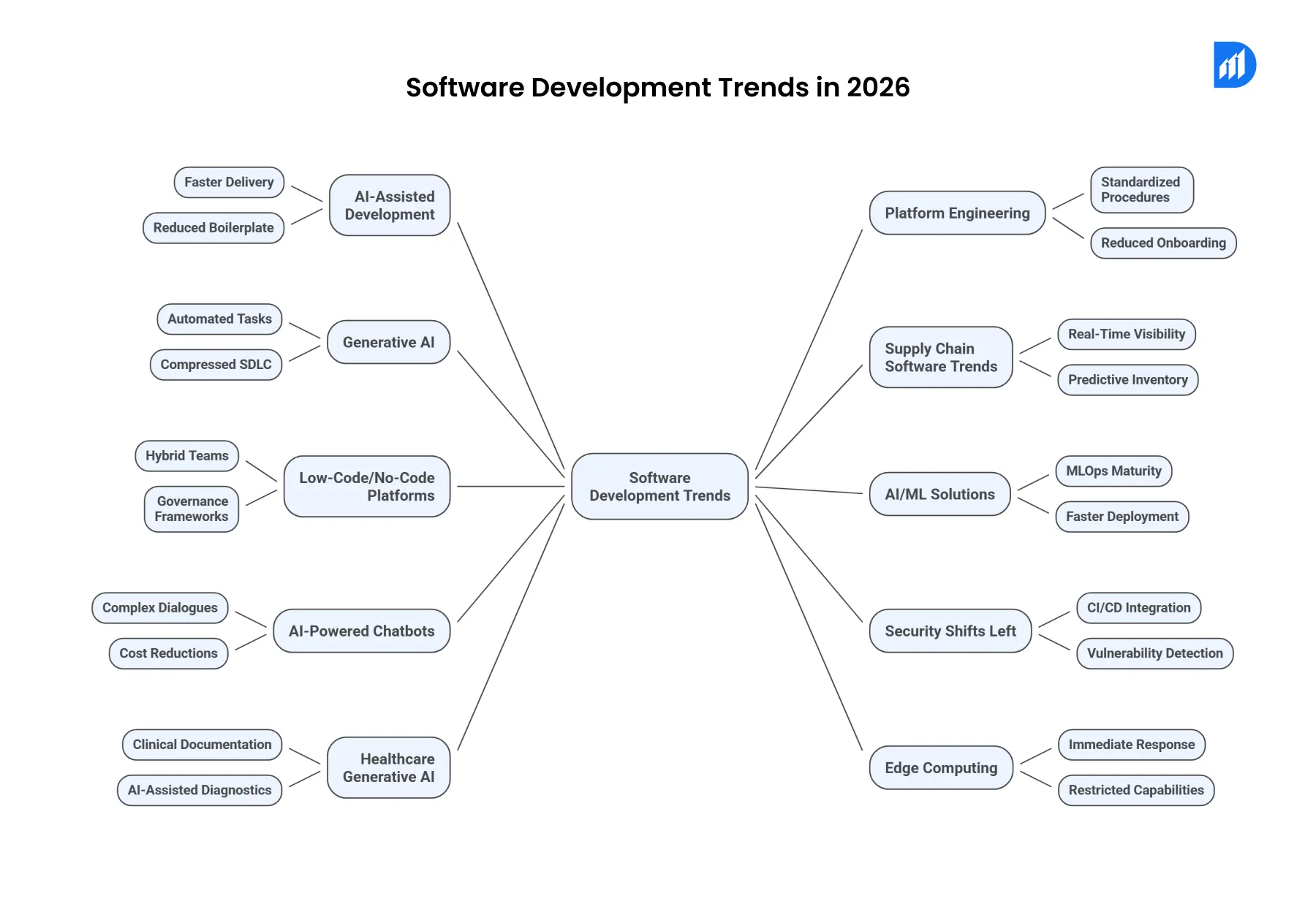
The GitHub 2024 Octoverse report shows that developers who use AI coding assistants can deliver their coding projects at a 55 percent faster rate. Engineering teams now use GitHub Copilot and Amazon CodeWhisperer and Tabnine as core elements of their daily operations. Among the most recent software development trends, developer replacement does not drive this industry change. Instead, the goal of this development process helps developers achieve greater work output.
AI-assisted development enables teams to decrease their time requirements for boilerplate code by 40 percent. As a result, the engineering team uses their work time to develop system architecture and resolve technical challenges.
Platform Engineering Is Replacing DevOps as the Default Model
DevOps democratized infrastructure access. Platform engineering, however, establishes standardized procedures for infrastructure deployment. Internal developer platform construction enables engineering teams to decrease cognitive demands while achieving a 60 percent reduction in onboarding duration.
Spotify and Netflix and Airbnb established internal platforms before the term became widely known. Now, mid-market companies follow this pattern. The goal requires developers to create their own environments while handling code deployment and system monitoring without depending on operations teams.
Generative AI Is Reshaping the Entire Software Development Life Cycle
In fact, the technology now exists throughout the software development life cycle starting from requirements gathering and ending with test automation. McKinsey’s 2024 research estimates that generative AI could automate 30% of software development tasks within the next three years.
The system automatically generates unit tests, creates API documentation, identifies security vulnerabilities during code review, and recommends architecture improvements. Consequently, the software development life cycle is compressing because AI completes all the repetitive tasks which teams used to perform.
Supply Chain Software Trends Are Driving Embedded Intelligence Demand
The 2020 to 2023 supply chain disruptions demonstrated the extreme vulnerability of old-fashioned systems which companies used for their operations. The supply chain software trends of 2026 will focus on three main areas which include real-time visibility and predictive inventory management and AI-based demand forecasting. According to Gartner 50% of large global companies will use AI-enabled supply chain analytics by 2026.
The intelligent software market needs solutions which enable ERP systems to function with both IoT sensor data and logistics APIs for seamless decision-making. Companies that do not update their supply chain software systems will experience a core competitive disadvantage.
Low-Code and No-Code Platforms Are Entering Enterprise-Grade Territory
Low-code platforms like Microsoft Power Platform, OutSystems, and Mendix now support enterprise-grade workflows. The Forrester study predicts that the low-code market will reach $50.1 billion by 2028. Current software development trends are creating hybrid teams which combine professional developers who build core systems with business users who create additional functions through no-code development.
Governance and Guardrails –
Still, the unregulated expansion creates a risk for organizations which need to establish governance frameworks that control building processes and user permissions and system integration methods with current architecture.
AI and ML Solutions Are Becoming Core Product Infrastructure
Just three years ago, AI and ML solutions existed as experimental features which product teams developed. In 2026 these features will become standard requirements for all products. Customers now expect every product to offer recommendations and predictions and personalized experiences.
The software development trends here point to MLOps maturity as the differentiator. The Databricks State of Data and AI report shows that organizations with advanced MLOps systems can deploy models five times faster while experiencing 90 percent fewer operational defects. Organizations which want to develop AI capabilities need to establish deployment and monitoring systems because developing AI technologies without these systems is equivalent to designing a car without brakes.
AI-Powered Chatbots Are Replacing Entire Service Layers
The 2026 AI-powered chatbot functions as a reasoning system which manages complex multi-turn dialogues while connecting to backend systems and executing intelligent escalation procedures. Businesses adopting AI-powered chatbots are seeing customer service cost reductions of up to 30 percent while resolution speed increases by 40 percent according to IBM.
Moreover, the development of conversational AI software now supports multimodal interfaces which allow users to communicate through voice and text and image during a single session. Chatbot infrastructure teams need to develop their systems from the beginning because they must manage context and handle fallback situations while enforcing compliance security measures.
Security Shifts Left Permanently
Simply put, “shift left” security means integrating security checks early in the development pipeline rather than treating it as a final gate. The average data breach cost which reached $4.88 million in 2024 according to the IBM Cost of a Data Breach Report requires engineering teams to create improved security systems.
Snyk, Checkmarx, and Veracode now provide tools which connect directly to CI/CD pipelines. Vulnerabilities get detected the moment code is committed to the system. Furthermore, the latest trends in software development now treat this practice as an essential standard which organizations must meet according to regulations.
The Healthcare Field Introduces a New Software Development Category Through Generative AI
The healthcare sector uses generative AI technology to establish completely new software systems. This industry is experiencing a software development boom because clinical documentation automation, AI-assisted diagnostics, and patient communication platforms continue to grow. The global AI in healthcare market is projected to reach $613 billion by 2034 according to Precedence Research.
As a result, development teams face substantial challenges when creating AI systems that must meet HIPAA regulations while maintaining traceability and providing understandable system functionalities. The software development life cycle for healthcare applications now requires regulatory review checkpoints and model interpretability as non-negotiable features.
Edge Computing Is Pushing Intelligence Closer to the Source
The world operated with cloud-first systems for ten years which became the standard. The main focus for applications that require immediate response has turned to edge computing since that time. Gartner predicted that 75% of enterprise data processing would occur outside centralized data centers by the year 2025.
Software teams need to change their application development methods to accommodate edge computing. Developers must build software that functions correctly on devices with restricted capabilities while maintaining connection to cloud services and handling network interruptions. The manufacturing industry and logistics sector and healthcare field show the fastest growth of edge adoption because their operations require urgent processing capabilities.
Comparing Traditional vs. Modern Software Development Approaches
Understanding the shift in software development trends requires a direct comparison. The table below shows how legacy approaches stack up against modern practices across key dimensions:
| Dimension | Traditional Approach | Modern Approach (2026) |
| Deployment Frequency | Monthly or quarterly | Multiple times daily |
| Security Integration | Post-development audit | Shift-left, CI/CD embedded |
| AI Involvement | None or experimental | Core to development lifecycle |
| Infrastructure Management | Manual provisioning | Platform engineering, self-service |
| Testing | Manual QA cycles | Automated, AI-assisted testing |
| Time to Production | 6-12 weeks | Days to 2 weeks |
The operational differences between traditional and modern approaches create a competitive divide. Teams that maintain monthly release schedules will experience slower progress compared to teams that push daily software updates.
When These Trends Won’t Apply to Your Context
Not every organization should chase every trend. Small engineering teams under 20 developers may not need a full internal developer platform. The overhead of building and maintaining an IDP can outweigh the benefit at that scale. Low-code platforms also lack the capability for complex custom systems that professionals build through traditional programming methods. The correct software development trends for your organization require evaluation based on your team size and industry and compliance requirements and product complexity.
FAQs
- What are the biggest software development trends in 2026?
The software development process now integrates generative AI while AI-assisted development and platform engineering and shift-left security solutions drive the industry forward. These tools have become essential system components which organizations now use as fundamental technology.
- What impact does artificial intelligence have on software development life cycle processes?
AI now handles test generation, documentation, and code reviews which leads to cycle time reduction of 30 percent across multiple use cases. Engineering teams benefit because faster release times now occur between production cycles.
- What are the current software development industry patterns which shape healthcare technology development?
HIPAA-compliant documentation tools and intelligent diagnostic systems and explainable machine learning systems have emerged as essential requirements for healthcare organizations that use generative AI. Innovation here requires development of intelligent solutions which maintain responsible oversight.
- Do supply chain software trends exist as part of a larger pattern that influences software development?
Yes, the current supply chain software trends require organizations to implement real-time data pipelines which include IoT integration and AI-powered forecasting systems. Organizations need modern architectural systems because these now serve as basic operational needs.
- Which types of organizations should implement low-code development platforms?
Not necessarily. Low-code works well for extending workflows and speeding up internal tools, but mission-critical systems demand professional developers who follow established protocols to maintain their operational integrity.

Deepesh Jain
Recent Blog

Private Blockchain vs Public Blockchain: Pros, Cons, and Business Impact
February 28, 2026