Siri vs Google Assistant vs AI Agents: Which Assistant Strategy Actually Works for Enterprises?
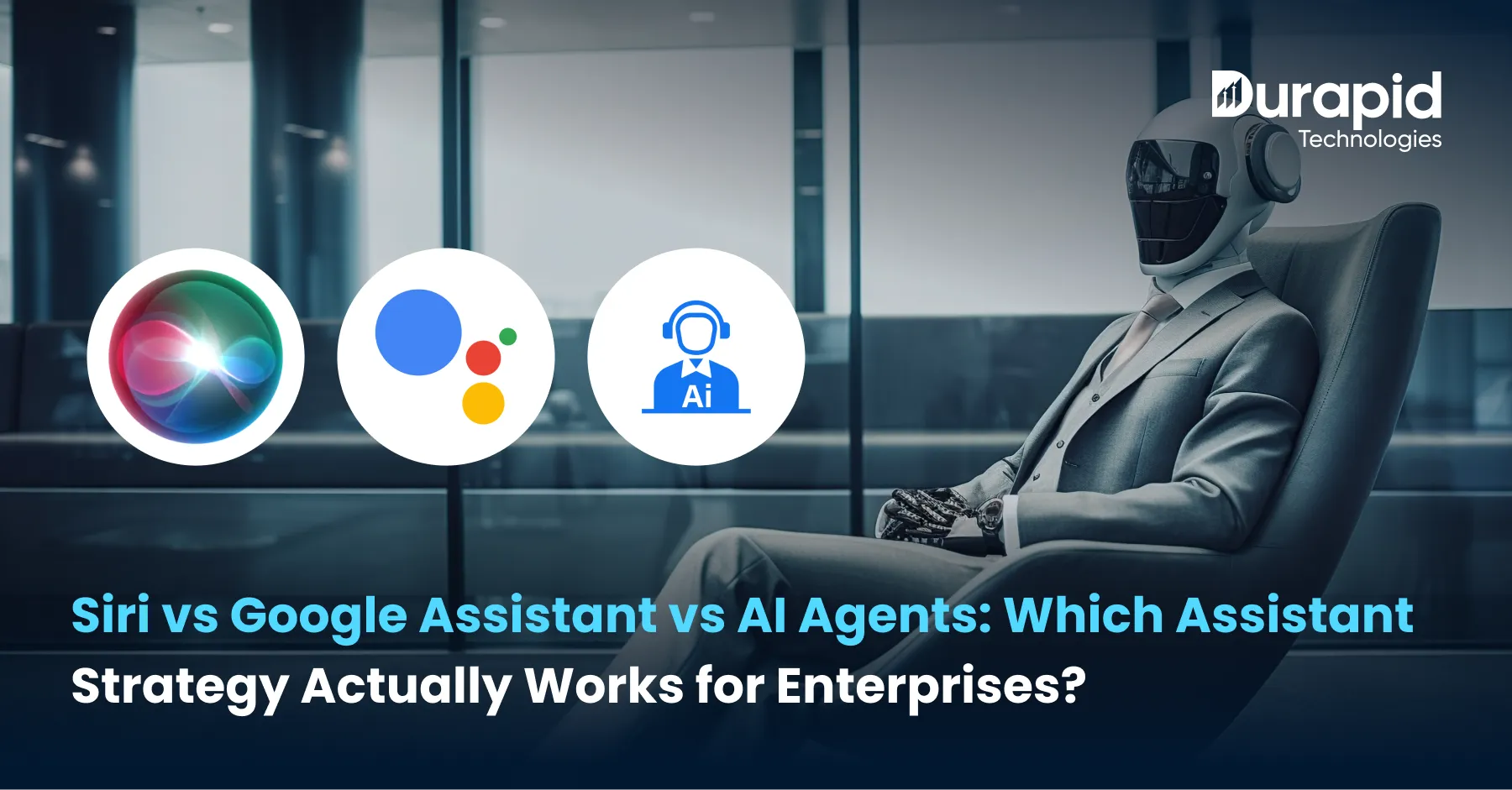
The debate between Siri and Google Assistant has evolved into a broader dispute. The current competition involves Google Assistant vs AI Agents, which brings complete transformation to enterprise operations. Businesses require systems that extend beyond basic command execution. Siri and Google Assistant simply cannot meet those growing demands. Businesses need solutions that enable complete workflow automation, along with AI-powered call center solutions and large-scale customer service automation capabilities.
AI Agents provide the needed solution. Enterprises are adopting systems that deliver operational support through ai customer service automation and complete customer service automation software. These systems enable organizations to deliver exceptional customer service through automated processes that execute tasks, acquire new knowledge, and connect with multiple systems. So the real question in the Google Assistant vs AI Agents debate depends on which assistant actually proves effective for your business operations.
Most enterprise teams treat Siri, Google Assistant, and AI agents as interchangeable tools. However, the three tools should be seen as distinct entities. One category answers questions. Another takes action. The gap between those two capabilities is costing businesses time, money, and competitive ground. A McKinsey report from 2024 found that companies deploying autonomous AI systems see up to 40% higher productivity gains than those relying on voice assistants alone. If your enterprise still routes decisions through Siri or Google Assistant, this comparison will clarify exactly what you are missing.
What Are Siri, Google Assistant, and AI Agents?
The three tools show only basic similarity because they both analyze language and produce responses to user requests. Still, the three systems show different system design, performance capabilities, and suitability for business use.
Siri functions as Apple’s voice assistant. It performs device operations like creating reminders, sending text messages, and retrieving calendar information. The system works with iOS and macOS, but its enterprise functionality remains limited to basic API access and workflow automation tools.
Google Assistant establishes connections with Google Workspace, Maps, and Search. It processes voice commands, creates meeting summaries, and performs basic task functions on Android devices and Chromebook devices. Google Workspace provides enterprise customers with access to enterprise versions through its Google Workspace integration system.
AI Agents develop their task execution abilities through software systems. They use large language models (LLMs) along with tool-calling, memory, and reasoning abilities to achieve objectives without human assistance. AI agents perform functions that enable them to build software code, connect to databases, and work together with other agents. That core capability is the fundamental difference in the Google Assistant vs AI Agents comparison.
Key Differences Between Consumer Voice Assistants and Enterprise AI Agents
Voice assistants exist to provide consumers with convenient access to their services. Businesses use artificial intelligence to develop systems that produce measurable results. That distinction shapes everything from integration depth to compliance readiness.
Consumer assistants respond to single-turn commands. They complete one task per interaction. AI agents handle multi-step workflows. They execute plans while controlling errors through a process that restarts when outputs fail. For enterprise automation, this difference matters enormously.
The following section presents an essential comparison covering all major enterprise dimensions.
| Capability | Siri | Google Assistant | AI Agents |
| Multi-step task execution | No | Limited | Yes |
| API and system integration | Minimal | Moderate | Deep |
| Custom workflow automation | No | No | Yes |
| Memory and context retention | Session-level | Session-level | Persistent |
| Compliance and audit logging | No | Partial | Yes (customizable) |
| Enterprise scalability | Low | Medium | High |
This table illustrates why enterprise teams choosing between Google Assistant vs AI Agents consistently find that AI agents offer substantially more operational leverage.
Siri for Business: What It Can and Cannot Do in an Enterprise Context

Siri operates effectively within Apple’s complete system of products and services. It enables staff members to manage meetings, create text through voice input, and control their iPhone and Mac devices with fast execution. Apple Business Manager offers some fleet management tools. However, companies need more advanced automation than Siri currently provides.
Siri cannot support large-scale custom API integrations. It lacks the ability to query your CRM, initiate Salesforce workflows, or generate compliance reports from your data warehouse. For enterprises running on Azure, AWS, or SAP environments, Siri adds minimal operational advantages beyond personal productivity shortcuts.
When NOT to use Siri: Any enterprise workflow that needs system connections, internal data access, or multi-step process automation is outside Siri’s current design scope.
Google Assistant for Business: Where It Shines and Where It Falls Short
The performance of Google Assistant in enterprise environments exceeds that of Siri, especially for organizations using Google Workspace. It manages meeting arrangements, produces intelligent responses, enables document search, and completes fundamental voice commands inside the Google platform.
Google’s Duet AI has introduced enterprise document drafting and meeting summarization capabilities through its integration with Gemini for Workspace. Nevertheless, deep system integrations, autonomous workflow execution, and cross-platform agent coordination remain limited compared to purpose-built AI agent platforms.
Google Assistant works best for teams deeply embedded in Google products. It struggles when enterprises need to connect legacy ERP systems, run multi-agent pipelines, or maintain audit-ready automation logs for regulated industries.
AI Agents in Enterprises: The Strategic Shift Redefining Automation
AI agents represent a structural change in how enterprises automate work. Rather than answering commands, they pursue goals. You define an objective, and the agent determines the steps, executes them, monitors results, and adjusts when something fails.
Platforms like Microsoft Copilot Studio, AWS Bedrock Agents, and AutoGen support enterprise-grade agent deployment. They come with built-in memory, tool access, and human-in-the-loop controls. Companies using AI agent development frameworks report 3x faster process completion on complex workflows compared to RPA-only approaches, according to Forrester’s 2024 automation survey.
AI agents also integrate with customer service automation software, sales tools, data pipelines, and internal knowledge bases simultaneously. That cross-system reach is what makes them genuinely valuable at enterprise scale. Furthermore, the ability to connect with multiple systems at once enables organizations to achieve full transformation across their operations.
Head-to-Head Comparison: Siri vs Google Assistant vs AI Agents
When comparing Google Assistant vs AI Agents side by side, the differences become even sharper. Google Assistant handles simple commands well within its ecosystem. AI agents, by contrast, execute autonomous sequences across tools and systems without waiting for the next instruction.
Siri trails both in enterprise contexts. It lacks API depth and workflow automation that modern businesses expect. Google Assistant sits in the middle. It delivers more than Siri, but less than what dedicated AI agent platforms can offer.
The head-to-head outcome is clear. For enterprises moving beyond basic convenience tasks, AI agents win on every critical dimension.
Enterprise Use Cases: Which Assistant Strategy Fits Which Business Need
Not every enterprise scenario needs the same tool. Matching the assistant type to the business problem avoids wasted investment and implementation complexity.
Siri fits best for: Personal productivity within Apple device fleets, employee calendar management, and quick dictation tasks.
Google Assistant fits best for: Teams on Google Workspace needing meeting assistance, document search, and lightweight scheduling automation.
AI agents fit best for: Customer service automation, lead qualification pipelines, financial report generation, multi-system data retrieval, and AI in product development workflows that require cross-tool coordination.
For example, a financial services firm using an AI agent for client onboarding can pull KYC data from a compliance database, draft a welcome email, schedule a follow-up, and log the interaction in the CRM automatically. Neither Siri nor Google Assistant can execute that sequence without human intervention at every step.
Scalability, API Access, and System Integration Capabilities
Scalability separates AI agents from voice assistants most clearly. Voice assistants operate at the individual user level. In contrast, AI agents operate at the organizational level.
Enterprise AI agent platforms support multi-agent orchestration. One orchestrator agent can coordinate 10 specialized sub-agents working on different tasks simultaneously. Sierra AI, a leading ai call center platform, demonstrated 60% call resolution rates without human escalation using this architecture in 2024.
API access is another key differentiator. AI agents connect to REST APIs, GraphQL endpoints, SQL databases, and third-party SaaS platforms. AI integration services teams configure these connections during deployment to match existing enterprise architecture. Voice assistants offer no comparable integration depth.
Data Privacy, Security, and Compliance Across All Three Platforms
Enterprise compliance requirements make data handling a non-negotiable evaluation criterion.
Siri processes voice data through Apple servers by default. Apple offers on-device processing for some requests. However, enterprise-grade data residency controls remain limited.
Google Assistant routes data through Google’s infrastructure. Google Workspace enterprise agreements include data processing terms, plus some regional storage options. Still, regulated industries like healthcare and finance often find these controls insufficient.
AI agent platforms deployed on private cloud infrastructure, such as Azure OpenAI Service with VNet isolation or AWS Bedrock with PrivateLink, offer full data residency, audit logging, and role-based access controls. For HIPAA, GDPR, or SOC 2-regulated environments, enterprise AI agents are the only viable option among the three.
Cost, ROI, and Implementation Complexity for Enterprise Teams
Cost comparison across these three categories depends on scale and use case.
Voice assistant costs are minimal. Siri is bundled with Apple devices. Google Workspace plans include Google Assistant access starting at $12 per user per month.
AI agent platforms carry higher upfront investment. Azure AI Foundry and AWS Bedrock charge based on token usage and API calls. A mid-size enterprise deployment typically costs $15,000 to $80,000 annually, depending on agent complexity and usage volume.
However, the ROI comparison shifts that equation quickly. Enterprises deploying AI marketing agents for campaign automation report a 25–35% reduction in campaign cycle time. Additionally, AI customer service automation solutions reduce cost per interaction by up to 50% compared to fully human-staffed teams, according to Gartner’s 2024 CX Technology report.
Why Enterprises Are Rapidly Moving Toward AI Agents in 2026
The enterprise shift toward AI agents is accelerating. IDC projects that by the end of 2026, 45% of Fortune 500 companies will have at least one production AI agent deployment handling business-critical workflows.
The reasons are measurable. AI agents complete tasks that previously required 3–5 human touchpoints in a single automated sequence. They work continuously without shift limitations. They also scale horizontally without proportional cost increases. Unlike voice assistants, they generate structured logs that compliance teams can audit.
Tools like Durapid’s GenAI Interview Evaluator demonstrate how AI agents already handle complex evaluation workflows autonomously, reducing HR screening time by 60%. That kind of measurable efficiency is driving enterprise adoption faster than any previous automation category.
Challenges and Risks in Adopting AI Assistants at Enterprise Scale
AI agents require careful deployment planning. Common challenges include prompt injection vulnerabilities, hallucination in high-stakes decisions, and integration failures when connecting to legacy systems.
Enterprises must build human-in-the-loop checkpoints for sensitive workflows. Financial approvals, medical decisions, and legal document generation should always include a human review stage before final execution.
Change management is also a factor. Employees often resist automation that replaces familiar workflows. Clear internal communication about agent roles and boundaries reduces friction and improves adoption rates.
Security teams need to audit agent permissions regularly. An over-privileged agent with write access to production databases creates unnecessary risk. Least-privilege architecture applied to agent tool access is a best practice that most enterprise deployments underinvest in initially.
FAQs
Can Google Assistant replace AI agents for enterprise automation?
No. Google Assistant handles simple commands within the Google ecosystem, while AI agents execute multi-step workflows across systems, a fundamentally different capability.
What is the main difference between Siri and enterprise AI agents?
Siri responds to single commands on personal devices. AI agents plan and execute multi-step business processes across APIs, databases, and enterprise tools autonomously.
Are AI agents safe for regulated industries like healthcare or finance?
Yes, when deployed on private cloud infrastructure with proper access controls, audit logging, and human review checkpoints built into sensitive workflows.
How much does it cost to deploy an enterprise AI agent?
Costs typically range from $15,000 to $80,000 annually for mid-size deployments, but ROI from process automation often recovers that investment within 6–12 months.
What is Sierra AI in the context of AI call centers?
Sierra AI is an enterprise platform focused on AI customer service automation. It uses AI agents to handle voice and chat interactions, resolving 60% of calls without human escalation.

Deepesh Jain
Recent Blog

Top AI Development Companies in India 2026
March 31, 2026