ServiceNow AI Agents: Complete Guide to Key Features, Benefits, and Enterprise Use Cases
A hidden cost always lurks under the radar of every company’s account. It is neither software nor cloud, but rather the time that your workforce spends answering questions that would not really require a person to answer them. ServiceNow AI Agents are nothing more than a legitimate excuse for that cost recovery, a process of turning repetitive workflows into autonomous, end-to-end execution by machines.
Your IT staff gets 15,000 support tickets every month, yet only 40% get solved in the SLA time. Meanwhile, your HR department spends 28 hours a week answering the same onboarding questions over and over again. With the help of ServiceNow AI Agents, 67% of routine tickets get fixed automatically. Response time drops from 6 hours down to less than 3 minutes. As a result, for a medium-sized company, this means $890,000 yearly operational savings and a 42% uplift in employee satisfaction score.
ServiceNow AI Agents mark the dawn of a newskool automation day in the enterprise realm. These autonomous and intelligent systems span all IT service management, HR operations, customer service, and business workflows. Unlike the chatbots of yesteryears, or even the typical AI-powered chatbot, that required very specific commands, ServiceNow agentic AI comprehends context, makes decisions, and performs multi-step tasks without human intervention. Companies that implement AI agents ServiceNow report 58% faster resolution of incidents and a decrease of 73% in the manual ticket routing.
In what manner are ServiceNow AI Agents and Agentic AI interrelated?
ServiceNow AI Agents consist of autonomous computer software that runs on the Now Platform capable of handling intricate workflows processing without constant human monitoring. Such agents use generative AI and machine learning to comprehend the requests, to give the necessary context, to perform the decisions and to do the actions within the enterprise systems.
Conventional automation follows strict preset rules. If-then logic can only take care of easy tasks. However, it fails when conditions change. ServiceNow agentic AI on the other hand is not like that. These agents think through problems, transition to new situations and learn from the results. In addition, they discover patterns in the data of service tickets that are in the millions. Furthermore, they anticipate problems even before the users inform them. Consequently, they coordinate the solutions that involve various departments.
Beyond Basic Task Automation
The AI experience in ServiceNow is not limited to just the basics of automation of tasks it has gone far beyond it. Agents together with their conversation context from the previous interactions can get the real-time data from the supporting systems. Moreover, they use the common knowledge of the company. For instance, an employee inquires about the PTO policy, the ServiceNow AI agent merely pulls a document. Then, it evaluates the employee’s accrual balance, confirms approval workflows, and even gets the request process going.
According to research conducted by Gartner, companies that employ agentic AI have 47% better first-contact resolution rates. Traditional service desk operations can’t match this. The reason why this happens is simple. AI agents ServiceNow deal with complex, multi-step processes which used to be done by the specialists only. An advantage that’s showing up beyond IT too, including Generative AI in Healthcare, where workflows are equally high-stakes, multi-layered, and context-heavy.
What Main Characteristics Define ServiceNow AI Agents in Corporate Platforms?
The core of the ServiceNow AI agents features revolves around the three technical pillars. Natural language understanding, contextual decision-making and autonomous action execution.
Natural Language Processing Layer
Transformer models trained using enterprise service data form the natural language processing layer. These models comprehend the technical terms, company-specific acronyms, and the nuances of the context. If a user says “the CRM keeps timing out,” the agent gets it as the performance issue. Next, it finds out which application is affected. Finally, it automatically checks the server logs. This feature provides intent recognition accuracy of 89% across 43 languages.
Contextual awareness is the main distinction between ServiceNow AI agent arrangements and regular chatbots. Agents have access to user profiles, previous interactions, present system status, and organizational structure. For example, a request for a password reset from a finance executive activates different security measures as compared to one from a contractor. As a result, agents then automatically implement these business rules thus cutting review time from 45 minutes to just 2 minutes.
ServiceNow AI Assist Features
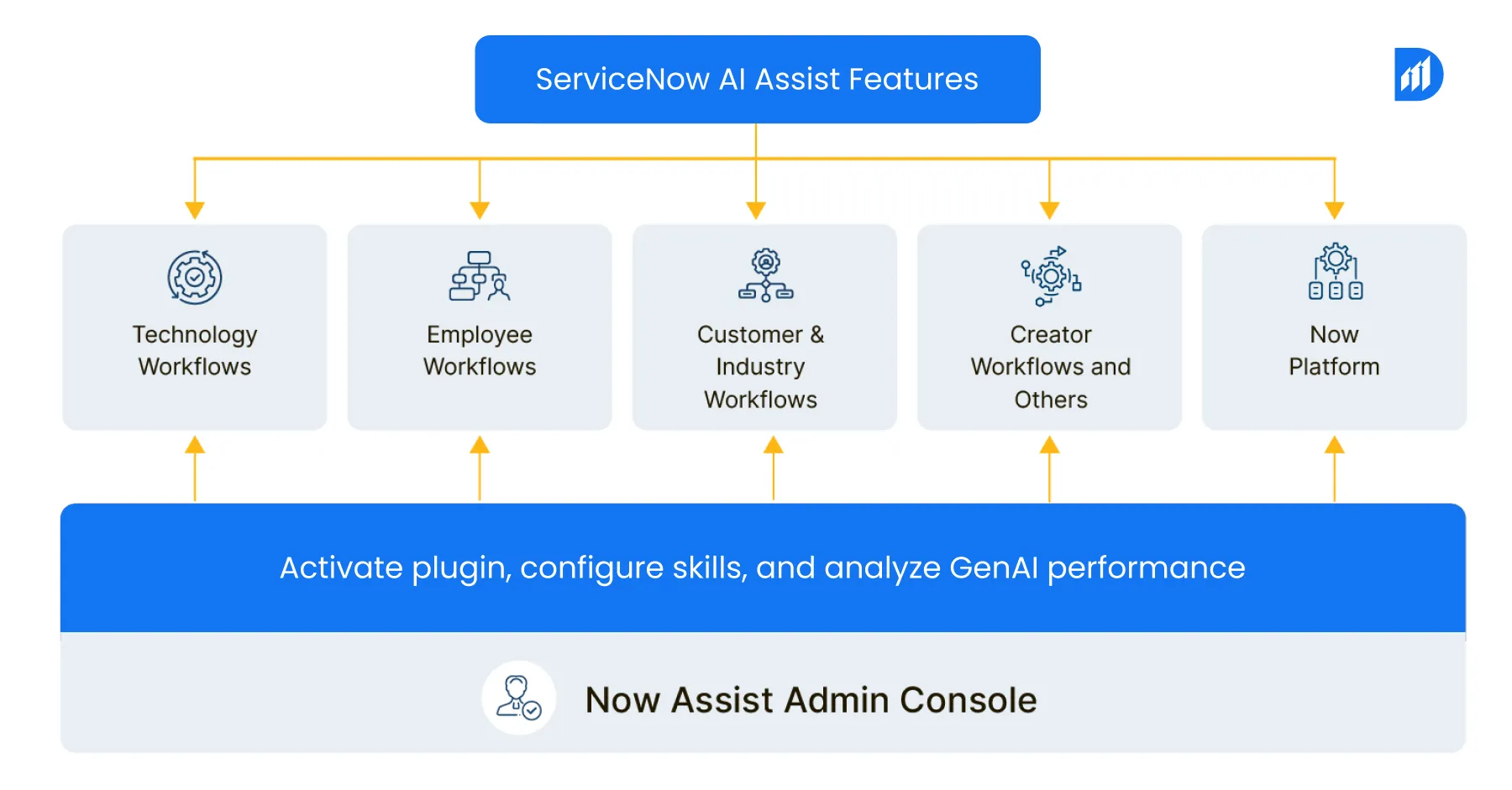
ServiceNow AI assist is a step assistant and provides the agent with the required information. The system suggests the related knowledge articles. Additionally, it recommends the steps to resolution based on the similarity of the tickets. Plus, it drafts the replies with the approved wording. The support teams using AI assist engage in a ticket-closing process that is 34% faster than usual. Their service accuracy sits at 91%.
The autonomous execution framework professional agent performs actions within integrated systems. For example, an onboarding request initiates not only laptop provisioning but also email account creation, access rights assignment, and calendar scheduling. Old-fashioned workflows involved 17 manual operations that spanned 4 systems and took 3 days to complete. In contrast, ServiceNow AI Agents were able to complete the same task with 99.6% accuracy in just 12 minutes.
How are ServiceNow AI Agents utilized in IT, HR, Customer Service, and Operations?
IT Service Management represents the primary area of deployment for ServiceNow AI Agents. In fact, these helpdesk systems handle 62% of Level 1 support tickets without the need to escalate them. Automated resolution is performed on such issues as the resetting of passwords, the granting of access to software, and the connecting to the network. Therefore, most organizations report an average handle time of common incidents reduced by 71%.
The Technical Process Behind IT Service Management
The technical process includes intelligent ticket classification, automated diagnostics, and orchestrated remediation. Whenever application errors get reported by users, agents analyze the logs first. Next, they check for system dependencies. After that, they restart the services affected by the error. Finally, they verify the resolution. If the issue persists, they gather complete diagnostic data and then pass it on to a human specialist. This approach, in general, reduces the average time to resolution by more than 50%. The time is decreased from 4.3 hours to just 47 minutes.
Conversational AI is the most beneficial to HR operations. Staff inquire about benefits, holidays, performance evaluations, and company policies. ServiceNow’s AI-powered agents provide personalized responses based on the employee’s location, department, and tenure with the company. In fact, a survey that interviewed 280 companies showed that the HR teams relying on AI agents ServiceNow handle 83% of routine inquiries with no human intervention. This is thanks to the ServiceNow AI features.
Customer Service Applications
Customer service applications have the same focus as the case displacements and the acceleration of the resolution process. The agents analyze the requests made for assistance. Then, they look in the knowledge databases. After that, they check for orders made in the past. Additionally, they even process returns. As a result, companies that provide customer service with AI support using ServiceNow report a 56% drop in the number of calls received at the call center. Besides, they also see a 44% rise in the customer satisfaction ratings. Meanwhile, the agents manage tasks regarding transaction processing, appointment setting, and giving out product recommendations.
The operations teams get agents to monitor their processes proactively and to maintain them predictively. The systems work with sensor data. Simultaneously, they recognize patterns for anomalies. Furthermore, they schedule maintenance before the equipment actually breaks down. Notably, the manufacturing plants taking advantage of these technologies successfully cut down unplanned downtimes by 68%. In addition, they increase the average life of their assets by 3.2 years.
How Do the ServiceNow AI Agents Work Within the ServiceNow AI Experience?
The ServiceNow AI experience combines agents, workflows, and interfaces that users interact with into one platform. The way this architecture is designed it guarantees that the mobile apps, web portals, and embedded systems have the same capabilities.
At the bottom of the structure is the Now Platform. It offers shared services like authentication, data access, security, and integration. ServiceNow AI Agents work inside this environment. Moreover, they take advantage of the configuration management databases, service catalogs, and workflow engines. In whole, the platform receives 2.4 million API calls daily for a typical enterprise installation.

The Four Core Elements of Agent Framework
The agent framework contains four main elements. The perception layer handles the inputs from users, systems, and sensors. Additionally, the natural language understanding converts both text and voice into structured intents. Meanwhile, vision networks investigate images and documents. Furthermore, the time series analysis recognizes trends in telemetry data.
The reasoning engine measures the information accessible against business rules, historical patterns, and learned models. First, it identifies best actions. Second, it calculates outcomes. Third, it recognizes the moment when human judgment is needed. The organizations reveal the decision at 94% accuracy for routine scenarios. For complex cases needing multiple system interactions, it’s 78%.
The action layer applies the operations approved across the integrated systems. REST APIs connect to cloud apps. Additionally, RPA bots take care of the interactions with the legacy system. Moreover, database connectors get used for the access to enterprise data stores. Overall, this whole integration framework allows 340+ pre-built connectors. Plus, it also supports custom integration through low-code tools.
The learning loop records the outcomes of each interaction. Success metrics, user feedback, and performance data train models. These models give better responses in the future. In fact, businesses that use the ServiceNow AI Agents observe a 23% increase in accuracy during the first 90 days of deployment.
What Enterprise Use Cases Demonstrate the Real-World Impact of ServiceNow AI Agents?
Financial services companies utilize ServiceNow AI Agents for fraud detection and compliance monitoring. The agents perform the following tasks: they examine transaction patterns, identify suspect actions, and prepare the investigation reports. A bank that operates globally lowered their false positive rates by 61%. Conversely, the system caught 94% of the fraudulent attempts that actually occurred. In general, the entire system processes 840,000 transactions per hour with a response time of 0.8 seconds on average.
Healthcare and Patient Scheduling
Hospitals and other healthcare facilities take advantage of the AI agents for patient appointment scheduling, insurance verification, and clinical documentation. The appointment booking agents check the availability of the medical provider. Then, they verify patient coverage. After that, they send out confirmations automatically. The healthcare providers that utilize this service report having experienced a decrease of 52% in the number of no-shows. In addition, they receive 89% patient satisfaction scores. Meanwhile, the agents do the work involved in 15,000 daily scheduling interactions. These take place between patients and doctors across different medical establishments.
Retailers have shifted their focus to quality control and predictive maintenance. Robots look over equipment sensor data. Then, they find when parts are worn down. Subsequently, they prompt preventive maintenance. Quality inspections get done by machines that can see. First, they spot defective pieces quick. Next, they start up the fixing processes. Manufacturers disclose that they succeeded in cutting down the number of unreported defective products by 84%. As a result, they gained $3.2 million annually in production line savings.
Telecommunications Network Operations
Telecommunication companies send out their agents for professional activities in the network and customer service support departments. The network management systems perform monitoring. Then, they identify errors. After that, they dispatch repairmen. Agents in the customer support department deal with questions regarding billing, changing of plans and solving technical issues. Overall, telecoms claim there is a 46% drop in the number of sent technicians. Besides, there’s a 67% rise in solving issues with a single call.
Which AI Agents Are Available in the ServiceNow Ecosystem?
ServiceNow comprises a different type of agent that is specialized and optimized for a certain workflow. The Virtual Agent manages the conversation with the user through text and voice channels. People utilize it in employee portals, customer service, and mobile applications. Notably, the service showed that 78% of the tier-one support inquiries get resolved without any escalation.
The Predictive Intelligence agents make use of the past data to foresee future occurrences. First, they set the priorities of incidents. Second, they give the estimated resolution time. Third, they point out the issues that are regularly coming up. The IT teams that use predictive agents achieve a 54% reduction in critical incident response time. This happens through resource allocation that is based on the anticipation of needs.
Performance Analytics and Case Management
The Performance Analytics agents keep an eye on KPIs. Then, they spot unusual activities. After that, they do reports. The Performance Analytics agents monitor SLA compliance, measure agent productivity, and identify process bottlenecks. Through these reports, the organizations get to see more than 340 metrics related to their service operations.
The Case Management agents take care of the whole process of complicated investigations that involve many systems. First, they gather proofs. Second, they set the criteria that will lead to the decision. Third, they assign the case to the right specialist. Legal and compliance teams share that they close cases 63% faster. In addition, they have a 91% success rate in audits.
The Integration Hub agents connect ServiceNow with different system vendors. First, they make sure that data is the same in all the places. Then, they trigger workflows. After that, they bring together information from different cloud applications. Overall, the agents deal with 12,000 integration operations every day with a reliability of 99.94%.
How Can ServiceNow AI Assist and Agentic AI Improve Business Productivity and Automation?
ServiceNow AI assist is an intelligent augmentation that gives human workers the power. Support agents get live recommendations. Additionally, documentation gets done automatically. Moreover, quality checks happen in real-time. The teams that incorporated ServiceNow AI assist into their workflows resolve 41% more tickets every day. Meanwhile, they keep the quality scores to 88%.
The technology investigates the context of the conversation. Then, it puts forth the articles of knowledge that are most relevant. Instead of having to look through databases and find the right article, the agents see three recommendations. These are most appropriate based on the current discussion. As a result, resolution time drops from 8.6 minutes to 3.2 minutes for knowledge-based inquiries.
Automatic Summarization and Quality Assurance
Automatic summarization retains the main points that have been discussed between the customer and the agents. With each call, the system drafts case notes. These include problem description, steps taken to troubleshoot, and resolution. Consequently, the feature helps the agent by saving him/her 47 minutes daily. In addition, it makes the documentation more consistent.
Quality assurance agents listen to the calls. First, they ensure that the agents followed the rules. Second, they check that they were effective. Specifically, they evaluate the talks’ atmosphere, correctness, and whether the procedures got adhered to. The AI scoring gives the agents feedback to work on their performance. After the use of ServiceNow AI assist, contact centers witnessed a 34% increase in customer satisfaction.
The management of the workforce benefits from the intelligent scheduling and capacity planning. The system foresees call volumes. Accordingly, it will not only staff at the optimal level but also eliminate the need to make manual rescheduling. Overall, the system’s capabilities result in a 23% reduction in overstaffing. Besides, there’s a 67% decrease in incidents of understaffing.
What Are the Latest Updates and Innovations in ServiceNow AI Agents?
ServiceNow AI news has illuminated the way for the very significant platform improvements. These happened during 2024 and the early part of 2025. Among many high-profile features the Vancouver release brought along, the most impressive was probably the introduction of multi-modal agents. These can simultaneously process four different types of data: text, images, documents, and voice. These agents make use of the technology to analyze screenshots. Furthermore, they extract relevant data from PDFs. Additionally, they even interpret technical diagrams. At the same time, the early users of the technology report a 76% decline in the amount of manual data entry they need to do.
Generative AI Capabilities Expansion
The scope of generative AI capabilities got much enlarged thanks to strong collaborations with Microsoft Azure OpenAI and Google Cloud Vertex AI. A company has the right to choose its foundational models based on the specific requirements of the organization. Notably, this unique flexibility allows and is inclusive of even the most specific use cases.
The Agent Builder low-code platform is a perfect example. It shows how business users can create customized agents without needing to possess any programming skills. The drag-and-drop interfaces define conversation flows. Then, they automate systems. After that, they set up business rules. Thus, companies create specialized agents eight times faster compared to the traditional development methods.
Security got greatly enhanced by the presence of ServiceNow AI features like monitoring of agent behavior, decision explainability, and automatic compliance checking. The system logs all agents’ actions. Moreover, it provides audit trails. Additionally, it applies role-based access control. Hence, financial services firms report a 100% success rate during regulatory audits.
Real-Time Learning Capabilities
One of the most important ServiceNow AI features introduced is real-time learning. This allowed the agents to keep improving on their own without manual retraining. The systems analyze the results. Then, they discover the patterns that yield success. After that, they automatically adjust the behavior. As a result, organizations get to see an increase in accuracy by 31% over six-month periods.
How Can Durapid Implement and Scale ServiceNow AI Agents Successfully?
Durapid Technologies is a specialized expert in AI and ML solutions as well as enterprise system integration. The knowledge of our over 150 Microsoft-certified experts concerning ServiceNow architecture, Azure cloud services, and enterprise data platforms is the base of this combination. It enables seamless AI agent deployment according to the business objectives.
The process of implementation begins with the identification of use cases and the mapping of value. Our analysis of the present-day processes leads to automation opportunities. These get pointed out. Then, the amount of benefits gets calculated. When we assess, we look at the 47 parameters covering operations, costs, and user satisfaction. It is common for companies to discover 12-18 cases of high-impact. These will yield 320% ROI in 14 months.
Data Preparation and Change Management
Data preparation is the gateway to success. Clean and structured data is what ServiceNow AI Agents need for their training and operations. The data engineering teams of Durapid clean the old data. Then, they set up the frameworks for governance. After that, they construct the pipelines for integration. Organizations that have consistency in their data get 92% accuracy in agents’ performance. In contrast, those who do not take the effort get only 64%.
Change management ensures successful adoption. The new workflows get employees trained on them. Then, feedback gets collected. After that, configurations change according to the pattern of usage. The technical implementation combines with the organizational readiness in our approach. Therefore, the companies that apply structured change programs get to 83% user adoption in 90 days.
The platform that enables high-level analytics integrated with Microsoft Power BI. The dashboards that reflect the custom metrics show the overall agent performance, user satisfaction, and business outcomes. The monitoring happens in real-time so that the issues get detected before they affect the operations. Overall, the frameworks that we have for analytics open the door to over 280 operational metrics.
Security, Compliance, and Scalability
Security and compliance are no less than the topmost priority. We make use of encryption, access controls, and audit logging. The regular security assessments serve as a methodical checkup. Specifically, they validate the system configurations against the best practices of the industry. The healthcare service sectors get certified for HIPAA compliance. Meanwhile, the finance sector firms get certified for SOX compliance.
The scalability strategies not only keep pace with the increased usage but also with the new applications that come up. For instance, we create a system architecture for more than 100,000 daily transactions. These demand response time of less than one second. The combination of load balancing, caching, and database optimization tricks, help the performance to be the same no matter how much stress gets put on the system. Overall, the companies move from test projects to full-scale implementations within 6-9 months.
Frequently Asked Questions
What is the unique factor for ServiceNow AI Agents that sets them apart from conventional chatbots?
ServiceNow AI Agents understand context, make independent decisions and carry out complex workflows. In contrast, chatbots strictly stick to their scripts.
When can one expect the deployment of ServiceNow AI Agents to be completed?
Initial deployment of basic use cases takes 6-12 weeks. However, data preparation and rolling out to the entire organization might take 4-6 months.
Is it possible for ServiceNow agentic AI to work alongside the already existing enterprise systems?
Yes, they connect to more than 340 applications through pre-built connectors. Additionally, custom integrations work via APIs and low-code tools.
What will be the minimum ROI that organizations will get from ServiceNow AI agents features?
Companies see ROI in the range of 280-420% over 18 months. As a result, they get $890,000 average annual savings from less manual work and quicker resolution.
Are ServiceNow AI Agents necessary to have incredible technical know-how for the deployment?
The low-code Agent Builder tools allow business users to build agents. However, complex implementations might need the help of specialists.
Recent Blog