Offshore Software Development Explained: Benefits, Models, and Enterprise Use Cases

Your engineering team just declined another project request. The reason? Your team members are at maximum work capacity. Your competitor delivered three key product updates last quarter using their offshore software development approach. They achieve greater development speed while expanding operations and cutting costs by 60%. Meanwhile, you face a situation where you cannot employ new staff. The information they possess remains unknown to you.
Dedicated software development teams from overseas help businesses access particular skills which they require at specific times. The 2024 Global Outsourcing Survey from Deloitte shows that companies using offshore development teams achieve cost savings between 40 and 60 percent while 73 percent of companies use offshore development to access specialized skills. The model has evolved from code outsourcing into strategic partnerships that help businesses achieve their digital transformation goals through Generative AI development, AI and cloud computing, and data engineering.
What Is Offshore Software Development?
Offshore software development refers to partnering with software engineering teams in different geographic regions, typically countries with lower labor costs but high technical expertise. Organizations develop and sustain their technological solutions through their teams. Offshore development connects organizations with teams operating in countries with different time zones spanning 6 to 12 hours.
The model operates through three primary engagement structures. Staff augmentation places individual developers on your existing teams. Dedicated teams serve as additional engineering resources reporting to your organization. The project-based outsourcing model gives offshore partners complete project responsibility.
Modern offshore software development encompasses more than traditional web and mobile application development. Enterprise clients now use offshore teams to build cloud architecture systems on Azure and AWS. The team develops machine learning models using both TensorFlow and PyTorch. The teams create data engineering pipelines through their use of Apache Kafka and Databricks. They use Kubernetes and Jenkins to automate DevOps operations while developing GenAI applications through OpenAI and Azure OpenAI platforms.
Core Requirements for Success
The offshore development teams of companies need to follow three basic elements which include both technical systems and operational processes. First, organizations need to establish reliable communication systems which need to use platforms such as Slack and Microsoft Teams and Jira for their needs to work together effectively across different time zones. Companies that implement integrated communication systems achieve 35 percent better project outcomes than those using different communication tools.
The second point requires companies to implement agile development methods which use sprint-based delivery cycles to manage their time zone limitations. Teams dedicate 2 to 4 hours of their workday to perform synchronous collaboration activities. The team uses asynchronous workflows to complete their remaining tasks. This hybrid approach delivers 28 percent faster sprint completion compared to models which require complete synchronous operations. The teams require technical documentation to achieve successful collaboration with remote team members from various global locations.
The presence of well-documented codebases and API specifications together with architecture diagrams enables new employees to reach productivity levels 45% faster. The research conducted by IEEE Software Engineering demonstrates that they reduce integration errors by 62%. The security and compliance frameworks need to establish policies that protect data sovereignty and intellectual property while fulfilling various regulatory obligations. Organizations needing HIPAA, GDPR, or SOC 2 compliance require offshore partners with certified security practices.
The development teams can maintain code quality throughout all locations because of the continuous integration and deployment pipelines. The combination of automated testing with GitHub and GitLab code review processes and deployment automation establishes standardized quality benchmarks which all remote teams must follow.
Key Benefits and Development Models
Offshore software development delivers measurable benefits through impact on development costs and access to skilled workers and operational efficiency improvements. The cost reduction allows enterprises to achieve development expense savings which range between 40% and 70% according to their geographic location. A US company pays $140,000 annually for a senior Java developer. The developers possess skills which match the abilities of Eastern European developers who earn $45,000 and Indian developers who earn $30,000.
Access to specialized expertise creates a strategic advantage. Organizations requiring data engineers with Databricks certification, Azure OpenAI specialists, and Kubernetes platform engineers can find these professionals in offshore markets. India houses 95,000+ Databricks-certified professionals. Eastern Europe leads in cloud architecture expertise with 180,000+ AWS and Azure certified consultants. Domestic hiring for these specializations takes 4-6 months on average. Offshore partnerships reduce this to 2-4 weeks.
Offshore software development services enable rapid operational scalability. Companies can adjust team size by 30-50% every three months while avoiding expenses of maintaining permanent staff. Offshore teams quickly increase capacity during product launches and decrease it during optimization phases. The flexible system creates operational efficiency by minimizing 35% of the costs fixed domestic teams generate.
Three Main Engagement Models
Three major offshore development models meet different business requirements. Staff augmentation utilizes offshore developers working as part of existing teams. Businesses benefit from enhanced technical skills without modifying internal structure. In the same way, understanding Agentic AI vs Generative AI helps teams choose between AI that simply creates outputs and AI that can act autonomously to execute tasks.
Dedicated teams establish a complete offshore development team functioning as your extended engineering unit. This approach works best for ongoing product development, platform maintenance, or building new product lines. Dedicated offshore teams enable 45% total cost of ownership reduction over 24 months versus domestic team hiring costs.
Project-based models hand complete initiatives to offshore software development companies managing execution end-to-end. This works for projects with established requirements including mobile app development, cloud migration, and data warehouse development. It reduces internal management overhead by 60% but requires precise requirement documentation upfront.
When to Use Offshore Software Development
Offshore software development becomes strategically valuable under specific organizational conditions. First, when you need specialized technical skills unavailable or expensive in your local market. Offshore markets provide access to certified professionals. Think GenAI developers with LangChain and Azure OpenAI knowledge. Machine learning engineers who understand MLOps pipelines. Data platform architects using Snowflake and Databricks.
Project deadlines exceeding team capacity represent the first human resource problem. Companies use offshore teams to meet urgent business requirements after internal teams reach 6-9 month backlogs. Companies in this scenario report 55% faster time-to-market when combining internal and offshore teams.
Businesses use cost optimization measures to boost overall profitability. Enterprises spending $5M+ annually on software development can reduce costs by $2-3M through strategic offshore partnerships. Quality is maintained or improved. This applies particularly to mature products needing ongoing maintenance and incremental feature updates.
Organizations require perpetual development activities using different time zones. Financial services firms and SaaS platforms use offshore teams to create “follow-the-sun” development models. Continuous progress happens as code moves between teams across time zones. This approach produces a 40% decrease in development cycle time for essential projects.
Cost of Hiring an Offshore Development Team in 2026

Offshore software development costs vary based on location, developer experience, and partnership arrangement type. Offshore developer hourly charges begin at $25 and reach $80 based on geographic area and professional skills. India costs $25-$45 per hour for experienced developers. Eastern Europe charges $40-$70 and Latin America offers $35-$60. US developer hourly rates range between $100-$200. Offshore development delivers a 50-70% cost benefit.
Enterprises spend between $20,000 and $40,000 every month to hire dedicated offshore development teams. The teams consist of five developers together with one technical lead and one quality assurance engineer and one project manager. The same team structure domestically costs $80,000-$120,000 monthly, a 60-70% difference. The company saves between $480,000 and $960,000 for all teams over a 12 month period.
Hidden Costs to Consider
The total cost of ownership includes hidden expenses that people do not notice. The expenses required to create legal agreements and achieve security compliance and design operational processes range between $15,000 and $35,000. Each team member needs to spend between $200 and $500 every month to access communication systems and teamwork software and virtual private network services.
The work schedule of offshore teams requires some team members to work during specific time periods. This situation increases operational expenses by 10 to 15 percent. The yearly expenses for quality management through code review tools and automated testing platforms and CI/CD infrastructure total between $5,000 and $12,000 for each team.
The team requires travel expenses for alignment purposes two to three times during every year. The cost for each trip ranges between $3,000 and $5,000. Organizations still achieve cost savings of 45 to 60 percent when they compare their total expenses against domestic teams which have equivalent team sizes.
The different engagement models create distinct cost structures for their respective models. Staff augmentation charges companies for developer services through hourly and monthly payment options. The minimum fee to hire a senior developer starts from $4,000 and reaches up to $8,000. Dedicated teams combine their project management services and QA work and infrastructure support into their monthly team charges which range from $25,000 to $45,000 for an 8-person team. The project-based models establish fixed cost estimates, but these models need businesses to provide complete project details before they can start working. The cost of mobile app development projects varies between $40,000 and $150,000 based on the project complexity.
Strategic Risk, Compliance, and Governance Management
Managing Operational and Security Risks
Offshore software development needs risk management solutions which should handle three primary risk categories that include operational risks and security risks and compliance risks. The operational risks of a business arise from its communication gaps and from its cultural differences and its quality inconsistencies. Organizations implement cultural training programs and explicit coding standards while they require their employees to work three hours each day during overlapping work hours. Structured onboarding during the first 60 days leads to a 55% reduction in initial productivity gaps which develop because of onboarding to new jobs.
Security risks include data protection and IP theft and unauthorized system access. Companies use dedicated NPAs and IP assignment agreements and restricted access controls as complete protection strategy. Offshore teams must work inside secure development environments which require VPNs and multi-factor authentication and encrypted communication channels. Organizations that need to protect sensitive data must create data residency requirements. The offshore teams need to work with sanitized development environments while production data needs to stay within domestic cloud regions.
Compliance and Governance Frameworks
Compliance risks show different patterns according to industry requirements. Healthcare organizations need offshore software development vendors following HIPAA regulations through Business Associate Agreements and ongoing audits. Financial institutions must obtain SOC 2 Type II certification while meeting PCI-DSS standards for payment processing. Organizations in regulated fields need offshore partners possessing necessary certifications. These include ISO 27001 for information security and ISO 9001 for quality management.
Governance frameworks create unambiguous responsibility structures including protocols for escalating issues. Successful offshore partnerships establish specific functions defining authority to make choices and ways to exchange information. Technical governance establishes CI/CD pipeline security scanning with architecture review boards and code quality gates. Operational governance includes sprint planning meetings, daily standup sessions, and weekly business review meetings. Organizations with advanced governance systems present 40% fewer project delays while achieving 50% greater stakeholder satisfaction.
The Structured Framework for Hiring Offshore Development Teams
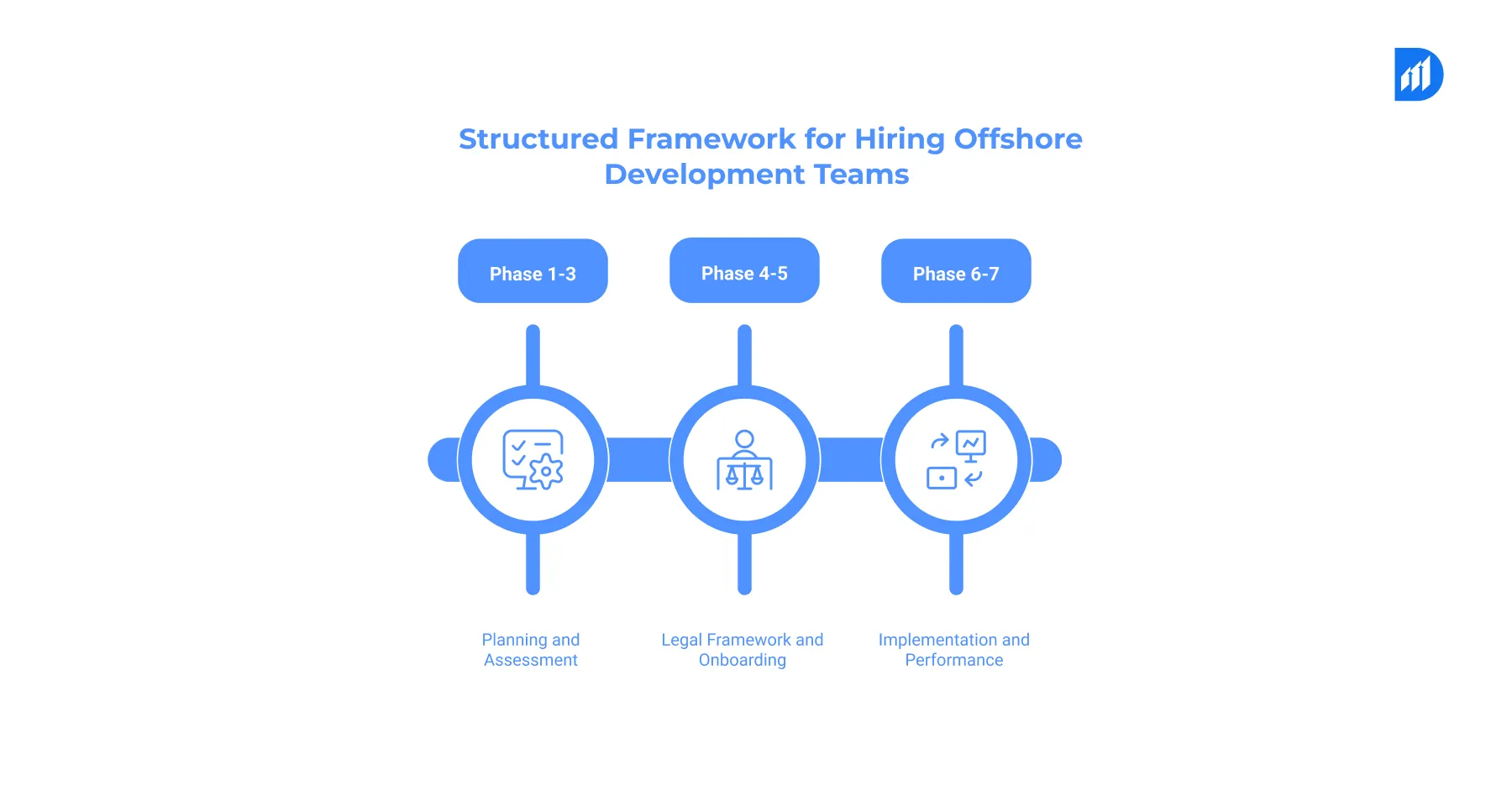
Phase 1-3: Planning and Assessment
Hiring offshore software development teams requires a seven-phase structured framework. Phase one requires organizations to create a list of technical needs including engagement models and precise technical requirements. Your document should establish required skills including programming languages, frameworks, and cloud platforms. Include expected experience levels for junior, mid-level, and senior professionals plus team structure. Establish whether you need staff augmentation, dedicated teams, or project-based delivery.
Phase two evaluates offshore software development companies through technical assessment. Examination needs to include portfolios with projects matching the same difficulty level, technology stack, and industry background.
Organizations need case studies showing expertise in GenAI development, cloud architecture, and data engineering. Confirm their Microsoft partnerships, AWS competencies, and Databricks specializations. According to research, companies with 50+ certified professionals in required technologies shorten employee training period by 35%.
Phase three involves conducting technical interviews while evaluating skills. Assess problem-solving skills through coding challenges available on HackerRank and CoderPad. Your organization evaluates system design abilities through architecture discussions. Then examine code samples from past projects. Organizations implementing strict technical evaluations complete first deliverables with 60% fewer quality problems.
Phase 4-5: Legal Framework and Onboarding
Phase four creates legal and security guidelines. Your organization creates complete Master Service Agreements addressing IP ownership, confidentiality, data protection, and termination clauses. Use Statement of Work documents to create specific project plans describing project scope, timeline, and acceptance criteria. Organizations need secure systems including VPNs, access controls, and monitoring systems before giving offshore teams system access.
Phase five brings teams into the organization through complete knowledge transfer programs. Your organization provides architectural documents, codebase walkthroughs, and domain knowledge training. Teams set up communication systems, development processes, and quality assessment criteria. Offshore teams use internal technical leads as designated contacts. Onboarding procedures decrease the duration until employees make their first significant contribution from eight weeks to three weeks.
Phase 6-7: Implementation and Performance
Phase six applies agile development methods modified for distant teams. Teams perform work through sprint cycles with defined goals and acceptance standards. They conduct daily standup meetings during shared time periods. Sprint reviews and retrospectives enhance collaboration capabilities. Teams implementing customized agile methods achieve 45% higher sprint performance results by their third sprint.
Phase seven monitors performance through objective metrics. Teams measure performance by tracking velocity, code quality scores, defect rates, and sprint completion percentages. They use SonarQube automated code analysis tools to enforce quality standards. Companies conduct quarterly business reviews to measure cost savings, delivery speed, and stakeholder satisfaction. Data analysis results modify team structure and operational methods.
Why Offshore Development Is Essential in 2026
Four Market Trends Driving Adoption
Offshore software development has become essential to enterprise operations because of four simultaneous market trends. Worldwide talent deficit in cloud managed services, machine learning, and data engineering has created a necessity for hiring overseas workers. The US needs 120,000 cloud architects and 85,000 data engineers according to CompTIA’s 2024 Workforce Report. Offshore markets fill these gaps immediately.
The period between 2020-2022 demonstrated that remote work became standard practice. Distributed teams produce work meeting high-quality standards. Companies previously avoiding offshore development due to collaboration concerns now possess proven methods for managing distributed teams successfully. This mindset shift resulted in 62% of Fortune 500 companies expanding offshore software development operations between 2022-2024.
Development of new technologies requires specific knowledge existing only in certain geographical areas. India leads in AI/ML talent with 850,000+ professionals. Eastern Europe excels in cloud architecture and security engineering. Enterprises developing next-generation products require these talent pools for specialized skills existing anywhere in the world.
Economic conditions create a need for businesses to operate with maximum efficiency. Companies using offshore partnerships cut operational expenses by 40-50%. They spend saved money on market growth, research and development, and market advantage. This cost advantage enables businesses to achieve profitability while others face financial losses in markets where profit margins exist.
Five Emerging Trends in 2026
Five major trends are reshaping offshore software development in 2026. First, AI-assisted development is accelerating productivity across offshore teams. Developers using GitHub Copilot, Amazon CodeWhisperer, and similar tools achieve 25-35% coding speed increases. Offshore software development companies investing in AI tools create more value per dollar spent versus companies depending exclusively on manual development processes.
Second, current research shows specialization is the new system replacing generalization. Specialized offshore teams now deliver vertical expertise through fintech teams, healthcare developers, and industrial IoT specialists. Teams possessing domain knowledge complete projects 40% faster because they don’t require time-consuming training processes.
Third, hybrid nearshore-offshore models are emerging. Companies combine nearshore teams in similar time zones for rapid iteration with offshore teams for cost-effective scaling. This system enables teams to work together easily while maintaining cost efficiency. Results include 30% cost savings through 4-6 hours of daily overlap.
Fourth, platform engineering and LLM security guide practices are mandatory industry standards. Enterprises require offshore teams possessing expertise in securing GenAI applications, implementing zero-trust architectures, and managing cloud-native platforms. Offshore partners lacking these essential operational skills will experience decreased competitive advantage.
Fifth, outcome-based pricing models are replacing hourly billing. Enterprises pay for delivered features, processed data volumes, and achieved performance metrics instead of developer hours. This new system motivates offshore teams to work efficiently. It eliminates the need to track billable hours resulting in 25-35% waste reductions.
FAQs
What is the main difference between offshore and nearshore software development?
Offshore development requires teams working from remote locations with time zones differing by 6-12 hours. Nearshore development operates with teams sharing time zones differing by 1-3 hours.
How long does it take to onboard an offshore development team?
The onboarding process requires 2-4 weeks for staff augmentation and 4-8 weeks for dedicated teams when organizations provide proper documentation and training materials.
Which countries provide the best offshore software development services in 2026?
India leads in AI/ML and cloud expertise. Eastern Europe provides security and architectural solutions. Latin America delivers effective nearshore and offshore development services.
What is the average cost savings with offshore software development?
Enterprises achieve 40-60% development cost reductions. This results in total annual savings between $2-3 million when development budgets exceed $5 million.
How do companies ensure quality when hiring offshore developers?
The process includes technical vetting with automated code quality testing and CI/CD pipeline implementation. Establishment of coding standards undergo periodic evaluation.

Deepesh Jain
Recent Blog