Mobile App Architecture: The Complete Guide to Building Scalable Apps

Most apps fail not because of bad ideas, but because of bad structure. A mobile product developed by a startup successfully manages 500 users but fails when the company reaches 50,000 users. The system experiences server timeouts, data synchronization problems, and user interface crashes. The team works to correct mistakes they should have anticipated from the beginning. Poor mobile app architecture serves as the root of that broken foundation. According to Gartner, 75% of mobile applications fail to satisfy user needs because developers selected architectural elements that led to performance and scalability problems during the initial development phase.
Getting mobile app architecture right from day one is not optional. The decision represents the highest level of technical importance your team must make. The foundation requires correct implementation because enterprise mobile app development has grown significantly.
The system establishes a dividing line between products which can grow and those which will remain temporary. This guide to mobile app architecture covers how it operates, which design patterns matter, and how current development methods help Mobile Application Development Services create applications that achieve long-term success.
What Is Mobile App Architecture, and Why Is It Important for Building Scalable Apps?
The mobile app architecture functions as the fundamental design framework which determines app component interactions and their ability to expand. It defines the function of your frontend, backend, database, API, and business logic components through their respective organizational structure. Your app functions like a city in need of planning. The absence of proper planning leads to traffic jams, bridge collapses, and total disorder during large-scale events. Smart planning means smooth flow regardless of how many users show up.
Poor architecture creates cascading problems. A McKinsey report found that enterprise teams spend up to 30% of their development time fixing technical debt caused by poor architectural decisions. Mobile app development incurs technical debt that results in system crashes, extended loading times, and unsuccessful deployments.
Strong mobile app architecture enables teams to develop new features while keeping existing functions operational. It also lets them expand system capacity on demand and maintain code that others can actually read and modify.
What Are the Core Components of Mobile App Architecture, and How Are They Structured?
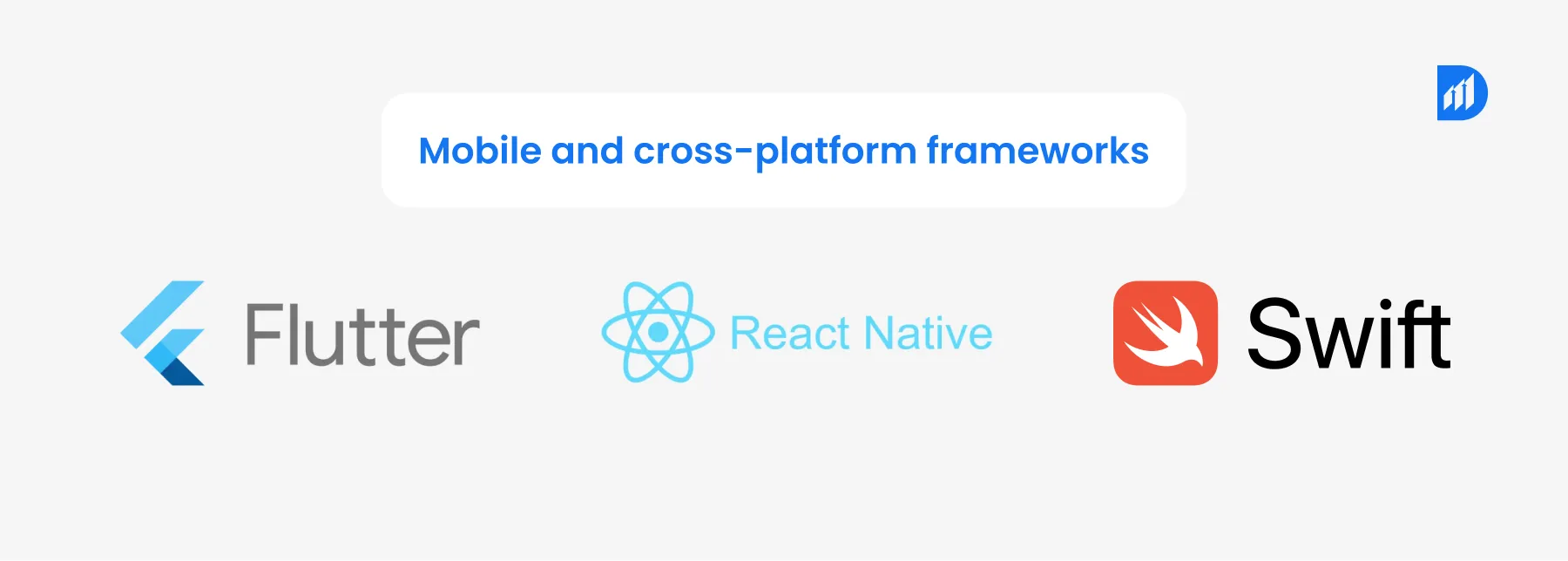
Mobile applications operate through three essential structural layers which function together to create their complete system. The presentation layer includes all elements which users interact with through their visual interface. Frameworks like React Native, Flutter, and SwiftUI control this layer. It must remain lightweight because it should only display user interface elements without containing any business functions.
The Business Logic Layer implements all application operations using established rules. It manages data processing, supports different workflows, and links the presentation system with data access. Mobile app development stays maintainable over time when this layer is cleanly separated from other components.
The data layer manages all operations involving data storage, retrieval, and synchronization. It consists of local databases like SQLite and Room, along with remote APIs and caching systems. A properly designed data layer enables data consistency while decreasing server demands. All scalable mobile applications use these three essential layers as their fundamental system design components.
How Does Mobile App Architecture Work Across Frontend, Backend, and API Layers?
The three structural layers above translate into real infrastructure: frontend systems, backend systems, and application programming interfaces. Mobile app development needs all three because they serve different functions.
The user’s device runs frontend software. It displays user interface elements, maintains local application state, and implements offline functionality. Frontend systems use state management tools such as Redux, Riverpod, and MobX to synchronize the user interface with data updates.
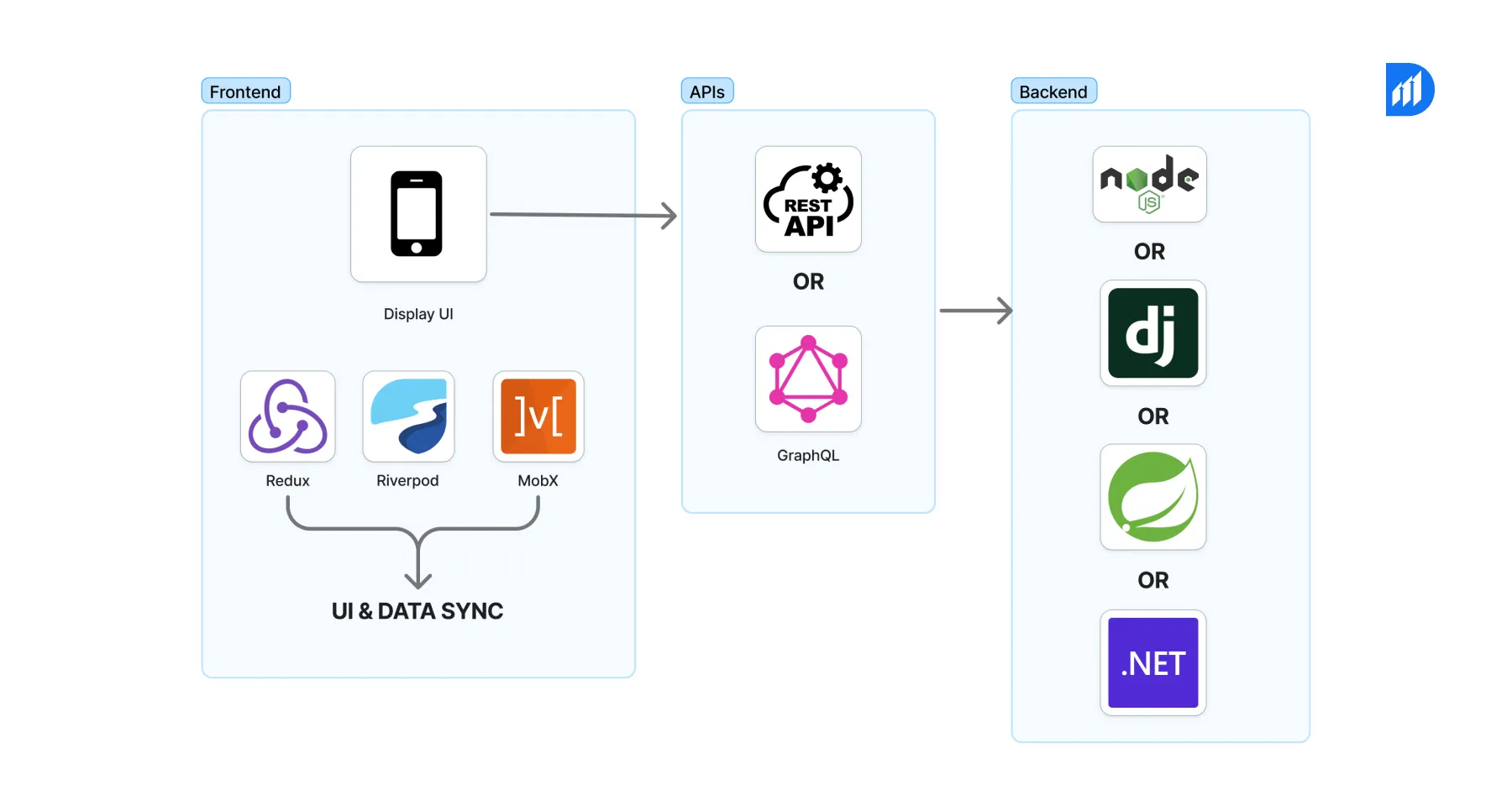
Backend systems operate from remote server locations. They execute business operations, control user access, perform data management, and run resource-intensive computations. Node.js, Django, Spring Boot, and .NET provide the main technologies that power mobile backends. Cloud infrastructure from Azure and AWS supports them further.
APIs serve as the communication channel between frontend and backend. REST APIs remain the industry standard. However, GraphQL has started gaining popularity because it lets developers grab only the exact data they need. A well-designed API layer reduces mobile bandwidth consumption by up to 40%, which directly improves app performance on low-connectivity devices. The design quality of APIs determines whether users experience fast or slow performance in a mobile application.
How Does Mobile App Architecture Differ from General Software Architecture in Application Development?
General software architecture assumes stable networks, dedicated hardware resources, and continuous network availability. Mobile applications need to be designed around much less forgiving conditions.
Mobile devices operate with limited battery life, changing network conditions, and different display sizes. Users switch between Wi-Fi and 4G mid-session. They also keep applications open while switching between different programs. Some use devices with 2GB RAM, others with 16GB.
Web app architecture needs continuous connections while delivering content through server-side rendering. Mobile applications need three core design elements: offline functionality, local data storage, and efficient data transmission. A web app can handle an API response time of 500 milliseconds. A mobile app on a 3G network cannot afford that. These different requirements push mobile architects toward decisions that enterprise web teams rarely face.
What Are the Key Mobile App Architecture Patterns Used in Modern Development?
The selection of a design pattern determines all subsequent choices throughout your mobile app development process. The four patterns below represent the most widely used approaches today.
MVC divides the system into three parts: data, user interface, and computational functions. It is easy to implement. However, its management becomes challenging as applications grow because the controller starts handling excessive tasks.
MVVM introduces a ViewModel component that processes data before it reaches the View. This pattern works best in applications that use data binding, such as Android Jetpack Compose and iOS SwiftUI. Teams report a 35% decrease in UI defects when using MVVM over MVC in advanced projects.
Clean Architecture divides a software system into concentric layers: entities, use cases, interface adapters, and frameworks. Each layer only relies on the layers inside it. As a result, the codebase becomes highly testable and scalable. This pattern sees wide usage in enterprise mobile app development.
Microservices-based Architecture breaks the backend into small services that users can deploy individually. Each service handles one business function. Teams can therefore expand their system by adding features without redeploying the entire backend.
| Pattern | Best For | Scalability | Complexity |
| MVC | Small apps, MVPs | Low | Low |
| MVVM | Data-heavy UI apps | Medium | Medium |
| Clean Architecture | Enterprise apps | High | High |
| Microservices | Backend-heavy platforms | Very High | Very High |
Each pattern comes with tradeoffs. The right choice depends on your team size, app complexity, and long-term roadmap.
What Role Does Backend Infrastructure Play in Supporting Scalable Mobile Applications?
Backend infrastructure is the crucial element that determines whether mobile app architecture holds up under real user demand. A properly constructed backend maintains operational efficiency during unexpected traffic spikes.
Docker containerization combined with Kubernetes orchestration enables backend systems to scale horizontally. The system automatically creates additional containers when traffic doubles. It then scales back down during quieter periods to reduce costs. Enterprise mobile app development depends on this kind of flexibility.
Why Database Architecture Matters as Much as Application Code
PostgreSQL provides dependable management of relational data. Redis handles session caching. It also reduces database query load by up to 60% in high-traffic applications. MongoDB suits document-heavy data models common in mobile content apps.
Cloud-native deployments on Azure or AWS give teams worldwide distribution, automatic system recovery, and integrated monitoring. Cloud infrastructure deployments achieve 99.9% uptime, while on-premise systems average only 97%.
What Challenges Arise When Designing and Implementing Mobile App Architecture for Scalability?
The architecture of mobile apps faces scalability difficulties that go beyond technical limitations. These challenges are organizational as much as structural.
The most common challenge is tight coupling. When components depend too heavily on each other, changing one breaks another. Consequently, mobile app development teams slow down and regression bug counts rise.
State management becomes difficult at scale. Managing data consistency across local storage, server state, and UI state creates race condition problems plus stale data errors. Organizations using dedicated state management solutions report 45% fewer data synchronization problems in production. Security is another substantial challenge. Mobile applications store confidential information on user devices while transmitting data over public networks. Without encryption, certificate pinning, and token management, apps become vulnerable to data breaches.
Performance optimization is an ongoing effort. The initial performance of applications often declines as developers add more features. Profiling tools such as Android Profiler and Xcode Instruments help developers detect memory leaks and CPU bottlenecks before they impact end users.
How Does Durapid Technologies Help Businesses Build Scalable Mobile App Architectures?
Every stage of mobile app development needs more than just execution. It needs a foundation that’s built to scale from day one, that’s where Durapid Technologies comes in. With a team of 300+ developers, 120+ certified cloud consultants, and 150+ Microsoft-certified experts, Durapid focuses on building mobile app architecture that grows with your business, not against it. Their experience spans industries like finance, healthcare, retail, and logistics, where scalability isn’t optional. By using proven architectural patterns, clean coding practices, and modern cloud deployment strategies, they ensure applications perform reliably even at enterprise scale.
Through their Mobile Application Development Services, Durapid supports everything from architecture design to production deployment. So if you’re planning a mobile product and want to get the architecture right from the start, this is where you begin.
FAQs
What is mobile app architecture?
It’s basically how your app is structured: UI, backend, data, APIs.
And honestly, this is what decides if your app scales or crashes under pressure.
What is the best pattern for enterprise mobile app development?
Clean Architecture works best because it keeps everything separate and manageable.
So when your app grows, your code doesn’t turn into chaos.
How does mobile app architecture affect performance?
Bad architecture = slow apps, broken APIs, messy data sync.
Good architecture = fast, stable, and doesn’t panic when traffic spikes.
What is the difference between MVC and MVVM in mobile development?
MVC connects everything directly, which can get messy fast.
MVVM adds a middle layer (ViewModel) so your UI doesn’t break every two seconds.
How do I hire mobile app developers with architecture expertise?
Don’t just look at skills, look at what they’ve actually scaled.
If they’ve built apps that handle real users (100k+), you’re on the right track.

Deepesh Jain
Recent Blog

Top AI Development Companies in India 2026
March 31, 2026