LLM Security Guide: Top 10 Enterprise Risks and Key Mitigation Strategies
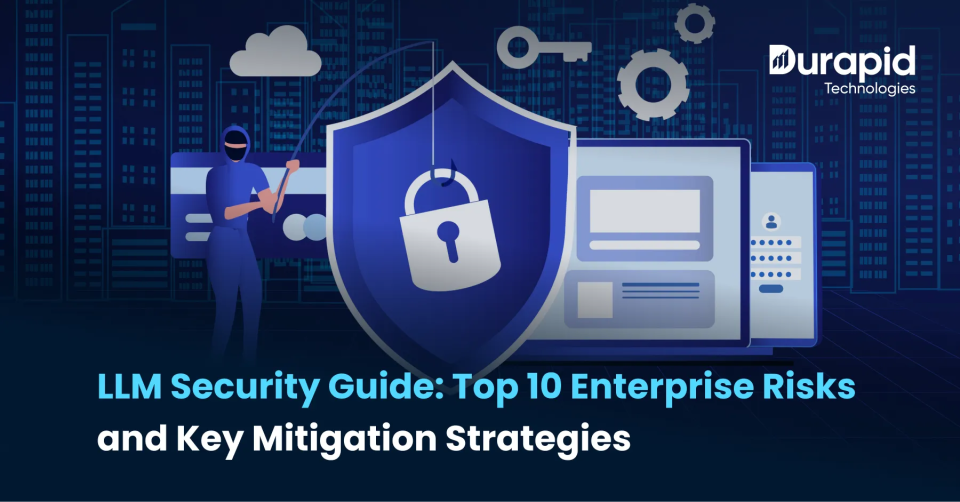
The security of LLMs has become a vital issue for companies that are using artificial intelligence throughout their operations. Additionally, the integration of large language models in customer support, content creation, and decision-making is coming with security challenges. Unfortunately, the existing security measures have not been able to deal with these challenges. As LLM use grows quickly, companies will have to consider and deal with the security risks before they interrupt the business processes.
What Is Large Language Model (LLM) Security?
LLM security is a term that denotes the overall protection of large language models. Specifically, it involves the implementation of practices, standards, and controls that are comprehensive. The model architecture, data used for training, deployment infrastructure, and user interactions can all be secured by this means.
The issue of LLM security is different from the usual security applied to the software. When discussing LLM vs Generative AI systems, fundamentally, it deals with problems that are unique to AI systems . Furthermore, the models use a lot of confidential information and sometimes by their replies they might expose it. This is why the security procedures should not only block unauthorized users. Rather, they must also protect the data and keep the model intact throughout its life.
The difficulty in dealing with LLM security comes from the many different ways attackers can target the models. For instance, hackers may change the input to get the training data. Alternatively, they can add harmful prompts to change the model’s output. Or they can take advantage of the API weaknesses to access the system. Therefore, organizations using LLM AI must design and apply multi-layered defense. Notably, this defense should cover all aspects of data governance, access restriction, and continuous surveillance.
How Do LLMs Work?
Large language models are movements that rely on a highly refined architecture known as transformers. Essentially, they handle text in such a way that they first scrutinize the patterns and connections among words. Moreover, organizations give such models a lot of training on extensive datasets. Through this training, they learn the linguistic rules, the contextual meanings and the representations of knowledge through billions of parameters.
The process of training consists of providing the model with different sources of text. Importantly, the model must be able to predict the next word in a sequence. Through this prediction technique, LLMs can produce human-like answers, grasp context, and also handle difficult language tasks. Furthermore, the impact of the model depends on the nature and variety of its training data.
In the process of deployment, LLM models receive initial user prompts. Subsequently, they generate responses by doing a probability analysis over their vocabulary. Initially, the model takes into account the context of past interactions. Then it makes use of the patterns it has learned. Finally, it produces outputs that are in line with the input request. What is more, the whole process takes just milliseconds. As a result, this speed makes the LLM applications extremely quick and suitable for real-time use cases.
How AI Language Models Are Risking Data & Security Governance: Top 10 LLM Risks
The large-scale use of what is llm in ai introduces different security risks. Moreover, these risks necessarily require specialized approaches for their mitigation. Fortunately, awareness of these risks gives companies the chance to establish strong walls of defense. In fact, they can do this before putting large language models into practice in their production areas.
Prompt Injection Attacks
The most serious risk to LLM overall is prompt injection. In these attacks, hackers compose inputs that are meant to shift system directions and thus affect the model’s behavior. Unfortunately, in such cases, the model cannot separate the users’ legitimate commands from the malicious ones within the user queries. Even worse, the situation becomes critical in cases where successful prompt injections lead to unauthorized data access, system manipulation, or even exposure of confidential information.
Training Data Poisoning
Data poisoning is a practice where malicious actors introduce corrupt or biased information to the training dataset. Consequently, this breaks the model’s integrity from the base. Notably, this threat is more serious for companies that deploy open-source LLM solutions relying on public datasets. In particular, such organizations are more vulnerable to data corruption. As a result, the use of tainted data could result in models showing the wrong responses. Additionally, it can apply biased behavior to them or even leak sensitive information.
Model Inversion and Data Extraction
One of the llm security risks is the possibility of being subjected to sophisticated attacks. Specifically, adversaries may query the model in a strategic manner. Through this, they will be able to extract sensitive information gathered from the model’s training data.
Such attacks take advantage of the model’s capacity to memorize certain data points. Notably, this is more pronounced when developers provide the model with repeated or unique information patterns. As a result, the attackers might be able to reconstruct personal data via well-crafted query sequences. Additionally, they can also retrieve proprietary code or even confidential business information.
Insecure Plugin and Integration Vulnerabilities
Today’s LLM applications are very often relying on the support of external tools, APIs, and databases. Essentially, this implies that their capacity is being extended. However, such integrations are giving rise to new areas of attack. Unfortunately, lack of security in these areas can lead to a system-wide compromise. Moreover, improperly secured plugins may open up unnecessarily large access. In some cases, they might not have any proper authentication. Or they might not even check if the data passing between the two systems is correct.
Inadequate Access Controls
A good number of organizations do not apply proper techniques for authentication and authorization in their LLM deployments. Unfortunately, insufficient access controls make it possible for unauthorized personnel to communicate with models. As a result, this can lead to them getting sensitive information or taking advantage of system bugs. Furthermore, this danger gets worse in multi-tenant environments and during LLM model integration. In such setups, users from different groups need different access levels.
Supply Chain Vulnerabilities
The security of LLM is not limited to the model. Instead, it rather expands to the entire development and deployment pipeline. For instance, pre-trained model vulnerabilities, third-party library exploits, or infrastructure components can create security loopholes. Consequently, firms that opt for the best llm for coding or domain-specific models have to carry out rigorous validation. Specifically, they must check the integrity and security of all elements in their supply chain.
Denial of Service Through Resource Exhaustion
LLM applications are resource-hungry. Unfortunately, this very characteristic makes them susceptible to denial-of-service attacks. Specifically, the attackers can bombard the system with extremely difficult queries. As a result, these queries will consume all the system’s resources, thus leading to performance degradation or complete outage. Moreover, this threat is present in both inference and training operations.
Model Theft and Intellectual Property Risks
The companies that go for custom LLM development are the ones that suffer most. Specifically, they have to deal with the risk of model theft. In these attacks, the attackers get hold of model parameters or duplicate functionality through query-based attacks. Notably, this is a significant threat for companies that are developing proprietary models to gain a foothold in the market. In the end, model theft can lead to large-scale financial losses. Additionally, it also results in the loss of strategic advantages.
Hallucination and Misinformation Generation
Large language models (LLMs) are capable of producing false information that appears valid. Unfortunately, this poses a threat to the security and even creates liability risks for the concerned organizations. Specifically, the hallucinations can be the utterances of falsehood or wrong directions. Furthermore, they can also give users unhelpful guidance that could eventually lead to user harm. Consequently, this negatively affects the organization’s reputation. To worsen the situation, it occurs in the most critical areas. For instance, these include healthcare, finance, and legal services where reliability is paramount.
Compliance and Privacy Violations
LLM security must comply with the legal requirements. For instance, GDPR, HIPAA and the regulatory frameworks of some industries set strict standards. Unfortunately, there is a possibility that models trained on confidential data can reveal such data through their answers unintentionally. Consequently, organizations face legal actions and reputational damage. Specifically, this happens whenever they use LLMs in ways that infringe privacy regulations.
What are Open LLMs exactly?
Open source LLM platforms deliver model architectures, weights, and training code that are publicly accessible. As a result, this allows organizations to adapt them according to their particular use cases. Moreover, the transparency, flexibility, and cost advantages of such models over the closed proprietary alternatives have made something possible. Specifically, they have given enterprises more control over their AI infrastructure.
Open source techniques like Llama, Mistral, and Falcon are among the popular ones. Notably, each one provides different functionalities and performance features. Furthermore, organizations can train these models further on custom datasets. Alternatively, they can change the architecture for specific applications. Or they can place them in highly secure isolated environments for maximum protection. However, the open-source path requires significant technical knowledge and investment in infrastructure.
LLM Security for Enterprises: Risks and Best Practices
LLM security for enterprises is a complex issue. Specifically, it needs a complete framework consisting of technical controls, governance policies, and operational procedures. Moreover, organizations need to find a way to innovate while managing risks at the same time. Therefore, they need to be very careful that their security measures do not slow down legitimate business use. At the same time, they must protect the organization against the new threats.
Understanding Enterprise Risk Landscape
The enterprise risk landscape is made up of both internal and external threats. For instance, internal risks can stem from giving employees insufficient training. Alternatively, they can also come from not having the right security awareness in the company. Additionally, accidental misuse by employees is another source. On the other hand, external threats come from advanced attackers. Notably, these attackers target the company’s data or try to disrupt the company’s operations through the weaknesses in the LLM.
Winning LLM security strategies coexist with the cybersecurity frameworks of the organization. Furthermore, they also tackle the unique challenges posed by AI. Among these are the clear assignment of responsibility for the security of the model. Additionally, they also specify the conditions under which people can use the model. And they provide training for the prevention of LLM-related security incidents.
Moreover, businesses can leverage the capabilities of an LLM optimization agency. As a result, this helps them create security frameworks that do not compromise performance while protecting with the necessary measures.
Input Validation and Output Monitoring
When it comes to input validation, organizations need to have a taken-for-granted procedure. Specifically, this involves scrutiny of all users’ queries before processing. Furthermore, the validation process should include the detection of injection attempts. It should also include filtering of malicious content and implementation of input length limits.
The same way, continuously monitoring the outputs of the model helps in detection of security incidents. Additionally, it raises the quality of the issue in real-time. Notably, the finest best llm security tools are the ones that provide automated systems. In particular, these systems flag suspicious responses, potential data leaks, or policy violations.
Encryption and Access Management
Data flowing to and from LLM applications require encryption both in transit and at rest. Specifically, all such data includes user queries, model responses, training data, and configuration files. Moreover, organizations use strong encryption standards as a shield. As a result, this protects against data interception and unauthorized access.
Companies must also adopt role-based access control. Additionally, they need multi-factor authentication and session management protocols for securing llm programs.
Security Testing and Governance
Regular security testing utilizing llm security tools is a way of discovering the vulnerabilities. Importantly, you want to find them prior to the attackers. Therefore, organizations should subject the LLMs to penetration testing, vulnerability assessments, and adversarial testing.
Furthermore, clear governance policies set up the boundaries of acceptable use. Specifically, they establish security requirements and compliance obligations for LLM applications. Notably, many enterprises now rely on the top rated llm for chat implementations. As a result, this ensures secure communication channels.
Model Versioning and Continuous Monitoring
Organizations maintain proper version control for LLM models. Specifically, this ensures they can quickly roll back to secure versions if vulnerabilities emerge. Moreover, update management processes should include security testing. In particular, this happens before deploying new model versions.
Companies working with the best coding llm solutions need clear policies. Notably, these policies define when updates are mandatory versus optional for maintaining security standards.
How Can Durapid Assist You in Making Your LLM Security Stronger?
Durapid Technologies has a lot of know-how and skill in AI security. Specifically, it is helping the enterprises to develop LLMs that are secured and are compliant with regulations right from the start. Moreover, the certified team of more than 120 cloud consultants plus over 95 Databricks-certified professionals comprise the group. In particular, this group has the knowledge of the specific difficulties posed by securing the production environments with large language models.
Comprehensive Security Services
We offer complete assistance for generative AI development. Notably, security is the first priority at all times with our approach. Among our services is the carrying out of a thorough security assessment. Specifically, this will pinpoint the weaknesses in the existing LLM deployments. Additionally, we also design a secure architecture that will apply the strategies of defense-in-depth. And we provide monitoring that will pick up and react to the threats as they appear.
Our method unites LLM security with the wider enterprise security frameworks. As a result, this ensures the consistency in policy enforcement and easier management.
Compliance and Governance Support
Plus, we help the organizations to comply with the regulations. Furthermore, we assist them to use the privacy-preserving methods. And we set up the governance that would allow risk management and innovation to co-exist. Moreover, Durapid’s skill in LLM model integration guarantees something important. Specifically, the security controls will not have an impact on the performance or user experience.
We will be making the model deployments both more secure and more efficient. Notably, we do this through the implementation of the security policies. Furthermore, we apply the strategies of caching, optimizing queries, and managing resources. As a result, these will keep responsiveness while security policies work. As a recognized LLM optimization agency, we are aware of how to meet the security requirements. Importantly, we do this without sacrificing performance.
Industry-Specific Solutions
We back up multiple organizations from different sectors. For instance, these include financial, medical, and retail. Notably, each has specific security and compliance rules. Furthermore, our custom software development skills allow us to create security solutions that are unique for each sector. Specifically, these address threats and regulations specific to each industry. Additionally, we help businesses understand LLM vs Generative AI security considerations. As a result, this helps them implement the right protection measures.
With Microsoft’s partnership and our knowledge of Azure, we apply security measures fit for enterprises. For instance, these include managed users, key storage, and securing the network. Moreover, the specialists from our company assist the clients in making use of the inherent security features of the cloud. At the same time, we configure extra protection specifically for LLM applications. Furthermore, our expertise spans across various llm artificial intelligence implementations. It also covers online llm programs deployment.
Frequently Asked Questions
What are the main security risks when using LLM models in production?
The primary risks include prompt injection attacks, data poisoning, unauthorized data extraction, and inadequate access controls.
How do llm security tools differ from traditional security solutions?
LLM security tools specifically address AI-related vulnerabilities like prompt manipulation and model inversion.
Can open source LLM platforms be as secure as proprietary solutions?
Open source LLM platforms achieve comparable security. Notably, this happens when organizations implement proper hardening and active vulnerability management.
What makes an LLM optimization agency valuable for security?
An LLM optimization agency provides expertise in balancing performance with security requirements.
How often should organizations assess their LLM security posture?
Organizations should conduct quarterly security assessments for production LLM applications.
Recent Blog

Top AI Development Companies in India 2026
March 31, 2026