How to Hire an AI Developer in 2026: Costs, Process, and Key Considerations
The competitor operates an AI customer service system which handles 78% of customer inquiries without needing human support. Your support team handles a massive ticket load which takes them six hours to respond to each request. The difference is that they made the correct AI developer choice eight months ago. You continue your search for a new candidate.
The process of hiring an AI developer for 2026 requires enterprises to select candidates with technical expertise because their knowledge will help businesses achieve 40% operational cost reductions while accelerating the development process by 60%, according to Gartner’s 2024 AI talent research. Companies that successfully hire AI developers report $2.8M in average annual productivity gains, while those who hire incorrectly face project failures costing upwards of $500K in wasted resources and delayed market entry.
This guide explains the complete process of recruiting dedicated AI developers including their salary requirements and the technical competencies which distinguish high-performing candidates from average performers. Your AI projects will succeed or fail based on your understanding of the recruitment process for full stack AI developers who create complete solutions and AI software engineers who focus on automation work.
What Does an AI Developer Do?
The work of an AI developer includes designing and building intelligent systems which make decisions through automated processes while handling large amounts of data. AI developers create applications through the use of machine learning models and neural networks and natural language processing algorithms and generative AI frameworks which their applications use to learn and improve over time.
The role of this position requires expertise in various technical fields. AI developers create recommendation engines which generate 35% of Amazon’s total income. They create fraud detection systems which help financial institutions avoid $28 billion in yearly losses. They develop predictive maintenance systems which cut manufacturing equipment downtime by 50%. Data scientists use TensorFlow and PyTorch and Azure OpenAI and Databricks to convert unprocessed data into useful operational knowledge.
Full Stack AI Development: Models and Deployment
The complete AI development process requires an AI developer to manage both the creation of AI models and their system implementation. They design and build systems that support algorithm training while they create infrastructure through Kubernetes. Deploying machine learning operations pipelines using Azure ML or AWS SageMaker comes next. They establish artificial intelligence functions in current business applications through REST APIs and microservices. The Stack Overflow 2024 Developer Survey reveals that only 23 percent of software engineers have both skills required for model development and production deployment which makes complete AI development expertise highly uncommon.
Why Do You Need AI Developers?
Traditional software development cannot address problems that need pattern recognition for extensive data sets or immediate decision-making during variable changes. AI developers create designed systems which learn and improve their performance through automatic changes without requiring human programming work.
The business case provides measurable financial benefits. McKinsey’s 2024 AI adoption study shows that organizations using AI-based automation experience 45 percent faster customer request processing. Organizations achieve 62 percent fewer manual data entry mistakes. A mid-sized company that handles 50,000 monthly transactions can achieve $1.2 million in yearly labor savings while improving customer satisfaction scores by 30 percent.
The requirement for specialized AI professionals emerges from particular use cases which require their expertise. Retailers hire AI developers to build dynamic pricing engines that increase margins by 8-12%. Healthcare providers need AI in patient care applications that predict patient deterioration 24 hours in advance with 89% accuracy. Financial services firms require fraud detection models which detect suspicious transactions within 100 milliseconds and maintain false positive rates below 2%.
Technical Skills Beyond Basic Programming
The skills required extend beyond basic programming. AI software engineers need to master statistical modeling and Apache Spark distributed computing systems. Neural network design for specific hardware represents another critical skill. Responsible AI practices that involve bias detection and model explanation round out their expertise. The needed abilities for these tasks do not exist in regular development teams, which is why 71% of enterprises now maintain dedicated AI development units separate from their standard engineering organizations.
How to Hire Dedicated AI Developers: 6 Proven Steps
The following six steps demonstrate the process to recruit dedicated AI developers. The recruitment process for AI developers demands a structured method which assesses their technical expertise and their capability to solve real-world challenges. Companies which disregard this framework will make incorrect hiring decisions 58% of the time. This leads to project failures and expensive employee replacements within the next year.
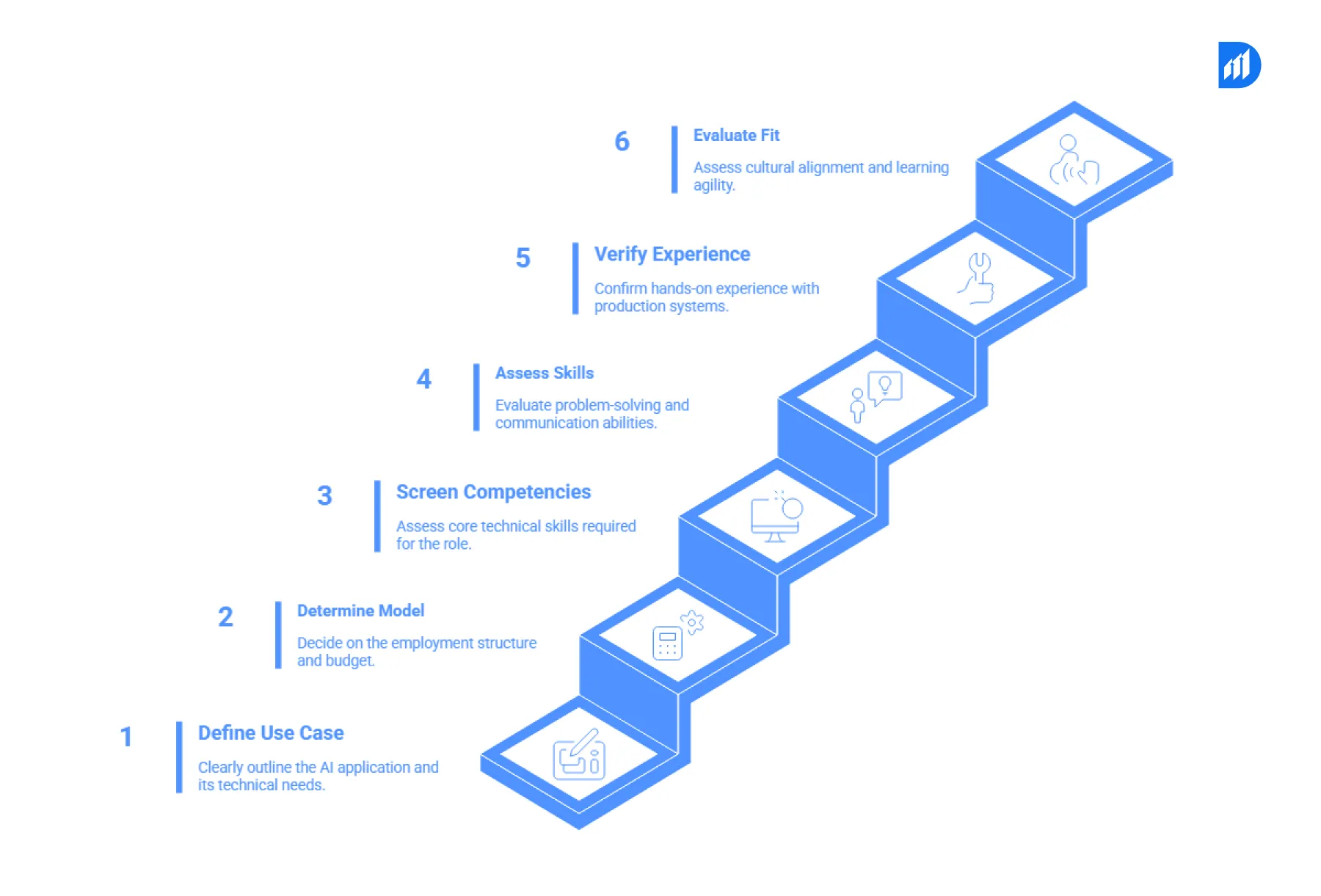
Step 1: Define Your AI Use Case and Technical Requirements
The first step of the process requires you to identify a specific business problem which needs a solution that requires artificial intelligence, not any artificial intelligence capability. The outcome should specify what needs to be achieved instead of stating “we need machine learning” because the business requires “we need to reduce customer churn through at-risk account prediction which needs a 45-day advance notice.” Another example: “we need to automate invoice processing to reduce approval time from 4 days to 6 hours.” The requirement for computer vision expertise and natural language processing skills and time-series forecasting capabilities depends on your specific needs which need to be defined through this process.
Your data infrastructure needs to be documented. AI developers need clean, accessible data to build effective models. Developers who need access to data from legacy systems which lack APIs need data engineering pipeline expertise through Apache Airflow and Azure Data Factory. Organizations with advanced data systems can concentrate on modeling expertise. Organizations with incomplete data systems need AI professionals who can manage both their infrastructure needs and algorithm development requirements.
Step 2: Determine Employment Model and Budget
The organization needs to choose between three options which include full-time hires and contract specialists and outsourced development teams. The complete hiring process requires a budget allocation. The organization needs to budget for technical hiring costs which include recruiting expenses that reach $15K per hire. Onboarding costs range from $25K to $40K for AI positions which need special tools. New employees need a three to six month period before they achieve complete work performance. The first AI developer for an organization will create total costs of $200K to $300K during the first year because the organization needs to spend money on infrastructure and training data and cloud computing resources.
Step 3: Screen for Core Technical Competencies
The evaluation process requires candidates to demonstrate their skills across five technical areas. First, candidates need to show programming skills in Python and R or Java together with usage experience of NumPy and pandas and scikit-learn libraries. Second, candidates need to show actual work experience with deep learning frameworks that use TensorFlow or PyTorch beyond their tutorial projects. Demonstrating expertise in cloud platforms which include Azure Machine Learning and AWS SageMaker and Google Vertex AI to deploy and scale their models becomes essential.
Fourth, MLOps capabilities require the creation of CI/CD pipelines which enable model versioning through MLflow tools. These pipelines support monitoring through both Prometheus and custom observability methods. Fifth, candidates need to show their industry-specific knowledge through domain expertise. Healthcare AI developers must understand HIPAA compliance. Financial services candidates need to know about real-time trading systems and regulatory compliance requirements.
Candidates need to demonstrate their skills through take-home assignments that simulate actual job responsibilities. Candidates must create a classification model based on a provided dataset which they will deploy as an API endpoint. Documentation of their methods for managing class imbalance and missing data is essential. Top performers complete this task within 4 to 6 hours. Complete documentation which describes the architectural choices they made and the decisions they took between different options shows their expertise.
Step 4: Assess Problem-Solving and Communication Skills
The evaluation process requires two tests: assessment of problem-solving abilities and verbal communication competencies. Successful artificial intelligence developers need to transform difficult statistical information into understandable business terms. Explaining their modeling decisions to people with no technical background becomes crucial. Interviews require candidates to solve undefined business challenges through their method of approaching the problem.
The testing results show that our recommendation engine achieves high accuracy yet exhibits poor performance with fresh users. Your debugging process requires explanation through a detailed step-by-step process. Best candidates will address cold-start challenges through their A/B testing framework proposal. This proposal combines collaborative and content-based filtering elements into a unified approach. Weak candidates demonstrate solution-making behavior because they lack understanding about actual problem origins.
The assessment requires testing their capacity to handle model failures. Every AI system eventually produces incorrect predictions—what matters is how developers detect, diagnose, and resolve these issues. Candidates should discuss three components which include monitoring techniques, automated retraining triggers, and fallback systems. These systems ensure business operations will continue during model performance declines.
Step 5: Verify Hands-On Experience with Production Systems
The application of academic knowledge results in a complete separation from actual production environments. Candidates must prove their ability to develop systems that can manage actual user traffic. Demonstrating their experience beyond Kaggle competitions and academic projects becomes essential. Candidates should provide information about their biggest operational model by answering three questions. These include daily request numbers, p99 latency, and model update management process.
Companies that require AI developers for their automation work need to see candidates’ past work with integrated systems. Showing how they integrated AI models with Salesforce, ServiceNow, and SAP through API connections demonstrates their expertise with enterprise systems. Developers need to show their experience with AI-backed chatbot development by proving their work with conversation design tools. These tools include Azure Bot Framework and Dialogflow beyond basic knowledge of their natural language processing capabilities. The organization should assess how employees maintain data quality standards.
Step 6: Evaluate Cultural Fit and Learning Agility
The evaluation process begins with Step 6 which assesses two factors. AI technology develops at a rapid pace because current dominant frameworks will lose their relevance within the next 18 months. Hire AI developers who show their ongoing development through three activities. These include their open-source work, their new technology certifications, and their research activities in artificial intelligence.
The organization should assess how candidates work with other people through their collaborative abilities. AI developers work with multiple teams. These teams include data engineers who create pipelines and public operations teams who handle infrastructure and business analysts who establish measurement criteria. Candidates must present their work on various projects that required collaboration with different teams. Detailing their methods for dealing with technical conflicts and project boundary disputes shows maturity.
How Do I Hire AI Developers for Automation Projects?
AI developers who focus on automation development need different skills than machine learning engineers who work on research projects. Specialists develop systems which automatically extract invoices and classify documents and direct customer inquiries to different departments. Their work needs dependable systems which can connect with existing infrastructure.
Organizations should give priority to hiring candidates who possess experience with robotic process automation (RPA) system implementation. Present-day automation technology uses traditional RPA tools such as UiPath and Automation Anywhere together with artificial intelligence to manage unstructured information. An AI software engineer who develops an original invoice parsing system for SAP implementation provides instant business benefits. Research scientists create superior models that never enter actual use.
The interview process needs to assess candidates through practical automation tests. Candidates need to create an automated solution which functions as a complete system to handle a business process which involves approving expense reports. Best applicants will determine which tasks need AI (receipt data extraction and policy compliance verification). Determining which tasks can use rule-based automation (approval routing and email notifications) shows understanding. Demonstrating how these systems will work with current processes completes the picture.
The evaluation process needs to test their ability to assess the trade-off between accuracy and cost. The development cost for a document classification model which achieves 95% accuracy stands at $100,000 with a monthly operational expense of $5,000. The 99% accuracy solution requires $500,000 to implement and $25,000 for monthly operations. Automation projects depend on developers who work to achieve the complete operational expenses of the project instead of only focusing on technical efficiency. Deloitte’s 2024 Intelligent Automation Survey shows that successful automation implementations generate return on investment within eight to fourteen months when developers use accurate calculation methods to determine implementation costs.
Types of Applications AI Developers Can Build
AI developers create different types of applications which require developers who possess unique knowledge and specific technical skills. Understanding these categories enables you to hire candidates who possess the required experience for your specific needs instead of hiring applicants with general AI abilities.
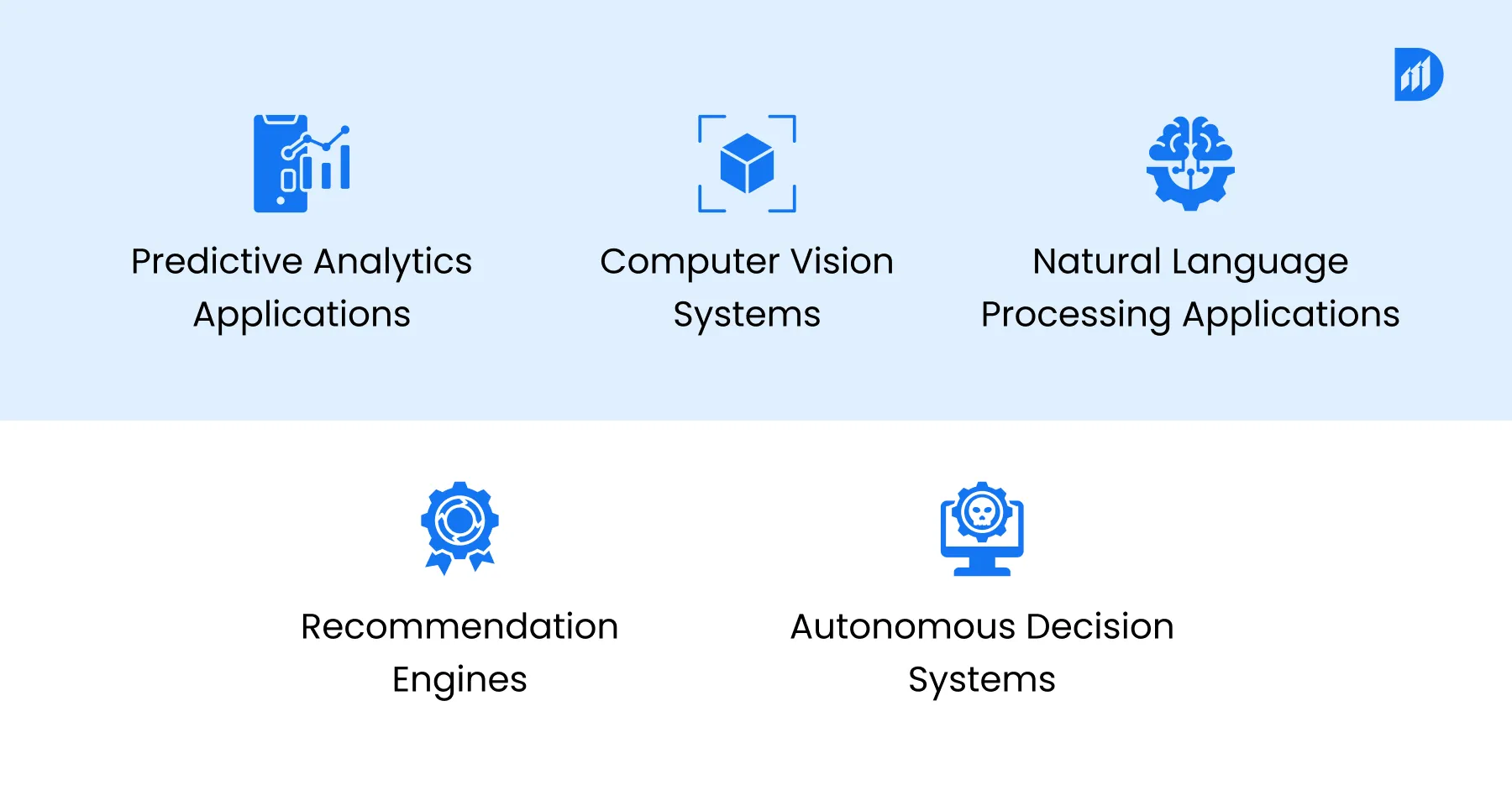
Predictive Analytics Applications
Applications of predictive analytics use historical data to create predictions regarding future events. Systems include demand forecasting systems which reduce inventory costs by 22%. Customer churn prediction models improve retention rates by 18%. Maintenance scheduling tools decrease equipment downtime by 35%. Developers of these applications require a strong understanding of statistical methods together with their knowledge of time-series algorithms such as ARIMA and Prophet. The ability to gather important data points from unstructured business information rounds out their skill set.
Computer Vision Systems
Computer Vision Systems use image and video analysis to perform visual inspection tasks and support autonomous navigation systems and process document information extraction. Manufacturing companies use these for quality control because they can detect defects with 99.2% accuracy which surpasses the 94% accuracy of human inspectors. Healthcare providers implement medical imaging AI systems which can detect tumors 12 hours faster than radiologists who work without assistance. Developers in this area utilize convolutional neural networks together with OpenCV libraries and specialized hardware which includes NVIDIA GPUs that have been designed for processing image-related tasks.
Natural Language Processing Applications
Natural Language Processing Applications enable machines to comprehend and produce human language. NLP-powered HR chatbots decrease employee inquiry response times from 4 hours to less than 2 minutes. Achieving 89% resolution rates without requiring human intervention shows their effectiveness. Sentiment analysis tools process 10,000 customer reviews every hour to detect product issues that emerge before they become popular on social media. These applications need professionals who possess BERT and GPT transformer model knowledge and named entity recognition skills and conversation management framework expertise.
Recommendation Engines
Recommendation Engines create tailored experiences which include customized content delivery and personalized product recommendations and individualized service options according to user behavior patterns. AI-powered recommendations drive 75% of streaming service viewer engagement because users prefer algorithmic suggestions over traditional search methods. AI-powered product recommendations lead to 30% higher average order values according to e-commerce platforms that use this technology. System developers must possess collaborative filtering skills and Apache Kafka or Azure Event Hubs real-time data processing abilities. A/B testing knowledge for evaluating recommendation performance completes their expertise.
Autonomous Decision Systems
Autonomous Decision Systems create immediate decisions which require no human control. This category encompasses algorithmic trading systems which execute 5000 trades every second. Dynamic pricing systems which modify prices every 15 minutes based on demand indicators fall into this category. AI agents versus agentic AI systems which manage numerous automated workflows represent another application. Development needs reinforcement learning expertise along with capabilities to design low-latency systems. Testing systems which can create thousands of scenarios for pre-production testing ensure reliability.
Hiring AI Developers for Automation vs. Advanced AI Applications
The process of developing automation tools requires different competencies than those needed for research in advanced artificial intelligence technologies. The hiring process results in a financial loss of $150000 to $300000 for organizations when they select an unsuitable professional, which takes between six and nine months to become apparent.
Automation-Focused AI Developers
Automation-Focused AI Developers build dependable systems which their customers can easily maintain while using current business operations. They choose established algorithms which provide sufficient performance because they consider rapid deployment to be more valuable than creating new academic research. Developers in this field acquire their AI expertise after working in software engineering for three to five years. This enables them to debug efficiently while understanding the requirements of production systems.
Their technical stack prioritizes essential operational tools. Managed AI services they utilize include Azure Cognitive Services and AWS Rekognition which supply ready-made models for standard tasks. This enables them to decrease development duration from three months to two weeks. Companies use Microsoft Power Automate and Apache Airflow to establish automated workflows. These workflows link AI systems to databases and APIs and legacy technology through common integration methods.
Advanced AI Application Developers
Advanced AI Application Developers use their technical skills to create solutions for problems which have no existing solutions. Custom model architectures which they use to design training methods that can process massive datasets represent their core work. Investigating solutions for niche industry-specific problems drives innovation. Specialists in this field need to obtain advanced degrees in computer science or related disciplines. Staying updated on academic research through their attendance at conferences and their publication of research papers maintains their expertise.
Infrastructure requirements differ significantly for this type of work. Advanced AI projects need distributed GPU cluster systems which run their workloads. Processing pipelines which can handle petabytes of data become essential. Custom training frameworks which go beyond standard tool capabilities enable breakthrough work. Development expenses for one experimental model reach $50,000 because developers use cloud computing resources while the deployment of a pre-trained automation model costs only $500.
Select automation specialists to address business challenges which have clear solutions through current AI methods. Choose advanced specialists when your competitive advantage depends on proprietary AI capabilities that don’t exist in the market. According to Gartner’s 2024 AI Strategy Survey, 82% of enterprises need automation-focused developers. Only 18% require advanced research capabilities. Many organizations hire the wrong profile because they confuse AI complexity with business value.
How Durapid Technologies Supports AI Hiring and End-to-End AI Development
Two solutions from Durapid Technologies address the AI talent shortage. First, they provide pre-approved AI developers for hiring. Second, offering complete AI and ML solutions which eliminate all hiring risks represents another approach.
Our talent network includes 300+ skilled developers with verified AI expertise across machine learning, deep learning, and automation technologies. Developers pass through expertise evaluation tests which assess their skills in Python and TensorFlow and PyTorch. Tests assess all cloud platforms including Azure and AWS and Google Cloud and MLOps practices. Companies can hire dedicated AI developers from this pool with 80% faster time-to-productivity compared to traditional recruiting. A team of 95+ Databricks-certified professionals and 150+ Microsoft-certified experts ensure this through their quality standards.
Durapid provides complete AI development solutions which begin with organizations selecting specific use cases. Solutions continue until data pipeline construction and model creation and deployment automation and continuous system improvement. Our ServiceNow AI agents implementation reduced IT ticket resolution time by 65% for a Fortune 500 client. Our custom recommendation engine increased e-commerce conversion rates by 28% for a retail partner.
The company specializes in connecting outdated systems with contemporary AI technologies. Our 120 certified cloud consultants provide cloud migration expertise. This enables our company to upgrade data systems before AI model deployment. Building solutions that operate on expandable and affordable base systems ensures long-term success. Projects usually reach their production deployment stage between 12 to 16 weeks. In-house teams need 6 to 9 months to develop AI skills from beginner level to production deployment proficiency.
Frequently Asked Questions
What skills should I look for when hiring an AI developer?
Essential competencies for selecting qualified AI developers include Python skills and TensorFlow or PyTorch proficiency. Azure ML or AWS SageMaker cloud platform expertise and MLOps skills and actual work deployment history complete the requirements.
How much does it cost to hire an AI developer in 2026?
AI developers charge fees between $145,000 to $220,000. Senior developers charge between $250,000 to $400,000. Contract rates depend on skill level and geographic region and range from $80 to $200 per hour.
What’s the difference between an AI developer and a data scientist?
An AI developer builds production systems. A data scientist develops new models through data exploration and analysis work.
How long does it take to hire a qualified AI developer?
The traditional method of hiring personnel needs 3 to 5 months to complete the hiring process. Durapid specialized talent providers can complete this process within 4 to 6 weeks.
Should I hire a full-time AI developer or use a development agency?
The decision depends on organizational needs. Full-time employees suit ongoing AI needs which demand more than 20 hours of work per week. Agencies provide quick project implementation with lower risks.

Rahul Jain
Recent Blog

How Much Does AI Development Cost in 2026? A Complete Guide
March 23, 2026